Canada Study-Permit Cuts: Why Indian Students Face the Largest Impact
Why in News?
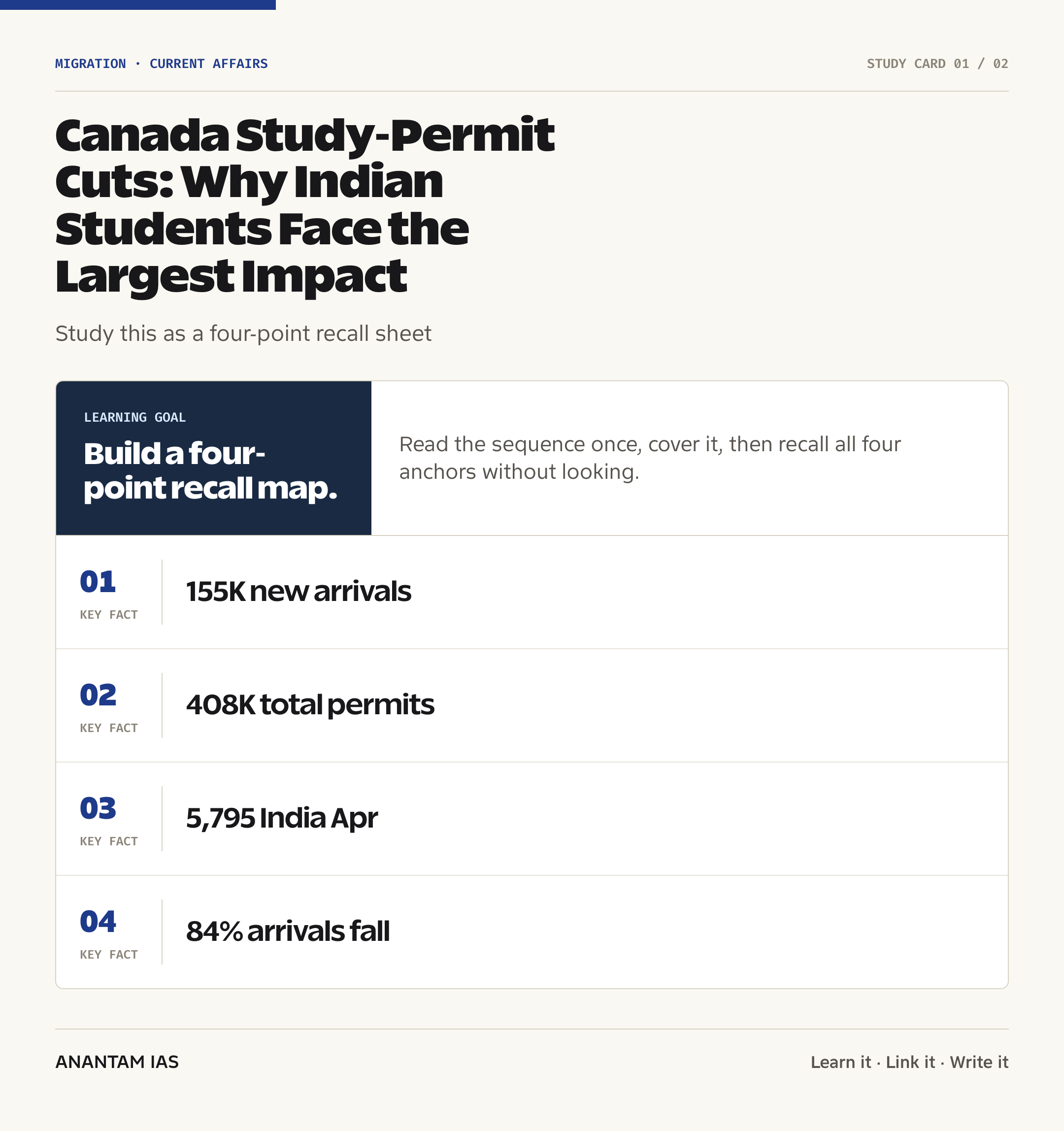
Indian students are bearing the largest national impact of Canada’s sharp contraction in international-student intake. The Hindu’s analysis of IRCC data found that permits issued to Indians, including renewals, fell to 5,795 in April 2026, from 6,895 in April 2025 and 36,510 in April 2024.
The decline coincides with Canada’s 2026–2028 Immigration Levels Plan. Immigration, Refugees and Citizenship Canada expects up to 408,000 study permits in 2026, but only 155,000 are for newly arriving international students; the remaining 253,000 are extensions for current and returning students.
- The April count for Indians fell by 16% year-on-year after an even steeper decline between April 2024 and April 2025.
- The Hindu notes that the April country data combine new permits and renewals; a country-wise split between the two isn’t available, so it shouldn’t be read as a pure arrivals figure.
- IRCC’s separate arrivals series recorded only 4,940 new international students from all countries in April 2026, excluding extensions and asylum claimants.
- Canada’s 2026 total issuance target of 408,000 is 7% below the 2025 target and 16% below the 2024 target.
- The policy is intended to reduce Canada’s temporary-resident population to below 5% of the total population by the end of 2027.
The development matters in the context of:
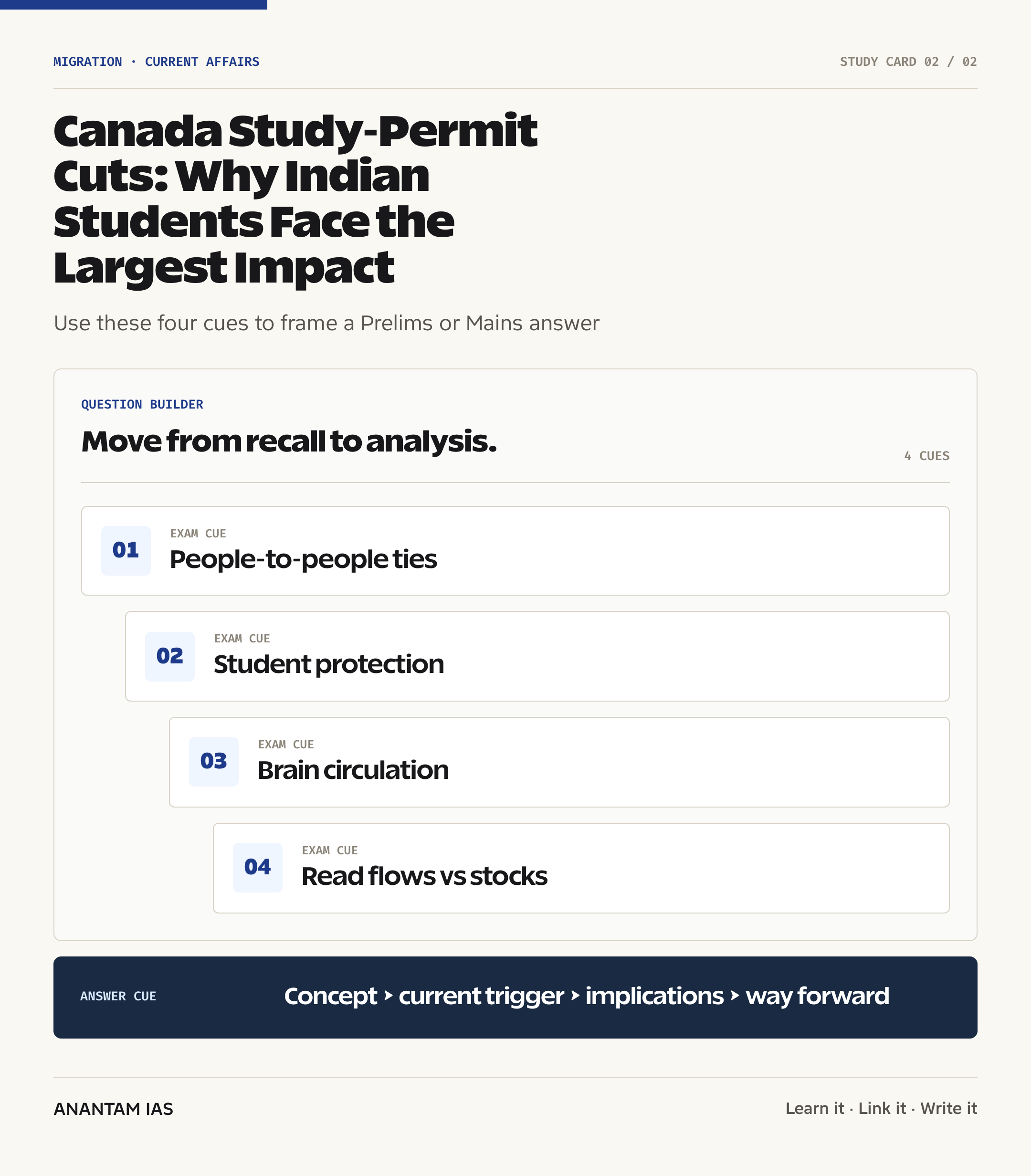
- This is an India–Canada relations issue because education is a major people-to-people bridge alongside trade, diaspora links and skilled mobility.
- It is a social-justice issue because abrupt rule changes can impose unequal losses on families that borrow heavily, while weak intermediaries may exploit information gaps.
- It is a skills-policy issue because reduced overseas intake can alter India’s brain-drain, return-migration and domestic higher-education pressures.
UPSC Relevance
Prelims Relevance
- IRCC is Canada’s federal department responsible for immigration, refugees, citizenship and the study-permit system.
- A study permit authorises a foreign national to study at an eligible Canadian institution; it isn’t the same as permanent residence.
- A Designated Learning Institution (DLI) is a school approved by a provincial or territorial government to host international students.
- A Provincial Attestation Letter or Territorial Attestation Letter shows that an applicant has been counted within a province’s or territory’s allocation under the federal cap.
- For 2026, public-DLI master’s and doctoral students are exempt from the PAL/TAL requirement, as are primary and secondary students and specified vulnerable or priority cohorts.
- The 2026 cap provides 309,670 application spaces for PAL/TAL-required applicants, while the expected permit-issuance target for that cohort is 180,000; applications and issuances are different measures.
- The Post-Graduation Work Permit is a separate work authorisation whose eligibility depends on the institution, program, language and, for some non-degree programs, field of study.
- The Immigration Levels Plan now includes targets for new temporary-resident arrivals as well as permanent-resident admissions.
Mains Relevance
GS Paper 2
- International relations: education and skilled mobility as stabilising constituencies in India–Canada relations.
- Indian diaspora: how migration rules affect family networks, remittances, consular needs and public perceptions.
- Social justice: protection of young migrants from fraud, debt distress and misleading recruitment.
GS Paper 3
- Human capital: the interaction between global mobility, brain drain, brain circulation and India’s domestic talent ecosystem.
- Employment: aligning Indian education and skills pathways with credible labour-market demand rather than migration promises.
Essay
- Mobility can connect societies, but rules that treat education chiefly as a migration channel can weaken trust in both.
- A talent-exporting country gains most when migration becomes brain circulation, not a one-way loss of skills or household savings.
Background and Context
How the Canadian Cap Works
Canada’s cap manages the intake pipeline through federal targets and province-level allocation of application spaces.
- The federal government introduced the international-student cap in 2024 after rapid growth in temporary residents and pressure on housing, health care and public infrastructure.
- Most covered post-secondary applicants need a PAL/TAL with their study-permit application. The letter confirms that a provincial or territorial allocation space is available.
- For 2026, IRCC expects to issue up to 408,000 permits: 155,000 to new international students and 253,000 as extensions for current or returning students.
- The 408,000 target includes 49,000 permits for public-DLI master’s and doctoral students, 115,000 for kindergarten-to-grade-12 students, 64,000 for other exempt applicants and 180,000 for PAL/TAL-required applicants.
- Canada allocated 309,670 processing spaces for PAL/TAL-required applications. This number exceeds the 180,000 issuance target because some applications will be refused.
- Provincial distribution matters because education is administered largely by Canada’s provinces, while the federal government controls immigration. Provinces allocate their spaces among DLIs, so the national cap works through cooperative federalism rather than a single central admission list.
- Ontario received the largest expected issuance share for PAL/TAL-required cohorts, at 70,074 permits, followed by Quebec at 39,474. The distribution reflects population, while application-space allocations also incorporate recent approval rates.
- The revised plan targets 150,000 new student arrivals in both 2027 and 2028, making the lower intake a multi-year policy rather than a single-year adjustment.
Why Indians Face a Disproportionate Shock
India’s exposure is high because Indian nationals became Canada’s largest international-student group during the previous expansion.
- The Hindu’s analysis shows that Indians’ share of Canada’s international students rose from 14.6% in 2015, overtook China’s share in 2018 and peaked at 41.2% in 2022.
- That share fell from 36.6% in 2024 to 24.6% in 2025, a 12-percentage-point decline in one year and the lowest share since 2016.
- The number of Indian students in the cited IRCC series fell by 66%, from about 278,000 in 2023 to 93,915 in 2025, while the overall decline across nationalities was 44%.
- The April 2026 figure of 5,795 Indian permits was 16% below April 2025. The much larger fall from 36,510 in April 2024 shows that the structural break came before the latest monthly decline.
- Indian students are also affected by changes beyond the cap: closure of the Student Direct Stream, tighter financial scrutiny, revised PGWP conditions and narrower spousal work-permit eligibility.
- The shock is geographically concentrated within India because overseas-study markets depend on regional family networks, local recruiters and education loans. A national fall can create deeper adjustment pressure in communities where Canada became a dominant destination.
- The impact also varies by income. Families with diversified savings can absorb a delayed or refused application more easily than borrowers who have already paid deposits, agent charges or test fees, making information asymmetry a distributive issue.
- The impact isn’t uniform. Public-university master’s and doctoral applicants receive a PAL/TAL exemption in 2026, while many college, undergraduate and non-degree applicants remain within capped cohorts.
Read the Numbers Carefully
Three related indicators measure different stages of the system and shouldn’t be treated as interchangeable.
- Application spaces are the maximum PAL/TAL-backed applications that IRCC will accept for processing; they are neither approvals nor arrivals.
- Permits issued can include new permits and extensions. The April India figures cited by The Hindu combine both, and the country-wise new-versus-renewal split isn’t published in that table.
- New arrivals exclude extensions and certain groups. IRCC recorded 16,115 new student arrivals from all countries during January–April 2026, 84% fewer than in the same period of 2024.
- IRCC’s April dashboard counted 423,850 people holding only a study permit; another group held both work and study permits. This stock measure differs from monthly flows.
- Policy analysis must compare like with like: the updated 155,000 new-arrivals target shouldn’t be directly compared with a total issuance figure that includes extensions.
- The distinction mirrors the data-literacy principles needed when reading migration, employment and education statistics in other current-affairs questions.
The Student-Protection Dimension
Lower quotas can increase the stakes of every application, making transparent information and enforceable safeguards more important.
- A study permit is tied to a valid offer from a DLI, but DLI status alone doesn’t guarantee that every program qualifies for a post-graduation work permit.
- IRCC now requires institutions to verify letters of acceptance, a response to fraud in which students may receive false or altered admission documents.
- PGWP rules require language proof for most recent applicants; some non-degree graduates must also complete an eligible field of study linked to long-term labour shortages.
- Spousal open work permits are now concentrated on students in doctoral programs, master’s programs of at least 16 months and selected professional or eligible programs, changing household financing assumptions.
- Protection must begin before payment. Offer-letter verification, plain-language fee and refund terms, direct confirmation from the institution and a record of every intermediary can reduce the scope for forged documents and undisclosed commissions.
- Protection must continue after arrival. Students can face insecure housing, workplace exploitation and pressure to work beyond permit conditions; effective complaint channels need to be accessible without making lawful status or academic progress harder to maintain.
- The Indian state has a legitimate role in pre-departure information, regulation of recruitment agents, grievance support and rapid consular coordination, even though admission and visa decisions remain Canadian sovereign functions.
- Students shouldn’t be framed only as migration statistics. Education quality, housing, mental health, workplace rights and protection from fraud remain central to a rights-based mobility framework.
India–Canada Relations Beyond Diplomacy
Education mobility is a form of practical foreign policy because it creates long-term economic and social constituencies in both countries.
- Indian students support Canadian campuses and local economies, while Canadian qualifications and work experience can add to India’s skills base when graduates return.
- A sudden contraction can affect household debt, education-service businesses, provincial college finances and the confidence that underpins people-to-people ties.
- The issue should be separated from zero-sum rhetoric. Canada retains the sovereign right to calibrate temporary migration, while India can seek predictability, fair treatment and protection for bona fide students.
- For Canada, the policy involves a genuine capacity trade-off: international students bring tuition revenue and talent, while rapid intake can outpace housing and public services. Credible policy must connect admission volumes to institutional and community capacity.
- For India, diplomatic advocacy should focus on due process, transparent transitions and welfare rather than demanding a particular quota. This preserves respect for Canadian sovereignty while defending legitimate interests of Indian nationals.
- Education can complement the broader bilateral agenda that includes trade, technology, critical minerals and diaspora relations. The site’s note on Canada’s IORA observer bid shows how the relationship also reaches Indo-Pacific institutions.
- Comparative migration policy matters: the U.S. fixed-term visa debate shows that Indian students face tightening pathways across more than one major destination.
- A stable bilateral channel on education and mobility can share verified data, flag fraud patterns and prevent individual cases from becoming wider diplomatic disputes.
Skills, Brain Drain and India's Policy Choice
Reduced access to one overseas destination can become either a human-capital setback or an opening for domestic reform.
- If fewer students leave, Indian institutions may face higher demand for quality postgraduate, vocational and research programs; capacity must expand without diluting standards.
- Returnees can carry technical skills, networks and work practices back to India, creating brain circulation when research and employment systems absorb them effectively.
- But a forced return without suitable opportunities can produce underemployment, debt stress and skill wastage. The response must connect higher education with actual sectoral demand.
- India’s PM Research Chair initiative represents one route to retaining high-end talent, while persistent faculty vacancies in technical institutions show the capacity constraint.
- Transnational education, joint degrees, credit mobility and research partnerships can preserve international exposure without requiring every student to migrate for an entire program.
- India should treat international mobility as part of a broader human-capital strategy, not as an escape valve for limited domestic seats or jobs.
Way Forward
Build a Verified Mobility Information System
- The Ministry of External Affairs, Indian missions and education regulators should maintain clear, regularly updated guidance on institutions, program status, work-right changes and common fraud patterns.
- Public advisories should distinguish admission, study-permit, PGWP and permanent-residence rules so that one stage isn’t marketed as a guarantee of the next.
Regulate the Recruitment Chain
- Create traceable registration and disclosure standards for overseas-education agents, including commissions, refund terms and verified institutional authorisation.
- Provide fast grievance channels for forged offers, mis-selling and coercive loan practices, with cross-border evidence-sharing where fraud networks operate in both countries.
Deepen Bilateral Education Cooperation
- India and Canada should establish a regular education-mobility dialogue covering data definitions, student welfare, institutional quality, qualifications and research collaboration.
- Policy changes should be communicated with adequate lead time and transition rules so that bona fide students already in the pipeline aren’t exposed to avoidable financial loss.
Strengthen Domestic Alternatives
- Expand high-quality postgraduate seats, apprenticeships, faculty recruitment and research funding in fields where Indian demand and global labour shortages overlap.
- Support joint and dual-degree programs, faculty exchange and industry-linked curricula so that global exposure doesn’t depend solely on outward migration.
Measure Outcomes, Not Just Departures
- Track student debt, course completion, employment, return migration and skills use to judge whether overseas education produces durable public and private value.
- Use gender, region and income-group data to identify who bears the costs of abrupt policy change and design targeted counselling or reintegration support.
Conclusion
Canada’s study-permit contraction is more than a visa story. It tests the resilience of India–Canada people-to-people ties and exposes how quickly household plans can change when education, work and migration are bundled into one expectation.
India’s best response is neither to contest Canada’s right to set migration levels nor to leave students alone with market intermediaries. It is to protect bona fide applicants, demand transparent implementation and build stronger domestic pathways for skills, research and employment.
The durable goal should be safe, informed and mutually beneficial mobility, with brain circulation replacing both uncontrolled expansion and abrupt exclusion.
UPSC Practice Questions
Prelims MCQ 1
With reference to Canada’s 2026 international-student cap, consider the following statements:
- The 408,000 target includes both permits for new arrivals and extensions for current or returning students.
- Every master’s and doctoral applicant must obtain a Provincial or Territorial Attestation Letter in 2026.
- The number of application spaces for PAL/TAL-required applicants can exceed the expected number of permits issued to that cohort.
How many of the above statements are correct?
(a) Only one (b) Only two (c) All three (d) None
Answer: (b) Only two
Explanation:
Statements 1 and 3 are correct. For 2026, master’s and doctoral students enrolling at public DLIs are exempt from the PAL/TAL requirement, so Statement 2 is incorrect.
Prelims MCQ 2
Which one of the following best describes a Designated Learning Institution in Canada?
(a) A foreign embassy authorised to issue study permits (b) A school approved by a provincial or territorial government to host international students (c) A federal tribunal that hears immigration appeals (d) A private agency that allocates permanent-residence quotas
Answer: (b) A school approved by a provincial or territorial government to host international students
Explanation:
A DLI is an institution approved by a Canadian province or territory to enrol international students. IRCC issues study permits; DLI status doesn’t by itself guarantee PGWP eligibility for every program.
UPSC Mains Questions
- Canada’s contraction of international-student intake is simultaneously an immigration-policy decision, a social-protection challenge and an issue in India–Canada relations. Analyse these interconnections and suggest a framework for predictable, fair and skills-oriented education mobility.
- A fall in overseas student migration need not automatically become a human-capital loss for India. Discuss how domestic higher-education reform, returnee absorption and transnational partnerships can convert brain drain into brain circulation.
- Why is it important to distinguish application caps, permits issued, new arrivals and permit-holder stocks while analysing migration policy? Explain using Canada’s 2026 international-student measures.
Sources: Immigration, Refugees and Citizenship Canada and The Hindu Data.
Frequently Asked Questions
What is Canada’s 2026 study-permit target?
IRCC expects to issue up to 408,000 study permits in 2026. This includes 155,000 permits for newly arriving international students and 253,000 extensions for current or returning students. The total shouldn’t be read as 408,000 new arrivals.
How sharply did April permits for Indians fall?
The Hindu’s analysis of IRCC data found 5,795 permits for Indians in April 2026, down 16% from 6,895 in April 2025. The 2025 figure was already far below April 2024’s 36,510. These country figures combine new permits and renewals.
What is a PAL or TAL?
A Provincial Attestation Letter or Territorial Attestation Letter confirms that an applicant has been counted within a province’s or territory’s allocation under Canada’s student cap. Several cohorts are exempt, including public-DLI master’s and doctoral students in 2026.
Why are Indian students disproportionately affected?
Indian nationals became Canada’s largest international-student group during the previous expansion, so they had unusually high exposure when intake contracted. Their share in the cited series fell from 36.6% in 2024 to 24.6% in 2025.
Does a study permit guarantee post-study work?
No. A study permit authorises study, while the Post-Graduation Work Permit has separate conditions. Eligibility depends on the institution, program and current rules, including language requirements and field-of-study requirements for some non-degree programs.
What should India prioritise in response?
India should strengthen verified pre-departure information, regulate recruitment agents, improve consular and fraud-response systems, seek predictable bilateral communication and expand credible domestic education, research and employment pathways for students who stay or return.