

Why in News?
The Department of Higher Education, Ministry of Education, has opened applications for the Prime Minister Research Chair (PMRC) Scheme 2026, a flagship effort to attract and anchor world-class researchers in premier Indian institutions. Applications opened on 1 June 2026 through the dedicated portal pmrc.education.gov.in, for both individual fellows and host institutions.
The scheme’s headline aim is to reverse brain drain by drawing accomplished Indian-origin scientists and technology leaders working abroad into the country’s research pipeline, plugging them into top-ranked universities and national laboratories to lead cutting-edge work.
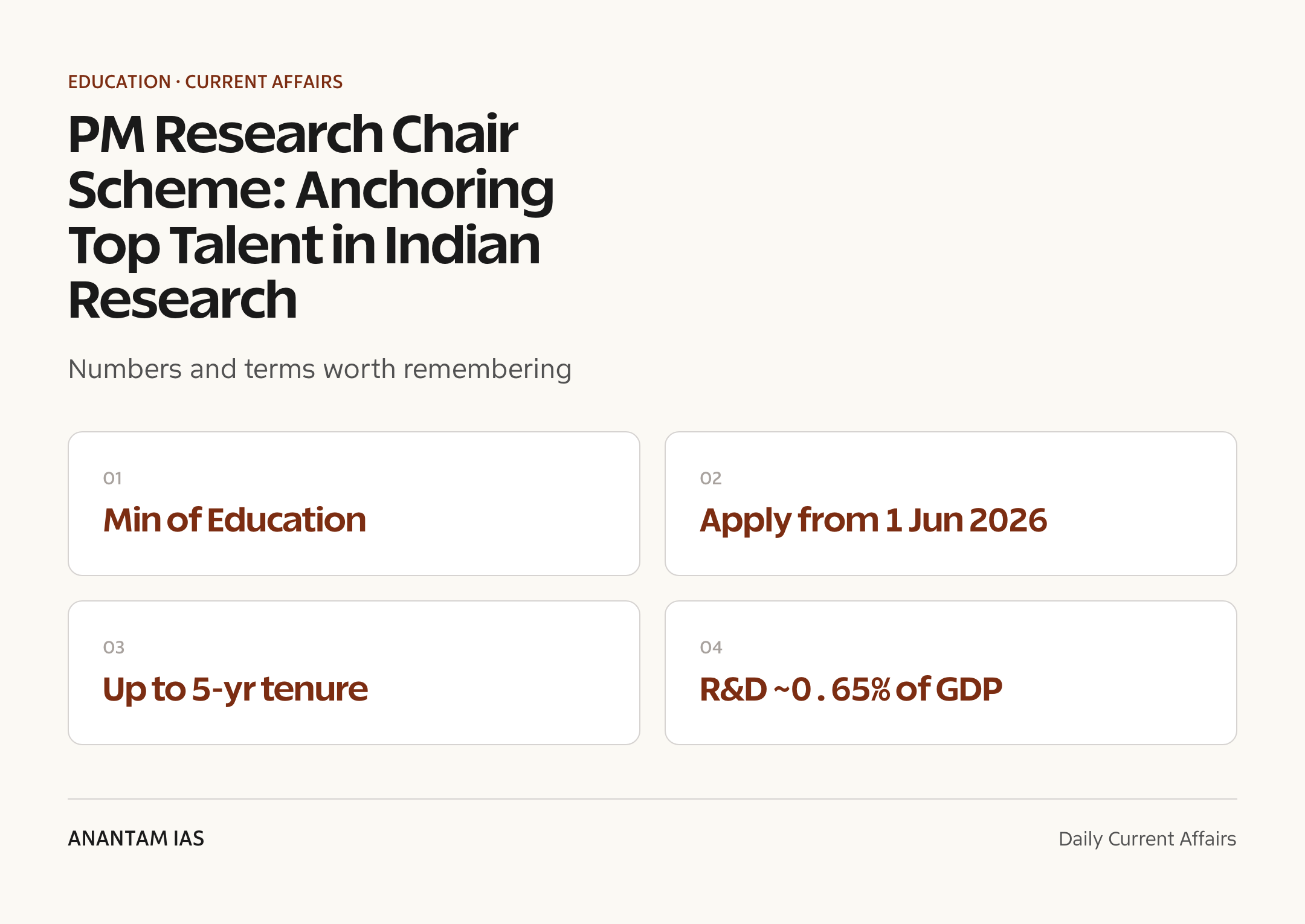
- Conceptualised, funded and administered by the Department of Higher Education, Ministry of Education.
- Applications opened 1 June 2026 on the portal pmrc.education.gov.in for fellows and host institutions alike.
- Three engagement tiers: Young Research Fellows, Senior Research Fellows and Research Chairs.
- Selection is overseen by an Empowered Committee chaired by the Principal Scientific Adviser to the Government of India.
- Engagement runs for a tenure of up to five years, with terms set on proposal and performance.
The development matters in the context of:
- Sits within the wider push to lift India’s gross expenditure on R&D (GERD), long stuck near 0.65% of GDP, well below major economies.
- Complements the Anusandhan National Research Foundation (ANRF) and the research thrust of the National Education Policy (NEP) 2020.
- Distinct from the older Prime Minister’s Research Fellowship (PMRF), which funds doctoral scholars rather than senior chairs.
UPSC Relevance
Prelims Relevance
- PMRC is run by the Department of Higher Education, Ministry of Education (not a science ministry).
- Three categories: Young Research Fellows, Senior Research Fellows, and Research Chairs.
- Targets Indian-origin researchers and professionals working abroad.
- Host eligibility tied to NIRF rankings — Top 100 Overall/Engineering or Top 50 Research.
- Seven designated Lead Hubs include IISc Bengaluru and several IITs.
- Selection via an Empowered Committee under the Principal Scientific Adviser.
- Engagement tenure of up to five years.
- Do not confuse with PMRF (a doctoral fellowship) or the ANRF (the apex research-funding body).
- ANRF was set up under the ANRF Act, 2023, subsuming the erstwhile SERB.
- India’s R&D spending is roughly 0.65% of GDP.
Mains Relevance
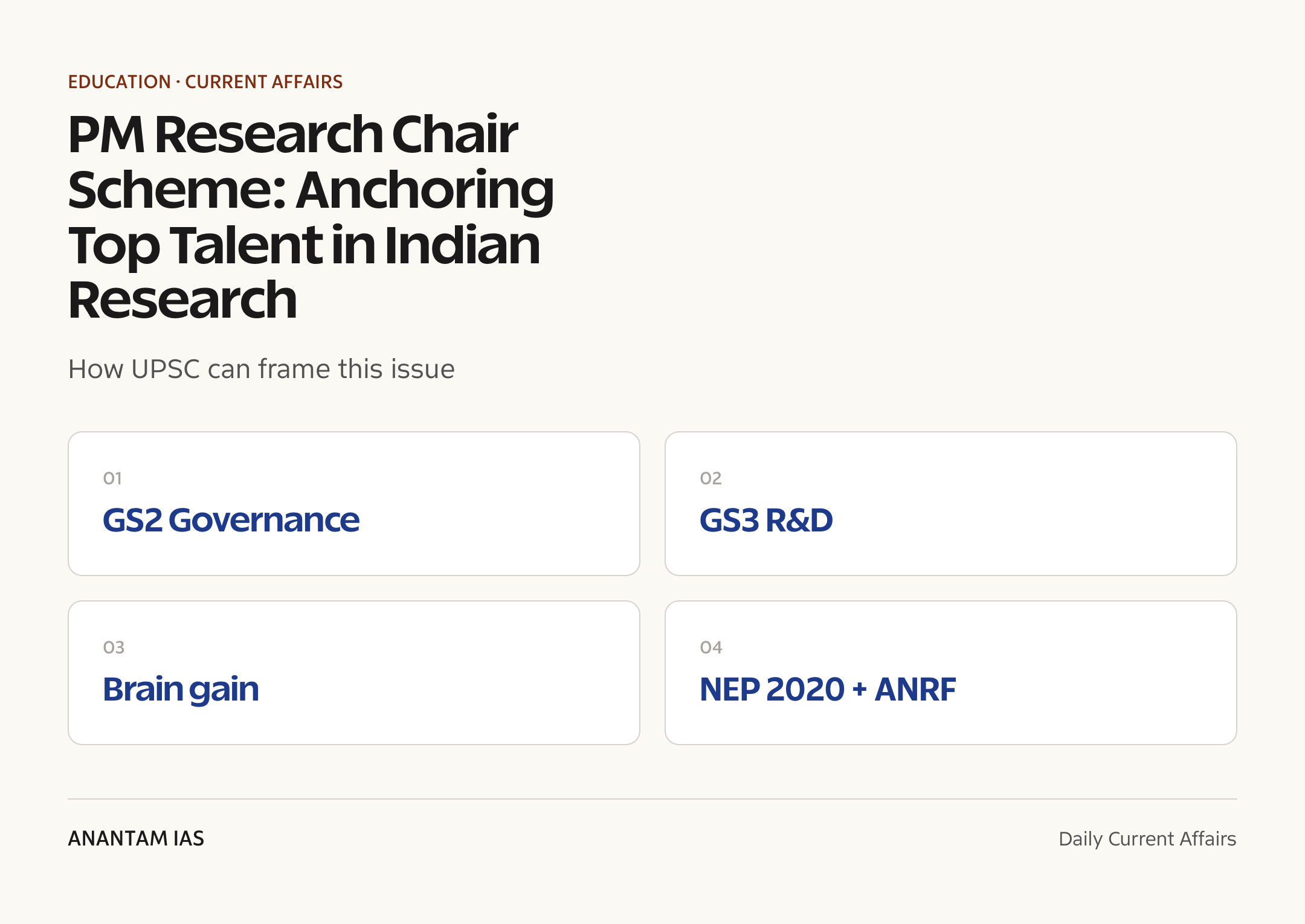
GS Paper 3
- Measures to strengthen India’s research and development ecosystem and raise R&D intensity.
- Role of brain gain and diaspora talent in advancing critical and emerging technologies.
GS Paper 2
- Government schemes and institutional design for higher education and skilled-talent retention, including NEP 2020 goals.
Essay
- Can talent return reverse a nation’s brain drain, or must opportunity be built at home first?
- Science as the engine of self-reliance: investing in minds, not only machines.
Background and Context
What does the PMRC Scheme set out to do?
The scheme is a talent-anchoring instrument, not a research grant alone.
- Aims to attract, incentivise and retain world-class Indian-origin scientists, technologists and academics.
- Places them in premier government higher-education institutions and national research laboratories.
- The goal is to seed cutting-edge research in critical technology sectors and build durable research leadership.
- Framed explicitly as a brain-gain measure to slow the outflow of high-skilled talent.
Three tiers of engagement
The scheme is built around a career-stage ladder of fellowships.
- Young Research Fellows — early-career scientists and postdoctoral scholars ready to seed new projects.
- Senior Research Fellows — mid-career researchers and industry experts with deep field expertise.
- Research Chairs — internationally recognised academic leaders, lab heads and technology pioneers.
- Each tier carries fellowship support, a research grant and institutional backing, scaled to seniority.
Host Institutions and Lead Hubs
Only the country’s top-ranked institutions can host a chair.
- Eligible hosts must rank in the Top 100 NIRF Overall or Engineering, or Top 50 NIRF Research categories.
- Seven designated Lead Hubs include IISc Bengaluru, IIT Delhi, IIT Bombay, IIT Madras, IIT Kanpur, IIT Hyderabad and IIT (ISM) Dhanbad.
- Hosts must offer world-class laboratories, advanced infrastructure and research-leadership roles.
- The design steers top talent toward institutions best placed to absorb and amplify it.
Governance and selection
A high-level committee guards quality and fit.
- Administered end-to-end by the Department of Higher Education, Ministry of Education.
- Selection is overseen by an Empowered Committee chaired by the Principal Scientific Adviser.
- Engagement runs up to a tenure of five years, fixed on the strength of the proposal and performance.
- Benefits typically bundle relocation assistance, a research grant and access to advanced facilities.
Why it matters: India’s R&D gap
The scheme answers a long-standing structural weakness in how India funds knowledge.
- India’s gross expenditure on R&D (GERD) hovers near 0.65% of GDP, far below research leaders such as South Korea, Israel and the United States, which spend several times more.
- Private-sector R&D is thin, so the state, public laboratories and academia still carry the bulk of the research load.
- High-skilled emigration has long drained STEM talent to better-funded labs abroad, with leading Indian-origin researchers heading global universities and corporate labs.
- Anchoring senior researchers at home can compound into spillovers — mentoring younger scholars, filing patents, founding start-ups and lifting the global standing of host institutions.
- A single accomplished chair can seed an entire research group, multiplying the public investment over the engagement period.
Likely benefits and risks
The promise is large, but execution risks are real.
- On the upside, the scheme can raise research quality, deepen industry-academia links and signal that India values frontier science.
- Relocation support, advanced laboratories and leadership roles lower the friction for talent considering a return.
- Risks include the pull of better-funded labs abroad, bureaucratic delays in procurement and hiring, and uneven absorptive capacity across institutions.
- If grants are one-off and tenures short, gains may not outlast the cohort unless the wider ecosystem keeps pace.
- Concentrating chairs in a handful of Lead Hubs could widen the gap between elite institutions and the rest.
How PMRC fits the policy stack?
It is one piece of a larger research-reform architecture.
- Aligns with the research and innovation thrust of the National Education Policy (NEP) 2020.
- Complements the Anusandhan National Research Foundation (ANRF), the apex body under the ANRF Act, 2023 that funds and seeds research.
- Sits alongside, but is distinct from, the doctoral-level Prime Minister’s Research Fellowship (PMRF).
- Addresses chronic weaknesses in India’s higher education sector, where research depth has lagged teaching load.
- Reinforces the broader science, technology and innovation policy goals and the Atmanirbhar Bharat ambition in deep tech.
Way Forward:
Make the offer competitive
- Match international peers on research grants, lab time and administrative freedom, not just salary.
- Cut red tape on procurement, hiring and ethics clearances so returning chairs can move fast.
Build a deeper bench
- Use chairs as mentors to grow home-grown talent, linking PMRC to PMRF and ANRF pipelines.
- Track outcomes — publications, patents, students trained and spin-offs — to justify scaling the scheme.
Sustained funding matters more than a one-off cohort: raising overall R&D intensity toward global norms is the real test of whether talent stays.
Conclusion
The PMRC Scheme reframes India’s talent story from loss to return, betting that distinguished researchers will come home if given world-class platforms and the freedom to lead.
Its success will hinge less on the prestige of a chair and more on whether India’s wider research ecosystem — funding, institutions and incentives — can keep that talent productive for the long haul.
UPSC Practice Questions
Prelims MCQ 1
With reference to the Prime Minister Research Chair (PMRC) Scheme, consider the following statements:
- It is administered by the Department of Higher Education under the Ministry of Education.
- Host institutions are selected on the basis of their NIRF rankings.
- It primarily funds doctoral students pursuing PhDs at IITs and IISc.
How many of the above statements are correct?
(a) Only one (b) Only two (c) All three (d) None
Answer: (b) Only two
Explanation:
Statements 1 and 2 are correct. Statement 3 is wrong — PMRC anchors senior/distinguished researchers as chairs and fellows; the doctoral-funding scheme is the separate Prime Minister’s Research Fellowship (PMRF).
Prelims MCQ 2
The ‘Anusandhan National Research Foundation (ANRF)’, sometimes seen alongside the PMRC Scheme, is best described as:
(a) A doctoral fellowship for engineering students
(b) The apex body to seed, fund and coordinate research in India, set up under the ANRF Act, 2023
(c) A ranking framework for higher-education institutions
(d) A scheme to fund foreign universities setting up campuses in India
Answer: (b) The apex body to seed, fund and coordinate research in India, set up under the ANRF Act, 2023
Explanation:
The ANRF was created under the ANRF Act, 2023, to fund and promote research across universities and laboratories, subsuming the earlier Science and Engineering Research Board (SERB).
UPSC Mains Questions
- India’s gross expenditure on R&D remains around 0.65% of GDP. Examine how talent-anchoring schemes such as the PM Research Chair (PMRC) Scheme can strengthen the country’s research and development ecosystem, and the constraints they face.
- “Reversing brain drain requires building opportunity at home, not merely offering grants.” Critically analyse this statement in the context of India’s efforts to attract Indian-origin researchers.
- Discuss how the PMRC Scheme, NEP 2020 and the Anusandhan National Research Foundation together aim to reshape India’s higher-education and research landscape.
Sources: PIB, Ministry of Education and PIB, Ministry of Education (Press Release).
Frequently Asked Questions
What is the PM Research Chair (PMRC) Scheme?
It is a flagship initiative of the Department of Higher Education, Ministry of Education, that invites accomplished Indian-origin researchers and professionals working abroad to take up research chairs and fellowships at India’s top institutions, with the aim of reversing brain drain and strengthening the country’s research base.
Who can apply under the scheme?
The scheme has three tiers — Young Research Fellows for early-career scientists, Senior Research Fellows for mid-career experts, and Research Chairs for internationally recognised academic leaders and lab heads. Both individual researchers and eligible host institutions apply, with applications opening on 1 June 2026.
Which institutions can host a PMRC chair?
Host institutions must rank among the Top 100 in NIRF Overall or Engineering, or the Top 50 in NIRF Research. Seven designated Lead Hubs include IISc Bengaluru and IITs at Delhi, Bombay, Madras, Kanpur, Hyderabad and ISM Dhanbad.
How is PMRC different from PMRF?
The Prime Minister’s Research Fellowship (PMRF) supports doctoral scholars pursuing PhDs, while the PM Research Chair Scheme anchors senior and distinguished researchers as chairs and fellows. They target very different career stages within the research ecosystem.
How does the scheme relate to India’s R&D spending?
India’s gross expenditure on R&D is roughly 0.65% of GDP, below leading economies. By anchoring high-calibre researchers in top institutions, PMRC aims to lift the quality and output of domestic research and complement bodies such as the Anusandhan National Research Foundation.
Who oversees selection under PMRC?
Selection is guided by an Empowered Committee chaired by the Principal Scientific Adviser to the Government of India. The engagement runs for a tenure of up to five years, with terms decided on the strength of the proposal and performance.
Tell Google you want more of this.
Add Anantam IAS as a preferred sourceOne tap, and this site shows up more often in your own Top Stories, AI Overviews and AI Mode. Remove it any time.