Why in News?
On 16 July 2026, the U.S. Department of Homeland Security announced a final rule replacing open-ended duration-of-status admission with fixed admission periods for the F, J and I nonimmigrant categories. The Hindu and The Indian Express reported the move as a major change for foreign students, exchange visitors and journalists.
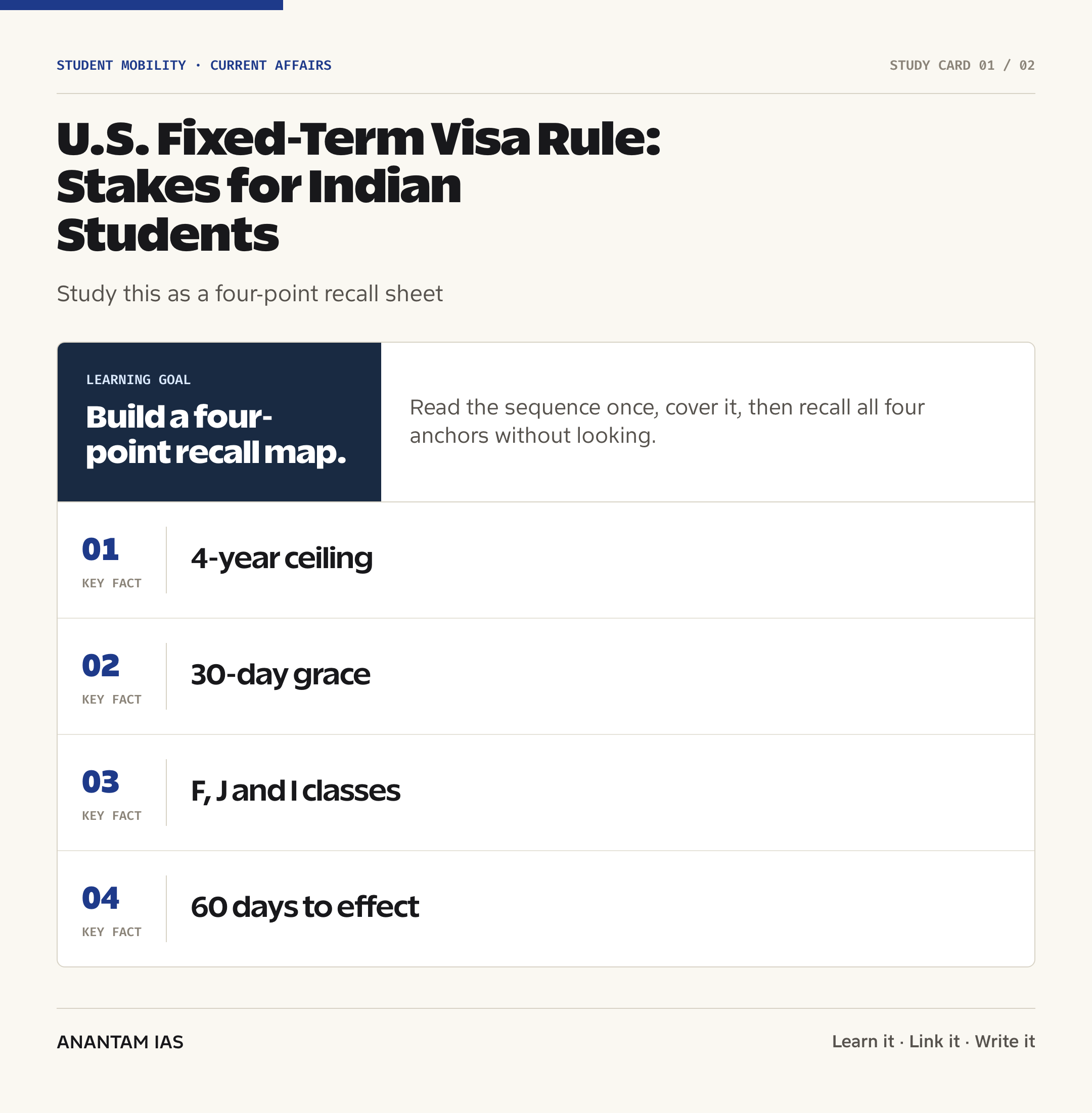
The announcement isn’t the rule’s effective date. DHS said the final text would be published in the Federal Register in the following days and would take effect 60 days after that publication. Until the effective date, the existing duration-of-status framework continues to govern eligible F, J and I holders.
- F and J ceiling: Admission would cover the specific programme length, subject to a maximum of four years.
- Extension route: A student or exchange visitor needing more time would have to seek an Extension of Stay from USCIS and undergo federal review.
- Grace period: DHS said the post-completion departure period for F-1 students would fall from 60 days to 30 days.
- Transition: Existing holders admitted for duration of status would move into the date-certain system, with DHS announcing a maximum four-year transition cap from the effective date.
- Separate media category: I classification covers representatives of foreign information media and shouldn’t be confused with F academic students or J exchange visitors.
The development matters in the context of:
- Large Indian exposure: ICE recorded 422,335 active SEVIS records linked to India in calendar year 2024, more than for any other country.
- Administrative change: A programme update certified through SEVIS won’t by itself substitute for a federal extension when the new admission date is reached.
- Mobility decision: Students weighing long doctoral programmes, transfers or post-study training will have to account for extension timing, cost and uncertainty.
- Bilateral stake: Education links support India-U.S. research, skills, innovation and people-to-people relations, so compliance policy can have wider strategic effects.
UPSC Relevance
Prelims Relevance
- F-1 is the main nonimmigrant classification for academic study at an approved U.S. institution; F-2 covers eligible dependants.
- J-1 covers approved exchange-visitor programmes; J-2 covers eligible dependants.
- I classification is for qualifying representatives of foreign information media and their eligible dependants, not for international students.
- M-1 applies to vocational or other recognized non-academic study and already operates with a date-certain admission framework.
- Duration of Status, recorded as D/S on Form I-94, permits an eligible person to remain while pursuing the authorized activity and maintaining the conditions of status.
- A visa permits its holder to travel to a U.S. port of entry and seek admission; it doesn’t by itself determine the period of lawful stay inside the country.
- Form I-94 is the arrival and departure record that shows the class of admission and either an admitted-until date or D/S.
- Form I-20 is issued for F and M students by a SEVP-certified school, while Form DS-2019 supports a J exchange programme.
- SEVP is managed by U.S. Immigration and Customs Enforcement, while SEVIS is the information system used to monitor participating schools, programmes and nonimmigrants.
- USCIS adjudicates an in-country Extension of Stay; CBP decides admission at a port of entry; the State Department issues visas abroad.
Mains Relevance
GS Paper 2
- International relations: Education and research mobility as a pillar of India-U.S. people-to-people ties.
- Indian diaspora: Regulatory uncertainty, consular communication and welfare support for a large student community.
- Governance comparison: The trade-off between immigration oversight and predictable, proportionate administration.
- Social justice: Unequal effects of fees, processing delays and legal complexity on students with fewer financial buffers.
GS Paper 3
- Human capital: Effects on advanced training, research networks and the movement of science and technology talent.
- Innovation ecosystem: Links between graduate education, practical training, skilled employment and knowledge circulation.
- Domestic opportunity: The case for stronger Indian research careers and institutions when overseas mobility becomes less predictable.
Essay
- Mobility and sovereignty: States can regulate entry, but durable knowledge partnerships depend on transparent and predictable rules.
- Brain drain to brain circulation: International education can create shared skills and networks rather than a simple one-way loss of talent.
Background and Context
From Proposal to Final Rule
The correct timeline separates an earlier rulemaking proposal from the final agency action announced in July 2026.
- Agenda stage: The Spring 2025 Unified Agenda listed RIN 1653-AA95 at the proposed-rule stage and described replacing D/S with date-limited admission.
- Notice stage: DHS published a Notice of Proposed Rulemaking on 28 August 2025 and invited public comment; a proposal and its regulatory agenda entry didn’t themselves change the governing rules.
- Final action: On 16 July 2026, DHS announced that it had issued a final rule after the notice-and-comment process.
- Publication step: At the time of the announcement, the final text had not yet appeared in the Federal Register. DHS said publication would follow within days.
- Effective step: DHS placed implementation 60 days after Federal Register publication, so the precise effective date depends on the publication date.
- Exam caution: Write that the rule has been finalized and announced, but don’t write that fixed terms already govern every holder before the stated effective date.
Visa Validity, Admission and Status Are Different
Many accounts call the measure a visa-duration cap, but the legal change chiefly concerns the period of admission recorded after entry.
- Visa validity: A State Department visa foil allows a person to travel to a port of entry during its validity and request admission in the stated classification.
- No guaranteed entry: Possessing a valid visa doesn’t compel CBP to admit the traveller; the port-of-entry decision remains a DHS function.
- Authorized stay: Form I-94 records how long the person may remain after admission, either through a specific date or, under the current eligible framework, as D/S.
- Expired visa inside the U.S.: Visa expiration doesn’t automatically end an F-1 student’s status if the student remains inside the country and continues to meet the status conditions.
- Travel consequence: A student who leaves the United States may need a valid visa for readmission even when an academic record or employment authorization continues.
- Fixed-term consequence: Under date-certain admission, the I-94 deadline becomes central; staying longer would require a timely extension, change of status or another lawful authorization.
How the Current Duration-of-Status Model Works
The current model links lawful presence to the continued performance of an authorized academic, exchange or media activity rather than only to a calendar deadline.
- D/S notation: An eligible F, J or I holder may receive D/S instead of a fixed admitted-until date on Form I-94.
- F-1 conditions: The student must pursue the authorized course, follow full-course and employment rules, maintain a valid SEVIS record and comply with transfer or practical-training requirements.
- Institutional role: A Designated School Official updates Form I-20 and SEVIS when the programme, school or practical-training record changes.
- J oversight: A designated programme sponsor and a Responsible Officer manage the exchange record through Form DS-2019 and SEVIS.
- Current F grace period: A compliant F-1 student generally has 60 days after programme completion or authorized post-completion practical training to depart, transfer or change status.
- Policy concern: DHS argues that D/S gives federal officers fewer scheduled opportunities to reassess continuing eligibility.
- Counterpoint: Universities and exchange sponsors argue that SEVIS already supplies continuing oversight and that a separate extension layer can duplicate administration.
What the Final Rule Changes
The new design shifts eligible categories from an activity-linked stay to a programme-linked but date-certain admission.
- Maximum period: DHS said F students and J exchange visitors would be admitted for the length of their programme, with a ceiling of four years.
- Not an automatic four years: A shorter programme can produce a shorter admission period; four years is a maximum, not a guaranteed minimum.
- Extension of Stay: A person needing more time would apply directly to USCIS, allowing biometric, background and fraud screening.
- Academic changes: DHS also announced restrictions on changes to programmes, fields or educational levels, making the eventual Federal Register text important for exact conditions.
- Departure window: The F-1 post-completion grace period would be 30 days rather than 60 days.
- Existing holders: DHS said people already admitted under D/S would transition automatically and face a maximum four-year authorized period measured from the rule’s effective date.
- I category: Foreign media representatives are also covered, but their press-freedom and assignment-continuity issues are distinct from student education policy.
- M category: The change doesn’t convert M vocational students from D/S because M admission was already date-certain.
Why Indian Students Have a Large Stake
India’s exposure is both numerical and strategic because it is the largest source of students in major U.S. datasets.
- SEVIS measure: ICE’s calendar-year 2024 country table listed 422,335 active SEVIS records for India, ahead of China.
- Counting caution: SEVIS reports records rather than a perfect headcount because one person can have more than one active record during a year.
- Higher-education measure: Open Doors separately counted 363,019 students from India at U.S. higher-education institutions in academic year 2024-25; its population and time period differ from SEVIS.
- Long programmes: Doctoral research, combined degrees and delayed laboratory work can extend beyond four years, creating a likely extension requirement.
- Practical training: Students must track how an admission deadline interacts with curricular practical training, optional practical training and any STEM extension.
- Career transition: F-1 status and H-1B specialty-occupation status are different legal pathways; completing a U.S. course doesn’t automatically confer a work visa.
- Distributional effect: Filing fees, biometrics, legal advice and processing uncertainty weigh more heavily on students with limited financial support.
- Choice effect: Prospective students may compare the United States with countries offering clearer programme-length and post-study pathways.
Oversight Rationale and Governance Concerns
A balanced assessment tests the rule against security, proportionality, capacity and due process rather than accepting either side’s label.
- DHS case: Date-certain admissions create periodic federal checks and a clearer point at which a person must depart or obtain additional authorization.
- Fraud control: Direct extension adjudication can test whether the person remains engaged in a genuine course, exchange or media assignment.
- Existing system: SEVIS already requires schools and sponsors to report enrolment, programme and status information to the government.
- Duplicate burden: Universities warn that adding USCIS adjudication to SEVIS reporting can increase paperwork for students, institutions and federal officers.
- Backlog risk: If extension processing is slow, a compliant student may face uncertainty over study, travel and employment even after filing on time.
- Predictability test: Clear transition rules, advance reminders, online status tracking and consistent adjudication are central to procedural fairness.
- Evidence test: Government should publish overstay, fraud, extension and processing data by category so the administrative burden can be compared with measurable gains.
India-U.S. Relations and Answer-Building Guidance
For GS2, the rule is best framed as a people-to-people and human-capital issue within a wider strategic partnership.
- Beyond migration: Indian students contribute to university research, laboratories, entrepreneurship and professional networks linking both economies.
- Knowledge circulation: Alumni can return with skills, build cross-border firms or sustain joint research, so the outcome isn’t limited to permanent brain drain.
- Indian response: Diplomatic engagement can seek clear implementation guidance without claiming a right to override another state’s immigration law.
- Consular role: Indian missions can issue verified advisories, coordinate student support and flag systemic problems through official channels.
- Domestic lever: Stronger laboratories, faculty careers and the PM Research Chair pathway for attracting research talent can widen credible options at home.
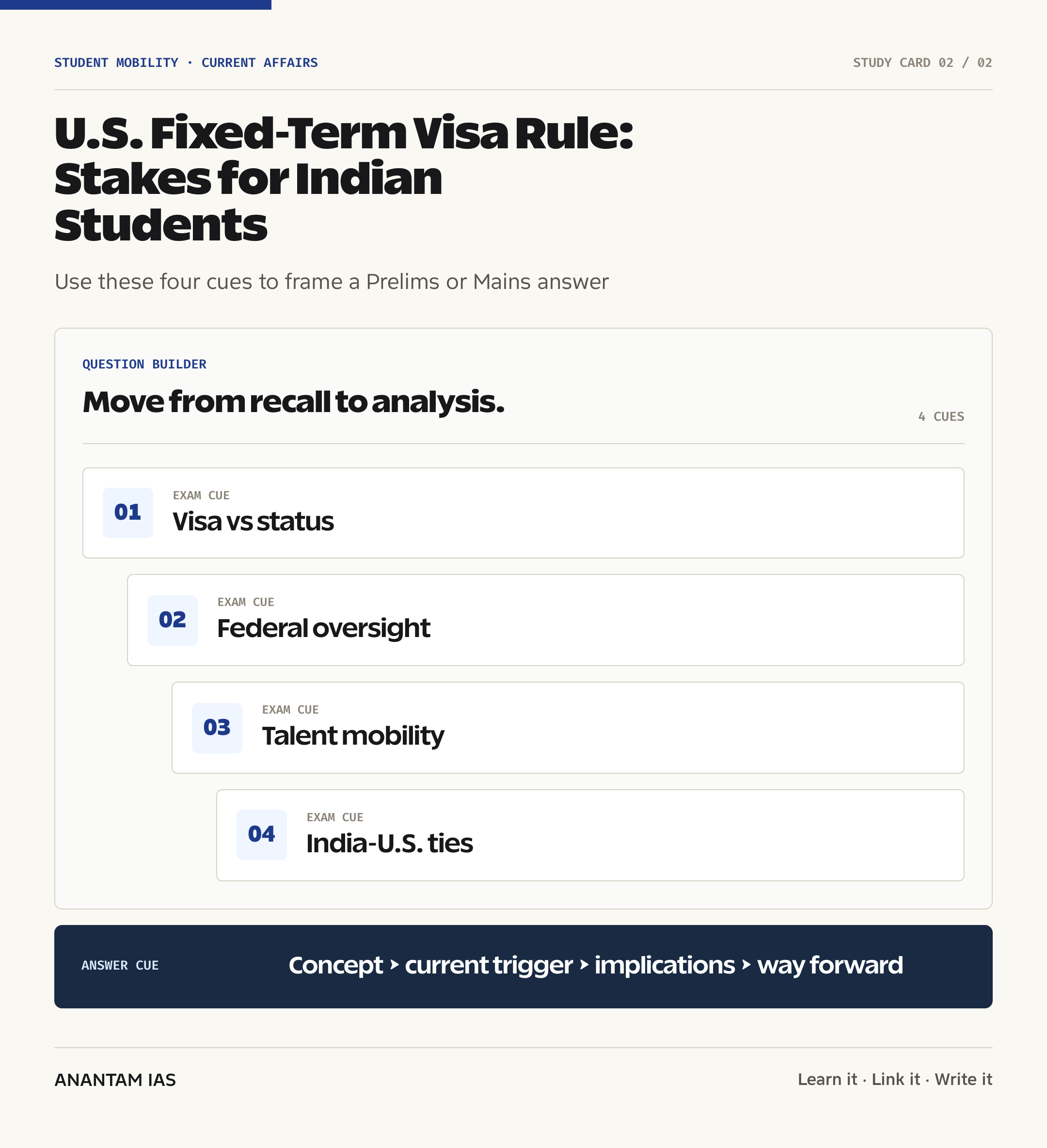
- Answer structure: Define D/S and date-certain admission, clarify visa versus status, state the final-rule timeline, quantify India’s exposure, weigh oversight against burden, and close with bilateral communication and domestic capacity.
- Balanced conclusion: The best policy objective is neither unrestricted stay nor unpredictable control, but lawful mobility backed by proportionate oversight and reliable administration.
Way Forward
Clarify Implementation
- DHS should publish a plain-language transition table for current students, programme completion, transfers, practical training, pending extensions and international travel.
- USCIS should offer early filing windows, electronic reminders, case tracking and clear protection for timely filers while an extension remains pending.
Make Oversight Proportionate
- Use risk-based review and interoperable SEVIS-USCIS records so students don’t repeatedly submit information already held by the government.
- Publish processing times, approval rates, requests for evidence and overstay outcomes by category to test whether the rule meets its stated purpose.
Support Indian Students
- Indian missions, universities and student associations should circulate official guidance on the I-94 deadline, extension filing and travel consequences.
- Students should maintain complete I-20, SEVIS, employment and address records and seek qualified advice for individual cases rather than relying on social-media claims.
Strengthen Talent Partnerships
- India and the United States should protect joint research, credit recognition and institutional exchanges within each country’s lawful immigration framework.
- India should deepen funded doctoral positions, research infrastructure and industry-academia careers so overseas uncertainty doesn’t become a human-capital shock.
Conclusion
The fixed-term admission rule is a structural change in immigration administration, not simply a shorter visa sticker. It moves F, J and I holders from an activity-linked D/S framework toward a calendar deadline backed by federal extension review.
For India, the answer lies in precise student guidance, transparent U.S. implementation, sustained education diplomacy and stronger opportunities at home. A credible assessment should defend lawful oversight while asking whether the rule is proportionate, predictable and capable of preserving legitimate study and research.
UPSC Practice Questions
Prelims MCQ 1
With reference to U.S. nonimmigrant admission, consider the following statements:
- The expiration date on a visa foil always determines the last lawful day of stay inside the United States.
- Form I-94 records the class and authorized period of admission.
- The I classification applies to qualifying representatives of foreign information media.
How many of the above statements are correct?
(a) Only one (b) Only two (c) All three (d) None
Answer: (b) Only two
Explanation:
Statements 2 and 3 are correct. Visa validity concerns travel to a port of entry; the authorized stay after admission is shown through an I-94 date or, under the current eligible framework, D/S.
Prelims MCQ 2
Which statement best describes the U.S. fixed-term rule announced in July 2026?
(a) It immediately converted every F, J and I holder to a four-year visa on 16 July. (b) It abolished F-1 status and replaced it with H-1B status. (c) It established date-certain admission, with extensions adjudicated by USCIS when more time is needed. (d) It applied only to M-1 vocational students and left F, J and I unchanged.
Answer: (c) It established date-certain admission, with extensions adjudicated by USCIS when more time is needed.
Explanation:
DHS announced a final rule for F, J and I categories. The rule is to take effect 60 days after Federal Register publication; the four-year period is a maximum for F and J admission, not a new visa automatically granted to everyone.
UPSC Mains Questions
- The U.S. move from duration-of-status admission to fixed terms for students is an immigration-control measure with consequences for education diplomacy and human-capital mobility. Examine its likely effects on Indian students and India-U.S. relations.
- Visa validity, admission and lawful status are related but distinct concepts. Explain these distinctions and assess whether date-certain admission can improve oversight without creating disproportionate uncertainty for genuine international students.
- International education should be understood as knowledge circulation rather than only brain drain. Discuss in the context of changing destination-country rules and India’s need to build stronger domestic research careers.
Sources: U.S. Department of Homeland Security and The Hindu and The Indian Express.
Frequently Asked Questions
Is the fixed-term rule already effective?
No. DHS announced the final rule on 16 July 2026 but said the text would be published in the Federal Register in the following days. The agency set effectiveness 60 days after that publication. Until the effective date, eligible F, J and I holders remain governed by the existing framework.
Does a four-year visa equal four years of stay?
No. Visa validity concerns travel to a U.S. port of entry. Authorized stay is recorded on Form I-94 after admission. Under the new design, an F or J admission would match the programme length up to a four-year ceiling, so a shorter programme can produce a shorter authorized period.
What does Duration of Status mean?
Duration of Status, shown as D/S on Form I-94, permits an eligible person to remain while continuing the authorized study, exchange or media activity and following all status conditions. It isn’t permission to remain without limits or to ignore enrolment, employment, reporting or programme requirements.
Who is covered by F, J and I?
F classification mainly covers academic students, J covers approved exchange visitors, and I covers qualifying representatives of foreign information media. They serve different purposes even though the announced rule moves all three away from D/S. M vocational students are a separate category with date-certain admission.
Why does this matter especially to India?
India supplied 422,335 active SEVIS records in calendar year 2024, the highest country total in ICE’s table. Long doctoral courses, programme changes and practical training can make deadline and extension rules consequential. Students may face added filing costs, documentation needs and uncertainty while planning education and careers.
What should an affected student do?
Track the Form I-94 and SEVIS record, retain every I-20 or DS-2019, follow school reporting rules and read the final Federal Register text when published. Individual cases can differ, so students should use official DHS, USCIS, CBP and university guidance and seek qualified legal advice when necessary.
Tell Google you want more of this.
Add Anantam IAS as a preferred sourceOne tap, and this site shows up more often in your own Top Stories, AI Overviews and AI Mode. Remove it any time.