Cauvery Water Sharing: Rainfall Deficit Tests the Adjudication Framework
Why in News?
The Cauvery Water Management Authority (CWMA) was scheduled to meet in New Delhi on 22 July 2026 to review a sharp early-monsoon water deficit in the basin. The review matters because the Cauvery arrangement is not a voluntary political bargain: it implements a tribunal award modified by the Supreme Court in 2018.
The Hindu reported that cumulative storage in Karnataka’s four principal Cauvery reservoirs was only 52% of full capacity. Against a reported stipulated flow of 28.3 TMC ft at Biligundlu from 1 June to 19 July, only 3.4 TMC ft had been recorded, placing drinking-water needs, irrigation claims and downstream entitlements in direct tension.
- Karnataka as a whole had an estimated 35% rainfall deficit, while Kodagu, the river’s source region and a major catchment, had a reported 45% deficit.
- Storage across Harangi, Hemavati, Krishnaraja Sagara and Kabini stood at about 52% of combined capacity.
- Storage at Krishnaraja Sagara (KRS) was about 35% of capacity, with an inflow of only 775 cusecs on 21 July.
- The Karnataka government said the available reservoir water would be reserved for drinking purposes and not released for irrigation at that stage.
- The preceding CWRC review had assessed the hydrological position; the CWMA’s earlier meeting on 23 June had asked basin States to use stored water judiciously, particularly for drinking needs.
The development matters in the context of:
- The episode tests whether cooperative federalism can convert a legally binding allocation into a credible distress-sharing decision before crop losses and urban shortages harden State positions.
- A rainfall shortfall does not automatically cancel scheduled releases. The CWMA must identify the distress, assess its extent from data and decide proportionate adjustments under the 2018 scheme.
- The dispute joins three kinds of claims: upstream storage security in Karnataka, downstream irrigation and delta needs in Tamil Nadu, and basin-wide domestic, ecological and livelihood requirements.
UPSC Relevance
Prelims Relevance
- Article 262 permits Parliament to provide for adjudication of inter-State river-water disputes and to exclude the jurisdiction of courts over such disputes.
- Entry 17 of the State List covers water, subject to Entry 56 of the Union List concerning Union regulation and development of inter-State rivers in the public interest.
- The Inter-State River Water Disputes Act, 1956 provides the statutory route for reference to a tribunal; Section 6A empowers the Union to frame a scheme to implement a tribunal decision.
- The Union constituted the Cauvery Water Disputes Tribunal in 1990; its final award came in 2007 and was notified in 2013.
- The Supreme Court judgment of 16 February 2018 modified the allocation, and the Union notified the Cauvery Water Management Scheme on 1 June 2018.
- The scheme created the CWMA as the apex implementation body and the Cauvery Water Regulation Committee (CWRC) as its technical and regulatory support mechanism.
- The principal Karnataka-Tamil Nadu measuring point is Biligundlu on the inter-State border; Mettur reservoir is the critical downstream storage for Tamil Nadu.
- A TMC ft is one thousand million cubic feet, about 28.317 million cubic metres; a cusec is one cubic foot per second.
- The adjudicated framework is based on a basin yield of 740 TMC ft at 50% dependability, while actual operation must respond to rainfall, inflows, storage and demand.
Mains Relevance
GS Paper 2
- Federalism: inter-State rivers show why constitutionally divided powers need permanent institutions, trusted data and enforceable coordination.
- Dispute resolution: distinguish adjudication by a tribunal and the Supreme Court from day-to-day implementation by the CWMA and CWRC.
- Governance: evaluate whether transparent distress criteria can reduce recurring litigation and political escalation.
GS Paper 3
- Water resources: connect monsoon variability, reservoir operations, crop planning, urban demand and environmental flows.
- Disaster resilience: treat drought as a basin-wide risk requiring demand management, not only emergency release orders.
- Agriculture: examine how water-intensive cropping and poorly coordinated sowing amplify distress-year conflict.
Essay
- Rivers ignore political borders, but institutions cannot ignore political trust.
- Cooperative federalism is tested most severely when a common resource becomes scarce.
- Climate variability turns old allocation disputes into recurring governance challenges.
Background and Context
Cauvery Basin and the Upstream-Downstream Relationship
The Cauvery is a shared monsoon-fed river system in which storage decisions upstream quickly affect irrigation, drinking water and ecosystems downstream.
- The river rises at Talakaveri in Kodagu, crosses Karnataka and Tamil Nadu, serves the Karaikal region of Puducherry, and drains into the Bay of Bengal.
- Major tributaries include the Kabini, Hemavati, Harangi, Shimsha, Arkavathy, Bhavani and Amaravati; Kerala is a basin State through the Kabini, Bhavani and Pambar sub-basins.
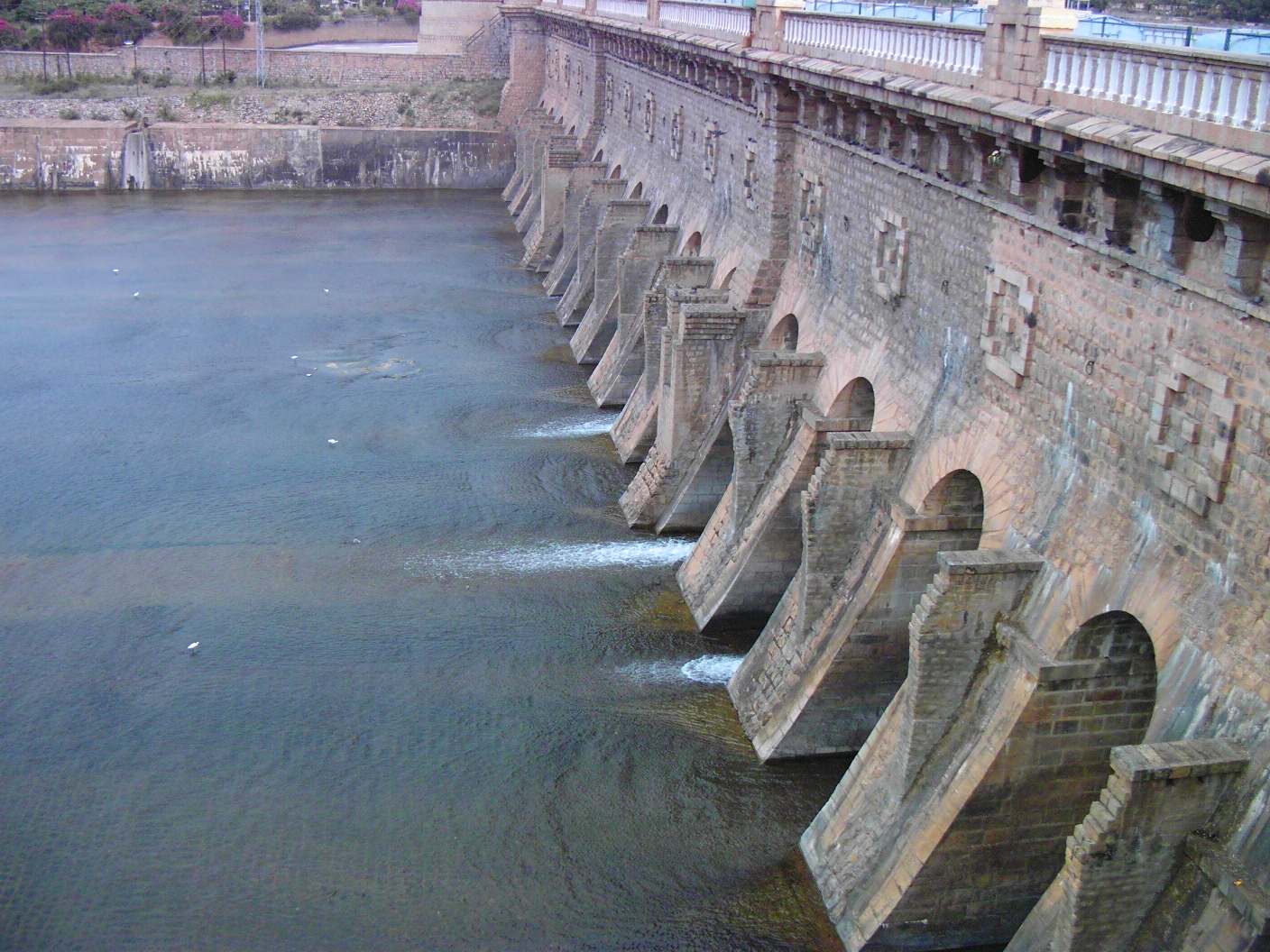
- Karnataka’s Harangi, Hemavati, KRS and Kabini reservoirs regulate much of the upper-basin flow, while Mettur supports irrigation and water supply in Tamil Nadu.
- The Biligundlu gauge and discharge station records flows near the Karnataka-Tamil Nadu border. Recorded flow includes regulated releases and contributions from uncontrolled catchments, so it isn’t identical to a dam-gate release figure.
- For physical geography, revise the basin through the published Cauvery River notes, including its course, tributaries and delta.
From Tribunal Award to the 2018 Binding Framework
The present arrangement combines a specialized tribunal’s adjudication, Supreme Court modification and a Union-notified implementation scheme.
- After negotiations failed, the Union constituted the Cauvery Water Disputes Tribunal in 1990 under the 1956 Act; the tribunal delivered its final award in 2007.
- The award was published in the Gazette in 2013. Under Section 6 of the 1956 Act, a published decision is final and binding and has the same force as an order or decree of the Supreme Court.
- In civil appeals, the Supreme Court modified the shares in 2018. The operative annual allocation at 50% dependable yield is Karnataka 284.75 TMC ft, Tamil Nadu 404.25 TMC ft, Kerala 30 TMC ft and Puducherry 7 TMC ft.
- The balance of the assessed 740 TMC ft includes 10 TMC ft for environmental protection and 4 TMC ft for inevitable escapages to the sea.
- Karnataka must make available 177.25 TMC ft annually at Biligundlu in a normal year. This is an inter-State delivery obligation within the full allocation, not Tamil Nadu’s entire 404.25 TMC ft share.
- The detailed constitutional route and tribunal process are covered in Inter-State Water Disputes in India.
CWMA and CWRC: Different Roles
The two bodies form a decision-and-execution chain rather than competing authorities.
- The CWMA is the apex body charged with implementing the award as modified by the Supreme Court, including reservoir guidance, releases, carry-over storage and environmental flows.
- The CWRC monitors rainfall, storage, inflows, outflows, withdrawals and State demands, and supports or carries out the Authority’s operational directions.
- At the start of the irrigation year on 1 June, States submit water indents. The Authority assesses them against cropping patterns, carry-over storage and likely inflows.
- Important reservoirs are to be operated in an integrated manner under CWMA guidance for each ten-day period, rather than as isolated State assets.
- The Authority may call for hydrological and water-use data. A common, near-real-time data system is essential because disputed figures can turn a technical deficit into a political confrontation.
How Distress Sharing Is Supposed to Work
The scheme recognizes hydrological distress, but it assigns the finding and adjustment to a basin institution rather than to unilateral State declarations.
- The normal schedule rests on a 740 TMC ft yield at 50% dependability. Actual rainfall and inflow can depart sharply from that statistical benchmark.
- The CWMA, through the CWRC and with help from the Central Water Commission and State agencies, must identify whether a distress condition exists and determine its extent.
- A diminution in flows is to be shared among party States, keeping their allocated shares in view. This supports proportionate burden-sharing rather than placing the full shock on either the upper or lower riparian.
- The CWRC watches monsoon performance in ten-day intervals. The CWMA may revise an earlier release order as rainfall, storage and inflow data change.
- The reported 28.3 TMC ft due by 19 July is an intra-season benchmark; the enduring annual normal-year obligation remains 177.25 TMC ft at Biligundlu.
- The full case history and allocation logic are available in the site’s Cauvery Water Dispute guide.
Drinking Water Priority Is Important but Not Unlimited
Human consumption receives high priority, yet a State’s drinking-water claim must still be considered within the adjudicated basin framework.
- The Supreme Court treated drinking water as a primary consideration and added 4.75 TMC ft to Karnataka’s allocation for drinking and domestic needs, including Bengaluru.
- The 2018 scheme directs the Authority to track domestic and industrial use alongside irrigation demand and cropping patterns.
- Karnataka’s decision to conserve current storage for drinking water identifies a serious need, but it doesn’t by itself rewrite downstream entitlements or formally determine basin distress.
- Tamil Nadu’s claim is also not limited to irrigation: downstream cities, rural settlements, livestock, industry and ecological functions depend on the river system.
- The workable legal position is priority plus proportionality: protect essential consumption, verify demands, recognize the shared scarcity and let CWMA issue an evidence-based adjustment.
What the July Review Must Resolve
The immediate task is to convert a contested shortage into a reasoned, time-bound operating decision without prejudging the rest of the monsoon.
- First, the Authority needs a verified basin water balance: carry-over storage on 1 June, rainfall departure by catchment, reservoir inflows and outflows, Biligundlu flows, current withdrawals and likely inflows for the next ten-day period.
- Second, it must test the reasonableness of State indents. Drinking supply, standing crops and minimum ecological needs carry different urgency, but every claim should be supported by demand and use data rather than broad assertions.
- Third, CWMA must state whether the evidence establishes basin distress, how severe it is and how the burden will be shared. A reasoned finding gives both States a common legal and factual reference point.
- Fourth, any reduced release should have a review date and trigger. Early-season projections can change quickly if Kodagu and other catchments receive rain, so a provisional order is safer than treating July conditions as the final water-year position.
- Finally, the direction should explain compliance in measurable terms: the required flow at Biligundlu, the relevant interval, reporting duties and the consequences of deviation. Clarity improves enforceability and reduces room for competing political interpretations.
Federalism Lessons from the 2026 Deficit
Cauvery shows that adjudication can settle shares, but only cooperative administration can manage a changing monsoon.
- Water is primarily a State subject under Entry 17, yet inter-State rivers bring in Parliament’s competence under Entry 56 and the special dispute mechanism under Article 262.
- The arrangement reflects cooperative federalism: the Union provides the statutory institution, States supply data and operate reservoirs, and all parties are bound by the adjudicated allocation.
- Its weak point is not the absence of law but the gap between legal entitlement and hydrological availability. A fixed annual share still needs adaptive, transparent operational decisions.
- Political incentives reward visible defence of one State’s farmers or cities. Basin governance asks governments to explain why some sacrifices are unavoidable and how those sacrifices are distributed.
- For a wider conceptual frame, connect this dispute with cooperative and competitive federalism.
Why the Current Figures Need Careful Reading
Headline percentages describe different parts of the water system and shouldn’t be treated as interchangeable.
- A 35% State-wide rainfall deficit is not the same as rainfall deficiency inside every Cauvery sub-catchment; the reported 45% Kodagu deficit is more directly relevant to upper-basin inflows.
- Combined storage at 52% of full capacity doesn’t show usable live storage, dead storage, reservoir-wise variation or competing committed demands.
- KRS at 35% and inflow at 775 cusecs signal stress at one critical reservoir, but CWMA must assess the full system, including other reservoirs and downstream contributions.
- The gap between 3.4 TMC ft recorded and 28.3 TMC ft stipulated is large, but a lawful distress response still requires verified data, a basin-level finding and an Authority decision.
- Good answers separate reported real-time data from durable legal facts such as the annual allocation, institutional powers and distress-sharing rule.
Way Forward
Publish a Common Hydrological Balance Sheet
- Release a ten-day public dashboard showing basin rainfall, reservoir-wise live storage, inflows, outflows, Biligundlu flow and approved State indents.
- Use harmonized measurements audited by the CWC so arguments focus on allocation choices rather than competing data sets.
Adopt a Transparent Distress Formula
- Pre-agree triggers for normal, watch, distress and severe-distress conditions using rainfall, storage and projected inflow.
- Translate the scheme’s proportionality principle into an announced release path, with reasons for any departure and periodic review as the monsoon changes.
Manage Demand Across the Basin
- Coordinate sowing advisories with credible seasonal water availability and discourage expansion of water-intensive crops during low-inflow years.
- Reduce urban leakage, expand wastewater reuse, protect tanks and wetlands, and improve micro-irrigation so every drought doesn’t become only a reservoir-release dispute.
Protect Essential and Ecological Uses
- Ring-fence verified minimum drinking-water requirements across all basin States while avoiding inflated demand projections.
- Keep the adjudicated environmental flow visible in operational decisions; scarcity cannot make the river ecosystem a residual claimant.
Strengthen Cooperative Compliance
- Hold regular CWMA meetings before acute conflict develops and publish reasoned directions, dissenting State positions and compliance data.
- Use litigation for genuine legal questions, while leaving routine ten-day operations to the specialist bodies created for that purpose.
Conclusion
The July 2026 deficit is more than a storage story. It is a test of whether adjudication, science and federal negotiation can work together when the river carries less water than the normal-year schedule assumes.
A durable response cannot be either mechanical release enforcement or unilateral retention. The credible middle path is a CWMA-led, data-backed distress determination that protects essential drinking needs, shares scarcity fairly and preserves the authority of the binding settlement.
Over time, basin States must reduce the gap between demand and dependable supply. Better crop choices, urban efficiency, ecosystem protection and transparent reservoir management are as important as the legal allocation itself.
UPSC Practice Questions
Prelims MCQ 1
With reference to the institutional framework for the Cauvery water dispute, consider the following statements:
- The Cauvery Water Management Authority was constituted under a scheme framed using Section 6A of the Inter-State River Water Disputes Act, 1956.
- The Cauvery Water Regulation Committee is the apex adjudicatory body that can alter the annual water allocation among basin States.
- Biligundlu is the principal gauge site for measuring flows at the Karnataka-Tamil Nadu border.
How many of the above statements are correct?
(a) Only one (b) Only two (c) All three (d) None
Answer: (b) Only two
Explanation:
Statements 1 and 3 are correct. The CWMA is the apex implementation authority. The CWRC supports monitoring and regulation; it is not an adjudicatory body empowered to rewrite annual allocations.
Prelims MCQ 2
Which constitutional provision specifically enables Parliament to provide for adjudication of disputes concerning waters of inter-State rivers?
(a) Article 249 (b) Article 252 (c) Article 262 (d) Article 263
Answer: (c) Article 262
Explanation:
Article 262 authorizes Parliament to create a legal mechanism for adjudicating inter-State river-water disputes and to exclude court jurisdiction over such disputes by law.
UPSC Mains Questions
- The Cauvery dispute shows that adjudicating water shares is easier than governing scarcity. Examine how the CWMA framework seeks to reconcile binding allocations, drinking-water priority and proportionate distress sharing in India’s federal system. (15 marks, 250 words)
- Inter-State river governance requires both credible hydrological data and political trust. Discuss the institutional and demand-side reforms needed to reduce recurring Cauvery conflicts during deficient monsoons. (15 marks, 250 words)
- Differentiate the constitutional, adjudicatory and implementation roles of Article 262, the Inter-State River Water Disputes Act, water tribunals, the Supreme Court, CWMA and CWRC with reference to the Cauvery basin. (10 marks, 150 words)
Sources: Supreme Court of India, Cauvery Water Management Scheme judgment and The Hindu.
Frequently Asked Questions
What triggered the July 2026 CWMA review?
Deficient rainfall, weak inflows and low reservoir storage in Karnataka’s Cauvery basin triggered the review. The Hindu reported combined storage at 52% of capacity and only 3.4 TMC ft recorded at Biligundlu against a reported 28.3 TMC ft benchmark for 1 June to 19 July.
What is the CWMA?
The Cauvery Water Management Authority is the apex implementation body created under the Union’s 2018 Cauvery Water Management Scheme. It implements the tribunal award as modified by the Supreme Court, guides integrated reservoir operations, assesses distress and orders releases with technical support from the CWRC and other agencies.
How is CWRC different from CWMA?
The Cauvery Water Regulation Committee performs the technical and operational support role. It monitors rainfall, storage, inflows, releases and demands, and gives effect to CWMA directions. The CWMA takes the higher-level implementation decisions; neither body can casually rewrite the adjudicated annual shares.
Does drought automatically stop Cauvery releases?
No. The scheme allows adjustment when water availability falls, but CWMA must identify the distress and its extent using basin data. The resulting diminution is to be shared among party States with their allocated shares in view. A unilateral State announcement isn’t itself the formal distress decision.
What is Karnataka’s normal-year delivery obligation?
Following the Supreme Court’s 2018 modification, Karnataka must make 177.25 TMC ft available annually at Biligundlu in a normal year. This border delivery is part of Tamil Nadu’s wider 404.25 TMC ft allocation, not the entirety of that allocation. Operations are reviewed in ten-day intervals.
Why is Cauvery a federalism issue?
Water is largely a State subject, but an inter-State river links the actions and needs of several governments. Article 262, Parliament’s 1956 law, the tribunal, the Supreme Court-modified award and the CWMA scheme together create a shared framework in which States retain operational roles but cannot treat the river as an exclusively local resource.