Inter-state water disputes are among the most politically combustible federal questions in India, and the Ravi and Beas Waters Tribunal has just had its tenure extended by another year, taking the unresolved Punjab-Haryana-Rajasthan stalemate past the 39-year mark. The tribunal was set up in April 1986 under the Inter-State River Water Disputes Act, 1956. Its first report came out in 1987. The clarification petitions filed by the riparian states under Section 5(3) of the Act have been pending for almost four decades, and the government keeps renewing the tribunal’s term because the Act offers no other graceful exit.
That single fact captures everything that is broken about how India adjudicates river-water disputes. The constitutional design under Article 262 is sound, the legal scaffolding under the ISRWD Act, 1956 is workable on paper, and yet not one inter-state tribunal has delivered a clean, time-bound, fully implemented award without parallel litigation, political agitation, or a back-channel role for the Supreme Court. For the UPSC aspirant, this topic is a goldmine: it ties together federalism, the Seventh Schedule, original jurisdiction, judicial review, and the ongoing reform debate around a single permanent tribunal.
This guide unpacks the entire framework, walks through every tribunal constituted so far, explains why Article 262(2) has not actually kept the Supreme Court out, and lays out the prelims and mains pointers you need.
Quick Facts on Inter-State Water Disputes
Inter-state water disputes are governed primarily by Article 262 of the Constitution, the Inter-State River Water Disputes Act, 1956, and the River Boards Act, 1956. (For the broader constitutional context, see our hub on Indian Polity notes and the Constitution of India book guide.) Water is a State subject under Entry 17 of the State List. Inter-state rivers fall under Entry 56 of the Union List, but only when Parliament declares such regulation expedient in public interest. As of 2026, nine inter-state river water tribunals have been constituted, of which the Mahanadi Tribunal is still adjudicating and the Ravi and Beas Tribunal is technically still in operation despite delivering a 1987 report. Tribunal awards are final and binding and carry the force of a Supreme Court decree.
What Inter-State Water Disputes Are
An inter-state water dispute, in the legal sense, is a disagreement between two or more states over the use, distribution, or control of the waters of an inter-state river or river valley. The dispute may be over apportionment of flow, construction of a dam or barrage that affects downstream supply, sharing of project costs, the interpretation of a previous award or agreement, or the implementation of a notified order.
Background and Historical Context
The framers of the Constitution were acutely aware that water sharing would become a flashpoint in a federation organised partly along linguistic lines. The 1935 Government of India Act had a parallel provision in Section 130, and the framers borrowed its core logic. They decided three things at once. First, water inside a state would remain a state subject. Second, the Centre would have exclusive competence to legislate on inter-state rivers when needed. Third, the regular court system would be barred from directly adjudicating these disputes because mixing high-stakes federal water politics with ordinary judicial process had failed in other federations.
The first major test came almost immediately. The Krishna and Godavari basins, the Narmada basin, and later the Cauvery basin produced disputes that were referred to ad-hoc tribunals. The Cauvery dispute, in particular, exposed how Article 262(2) does not really work as a clean ouster clause, because the Supreme Court began to use Article 136 and Article 32 to enter through the side door. The pattern that emerged is the one we still live with: a tribunal is set up, it delivers an interim award, the losing state goes to the Supreme Court, the Court refuses to fix the quantum but rules on procedure, and the central government takes years to notify the final award.
Constitutional Framework: Article 262 and the Seventh Schedule
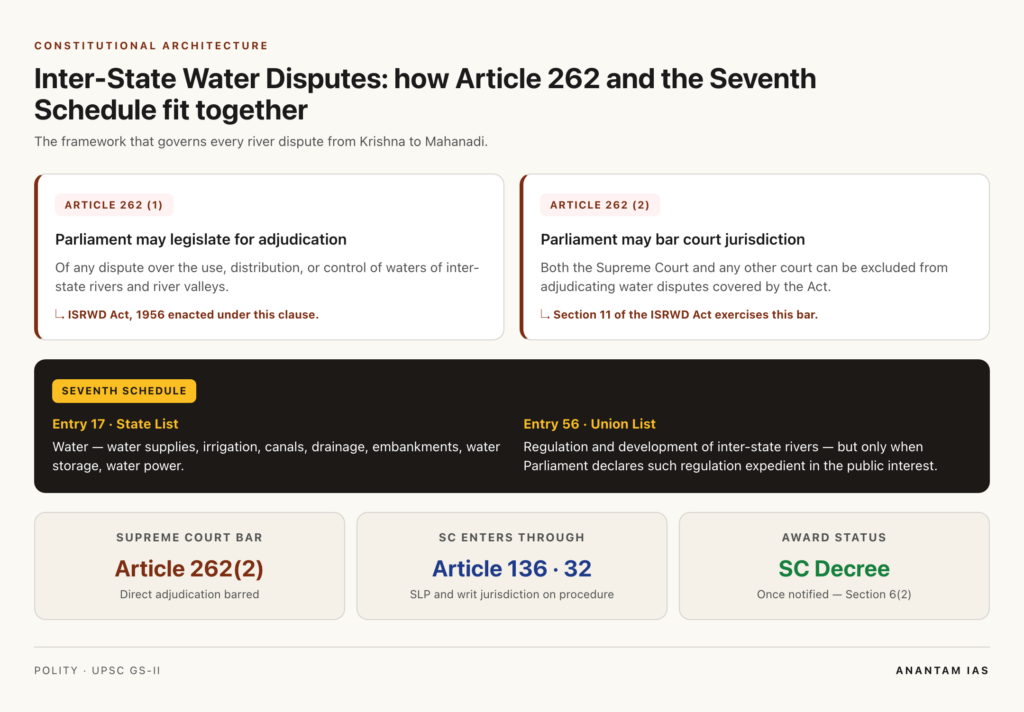
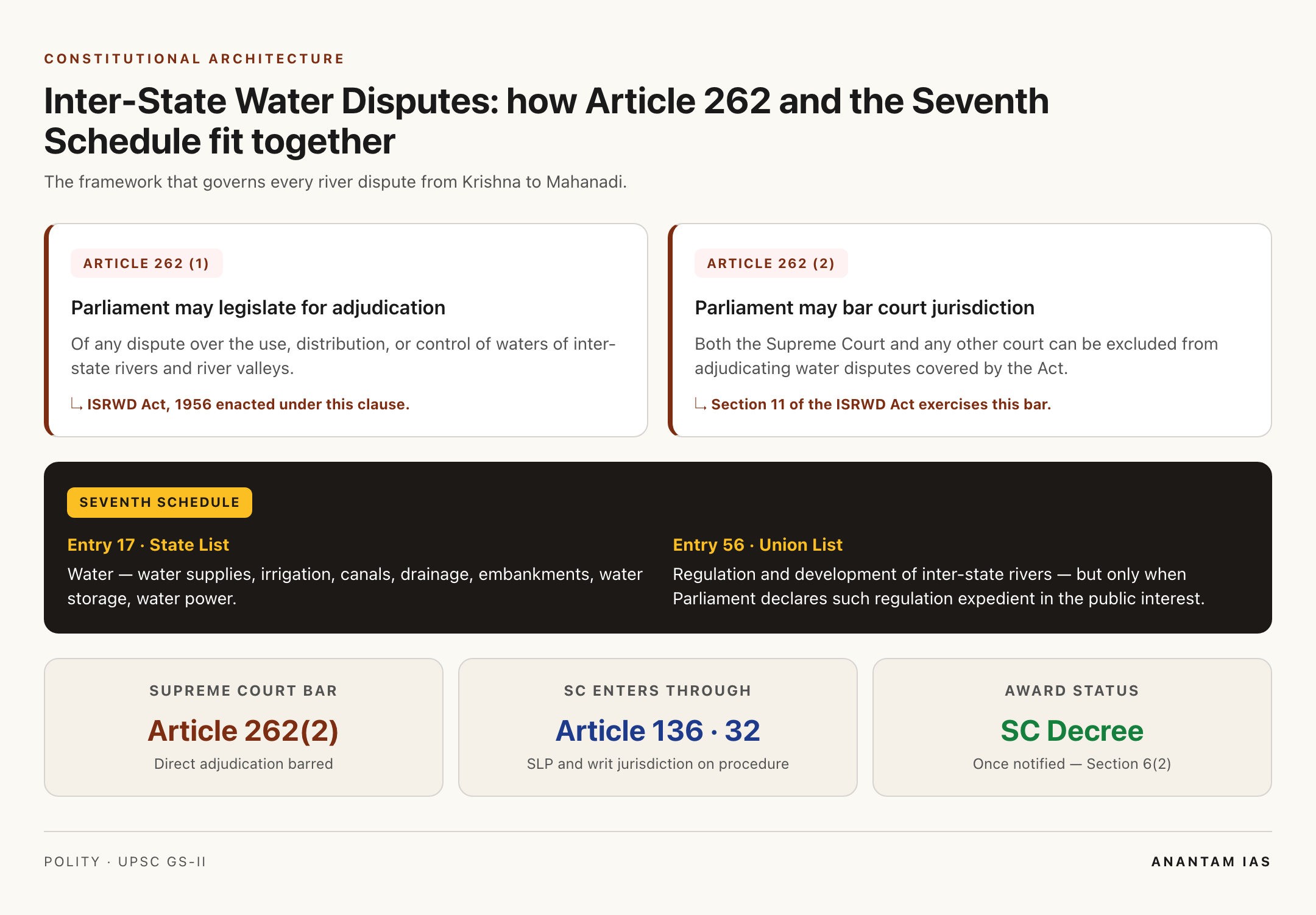
Article 262 has two clauses. Clause (1) empowers Parliament to provide by law for the adjudication of any dispute or complaint over the waters of any inter-state river or river valley. Clause (2) is the more striking provision. It allows Parliament to bar both the Supreme Court and any other court from exercising jurisdiction over such a dispute. Parliament has used both clauses. The Inter-State River Water Disputes Act, 1956 was enacted under Article 262(1), and Section 11 of that Act exercises the bar contemplated under Article 262(2).
The Seventh Schedule reinforces this division. Entry 17 of the State List places water, water supplies, irrigation, canals, drainage, embankments, water storage, and water power in the exclusive domain of the states. Entry 56 of the Union List, however, allows the Union to regulate and develop inter-state rivers and river valleys to the extent that Parliament declares such regulation expedient in the public interest. The phrase “to the extent” is doing significant work here. The Centre cannot simply step into any inter-state river. Parliament must first pass a law declaring that the development is in public interest. The River Boards Act, 1956 was enacted under Entry 56, but no river board has actually been constituted under it, which tells you how reluctant the Centre has been to use this power.
The Legal Mechanism: ISRWD Act 1956
The Inter-State River Water Disputes Act, 1956 sets up the entire procedural machinery. Any state government may request the Centre to refer a dispute to a tribunal. The Centre has one year to decide whether to constitute one. If it does, the tribunal is composed of a chairperson and two other members, all sitting or retired Supreme Court or High Court judges, nominated by the Chief Justice of India. The tribunal must give its award within three years of constitution, extendable by two more years, though in practice extensions have been rolled over indefinitely.
The award is binding on the parties once notified by the Centre in the official gazette. Section 6(2) of the Act, inserted by a 2002 amendment, says the notified award has the same force as an order or decree of the Supreme Court. Section 5(3) allows the parties to seek clarifications within three months of the award, and this is the provision that has trapped the Ravi and Beas dispute for almost four decades. Once a tribunal is asked for a clarification, it cannot fold up shop, and the Centre cannot constitute a fresh body without the original one being formally wound up.
The River Boards Act, 1956 sits alongside the ISRWD Act and is often confused with it in MCQs. The River Boards Act provides only for advisory boards to advise the central government on integrated development of inter-state rivers. It does not provide for tribunals or adjudication. The fact that not a single river board has been constituted under it makes it largely a paper statute.
Why Inter-State Water Disputes Matter
Three reasons explain why this is one of the most consequential subjects in Indian federalism. First, water scarcity is intensifying. Per capita water availability is falling, and basin-wide flows are becoming more variable as monsoons turn erratic. Second, water disputes have become a vehicle for sub-regional identity politics, with parties on both sides of a dispute using the issue to mobilise voters. Third, the federal compact itself is tested every time a riparian state refuses to comply with a tribunal award or a Supreme Court order, as Karnataka famously did during phases of the Cauvery dispute. A failure to enforce a binding award undermines the credibility of the entire constitutional adjudication mechanism.
For the policy maker, the cost of unresolved disputes shows up everywhere: stalled irrigation projects, blocked drinking water supply schemes, capital expenditure that sits idle because canal alignments cannot be finalised, and chronic agrarian distress in tail-end command areas of disputed rivers.
Detailed Analysis of Major Tribunals
The nine inter-state river water tribunals constituted so far reveal a clear pattern. Tribunals dealing with rivers in basins where political stakes are lower, such as Godavari and Narmada, have produced final awards that have been notified and largely implemented. Tribunals dealing with rivers in highly contested basins, such as Cauvery and Ravi-Beas, have produced awards that are either unnotified or repeatedly modified.
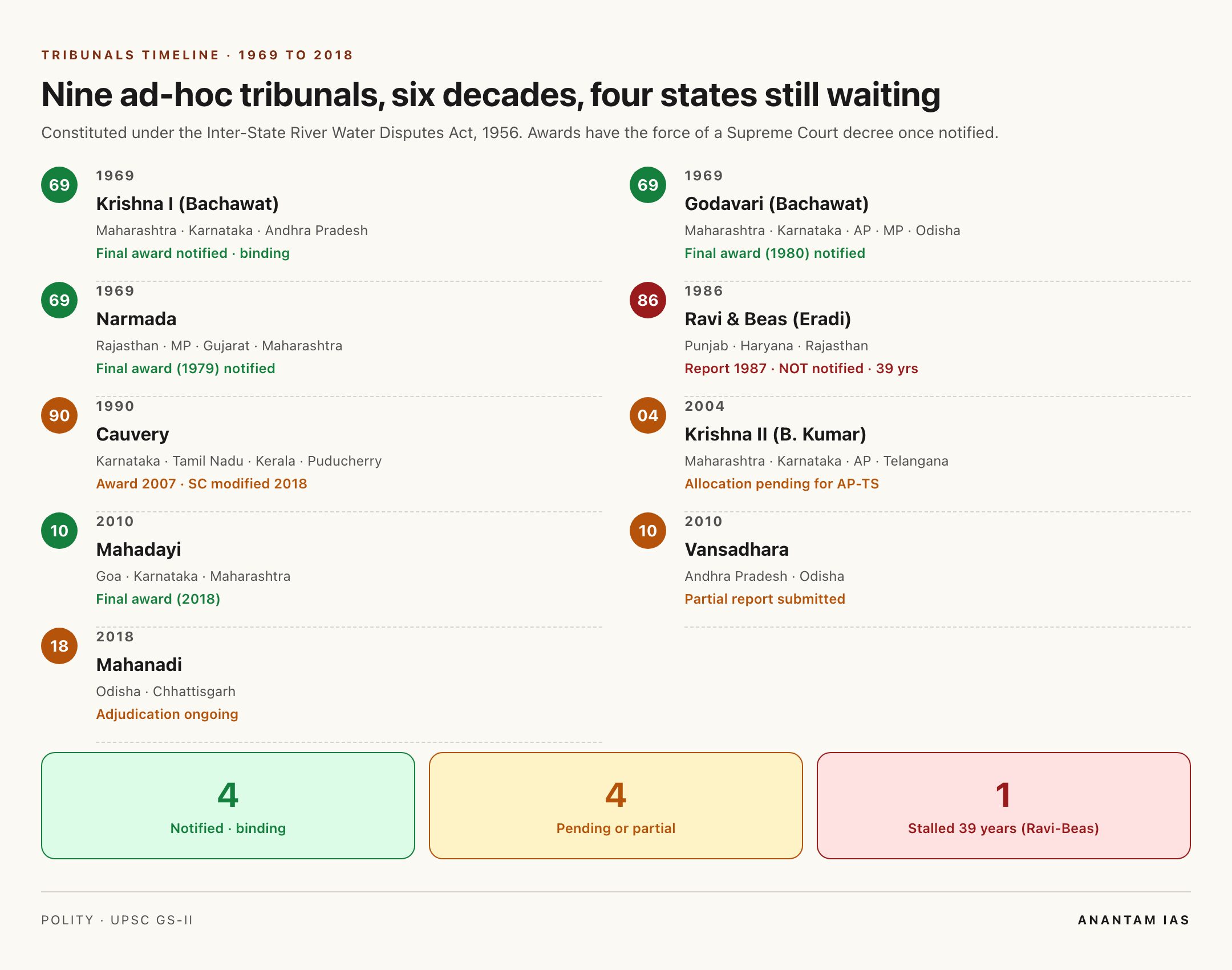
The Krishna Water Disputes Tribunal-I, constituted in 1969 under Justice R.S. Bachawat, allocated waters between Maharashtra, Karnataka, and Andhra Pradesh, and its 1973 award was notified in 1976. The Godavari Tribunal, also constituted in 1969 under Justice Bachawat, gave its final award in 1980. The Narmada Water Disputes Tribunal, constituted in 1969, gave its award in 1979 covering Rajasthan, Madhya Pradesh, Gujarat, and Maharashtra. All three of these older awards have been notified and are binding.
The Ravi and Beas Waters Tribunal, constituted in 1986 under Justice V. Balakrishna Eradi, delivered a report in 1987 that was never notified because Punjab, Haryana, and Rajasthan all filed clarification petitions under Section 5(3). The Cauvery Water Disputes Tribunal, constituted in 1990, gave its final award in 2007 allocating water between Karnataka, Tamil Nadu, Kerala, and Puducherry. The Supreme Court modified this award in February 2018, raising Karnataka’s share by about 14.75 thousand million cubic feet at the cost of Tamil Nadu, while reaffirming that the tribunal’s award stood notified. The 2018 ruling also led to the constitution of the Cauvery Water Management Authority.
More recent tribunals include Krishna-II constituted in 2004 under Justice Brijesh Kumar to allocate water between Maharashtra, Karnataka, undivided Andhra Pradesh, and now Telangana. Allocation between Andhra Pradesh and Telangana remains pending. The Vansadhara Tribunal, constituted in 2010 between Andhra Pradesh and Odisha, has given a partial report. The Mahadayi Tribunal, constituted in 2010, gave its final award in 2018 covering Goa, Karnataka, and Maharashtra. The Mahanadi Tribunal, constituted in 2018 between Odisha and Chhattisgarh, is still adjudicating.
Comparative Approach: Tribunals vs Ordinary Courts vs Negotiation
Inter-state river water disputes can in theory be resolved through three routes: a tribunal under the ISRWD Act, the original jurisdiction of the Supreme Court under Article 131, or political negotiation under the aegis of the inter-state council. The Constitution and the Act push disputes toward the tribunal route by default. Article 262(2) and Section 11 of the ISRWD Act bar both the Supreme Court and other courts from adjudicating these disputes once they fall within the Act’s scope.
In practice, the Supreme Court intervenes through Article 136 special leave petitions, hearing challenges that an award is arbitrary, violates natural justice, or that the tribunal acted beyond its jurisdiction. The Court has also entertained Article 32 petitions where access to drinking water has been linked to the right to life under Article 21. The Court is careful never to fix the quantum of water sharing itself, but it routinely shapes procedural outcomes that effectively determine quantum. Negotiation, by contrast, has been used sparingly, with the Punjab-Haryana SYL canal issue being the most prominent example of negotiations that ultimately failed.
Challenges in the Existing Framework
The single biggest problem is delay. Tribunals are supposed to deliver awards in three years but routinely take much longer. The Cauvery Tribunal took 17 years. The Ravi and Beas Tribunal has been operational for 39 years and counting. The second problem is data. There is no neutral central agency that maintains hydrological data, so each riparian state shows up to the tribunal with its own flow numbers, often diverging by 30 to 40 percent. The third problem is the absence of a mandatory negotiation stage before adjudication, which means disputes are often referred to a tribunal when they are still ripe for political settlement. The fourth is enforcement. Even after an award is notified, riparian states sometimes simply refuse to comply, and the Centre lacks a clean coercive mechanism short of approaching the Supreme Court.
The fifth problem is constitutional fragmentation between Article 262 and Article 131. Article 131 gives the Supreme Court original jurisdiction over disputes between the Centre and states or between states, and is a recurring touchpoint in the basic structure doctrine jurisprudence on federalism. Article 262(2) seeks to oust this jurisdiction in water disputes, but states have routinely filed Article 131 suits raising adjacent issues such as inter-state agreements, breach of pacts, or constitutional violations, which keeps the Supreme Court in the picture.
The Proposed Reform: Single Standing Tribunal
The Inter-State River Water Disputes (Amendment) Bill, debated in various forms since 2017 and reintroduced more recently, proposes the most significant overhaul of the 1956 Act in its history. The reform has three structural pillars.
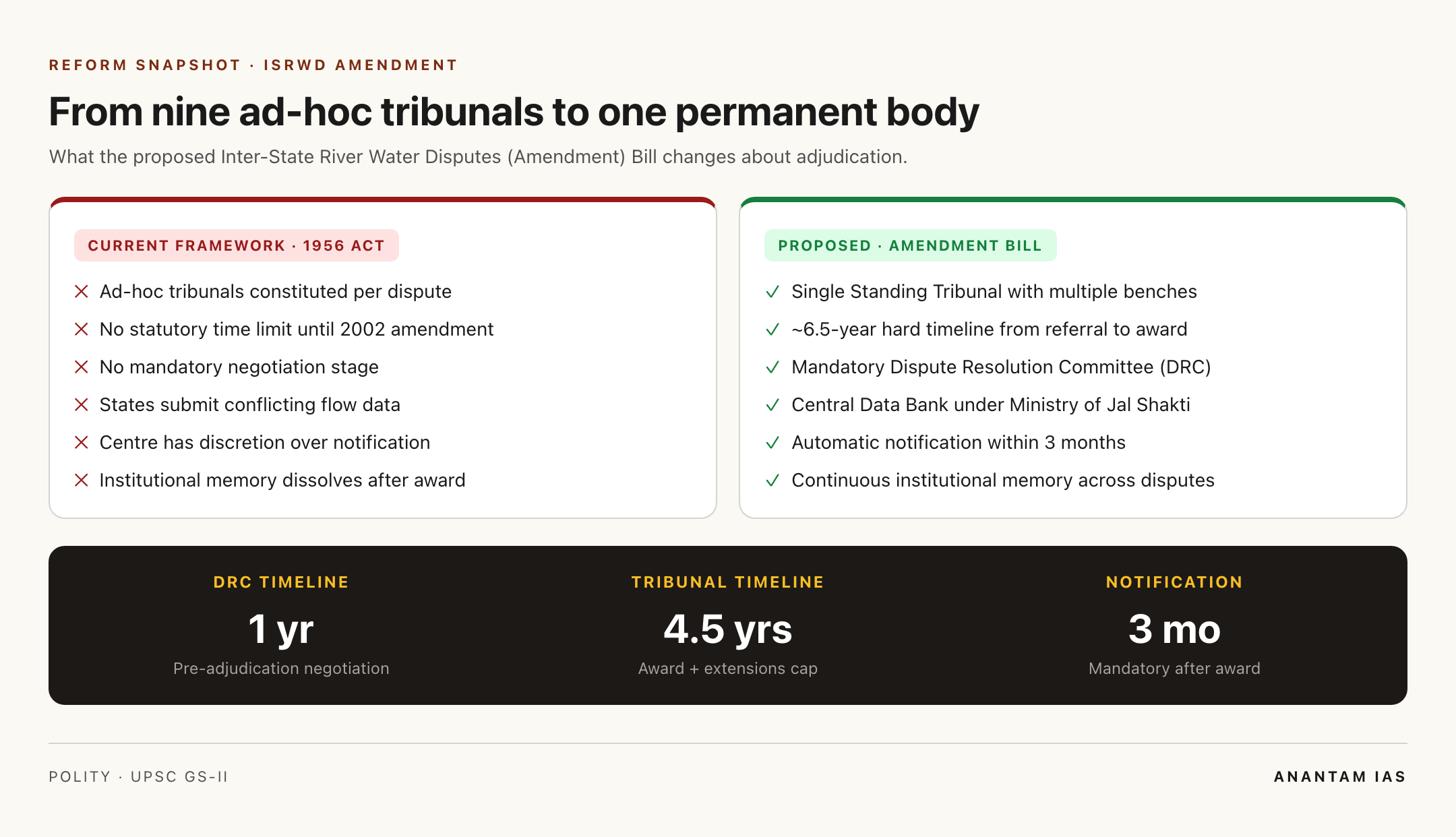
The first is a Single Standing Tribunal that replaces all existing ad-hoc tribunals. The new tribunal would have multiple benches, one for each active dispute, but a unified institutional identity that survives across disputes. This avoids the wasted institutional memory that comes with shutting down a tribunal after an award and reconstituting fresh ones for new disputes.
The second is a mandatory Dispute Resolution Committee, which would attempt negotiated settlement before any matter is referred to the tribunal. The DRC would have a one-year window to broker settlement, after which unresolved disputes would automatically move to the tribunal.
The third is a centralised Data Bank, maintained by an agency under the Ministry of Jal Shakti, that would be the single authoritative source of hydrological data for all tribunals and disputes. This would end the embarrassment of conflicting state-supplied flow data.
The amendment also proposes strict timelines: two years for the DRC and a further four and a half years maximum for the tribunal, including extensions. The award would be notified automatically within three months of being delivered, removing the political discretion the Centre currently has over notification.
Prelims Pointers
Article 262 has two clauses: Clause (1) authorises Parliament to make law for adjudication; Clause (2) authorises Parliament to bar court jurisdiction. Both have been exercised. The ISRWD Act, 1956 is the operating statute. The River Boards Act, 1956 provides only for advisory boards, not adjudication. Water is in Entry 17 of the State List. Inter-state rivers fall under Entry 56 of the Union List but only after a parliamentary declaration. Tribunal awards have the force of a Supreme Court decree once notified. Members of a tribunal are sitting or retired SC or HC judges, nominated by the CJI. The Cauvery final award of 2007 was modified by the Supreme Court in 2018. The Cauvery Water Management Authority was set up in 2018 to oversee implementation. A 2002 amendment to the ISRWD Act inserted a five-year time limit (three plus two) for tribunal awards. The 97th Constitutional Amendment dealt with cooperative societies, not water; do not confuse the two in MCQs.
Mains Practice Questions
- Critically examine the constitutional framework for resolution of inter-state river water disputes in India. Why has the bar on Supreme Court jurisdiction under Article 262(2) failed to keep these disputes out of the apex court? (GS Paper 2, 250 words)
- The proposed Inter-State River Water Disputes (Amendment) Bill seeks to replace ad-hoc tribunals with a single permanent tribunal. Discuss the advantages and limitations of this proposal. (GS Paper 2, 250 words)
- “Water disputes between states are not just legal questions but expressions of federal stress.” Discuss with reference to the Cauvery and Ravi-Beas disputes. (GS Paper 2, 150 words)
- Examine the role of Entry 56 of the Union List and the River Boards Act, 1956 in the integrated development of inter-state rivers in India. (GS Paper 2, 150 words)
Way Forward
A workable reform package needs to do four things at once. It needs to establish a single permanent tribunal with multiple benches and stable institutional memory. It needs to embed mandatory pre-adjudication negotiation through a dispute resolution committee with real authority. It needs a neutral central data bank that all parties accept as the source of truth on flows, withdrawals, and storage. And it needs automatic notification of awards within a tight statutory window so that the Centre cannot indefinitely sit on a tribunal’s verdict.
Beyond the tribunal architecture, the deeper challenge is to revive the inter-state council and the zonal councils as forums for political negotiation, to bring water within the working agenda of cooperative federalism rather than treating each dispute as a one-off litigation. The Mekedatu, Mahadayi, and SYL stalemates show that legal adjudication alone cannot resolve disputes that are simultaneously hydrological, political, and emotional. A combination of statutory reform, institutional revival, and a credible data architecture is the only path that does not end with another tribunal entering its fourth decade.
Frequently Asked Questions
What is the constitutional basis of inter-state water disputes in India?
Article 262 of the Constitution is the constitutional basis. Clause (1) empowers Parliament to make a law for adjudication of disputes over inter-state rivers, and Clause (2) empowers Parliament to bar the Supreme Court and other courts from exercising jurisdiction over such disputes. Parliament has used both powers. The ISRWD Act, 1956 was enacted under Article 262(1), and Section 11 of that Act exercises the bar contemplated under Article 262(2).
Is water a state subject or a Union subject?
Water is primarily a state subject under Entry 17 of the State List, which covers water supplies, irrigation, canals, drainage, embankments, water storage, and water power. However, Entry 56 of the Union List allows the Union to regulate and develop inter-state rivers and river valleys, but only to the extent that Parliament declares such regulation expedient in the public interest.
What is the difference between the ISRWD Act, 1956 and the River Boards Act, 1956?
The ISRWD Act provides for the adjudication of inter-state water disputes through ad-hoc tribunals. Tribunal awards under it are final and binding. The River Boards Act, 1956 provides only for advisory boards to assist the central government on integrated development of inter-state rivers. It does not provide for adjudication and, in fact, no river board has ever been constituted under it.
Are tribunal awards binding?
Yes. Once notified by the central government in the official gazette, a tribunal’s award has the same force as an order or decree of the Supreme Court under Section 6(2) of the ISRWD Act. This was clarified by the 2002 amendment.
Why does the Supreme Court still hear water dispute cases despite Article 262(2)?
Article 262(2) bars the Supreme Court from directly adjudicating an inter-state water dispute. But the Court entertains Article 136 special leave petitions challenging the procedure followed by a tribunal, or alleging that the award is arbitrary or violates natural justice. It also entertains Article 32 petitions where access to drinking water is linked to the right to life under Article 21. The Court is careful not to determine the quantum of water sharing itself, but it routinely shapes procedural outcomes.
What is the Cauvery Water Disputes Tribunal verdict and the 2018 Supreme Court ruling?
The Cauvery Tribunal, constituted in 1990, gave its final award in 2007 allocating water between Karnataka, Tamil Nadu, Kerala, and Puducherry. In February 2018, the Supreme Court modified the award, raising Karnataka’s share by about 14.75 thousand million cubic feet at the cost of Tamil Nadu, while reaffirming the tribunal’s award as notified. The 2018 ruling also directed the constitution of the Cauvery Water Management Authority.
How many inter-state water disputes tribunals have been constituted so far?
Nine tribunals have been constituted so far: Krishna-I (1969), Godavari (1969), Narmada (1969), Ravi-Beas (1986), Cauvery (1990), Krishna-II (2004), Vansadhara (2010), Mahadayi (2010), and Mahanadi (2018). Of these, Krishna-I, Godavari, Narmada, and Mahadayi have notified awards. Krishna-II, Vansadhara, and Mahanadi have pending or partial reports. Cauvery has a notified award modified by the Supreme Court. The Ravi-Beas tribunal is still alive after 39 years because clarification petitions under Section 5(3) remain pending.
What does the proposed ISRWD Amendment Bill change?
The amendment proposes to replace all ad-hoc tribunals with a single standing tribunal with multiple benches, mandate a Dispute Resolution Committee for negotiation before referral, set up a central data bank for hydrological information, and impose strict timelines of around six and a half years from referral to award. It also proposes automatic notification of awards within three months.
Why has the Ravi and Beas tribunal not concluded after 39 years?
The tribunal delivered a report in 1987, but Punjab, Haryana, and Rajasthan all filed clarification petitions under Section 5(3) of the ISRWD Act. The Act provides no mechanism to dispose of such petitions if the tribunal cannot conclude them. The Centre has therefore renewed the tribunal’s tenure year after year because the law offers no alternative route to wind it up while petitions are pending.
Is the dispute over Mekedatu a tribunal dispute?
The Mekedatu reservoir dispute is technically not before a tribunal. It is an offshoot of the Cauvery dispute, with Tamil Nadu objecting to Karnataka’s proposed Mekedatu balancing reservoir on the ground that it would affect downstream flow. The matter has been raised before the Supreme Court and the Cauvery Water Management Authority rather than through a fresh tribunal.
Tell Google you want more of this.
Add Anantam IAS as a preferred sourceOne tap, and this site shows up more often in your own Top Stories, AI Overviews and AI Mode. Remove it any time.