The Silence Around Child Sexual Abuse: POCSO and the Reporting Gap
Why in News?
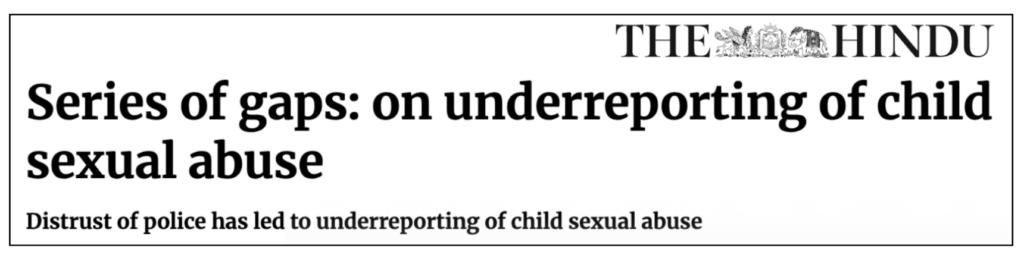
The Hindu, in its editorial ‘Series of gaps: on underreporting of child sexual abuse’, argued that despite a decade of the POCSO Act, 2012, the vast majority of child sexual abuse in India is never reported, prosecuted, or counted. The editorial reads the visible case numbers not as the true scale of the problem but as the small tip of a much larger, hidden one.
The core fact is uncomfortable but durable: most child sexual abuse goes unreported because the offender is usually someone the child knows and trusts, and fear, stigma and family pressure silence disclosure. The law exists, the duty to report exists, but the system around the child is leaking at every stage.
- The editorial frames underreporting as a series of gaps — at disclosure, at the police station, in medical examination, in trial, and in rehabilitation — not a single failure.
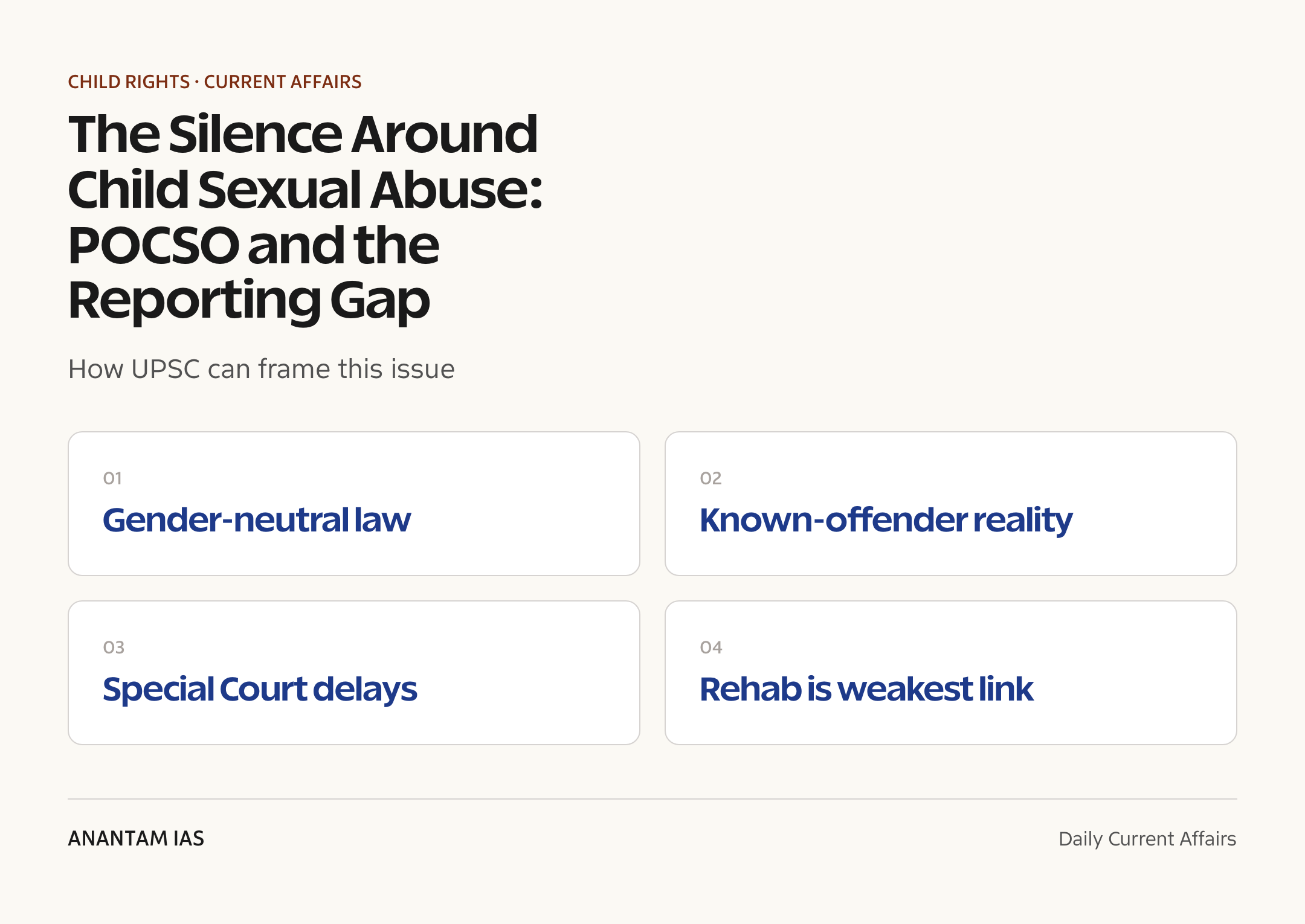
- Most offences are committed by a known offender — a relative, neighbour, teacher or acquaintance — which is why families often suppress complaints to protect ‘honour’ or relationships.
- Section 19 of POCSO makes reporting of known or suspected child sexual abuse mandatory for every person, yet awareness and compliance remain weak.
- Recorded NCRB POCSO cases run into tens of thousands a year (see the NCRB report), but surveys of childhood experiences suggest true prevalence is far higher.
- Even reported cases face low conviction rates and long delays despite the law’s one-year trial target, deterring families from coming forward.
- Support structures — counselling, victim compensation, and protection from the accused during trial — reach only a fraction of survivors.
The development matters in the context of:
- Underreporting matters because policy, budgets and policing are sized to recorded numbers — so an invisible problem gets invisible resources.
- It sits at the intersection of the child’s right to life with dignity under Article 21, the right to protection, and the state’s duty under Article 39(f) to protect childhood against exploitation.
- The gap is a governance test of whether a strong, gender-neutral special law can actually change outcomes when social silence and weak institutions work against it.
UPSC Relevance
Prelims Relevance
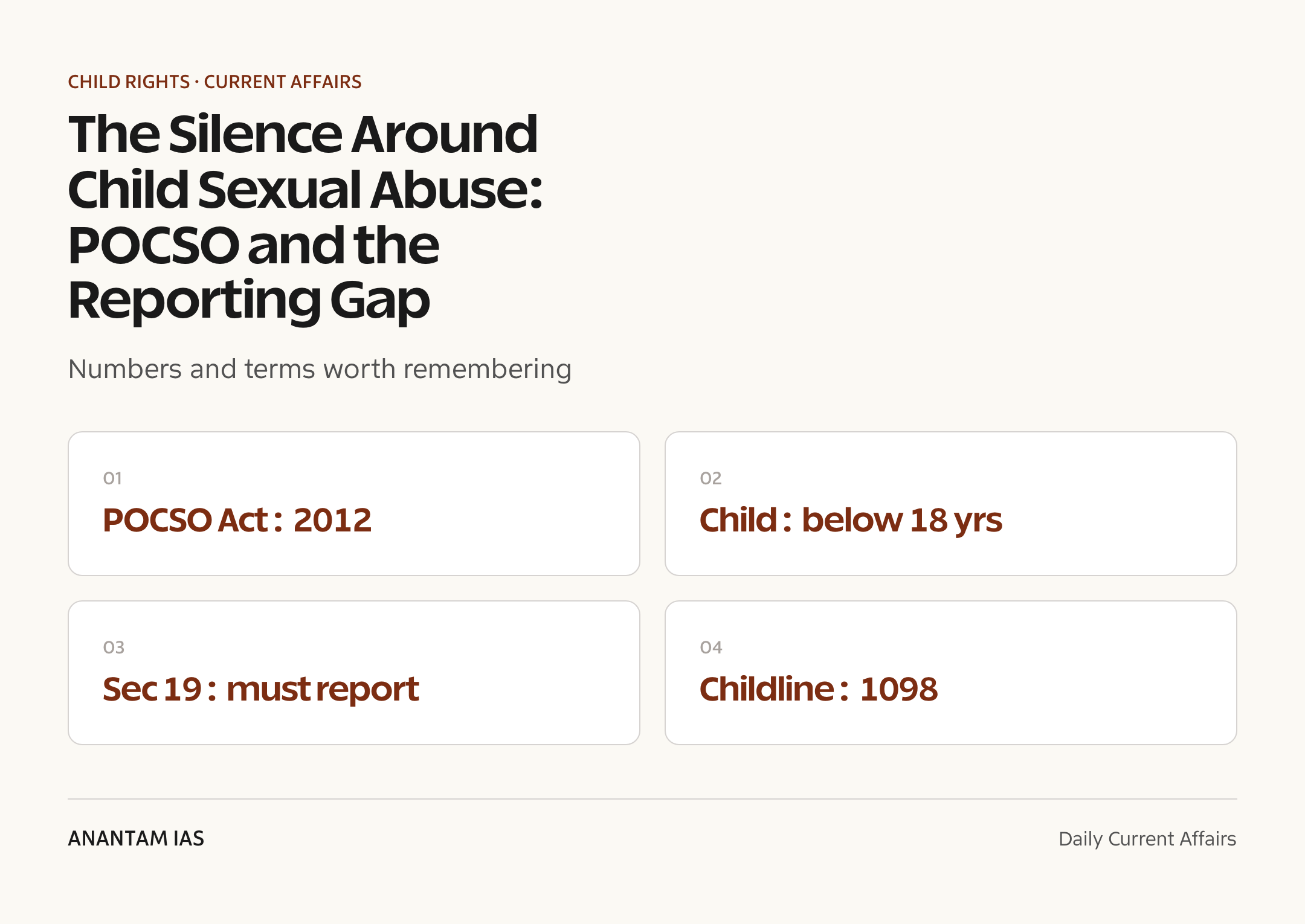
- POCSO Act, 2012: gender-neutral, defines a child as any person below 18 years, covers penetrative and non-penetrative assault, harassment and pornography.
- Section 19, POCSO: mandatory reporting duty on any person with knowledge of an offence; failure to report is itself punishable.
- POCSO mandates Special Courts and child-friendly procedures, with trial ideally completed within one year.
- NCRB (National Crime Records Bureau) compiles annual ‘Crime in India’ data, including POCSO cases.
- Childline 1098: 24×7 national emergency helpline for children in distress.
- NCPCR and SCPCRs are statutory bodies under the Commissions for Protection of Child Rights Act, 2005.
- Juvenile Justice (Care and Protection of Children) Act, 2015, governs Child Welfare Committees and the care of children in need of protection.
- POCSO trials use in-camera proceedings, support persons, and bar disclosure of the child’s identity (Section 23).
Mains Relevance
GS Paper 2
- Mechanisms, laws, institutions and bodies for the protection and betterment of vulnerable sections — evaluate POCSO implementation and the reporting gap.
- Issues relating to the development and management of social-sector services relating to children and child protection.
GS Paper 1
- Social empowerment and the role of family, stigma and patriarchy in suppressing disclosure of abuse against children.
Essay
- Silence is not safety: protecting children means hearing them.
- A law is only as strong as the system that enforces it.
Background and Context
What the POCSO Act actually does
The Protection of Children from Sexual Offences Act, 2012, is India’s dedicated, child-centred criminal law for sexual offences against minors.
- The POCSO Act defines a child as anyone below 18 years and is gender-neutral — boys and girls are equally protected.
- Criminalises a graded set of offences: penetrative and aggravated penetrative assault, sexual assault, sexual harassment, and use of children for pornography.
- Creates designated Special Courts and Special Public Prosecutors, with child-friendly recording of evidence.
- Mandates that the child’s statement be recorded by a woman officer, where possible, at the child’s home, avoiding repeated questioning.
- Bar’s disclosure of the child’s identity by the media presumes certain facts against the accused once foundational evidence is shown.
The mandatory-reporting duty and why it underperforms
POCSO is unusual in placing a legal duty to report on every citizen, not just officials, but the duty rarely converts into FIRs.
- Section 19 obliges any person who knows or apprehends that an offence has been committed to inform the police or the Special Juvenile Police Unit.
- Failure to report by a person in charge of an institution is separately punishable under Section 21.
- Doctors, teachers and counsellors are bound to report — yet fear of police, court appearances and reprisal keeps many silent.
- Families often choose private settlement or silence to protect marriage prospects and ‘family honour’, especially when the offender is a relative.
- Mandatory reporting can also deter adolescents seeking help, since it removes the child’s control over disclosure — a recognised tension the editorial flags.
The ‘known offender’ reality and the culture of silence
Underreporting is driven less by ignorance of the law than by who the abuser usually is.
- In most substantiated cases, the offender is a known and trusted person — parent, relative, neighbour, tutor or caregiver.
- Disclosure threatens the family’s relationships, finances and reputation, so adults around the child often suppress it.
- Children fear they will not be believed, will be blamed, or will be punished — classic barriers to disclosure documented in child-protection research.
- Stigma attaches to the survivor rather than the offender, deterring reporting and prolonging trauma.
- Boys are especially under-counted because of the assumption that abuse happens only to girls, despite the law’s gender-neutral design.
The institutional architecture is meant to catch a child
Several bodies and a helpline are supposed to form a safety net, but coverage and capacity are uneven.
- Childline 1098 offers a 24×7 helpline for children in distress and is integrated with district child-protection systems.
- NCPCR and state SCPCRs, statutory bodies under the 2005 Act, can monitor POCSO implementation and inquire into violations.
- Under the Juvenile Justice Act, 2015, Child Welfare Committees decide care and protection for children, including abuse survivors, part of the wider child-rights and child-protection framework.
- Special Juvenile Police Units and child-welfare police officers are meant to make first contact child-sensitive.
- The Mission Vatsalya umbrella scheme funds district child-protection units, but staffing, training and counsellor availability remain thin in many districts.
Where the system leaks: from FIR to verdict
Even when a child reports, the process loses cases at each stage:
- Judicial pendency: Despite the one-year trial target, POCSO Special Courts carry heavy backlogs, and trials stretch for years.
- Low conviction rates follow from hostile witnesses, ‘compromise’, poor investigation and weak forensic and medical evidence.
- Repeated court appearances and confronting the accused re-traumatises the child, pushing families to abandon cases.
- Victim compensation and interim relief under POCSO Rules and state schemes reach only a minority of survivors.
- Rehabilitation — counselling, education continuity and reintegration — is the weakest link, treated as optional rather than core.
Constitutional and policy anchors
Child protection is not charity but a constitutional obligation, which is why the reporting gap is a rights failure.
- Article 21 guarantees life with dignity, read to include protection from sexual abuse and a child-sensitive justice process.
- Article 39(f) directs the state to protect childhood and youth against exploitation and moral and material abandonment.
- Article 15(3) permits special provisions for children, the basis for child-specific laws and schemes.
- India is a party to the UN Convention on the Rights of the Child, committing to protection from all forms of sexual exploitation.
- The Right to Education framework and school safety guidelines link directly to early detection of abuse.
Way Forward
Make reporting safe, not just mandatory
- Pair Section 19 awareness with confidential, child-led disclosure channels in schools and clinics so reporting does not feel like a threat.
- Train teachers, doctors and Anganwadi workers as trusted first responders who know exactly where a child’s complaint goes next.
- Publicise Childline 1098 in every school and panchayat so a child has a memorable, non-police route to help.
Fix the process so cases survive to verdict
- Fully staffed and fast-track POCSO Special Courts, using one-stop centres, vulnerable-witness deposition rooms and video evidence.
- Strengthen child-sensitive investigation and forensics to reduce reliance on the child re-testifying.
- Guarantee interim victim compensation and protection from the accused during trial to keep families engaged.
Build rehabilitation as a right
- Treat counselling, education continuity and reintegration as standard entitlements, not discretionary add-ons.
- Resource district child-protection units under Mission Vatsalya with trained counsellors and case managers.
- Track survivors through structured follow-up so support does not end at the verdict.
And the deepest fix is cultural: shifting shame from the survivor to the offender, so that families report rather than hide, and a child who speaks is believed and protected.
Conclusion
The reporting gap is the real story of POCSO. A strong, gender-neutral law with a mandatory-reporting duty has not, on its own, broken the silence, because abuse is usually intimate, stigma falls on the child, and the system loses cases between the complaint and the verdict.
Closing the gap is less about new offences than about safe disclosure, staffed special courts, real compensation and serious rehabilitation — backed by a culture that no longer treats a child’s suffering as a family secret. Protecting children is the clearest test of whether constitutional promises reach the most vulnerable.
UPSC Practice Questions
Prelims MCQ 1
With reference to the Protection of Children from Sexual Offences (POCSO) Act, 2012, consider the following statements:
- The Act is gender-neutral and protects all persons below 18 years of age.
- It places a legal duty on any person to report knowledge or suspicion of a sexual offence against a child.
- It provides for the establishment of Special Courts to try offences under the Act.
How many of the above statements are correct?
(a) Only one (b) Only two (c) All three (d) None
Answer: (c) All three
Explanation:
POCSO is gender-neutral and defines a child as anyone below 18 (statement 1). Section 19 imposes a mandatory duty to report (statement 2). The Act mandates designated Special Courts for child-friendly, time-bound trials (statement 3). All three are correct.
Prelims MCQ 2
The Childline 1098 service and the National Commission for Protection of Child Rights (NCPCR) are best described as:
(a) A 24×7 helpline for children in distress and a statutory child-rights body, respectively (b) Two statutory courts that try offences under POCSO (c) Schemes funded entirely by the United Nations (d) Bodies created under the Right to Education Act
Answer: (a) A 24×7 helpline for children in distress and a statutory child-rights body, respectively
Explanation:
Childline 1098 is a 24×7 emergency helpline for children. The NCPCR is a statutory body under the Commission for Protection of Child Rights Act, 2005. Neither is a court, a UN scheme, or created under the RTE Act.
UPSC Mains Questions
- Despite a strong, gender-neutral POCSO Act with a mandatory-reporting duty, most child sexual abuse in India goes unreported. Examine the social and institutional reasons for this reporting gap and suggest measures to close it.
- Child protection is a constitutional obligation, not a welfare charity. In this light, evaluate the effectiveness of India’s child-protection architecture in detecting, prosecuting and rehabilitating survivors of child sexual abuse.
- Mandatory reporting can both protect children and deter adolescents from seeking help. Discuss this tension and how child-protection systems can be designed so that reporting becomes safe rather than threatening.
Sources: The Hindu (Editorial) and NCRB, Ministry of Women and Child Development.
Frequently Asked Questions
What is the POCSO Act in simple terms?
The Protection of Children from Sexual Offences Act, 2012 is India’s dedicated law against sexual offences targeting anyone below 18. It is gender-neutral, defines a graded set of offences, sets up child-friendly Special Courts, and protects the child’s identity throughout the process.
Why does child sexual abuse go unreported?
The offender is usually someone the child knows and trusts, so families fear stigma, broken relationships and loss of ‘honour’. Children fear disbelief and blame. Low conviction rates, long trials and repeated court appearances further discourage families from coming forward.
Is reporting child sexual abuse legally compulsory?
Yes. Section 19 of POCSO makes it mandatory for any person who knows or suspects an offence to inform the police or the Special Juvenile Police Unit. Section 21 separately punishes failure to report by those in charge of institutions, such as schools.
Who can a child or adult turn to for help?
Childline 1098 is a 24×7 national helpline for children in distress. Cases can also reach the Special Juvenile Police Unit, Child Welfare Committees under the Juvenile Justice Act, and the NCPCR or state SCPCRs, which are statutory child-rights bodies.
What constitutional rights protect children from abuse?
Article 21 guarantees life with dignity, including a child-sensitive justice process. Article 39(f) directs the state to protect childhood against exploitation, and Article 15(3) allows special laws for children. India is also bound by the UN Convention on the Rights of the Child.
What reforms would reduce the reporting gap?
Safe, confidential disclosure channels in schools and clinics, fully staffed and fast-tracked Special Courts, child-sensitive investigation, guaranteed victim compensation, and proper rehabilitation. Above all, shifting shame from the survivor to the offender so families report rather than hide abuse.