
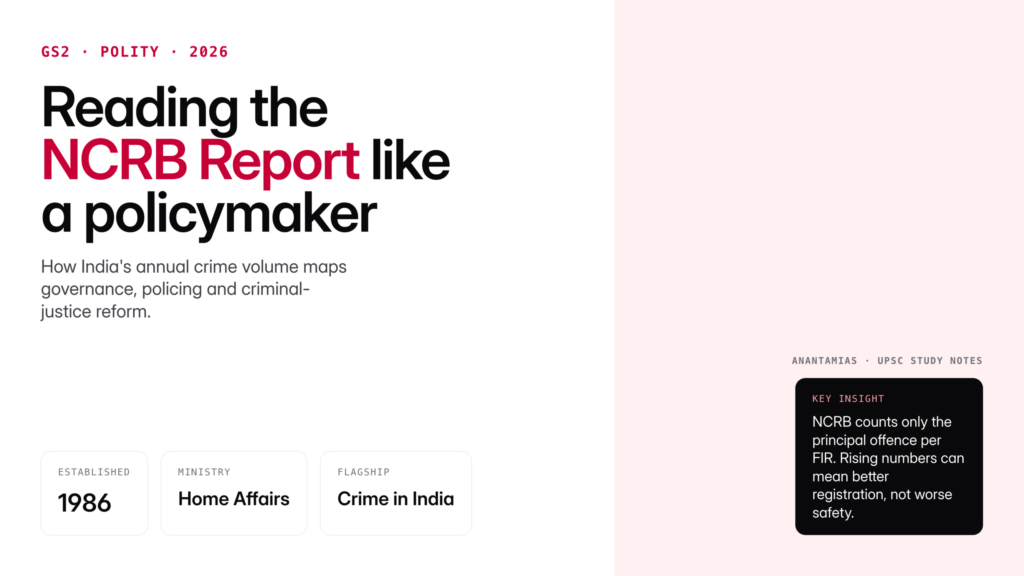
The NCRB Crime in India 2024 report is the latest published edition of the National Crime Records Bureau’s flagship crime dataset. Released in May 2026, it records 58.85 lakh cognisable crimes at a rate of 418.9 per lakh population, down about 6% from the 62,41,569 cases logged in 2023.
Read the numbers as police-recorded crime, not as a perfect count of crime experienced. Registration practices, legal categories, population, the principal offence rule, and under-reporting all affect comparisons across states and years.
Crime in India 2024: Five Findings
| Indicator | Crime in India 2024 finding | Change from 2023 |
|---|---|---|
| All cognisable crimes | 58.85 lakh cases; rate 418.9 per lakh | Cases down about 6%; rate down from 448.3 |
| Murder | 27,049 cases | Down 2.4%; disputes remain the leading motive |
| Crime against women | 4.41 lakh cases; rate 64.6 per lakh women | Cases down 1.5%; rate down from 66.2 |
| Crime against children | Rate 42.3 per lakh children | Cases up 5.9% |
| Cybercrime | 1,01,928 cases; 72.6% recorded with online fraud as the motive | Cases up over 17%; rate 6.2 to 7.3 |
Three shifts define the 2024 edition:
- Cybercrime crossed one lakh cases for the first time, with online fraud behind 72.6% of them.
- Crimes against senior citizens rose 16.9%, the sharpest increase among vulnerable groups.
- Deaths from drug overdose climbed about 50%, from 650 in 2023 to 978 in 2024.
Check the official Crime in India 2024 catalogue or open the official NCRB Part I report PDF before quoting a table in an answer.
How NCRB Crime Data Is Compiled
Crime in India 2024 aggregates cases recorded by State and Union Territory police. NCRB uses the principal offence rule, reports both counts and population-adjusted rates, and warns that states and Union Territories should not be compared solely on headline crime figures.
| Attribute | Verified detail |
|---|---|
| Publishing agency | National Crime Records Bureau, Ministry of Home Affairs |
| Edition covered here | Crime in India 2024, published in May 2026 |
| Data source | Police-recorded cases supplied by States and Union Territories |
| Legal classification | Indian Penal Code and Special and Local Laws for the 2023 reporting year |
| Counting rule | Principal offence rule when one case contains multiple offences |
| Best comparison | Use rates, registration context, legal changes, and multiple years together |
Background and Historical Context
The NCRB was created in 1986 by merging four existing units, including the Directorate of Coordination of Police Computers and the Central Finger Print Bureau. Its mandate, drawn from the National Police Commission report, was to give India a single crime-data backbone at a time when each state maintained its own registers in paper.
Three shifts made the NCRB central to modern governance. First, the push for computerisation in the 1990s produced the Common Integrated Police Application, later replaced by the Crime and Criminal Tracking Network and Systems (CCTNS) under the Digital India umbrella. Second, the Supreme Court and parliamentary committees began citing NCRB figures while hearing matters on custodial deaths, mob lynching and crimes against women, which raised the bureau’s evidentiary profile. Third, public-interest litigation and data journalism turned the annual volumes into a mainstream civic resource.
The NCRB’s first Crime in India volume in 1953 pre-dates the bureau itself; that series was earlier maintained by the Intelligence Bureau. Since 1986 the bureau has expanded its basket to cover Accidental Deaths and Suicides in India (ADSI), Prison Statistics India (PSI), the Fingerprint in India report and thematic compendiums like Crime in Mega Cities. The 2023 edition is still classified under the Indian Penal Code and Special and Local Laws. The Bharatiya Nyaya Sanhita, Bharatiya Nagarik Suraksha Sanhita and Bharatiya Sakshya Adhiniyam took effect in 2024, so later reporting years will need careful category mapping before trend comparisons are made.
Key Features and Structure
Core Publications
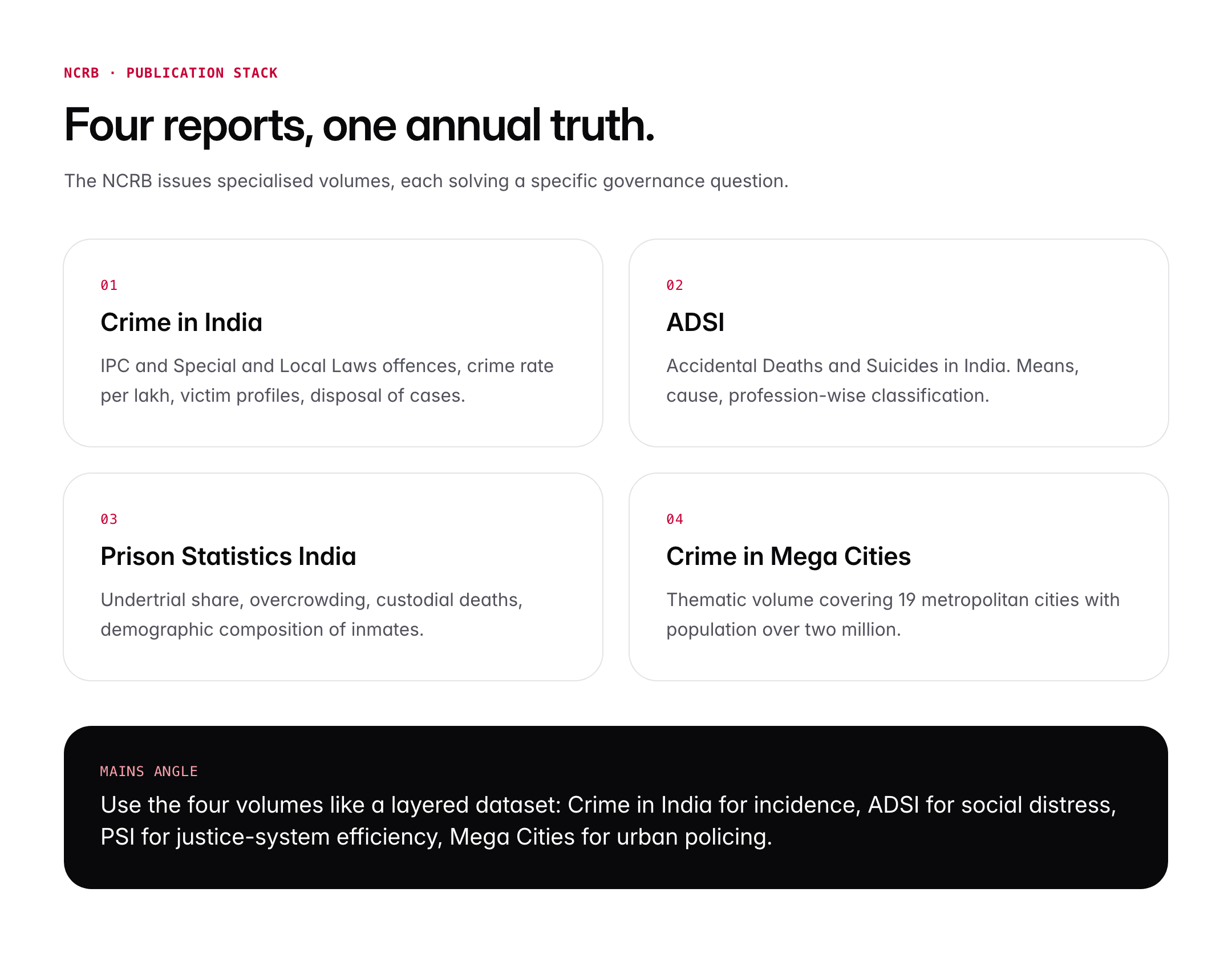
The Crime in India volume is the flagship. It aggregates First Information Reports (FIRs) registered under the IPC and under special and local laws such as the Protection of Children from Sexual Offences Act and the Scheduled Castes and Scheduled Tribes (Prevention of Atrocities) Act. It presents crime counts, crime rates per lakh population, disposal of cases by police and courts, and victim profiles disaggregated by age, gender and social category.
The Accidental Deaths and Suicides in India report covers road, rail and natural-cause deaths along with suicide data classified by profession, cause and means. The Prison Statistics India report tracks undertrial proportions, overcrowding, custodial deaths and demographic composition of inmates, and is heavily used in criminal-justice reform debates.
Methodology
The NCRB follows the principal offence rule, counting only the most serious offence when an FIR lists multiple charges. Data flows from police stations into state crime records bureaus and then to the NCRB through CCTNS. Crime rate is expressed per lakh population using projected Census figures, which matters because absolute numbers can be misleading when population rises.
Crime Classification
Offences in the 2023 report are split into IPC crimes and Special and Local Laws. Cognisable offences alone are tallied, which excludes many non-cognisable disputes. The bureau also publishes separate heads for cybercrime, economic offences, crimes against Scheduled Castes and Scheduled Tribes, crimes against women and children, and crimes against senior citizens.
Institutional Role
Beyond reporting, the NCRB runs the National Digital Police Portal, operates the Central Finger Print Bureau, maintains the National Database on Sexual Offenders and the CCTNS Interoperable Criminal Justice System. It publishes training modules and coordinates with the Bureau of Police Research and Development.
Significance for UPSC and General Knowledge
- NCRB figures anchor factual questions in Prelims on institutions under the Ministry of Home Affairs and on crime categories created by specific statutes.
- GS Paper 2 questions on internal security, police reforms and the criminal justice system draw on NCRB tables about undertrials, custodial deaths and case pendency.
- GS Paper 1 questions on crimes against women, children and Scheduled Castes rely on NCRB disaggregation for evidence.
- Essay and ethics answers gain credibility when they cite NCRB data instead of anecdotal press reports.
- Interview panels often test whether candidates can read the NCRB critically rather than parroting headline numbers.
Detailed Analysis: Reading Crime Data Responsibly
A serious reader of the NCRB learns to separate three things: reporting, registration and incidence. A rise in the crime rate against women, for instance, can reflect genuine growth in offences, but it can also reflect improved police response, expanded legal definitions after the Criminal Law (Amendment) Act 2013, or aggressive outreach by women’s helplines and one-stop centres. NCRB itself cautions that states and Union Territories should not be compared purely on the basis of crime figures. Higher registration can reflect better reporting and police access, while lower registration can hide crime.
The principal offence rule also shapes the story. If a single FIR charges murder, rape and robbery, only the murder is counted. This understates composite crimes and complicates comparisons across regimes that classify offences differently, such as the shift from IPC to BNS. Specialists use NCRB data alongside victimisation surveys, such as the India Justice Report, the SATARC surveys and the Lokniti-CSDS Status of Policing reports, which capture unreported crime.
State-wise rankings attract political heat but reward careful handling. Uttar Pradesh, the most populous state, often posts the largest absolute crime count, while smaller northeastern states record low totals yet relatively high rates for specific offences. Cybercrime has grown especially fast, with Karnataka, Telangana and Maharashtra reporting large numbers because they host metropolitan commercial hubs where online fraud thrives.
Custodial and institutional data deserve particular attention. The Prison Statistics India volume repeatedly shows that over seventy percent of inmates are undertrials, a figure that the Supreme Court has cited in rulings on bail reform and that the Second Administrative Reforms Commission flagged as a rule-of-law crisis. Similarly, the ADSI report frames debates on farmer suicides, student suicides and gig-worker distress by giving each category a numerical shape.
A mature analytical answer, therefore, cites NCRB data, acknowledges its limits, and pairs it with complementary evidence and structural explanation.

Comparative Perspective
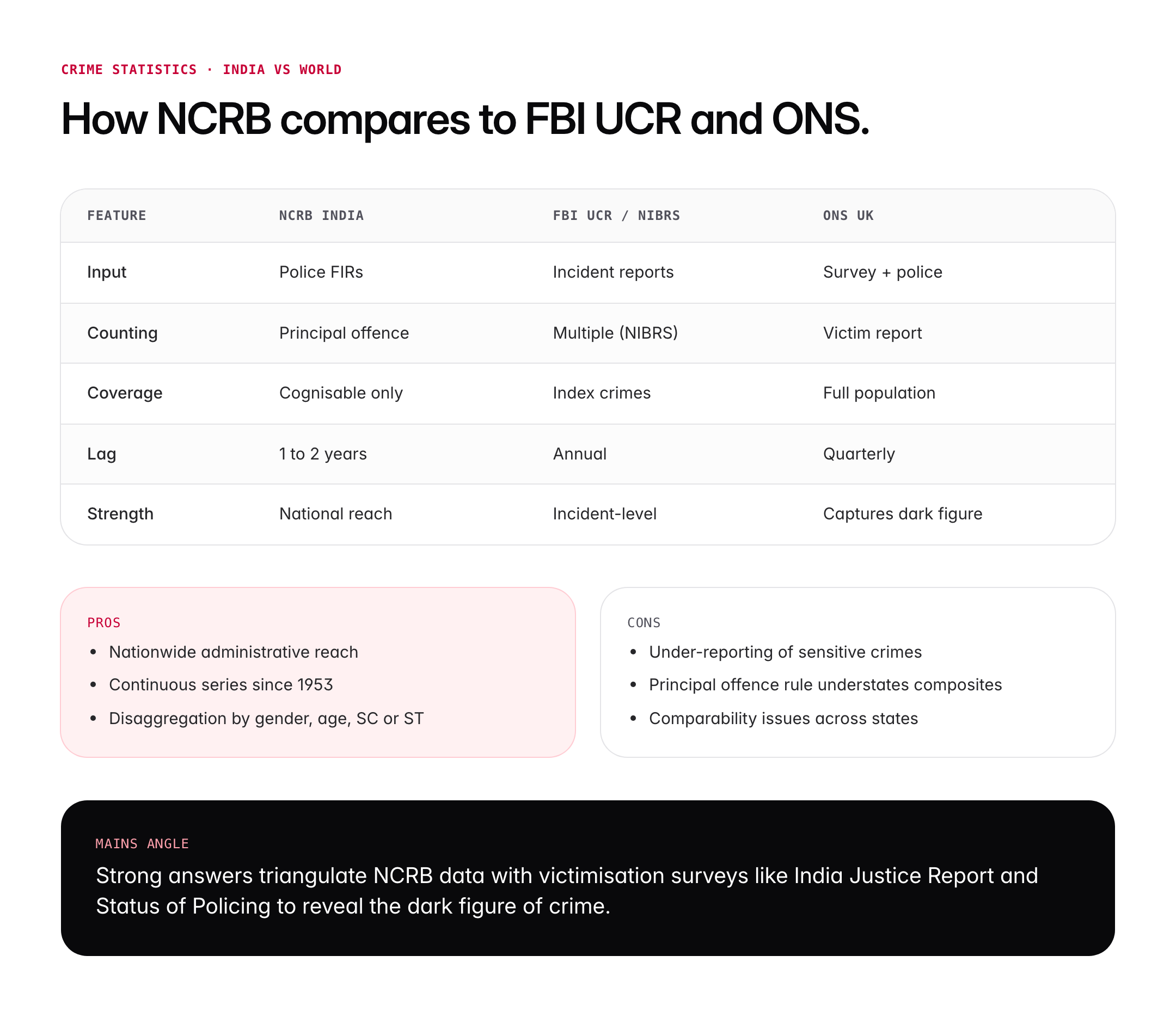
| Feature | NCRB (India) | FBI UCR / NIBRS (United States) | ONS Crime Survey (United Kingdom) |
|---|---|---|---|
| Primary input | Police-registered FIRs | Police incident reports | Household victimisation survey plus police data |
| Counting rule | Principal offence only | Multiple offence counting in NIBRS | Victim-reported incidents |
| Coverage | Cognisable crime only | Index crimes plus selected offences | Full population sample including unreported crime |
| Publication lag | One to two years | Annual, with monthly updates | Quarterly and annual |
| Strength | Nationwide police-administrative reach | Granular incident-level data | Captures dark figure of crime |
The NCRB is administratively comprehensive but, like the earlier FBI UCR system, struggles with the so-called dark figure of unreported crime. Many mature jurisdictions therefore combine police data with independent victimisation surveys. India’s experiments with the SATARC survey and state-level studies are early steps in this direction.
Challenges and Criticisms
Critics raise three recurring concerns. The first is under-reporting. Crimes against women, SC and ST communities, migrant workers and LGBTQIA plus individuals are widely believed to be under-registered. The Status of Policing in India Report and the Common Cause surveys document hesitation to approach police, especially in rural areas and in cases involving intimate partners.
The second is inter-state comparability. Because registration practices vary with political climate and police capacity, comparing the crime rate of two states can reward denial and punish transparency. Former NCRB officials have publicly warned against crude rankings.
The third is delay and opacity. Reports often arrive one to two years late, and some chapters have been dropped or restructured without explanation, including sections on lynching and farmer suicides in particular years. Researchers have asked for faster release cycles, open machine-readable data and published methodology notes. Ongoing reforms around the BNS and the e-FIR system offer a chance to fix these gaps, but only if the bureau commits to systematic disclosure.
Prelims Pointers
- NCRB is an attached office under the Ministry of Home Affairs, set up in 1986.
- Headquarters are in New Delhi; the Director is an Indian Police Service officer.
- Crime in India follows the principal offence rule for counting.
- Crime rate is measured per lakh population, using Census-projected figures.
- CCTNS is the data backbone for FIR-level reporting from states and UTs.
- ADSI covers suicides and accidental deaths; PSI covers prison statistics.
- The National Database of Sexual Offenders is maintained by NCRB since 2018.
- NCRB also runs the Central Finger Print Bureau.
- The Interoperable Criminal Justice System links police, courts, prisons, forensics and prosecution.
- Cybercrime is reported through the National Cyber Crime Reporting Portal and aggregated by NCRB.
- The transition from IPC to BNS is being reflected in NCRB classification from 2024 onwards.
- NCRB publications are tabled before Parliament and are public documents.
Mains Practice Questions
- Discuss the institutional role of the National Crime Records Bureau in India’s criminal justice system and examine the limitations of relying solely on NCRB data to assess the state of crime in India.
- Explain NCRB’s mandate, publications and data-flow via CCTNS.
- Analyse methodological limits such as under-reporting, principal offence rule and inter-state variance.
- Suggest reforms: victimisation surveys, open data, faster release and BNS-era recalibration.
- “Crime statistics reflect policing as much as crime.” Critically evaluate this statement with reference to NCRB reports and recent trends in crimes against women and cybercrime in India.
- Set out what NCRB measures and how registration affects numbers.
- Use examples of states with high reporting and discuss women-related and cybercrime trends.
- Conclude with recommendations on combining police data with independent evidence for policy.
Conclusion
The NCRB report is India’s most visible instrument of statistical self-scrutiny, converting millions of FIRs into a single public record that politicians must defend, judges can cite and citizens can interrogate. Its strength lies in continuity and nationwide reach; its weakness lies in the gap between registered and actual crime, and in the political use of headline rankings.
For the UPSC aspirant, the right habit is neither worship nor dismissal. Learn the architecture, understand the counting conventions, respect the limitations, and always pair NCRB numbers with structural analysis. That is how a policymaker, and a good civil servant, reads a statistical report.
Frequently Asked Questions
What is the NCRB report?
The NCRB report is the annual statistical compilation published by the National Crime Records Bureau under the Ministry of Home Affairs. Its flagship volumes include Crime in India, Accidental Deaths and Suicides in India, and Prison Statistics India. The reports aggregate FIR-level data from state and UT police via the CCTNS network and present counts, rates and disposal of cases.
Why is the NCRB report important for UPSC?
The NCRB report anchors factual and analytical questions in Prelims and Mains. It supports GS Paper 2 on criminal justice, internal security and police reforms, GS Paper 1 on social issues and crimes against women, and essay writing. Candidates who cite NCRB data with an awareness of methodological limits demonstrate stronger command over governance themes.
How is the NCRB related to the CCTNS project?
The Crime and Criminal Tracking Network and Systems is the digital backbone that connects over sixteen thousand police stations to state and national databases. NCRB operates CCTNS, uses it to collect FIR-level data, and builds the Interoperable Criminal Justice System on top of it. Without CCTNS, the annual NCRB volumes could not be produced at their current scale.
When was the NCRB established and why?
The NCRB was established in 1986 by merging four existing units, following recommendations of the National Police Commission and the Tandon Committee. The goal was to create a single national agency for crime data, police computerisation, fingerprint records and criminal-justice research, replacing fragmented state-level systems.
What is the principal offence rule in NCRB data?
Under the principal offence rule, when a single FIR lists several offences, only the most serious offence is counted in NCRB tables. This keeps counts simple but understates composite crimes such as a murder combined with robbery. Analysts must keep the rule in mind while comparing categories or years.
Does the NCRB cover cybercrime?
Yes. Cybercrime is a separate reporting head in Crime in India, covering offences under the Information Technology Act and related IPC or BNS sections. Data flows from state police and the National Cyber Crime Reporting Portal. States like Karnataka, Telangana and Maharashtra often post high cybercrime counts because of their large digital economies.
What are the main criticisms of the NCRB report?
Key criticisms include under-reporting of crimes against women, SC and ST groups and migrant workers, limited inter-state comparability because of differing registration practices, long publication lags of one to two years, and the dropping or restructuring of sensitive categories. Critics also call for open machine-readable data and published methodology.
How should aspirants use NCRB data in answers?
Cite NCRB figures with the year and specific indicator rather than generic claims. Acknowledge methodological limits, pair the data with victimisation surveys or institutional reports, and link the number to structural analysis such as policing capacity or legal reform. This balanced approach is rewarded by examiners far more than raw numerical recall.
Tell Google you want more of this.
Add Anantam IAS as a preferred sourceOne tap, and this site shows up more often in your own Top Stories, AI Overviews and AI Mode. Remove it any time.