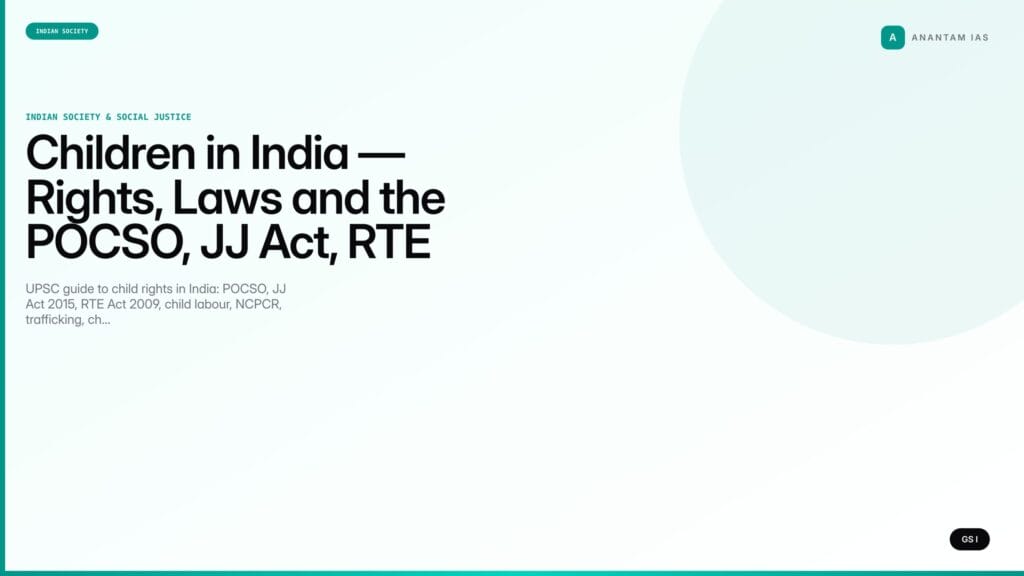
Children constitute 39% of India's population — approximately 47 crore, per UNICEF's 2023 estimate based on the UN Population Prospects. That is more than the total population of the United States. The Constitution carries a distinctive obligation to this population — Articles 21A, 24, 39(e), (f), 45 and 51A(k) collectively frame a children's rights architecture that predates most of the world's commitments.
India ratified the UN Convention on the Rights of the Child (UNCRC) in 1992. Since then, the child rights framework has expanded through the RTE Act (2009), POCSO (2012), the JJ Act (2015, amended 2021), the Child Labour Amendment Act (2016), and Mission Vatsalya (2022). This evergreen guide traces the framework and evaluates its implementation.
Who Is a Child?
- The Juvenile Justice (Care and Protection of Children) Act 2015 defines a child as a person below 18 years.
- POCSO 2012 — any person below 18.
- Child Labour Amendment 2016 — children (below 14) and adolescents (14-18).
- Prohibition of Child Marriage Act 2006 — girls below 18 and boys below 21.
Constitutional Framework
- Article 14, 15 — equality and non-discrimination.
- Article 15(3) — state may make special provisions for children.
- Article 21 — right to life and personal liberty.
- Article 21A — right to free and compulsory education for children 6-14 (86th Amendment, 2002).
- Article 23 — prohibition of trafficking and forced labour.
- Article 24 — prohibition of child labour in factories, mines, hazardous occupations.
- Article 39(e) and (f) — state to ensure children are not abused and have opportunities for healthy development.
- Article 45 (DPSP) — early childhood care and education (ECCE) for all children below 6.
- Article 51A(k) — fundamental duty of parents/guardians to provide education for children 6-14.
Key Laws
Right of Children to Free and Compulsory Education (RTE) Act 2009
- Free and compulsory education to all children 6-14.
- 25% reservation in private unaided schools for children from weaker sections.
- No detention policy originally; amended in 2019 to permit detention from Class V onwards with remedial measures.
- No physical punishment or mental harassment.
- Teacher qualification norms and PTR (pupil-teacher ratio) standards.
- Prohibition of capitation fees and screening procedures.
Juvenile Justice (Care and Protection of Children) Act 2015 (Amended 2021)
- Two categories: Children in Need of Care and Protection (CNCP), Children in Conflict with Law (CICL).
- 16-18 age bracket for heinous offences — after 2018 Nirbhaya-amendment, can be tried as adults following Juvenile Justice Board assessment.
- Child Welfare Committees (CWCs) — one per district.
- Juvenile Justice Boards (JJBs) — one per district.
- Adoption framework through Central Adoption Resource Authority (CARA).
- 2021 Amendment — District Magistrates issue adoption orders instead of courts; strengthened District Child Protection Units.
- Foster care and sponsorship as alternatives to institutional care.
POCSO Act 2012
Protection of Children from Sexual Offences:
- Gender-neutral — covers all children below 18.
- Stringent punishments for penetrative and aggravated sexual assault.
- Special courts and special public prosecutors.
- Child-friendly procedures for reporting, recording and trial.
- 2019 Amendment — death penalty for aggravated penetrative sexual assault.
- POCSO e-Box — online reporting platform.
Child Labour (Prohibition and Regulation) Amendment Act 2016
- Below 14 — complete ban on employment except helping family in non-hazardous occupations after school.
- 14-18 (adolescents) — prohibited in hazardous occupations and processes.
- Hazardous occupations list notified under Schedule.
Prohibition of Child Marriage Act 2006
- Minimum age: 18 for girls, 21 for boys.
- Child Marriage Prohibition Officers (CMPOs).
- Void at option of contracting child (upon turning 18 for girl / 20 for boy).
- Null and void if the child was trafficked or sold.
- Prohibition of Child Marriage (Amendment) Bill 2021 — proposes 21 for girls; pending in Parliament.
Commissions for Protection of Child Rights Act 2005
- National Commission for Protection of Child Rights (NCPCR) and State Commissions (SCPCRs).
- Inquire into violations, monitor RTE and POCSO implementation, examine existing safeguards.
Institutional Architecture
- Ministry of Women and Child Development — nodal ministry.
- NCPCR and SCPCRs.
- CARA — Central Adoption Resource Authority.
- NIMHANS — resource for child mental health.
- Childline 1098 — emergency helpline (now integrated with Emergency Response Support System 112).
- POCSO e-Box.
- District Child Protection Units (DCPUs).
Flagship Schemes
- Mission Vatsalya (2022) — integrated scheme for child protection, merging CWC/JJB support, child helpline, statutory bodies, institutional care, aftercare and foster care.
- Mission Shakti — includes Beti Bachao Beti Padhao and Pradhan Mantri Matru Vandana Yojana.
- Poshan Abhiyaan — nutrition mission for children 0-6.
- PM POSHAN — hot midday meals (previously MDM).
- Samagra Shiksha — school education from pre-school to Class XII.
- SAKSHAM Anganwadi and Poshan 2.0 — integrated nutrition delivery through anganwadis.
Child Wellbeing Indicators
- Under-5 mortality rate: 32 per 1,000 live births (SRS 2020), down from 126 in 1990.
- Stunting: 35.5% (NFHS-5, 2019-21), down from 38.4% in NFHS-4.
- Wasting: 19.3%.
- School dropout (secondary): about 12.6% (UDISE+ 2021-22).
- NFHS-5 — 23% of women 20-24 were married before 18.
- National Crime Records Bureau 2022 — over 1.62 lakh cases of crime against children reported; POCSO cases a major share.
Persistent Challenges
- Child malnutrition — despite progress, India has one of the world's largest absolute burdens.
- Child marriage — NFHS-5 reports 23% of women 20-24 married as children.
- Trafficking — significant cross-border and interstate trafficking.
- Child labour — Census 2011 reported 1.01 crore working children (5-14), likely lower now but still significant.
- Abuse and violence — POCSO cases climbing every year, often with low conviction rates.
- Learning loss post-pandemic — ASER 2023 found Class III children in government schools read at lower levels than a decade ago in many states.
- Digital safety — online harassment, exploitation, gaming addiction.
- Mental health — rising adolescent anxiety and depression.
Latest Developments (2024-26)
Caste Census 2025. Union Cabinet approved caste enumeration in the next national census (April 2025); disaggregated child indicators will be newly available.
POCSO and JJ Act Reforms. Supreme Court in 2024 directed strict implementation of POCSO Rule 9 and consistent compensation through State Legal Services Authorities. The court also flagged concerns about the consensual relationships gap — POCSO criminalises all adolescent sexual activity below 18.
Mission Vatsalya. Full rollout across states with digital CCI monitoring; integration of Childline 1098 with ERSS 112 operationalised in 2023-24.
NEP Rollout. Balvatika (pre-school) and foundational literacy emphasis continuing; NIPUN Bharat (2021-26) targets universal foundational literacy and numeracy by 2026-27.
ASER 2023. "Beyond Basics" report highlighted adolescent learning gaps; 25% of 14-18-year-olds cannot fluently read a Class II text in their regional language.
Women's Reservation Act. The Nari Shakti Vandan Adhiniyam 2023 — post-delimitation, greater women's political representation may accelerate child protection reforms.
MPI 2024. Global Multidimensional Poverty Index 2024 reported 415 million Indians exited multidimensional poverty between 2005-06 and 2019-21 — child nutrition and school attendance were key exit drivers.
Global Gender Gap Index 2024. India ranked 129/146; girl-child outcomes (health, education, marriage age) show persistent gender gaps.
Digital Personal Data Protection Act 2023. Provides specific protections for children’s data — parental consent requirement for processing.
Child Marriage Amendment. The 2021 Bill raising minimum age for girls to 21 remains pending; Standing Committee report awaited.
Policy Recommendations
- Universal ECCE — aligned with NEP 2020 and Poshan 2.0.
- POCSO consensual-relationships exception — judicial/legislative recalibration for adolescent autonomy.
- Mental health in schools — counsellors in every secondary school.
- Child protection services at scale — DCPUs in every district fully funded.
- Digital safety — integrated with DPDP Act.
- Strengthening of Child Marriage Prohibition Officers network.
- Comprehensive child online safety code.
- Adolescent health programmes — RKSK strengthening.
UPSC Relevance
GS Paper I — Indian Society
- Role of women and women's organisations.
- Issues related to population, child rights and social development.
GS Paper II — Governance, Social Justice
- Welfare schemes for vulnerable sections.
- Education, health, human resources.
Possible mains questions
- "India's legal framework for child protection is comprehensive but implementation is uneven. Examine." (250 words)
- "POCSO Act has strengthened child protection but created new dilemmas around adolescent autonomy. Discuss." (150 words)
- "Evaluate Mission Vatsalya as a consolidation of child protection services." (150 words)
Prelims pointers. UNCRC (India ratified 1992); RTE Act 2009 (Art. 21A, 86th Amendment); POCSO 2012 (gender-neutral); JJ Act 2015 (amended 2021); Child Labour (P&R) Amendment 2016; Prohibition of Child Marriage Act 2006; NCPCR (under CPCR Act 2005); CARA; Childline 1098; Mission Vatsalya; NIPUN Bharat (2021-26).
Essay themes. "The rights of the future"; "Every child's constitution"; "Learning, safety, dignity".
Protection of children is the long-term investment of a republic. India has the laws; the next decade's challenge is to make them work at scale.
Tell Google you want more of this.
Add Anantam IAS as a preferred sourceOne tap, and this site shows up more often in your own Top Stories, AI Overviews and AI Mode. Remove it any time.