China’s First Fields Medals: Lessons from Long-Term Research Investment
Why in News?
The International Mathematical Union (IMU) awarded the 2026 Fields Medals to Yu Deng, John Pardon, Jacob Tsimerman and Hong Wang at the International Congress of Mathematicians in Philadelphia. Deng was recognised for work in partial differential equations, while Wang was recognised for work in harmonic analysis and geometric measure theory.
The Indian Express reported that Deng and Wang are the first Chinese nationals to receive the medal. Both studied at Peking University before pursuing research careers abroad, making the result useful for examining how universities, long-horizon funding and international talent circulation interact.
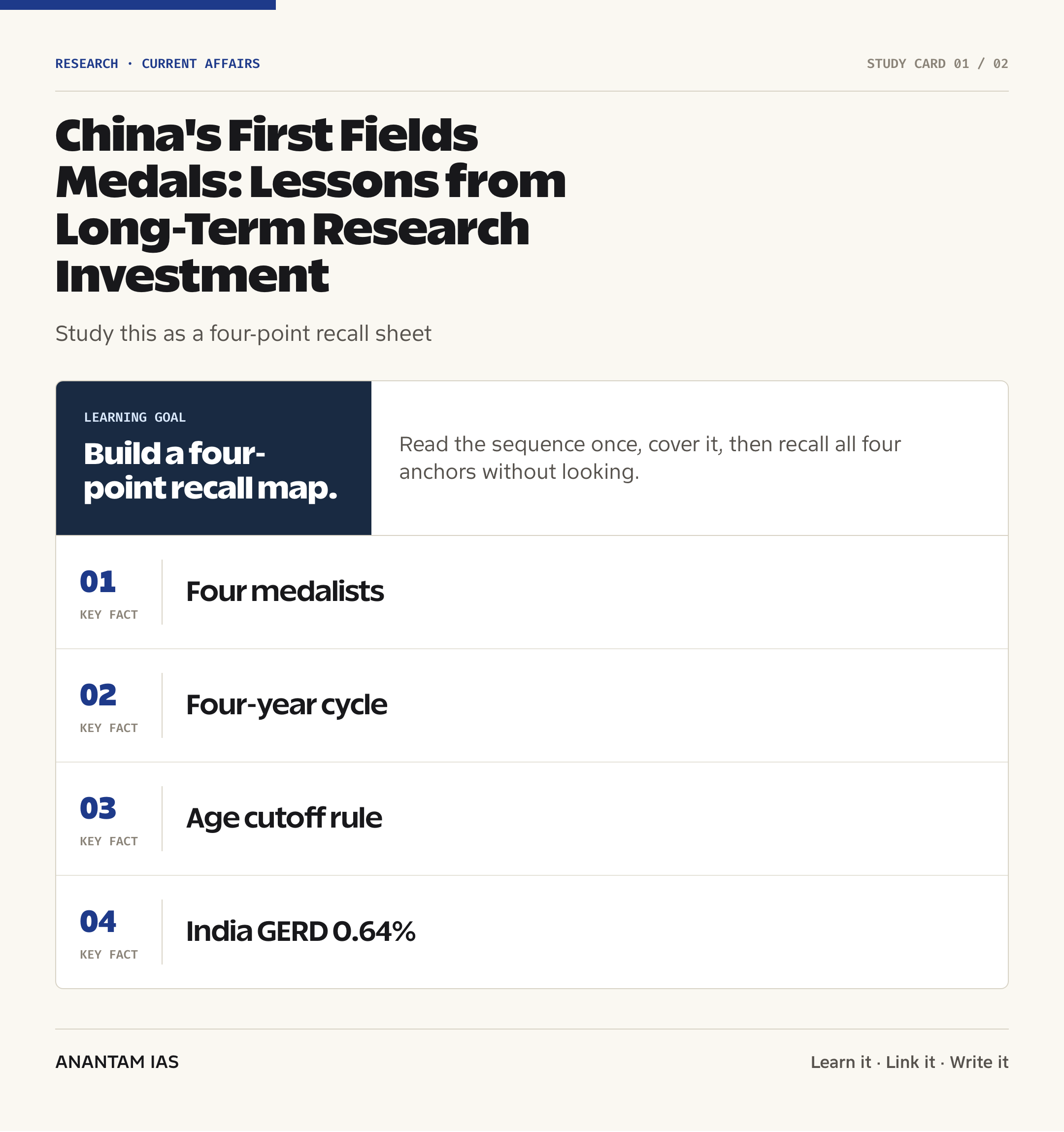
- The Fields Medal is awarded every four years at the International Congress of Mathematicians for existing achievement and the promise of future achievement.
- The precise age rule is that a candidate’s 40th birthday must not occur before 1 January of the Congress year; it is not a simple award-day cutoff.
- Yu Deng, a University of Chicago professor, was cited for results involving the Boltzmann equation, wave kinetic equations and nonlinear Schrödinger dynamics.
- Hong Wang, a professor at NYU Courant and IHES, was cited for advances connected with Fourier restriction, Falconer and Furstenberg sets, local smoothing and the three-dimensional Kakeya problem.
- The two other medalists were John Pardon, recognised for work across symplectic geometry, topology and related fields, and Jacob Tsimerman, recognised for work in arithmetic and complex algebraic geometry.
The development matters in the context of:
- A major prize is a lagging indicator: it reflects decades of schooling, mentoring, university capacity, grant support and international research networks rather than one recent programme.
- China’s official statistics put R&D expenditure at 2.80% of GDP in 2025; India’s latest detailed DST series put GERD at 0.64% of GDP in 2020–21, while a 2026 parliamentary reply described the current range as 0.6–0.7%. The reference years differ, so the figures show scale, not a controlled causal comparison.
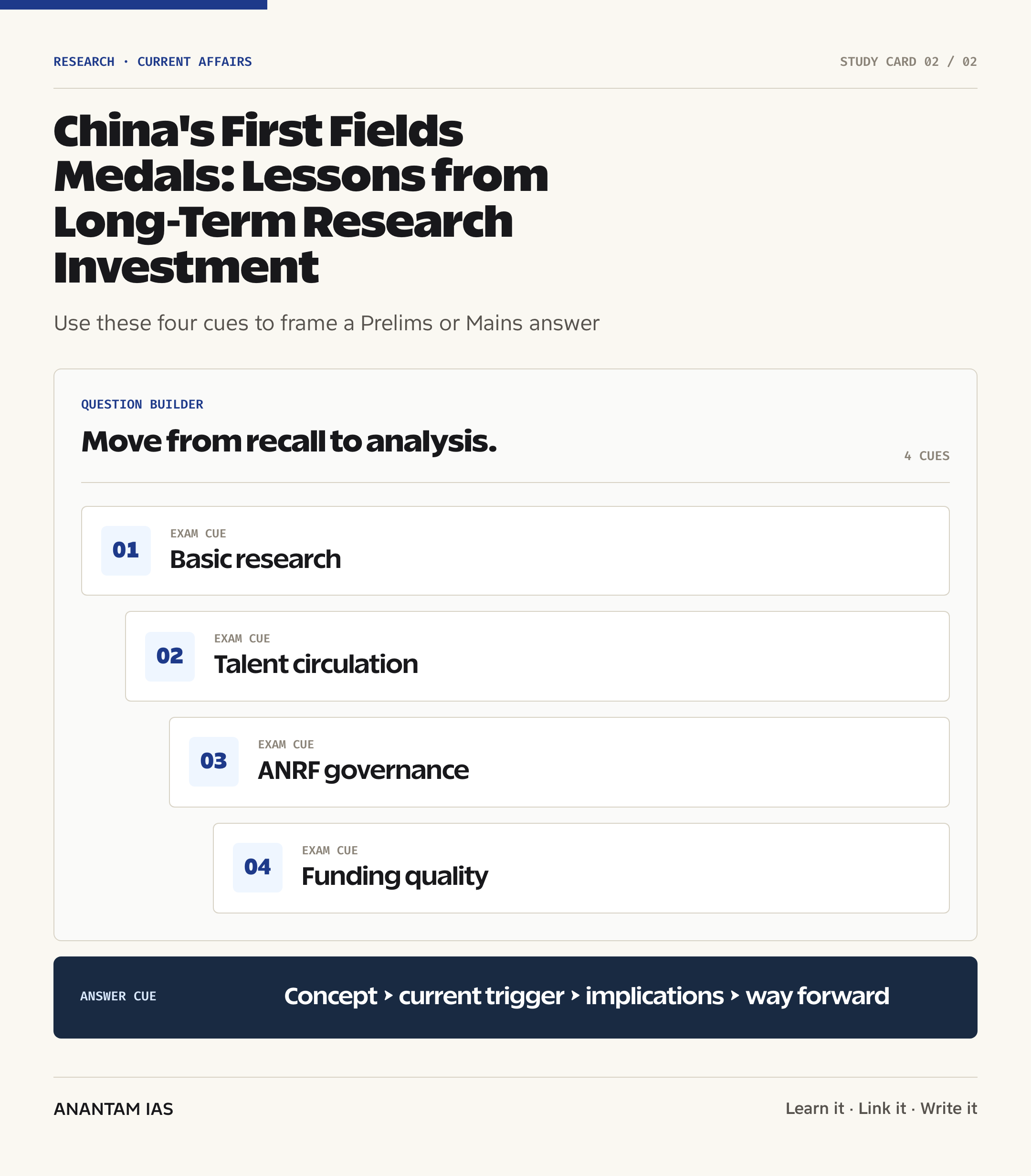
- For India, the policy question is whether the Anusandhan National Research Foundation (ANRF) can widen the base of research-performing universities while preserving rigorous peer review and long-term support for basic science.
UPSC Relevance
Prelims Relevance
- Fields Medal: an IMU award for outstanding mathematical achievement and future promise, presented every four years at the International Congress of Mathematicians.
- Eligibility rule: the candidate’s 40th birthday must not occur before 1 January of the Congress year.
- International Mathematical Union: an international non-governmental, non-profit scientific organisation that promotes international cooperation in mathematics.
- Basic research: systematic work aimed primarily at new knowledge without an immediate commercial application; its benefits may emerge after long and uncertain time lags.
- GERD: Gross Expenditure on Research and Development, covering total domestic R&D spending by government, business, higher education and other sectors.
- R&D intensity: GERD expressed as a share of gross domestic product; it measures resource commitment, not research quality by itself.
- ANRF Act, 2023: Act No. 25 of 2023, in force from 5 February 2024, covering natural sciences including mathematical sciences and their interfaces with other fields.
- ANRF governance: the Governing Board is chaired by the Prime Minister, while the Executive Council is chaired by the Principal Scientific Adviser.
- ANRF funding design: it aims to receive ₹50,000 crore during 2023–28, with a ₹14,000 crore Central Government budgetary provision and the balance expected from other permitted sources.
Mains Relevance
GS Paper 2
- Assess how higher-education governance, faculty autonomy, research mentoring and equitable institutional capacity affect India’s ability to produce original scholarship.
- Examine the links among NEP 2020, research-oriented multidisciplinary universities and the ANRF objective of seeding research beyond a small group of elite institutions.
- Discuss how public policy can support talent circulation so that international mobility builds Indian institutions rather than being framed only as brain drain.
GS Paper 3
- Compare the roles of basic research, mission-oriented research and translational innovation within a balanced science-and-technology strategy.
- Analyse India’s low R&D intensity, limited business participation and concentration of research capacity across institutions.
- Evaluate ANRF through funding additionality, peer-review quality, grant duration, institutional diversity and measurable research outcomes, not only its announced corpus.
Essay
- Scientific excellence is built through patient institutions before it is recognised through prizes.
- Talent becomes national capacity only when institutions allow curiosity, mobility and failure.
- The deepest returns on public investment often arrive after the political cycle that funded them.
Background and Context
What the Fields Medal Actually Recognises
The medal rewards frontier mathematical work, but its design also values the recipient’s potential to shape future research.
- The IMU describes the medal as recognition of outstanding mathematical achievement for existing work and the promise of future achievement.
- It is presented at the International Congress of Mathematicians, held every four years, and the selection committee normally chooses at least two medalists with a strong preference for four.
- The age condition encourages recognition at an earlier career stage, but the formal rule turns on 1 January of the Congress year, not the recipient’s age on the ceremony date.
- The medal is not a national ranking. It honours individual work, and many mathematicians study, collaborate and hold positions across several countries.
- Calling it a lagging indicator avoids a common reasoning error: a prize announced today cannot, by itself, identify which past policy produced the result.
The 2026 Mathematical Contributions
The citations span mathematical analysis, geometry, topology and number theory, showing why a broad research ecosystem matters.
- Yu Deng works on partial differential equations and mathematical physics. The IMU highlighted rigorous links from hard-sphere dynamics to the Boltzmann equation, wave kinetic equations and probabilistic methods for nonlinear Schrödinger dynamics.
- Hong Wang works in harmonic analysis and geometric measure theory. Her citation covers Fourier restriction, Falconer distance sets, Furstenberg sets, local smoothing and major progress on the Kakeya problem in three dimensions.
- John Pardon was recognised for contributions to symplectic geometry, virtual fundamental cycles, Fukaya categories, holomorphic-curve counting, topology and group actions on three-manifolds.
- Jacob Tsimerman was recognised for using o-minimality in arithmetic and complex algebraic geometry and for work connected with the André–Oort and Griffiths conjectures.
- These subjects depend on deep disciplinary communities: seminars, doctoral supervision, postdoctoral positions, research time, libraries, computing and contact with international peers.
Why China's Research Trajectory Draws Attention
China has expanded research resources and institutional capacity over a long period, but prize outcomes should not be reduced to one spending ratio.
- China’s National Bureau of Statistics reported R&D expenditure of 3.9262 trillion yuan in 2025, equal to 2.80% of GDP and 8.1% above the 2024 level.
- Within that total, official data put basic-research expenditure at 277.8 billion yuan in 2025, or 7.08% of total R&D expenditure.
- Deng and Wang’s paths combine Chinese undergraduate education with doctoral training and faculty careers abroad. Their achievements reflect transnational research networks as well as domestic educational foundations.
- The Peking University connection matters as an example of institutional depth: selective students encounter strong peers, research-active faculty, specialist courses and international pathways in one place.
- Spending can expand laboratories and positions, but quality depends on allocation: expert review, room for uncertain inquiry, low administrative friction and protection from short-term target chasing.
- Awards are sparse and volatile. A sound assessment should also examine research quality, doctoral training, open problems solved, institutional spread, industry absorption and societal outcomes.
India's Research Baseline
India has growing research output and strong specialist institutions, yet its research effort remains relatively low and unevenly distributed.
- The Department of Science and Technology’s R&D Statistics at a Glance 2022–23 recorded GERD of ₹1,27,380.96 crore in 2020–21, more than double the 2010–11 level.
- The same DST series put India’s GERD at 0.64% of GDP in 2020–21, compared with China’s 2.4% for 2020 in the international table used by the report.
- In India’s 2020–21 GERD, the Central Government contributed 43.7% and private-sector industry 36.4%; higher education accounted for 8.8%. This points to both a business-investment gap and a university-capacity gap.
- DST counted 262 researchers per million population in 2020. Researcher density matters because advanced work needs enough mentors, collaborators, technicians and doctoral students to sustain specialist communities.
- India’s output is not static: DST reported that scientific publications rose from 60,555 in 2010 to 149,213 in 2020. Quantity, citation impact and originality still need to be read together.
- The policy challenge described in India’s deep-tech and R&D gap is not only to spend more, but to convert public and private resources into durable research capability.
ANRF as India's Institutional Response
ANRF creates a national framework for strategic direction, competitive support and research culture across a wider set of institutions.
- The ANRF Act, 2023 covers natural sciences including mathematical sciences, engineering and technology, environment and earth sciences, health, agriculture and scientific interfaces with humanities and social sciences.
- Its provisions came into force on 5 February 2024. The Foundation replaced the earlier Science and Engineering Research Board framework while giving research policy a broader statutory base.
- The Prime Minister serves as ex-officio President of the Governing Board, and the Principal Scientific Adviser chairs the Executive Council that implements the Foundation’s objectives.
- The Press Information Bureau summary of a December 2024 parliamentary reply said ANRF aims to receive ₹50,000 crore during 2023–28, including a ₹14,000 crore Central Government budgetary provision; the remainder is to come from other permitted sources, including public enterprises, private industry and philanthropy.
- The funding headline is an intended envelope, not proof that every rupee has been mobilised or disbursed. Evaluation must track realised inflows, competitive awards, release delays and additional research created.
- The National Education Policy 2020 envisaged a National Research Foundation to fund outstanding peer-reviewed work and seed research in universities and colleges.
- The One Nation One Subscription initiative addresses journal access, while ANRF must address the connected needs of grants, mentorship, infrastructure and institutional research culture.
What India Can Learn Without Copying China
The transferable lesson is patient system design, not a mechanical import of another country’s governance model.
- Build a broad base and strong peaks: research-intensive centres need depth, while state universities need laboratories, faculty time, doctoral support and fair access to grants.
- Fund people and problems, not only equipment. Stable fellowships, postdoctoral positions, technical staff and multi-year grants reduce the pressure to chase quick, low-risk outputs.
- Treat mobility as brain circulation. Visiting appointments, joint laboratories, return grants and the PM Research Chair Scheme can connect global researchers with Indian institutions.
- Preserve a portfolio that includes curiosity-driven mathematics and basic science. Their applications are often unpredictable, and an excessive demand for immediate commercialisation can crowd out foundational work.
- Strengthen research integrity through transparent peer review, conflict-of-interest rules, reproducibility, ethical training and penalties for plagiarism or manipulated metrics.
- Judge programmes by additionality: whether they create new capacity, bring under-supported institutions into research, improve work quality and retain talent, not whether old spending is merely relabelled.
Limits of Medal-Based Comparisons
A responsible comparison separates the symbolic importance of a prize from the evidence needed to judge a national research system.
- One award cycle is a small sample. Exceptional individuals can emerge from imperfect systems, while strong systems may not produce a winner in a particular year.
- Nationality, birthplace, education and workplace can point to different countries. Deng and Wang’s careers show why credit cannot be assigned to one jurisdiction alone.
- R&D-to-GDP ratios are useful, but they do not reveal field mix, purchasing power, grant quality, institutional autonomy or the distribution of resources.
- University rankings capture selected indicators and can reward scale or reputation. They should not replace evidence on teaching quality, research culture and public value.
- The goal for India should not be to manufacture prize counts. It should be to create conditions in which original, rigorous and socially valuable research can persist over decades.
Way Forward
Make ANRF Funding Predictable and Additional
- Publish a transparent multi-year funding path showing government allocations, non-government mobilisation, grants sanctioned, money released and institution-wise distribution.
- Protect basic-research windows with longer grant periods and review criteria suited to uncertain discovery, alongside separate mission and translation programmes.
- Use independent evaluation to test whether ANRF funds are additional to existing departmental support rather than substitutes for it.
Build University Research Capacity
- Create shared instrumentation, research-computing and library facilities that state universities and smaller colleges can access without prohibitive overheads.
- Fund grant-writing support, technicians, doctoral training and protected faculty time so that institutional capacity grows with the award portfolio.
- Pair emerging departments with established centres through consortia, while preventing permanent dependence through time-bound capability milestones.
Improve Talent Pathways
- Expand high-quality doctoral and postdoctoral positions with reliable stipends, professional mentoring and transparent recruitment.
- Enable diaspora collaboration through joint appointments, visiting semesters and return pathways without treating overseas experience as a test of loyalty.
- Connect school-level problem solving, undergraduate research and advanced institutes so that mathematical talent is not lost at transition points.
Measure Quality, Diversity and Public Value
- Track peer-reviewed quality, influential datasets, solved problems, open tools, patents where relevant and researcher development, rather than raw paper counts alone.
- Report funding by region, institution type, discipline, gender and career stage to reveal whether opportunity is broadening.
- Review grants with field-sensitive time horizons and publish lessons from both success and failure, creating institutional learning instead of target compliance.
Conclusion
China’s first Fields Medal wins are best read as a reminder that research excellence matures slowly. Strong undergraduate foundations, specialist universities, long-horizon investment and international mobility can reinforce one another, but no prize can establish a simple causal chain.
For India, ANRF is an opportunity to move from isolated excellence toward a wider research-performing university system. Its test will be credible peer review, additional and predictable funding, room for basic science, and the ability to build talent and institutions beyond a few established centres.
The durable objective is not a medal target. It is a system where original inquiry can survive uncertainty, capable researchers can build careers, and knowledge can serve both intellectual progress and public needs.
UPSC Practice Questions
Prelims MCQ 1
With reference to the Fields Medal, consider the following statements:
- It is awarded every four years on the occasion of the International Congress of Mathematicians.
- A candidate’s 40th birthday must not occur before 1 January of the Congress year.
- The International Mathematical Union chooses at least two medalists, with a strong preference for four.
How many of the above statements are correct?
(a) Only one (b) Only two (c) All three (d) None
Answer: (c) All three
Explanation:
All three statements reflect the IMU’s rules. The age condition is tied to 1 January of the Congress year, and the medal is presented on the four-year ICM cycle.
Prelims MCQ 2
Which one of the following correctly describes the Anusandhan National Research Foundation?
(a) It is a constitutional body limited to defence research (b) It is a statutory body whose scope includes mathematical sciences (c) It is a private foundation that funds only commercial start-ups (d) It is a university-ranking body under the Ministry of Education
Answer: (b) It is a statutory body whose scope includes mathematical sciences
Explanation:
The ANRF Act, 2023 establishes a statutory foundation with a broad research mandate that expressly includes mathematical sciences, engineering, health, agriculture and other listed fields.
UPSC Mains Questions
- Major scientific prizes are lagging indicators of an ecosystem rather than direct products of a single policy. Examine the institutional conditions that sustain excellence in basic research, and identify the lessons India’s higher-education system can draw from China’s recent Fields Medal milestone.
- The success of the Anusandhan National Research Foundation will depend less on its announced funding envelope than on how it allocates resources and builds institutions. Discuss with reference to peer review, university capacity, talent circulation, basic science and research accountability.
Sources: International Mathematical Union and Indian Express Explained.
Frequently Asked Questions
What is the Fields Medal?
The Fields Medal is an International Mathematical Union award presented every four years at the International Congress of Mathematicians. It recognises outstanding existing mathematical work and the promise of future achievement. The formal age rule requires that a candidate’s 40th birthday must not occur before 1 January of the Congress year.
Who won the 2026 Fields Medals?
The International Mathematical Union named Yu Deng, John Pardon, Jacob Tsimerman and Hong Wang as the four medalists. Their cited work spans partial differential equations, symplectic geometry and topology, arithmetic and complex algebraic geometry, harmonic analysis, and geometric measure theory.
Why are Deng and Wang significant for China?
The Indian Express reported that Yu Deng and Hong Wang are the first Chinese nationals to win the Fields Medal. Both studied at Peking University and later built international research careers, illustrating how domestic education and cross-border academic networks can combine.
What is ANRF’s research mandate?
The ANRF Act, 2023 gives the Foundation a broad mandate across natural sciences, including mathematical sciences, engineering and technology, environmental and earth sciences, health, agriculture, and scientific interfaces with humanities and social sciences. It seeks to provide strategic direction and support research, innovation and entrepreneurship.
What should India learn from this milestone?
India should focus on patient institutional capacity: predictable multi-year grants, rigorous peer review, strong universities, doctoral and postdoctoral pathways, journal and infrastructure access, research integrity, and international talent circulation. Prize counts should remain an outcome, not the policy target.