India writes the world’s software and can’t yet build enough of its own hardware. It runs the third-largest startup ecosystem on the planet, has minted more than a hundred unicorns, and climbed from 81st to 38th on the global innovation table in a decade. And in the same breath, it spends less than a paisa on research for every rupee of national income that China spends two-and-a-half on. That contradiction is the whole topic. A services superpower has been built on Indian brains. A deep-tech base, the kind that owns the chips, the molecules, the models, and the patents underneath those services, has not. On 3 November 2025, the Prime Minister launched a ₹1 lakh crore fund to try and close that second gap. So the question stopped being academic.
The tension you have to hold is that both halves of that picture are true at once. India is genuinely rising and genuinely behind, and an answer that picks only one half misreads the country. The mark-scoring move is to explain why a nation this good at innovation outputs has been this poor at innovation inputs, and whether the new money and the new institutions actually fix the root cause or just paper over it.
The Issue, Framed
The argument here isn’t whether India is innovative. The evidence says it clearly is. The argument is about depth: whether India owns the foundational technology under its economy, or merely rents and assembles it.
Let’s fix the vocabulary first, because most of the confusion around this topic comes from loose words. Deep-tech means companies and products built on hard, frontier science and engineering, things like semiconductors, advanced materials, quantum computing, biotechnology, and core artificial-intelligence research, where the breakthrough takes years of lab work and the risk of failure is high. It’s the opposite of the asset-light, quick-return consumer-internet and software-services plays India is famous for. A food-delivery app is not deep-tech. A homegrown chip-design tool or a new gene therapy is.
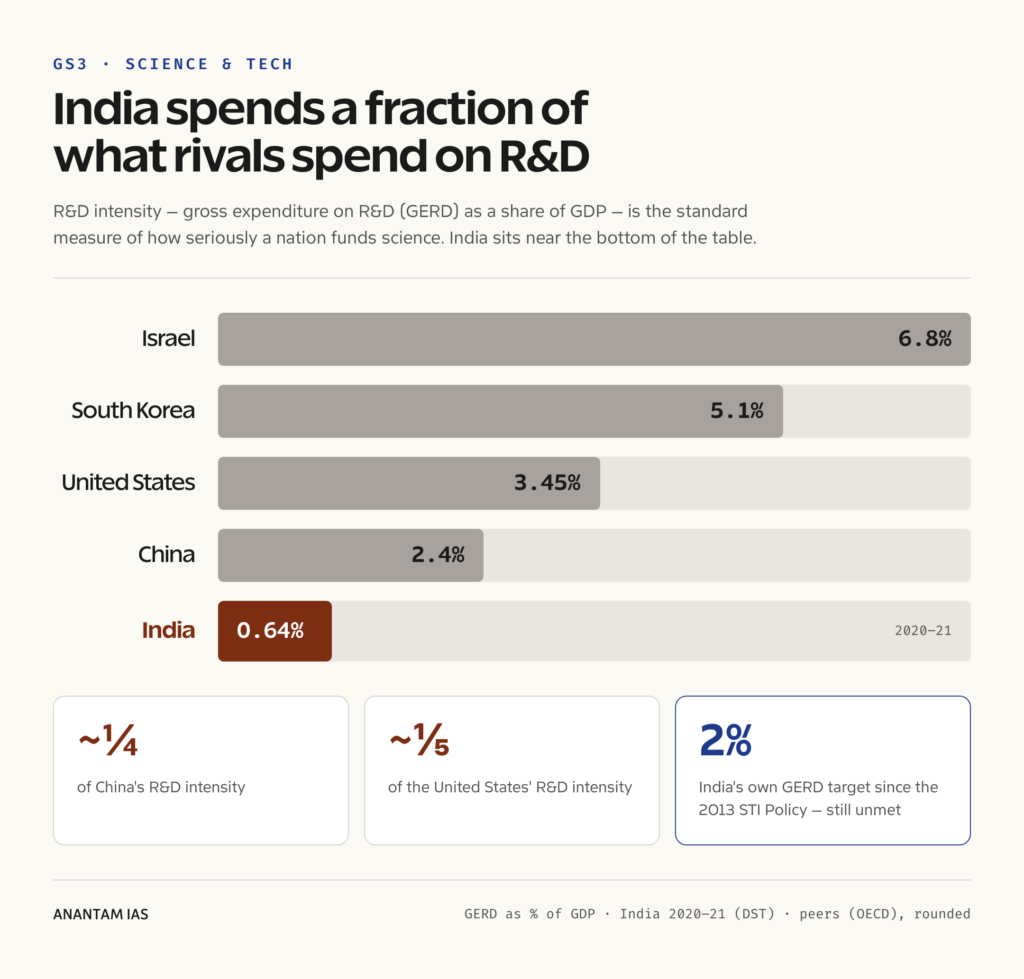
The single number that captures the input gap is GERD, Gross Expenditure on Research and Development, the total a country spends on R&D from every source, government and private, in a year. Divide it by the size of the economy and you get R&D intensity, GERD as a percentage of GDP, the standard yardstick for how seriously a nation funds science. India’s R&D intensity sits at roughly 0.64% of GDP (2020-21) by the Department of Science and Technology’s own count. That’s the headline weakness, and it has barely moved in years.
Two institutions now anchor the fix, so define them up front. The Anusandhan National Research Foundation (ANRF) is India’s new apex research-funding body, set up under an Act of 2023, designed to bankroll and steer research across universities and labs, and built to pull in private and philanthropic money rather than rely on the budget alone. And the financial muscle behind the private push is the RDI Scheme, the Research, Development and Innovation Scheme, which supplies what the field calls patient capital, money that’s willing to wait years, even decades, for a return and to tolerate the high failure rate that frontier science guarantees. That patience is exactly what venture funding chasing a three-year exit cannot provide.
So the frame is this. India has the talent and the output. What it has lacked is the money, the right kind of money, and the institutions to route it into hard science. The new architecture claims to supply all three. Whether it does is the test.
What the Data Says
The numbers are where you slow down, because they cut in two directions and a good answer carries both.
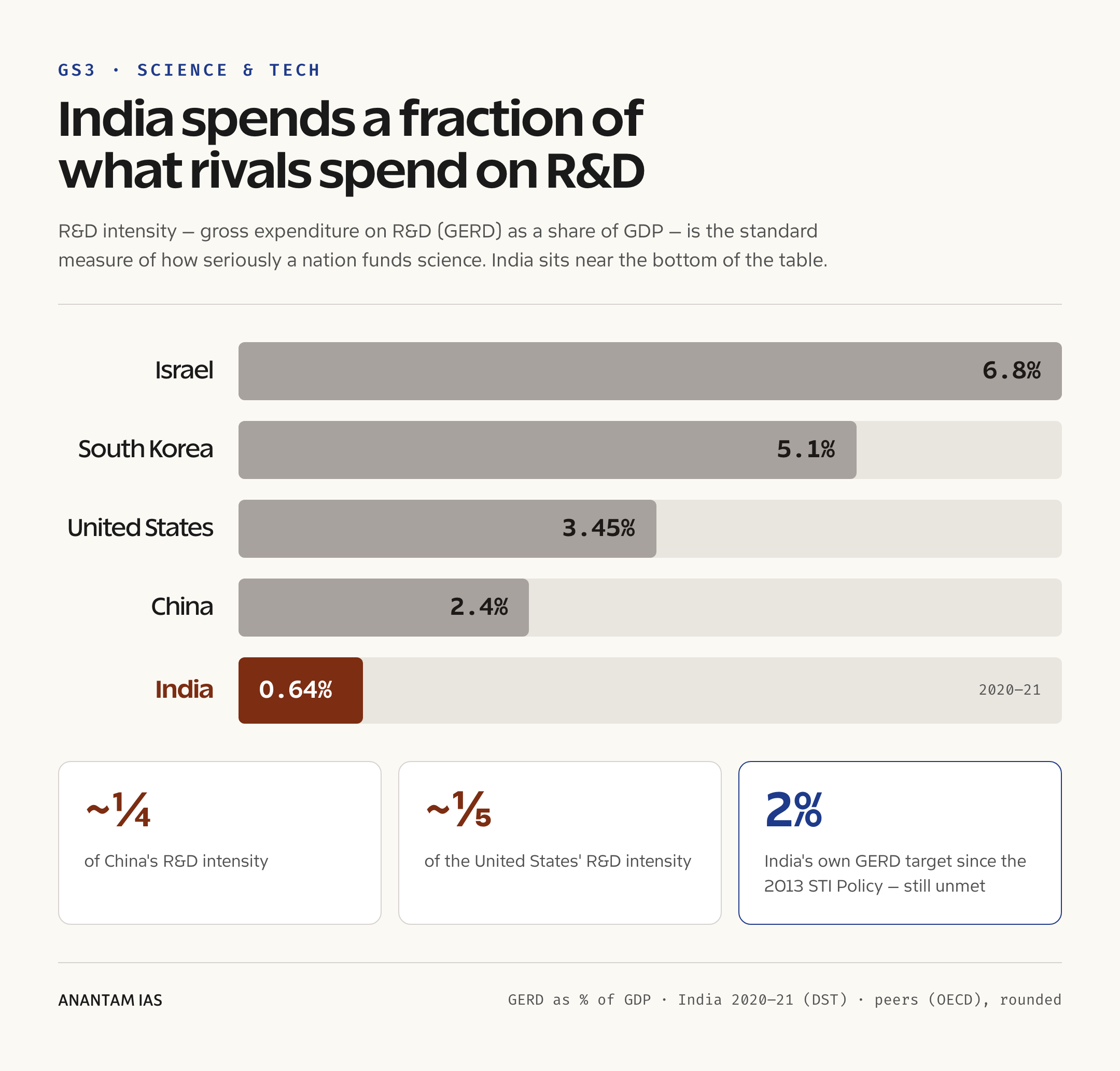
Start with the input gap, because it’s the foundation of the “laggard” case. India’s GERD is about 0.64% of GDP (2020-21) per DST/NSTMIS. Set that against the field: China around 2.4%, the United States about 3.45%, South Korea roughly 5.1%, and Israel near 6.8%. Read that again. India spends roughly a quarter of what China spends and about a fifth of what the US spends, as a share of income. The 2% target isn’t new either, the Science, Technology and Innovation Policy set it back in 2013, and India has never reached it. So this isn’t a fresh shortfall. It’s a structural habit.
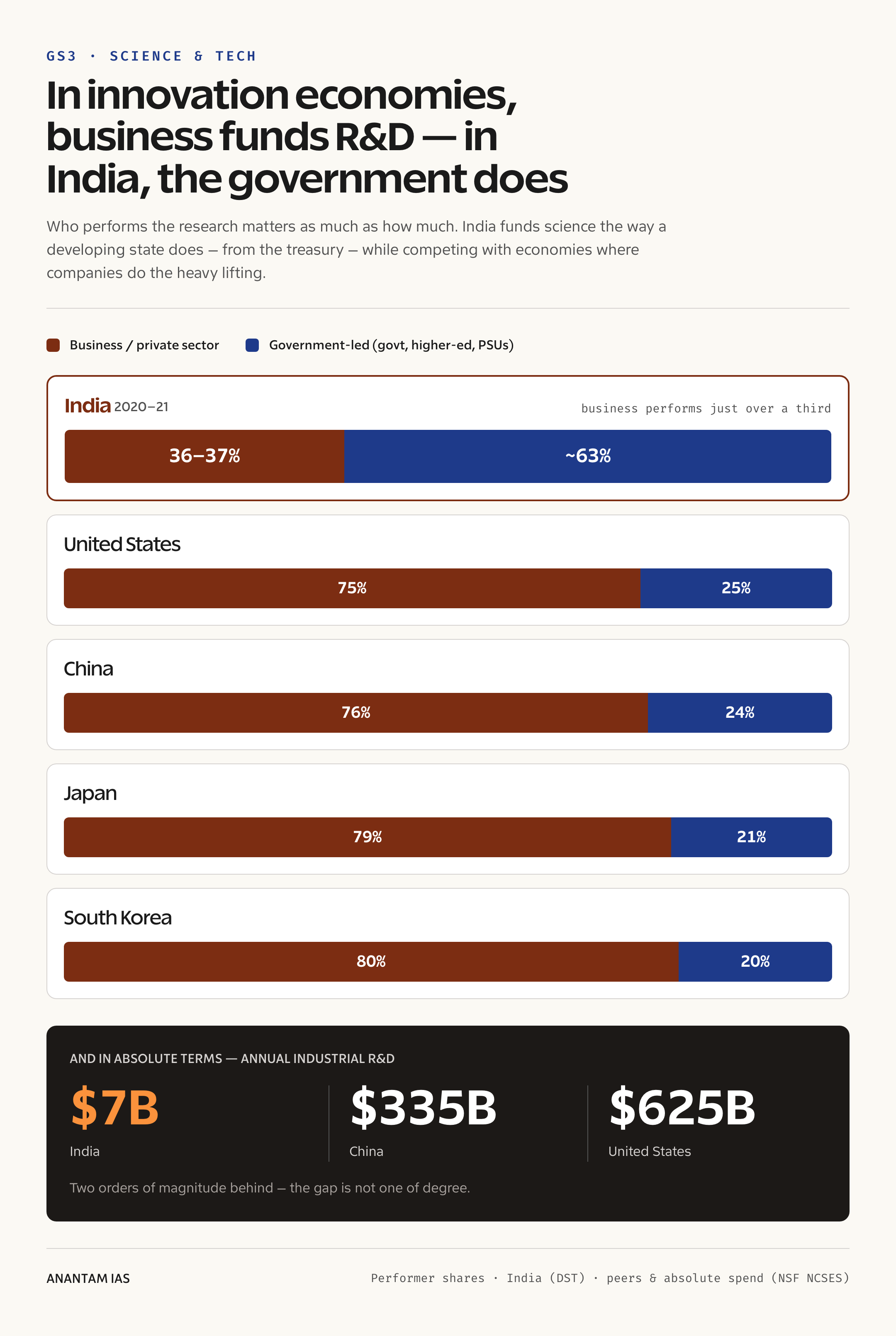
But the deeper problem isn’t the total. It’s who spends it. In India, private industry performs only about 36% to 37% of GERD, and the government carries roughly 56%. Flip to the innovation economies and the ratio inverts: business performs around 75% in the US, 76% in China, 79% in Japan, and 80% in South Korea. So India funds research the way a developing state does, from the treasury, while pretending to compete with economies where companies do the heavy lifting. And in absolute terms the gulf is brutal. India’s annual industrial R&D runs near USD 7 billion, against China’s USD 335 billion and the US’s USD 625 billion. That’s not a gap of degree. It’s two orders of magnitude.
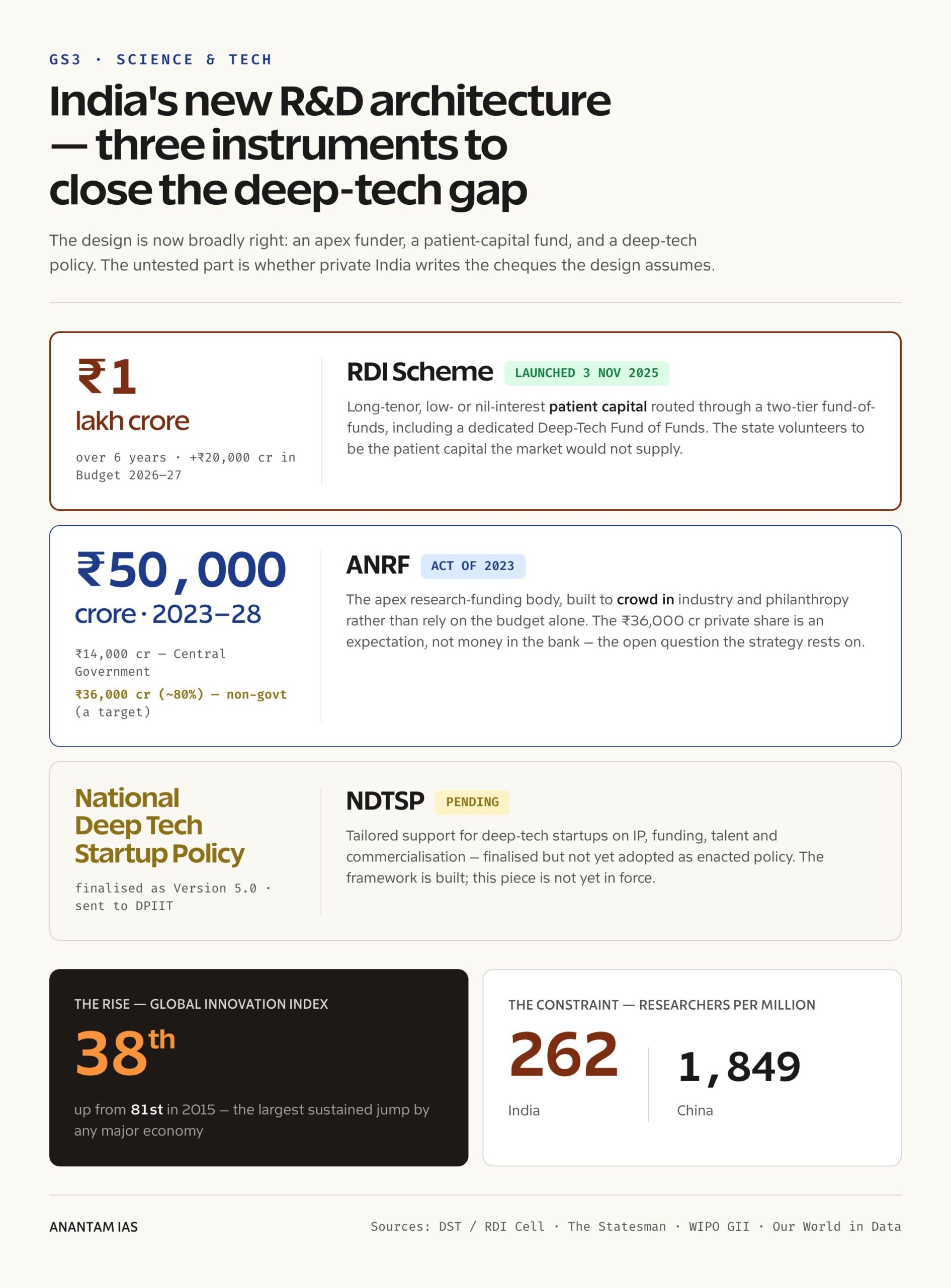
The thin research workforce tells the same story. India has about 262 researchers per million people (2020), up from 110 in 2000, so the trend is right. But China sits near 1,849 and the US near 4,825. So even before money, the headcount doing frontier science is small.
The Case For
Now the other direction, because the “laggard” word is only half the truth and a one-sided answer is a weak one. India has earned real ground, and the case that it can close the gap is genuinely strong.
The trajectory alone is hard to argue with. India ranked 81st on the Global Innovation Index in 2015 and stands 38th in 2025. The GII is the WIPO yardstick that scores economies on innovation inputs like institutions and skills, and outputs like patents and high-tech exports. A 43-place climb in a decade is the largest sustained jump by any major economy, and India is now first among lower-middle-income economies. So when the ecosystem matures, India converts talent into ranking. That’s not luck repeated ten years running.
The talent base is real and at scale. India produces roughly 300,000-plus scientific publications a year and around 40,000 PhDs, third in the world on both counts. And it runs the third-largest startup ecosystem globally with more than 100 unicorns. The raw material isn’t the constraint.
The demand base is a structural edge few rivals have. A billion-plus connected market, stitched together by India Stack, Aadhaar, and UPI, gives a homegrown deep-tech product a place to prove itself and scale before it ever looks abroad. That’s a runway most countries can only envy.
And the intent is shifting where it matters most, in patents. In 2024 India became the world’s sixth-largest patent filer with more than 63,000 applications, and the share filed by Indian residents rose from 28.1% in 2014 to 60.1% in 2024, the steepest such shift on the planet over the decade. So Indians aren’t just registering foreign inventions anymore. They’re inventing. Add the early money following the policy signal, deep-tech startup funding grew 78% in 2024 to about USD 1.6 billion, and the pieces of a real deep-tech base are visibly assembling.
The Case Against
Here’s what the optimism walks past. Outputs are rising on a foundation of inputs that’s still far too thin, and you can’t run a deep-tech economy on borrowed depth forever.
The underspend is chronic, not cyclical. At 0.64% of GDP, India has missed its own 2% target every single year since 2013. Other countries didn’t get to 3% or 5% by accident. They funded their way there over decades, and India hasn’t started that climb in earnest.
The private-sector reluctance is the structural heart of it. When business performs only about 36% to 37% of R&D and government carries the rest, you have an innovation economy running in reverse. Companies invest in research when they expect to own valuable, defensible technology. Too much of Indian industry has preferred to license, assemble, and serve, which is rational in the short run and ruinous in the long run.
The capital is the wrong shape. Deep-tech needs patient capital, money that waits a decade and survives a high failure rate. Indian venture funding has mostly chased asset-light, quick-return consumer-internet and SaaS bets, exactly the businesses that don’t need a fab or a wet lab. So the science that takes longest to pay off has had the least money willing to wait for it.
The university-to-market pipe is leaky. Higher education performs under 9% of GERD, and the translation from lab paper to product is thin. The patent picture carries the same caveat: filings are up and resident-led, but per-capita patenting still sits outside the global top 20, and converting academic IP into companies remains weak.
And the deep-tech slice itself is small. Of India’s 117,000-plus DPIIT-recognised startups, only about 10,000 are deep-tech, under one in ten. The headline “third-largest startup ecosystem” hides the fact that most of it is shallow. So the laggard label, painful as it is, is fair on inputs even as the rising label is fair on outputs.
The Deeper Structural Read
Step back from the league tables and the real fault line shows up. It isn’t that India is bad at innovation. It’s that India has optimised for the cheap kind and starved the expensive kind, and the new policy architecture is finally an honest admission of which kind it neglected.
The services success and the deep-tech failure are two faces of one choice. India’s IT-services boom rewarded human capital deployed against someone else’s intellectual property: world-class engineers writing code that others owned the platform for. That model needed almost no R&D, because the research was done abroad. It generated jobs, exports, and pride, and it quietly taught a generation of capital that you could win big without funding a single hard-science bet. So the very thing that made India a services superpower is the thing that left its deep-tech base hollow. The skill went into using frontier technology, not creating it.
Read the new instruments in that light and they make sense as a deliberate correction. The ANRF, set up under the Act of 2023, carries a five-year target of ₹50,000 crore for 2023-28, but the structure of that money is the real signal: only ₹14,000 crore comes from the Central Government, while ₹36,000 crore, about 80%, is meant to come from industry, philanthropy, and other non-government sources. ANRF’s whole design logic is to crowd in private money, to use public funds as bait that pulls in many times more from companies and foundations, rather than substitute for them. That’s the textbook fix for a private-underinvestment problem.
The RDI Scheme attacks the capital-shape problem head-on. It commits ₹1 lakh crore over six years of low or nil-interest, long-tenor loans, routed through a two-tier fund-of-funds and including a dedicated Deep-Tech Fund of Funds, with the ANRF Governing Board, chaired by the Prime Minister, setting direction and DST as the nodal department. The Cabinet cleared it on 1 July 2025, the PM launched it on 3 November 2025, and Budget 2026-27 topped the fund up with another ₹20,000 crore. In plain terms, the state is volunteering to be the patient capital the market wouldn’t supply, de-risking the early, lonely years of a deep-tech bet so private money will follow.
But here’s the part that should sober you. Both the headline private numbers are targets, not deposits in the bank. ANRF’s ₹36,000 crore from industry and philanthropy is an expectation, and whether that money actually arrives is the open question on which the entire strategy rests. The same caution applies to the still-pending National Deep Tech Startup Policy (NDTSP), finalised as Version 5.0 and sent to DPIIT for the Cabinet route, but not yet adopted as enacted policy. So the structural read is neither triumphant nor cynical. The architecture is now broadly right, which is real progress. The execution, getting private India to actually write the cheques the design assumes, is untested. That distance between a well-designed instrument and money that genuinely moves is where India’s deep-tech future will be decided.
What Should Be Done
So what does closing the gap actually require? Not a vague call for “more research,” but a sequence a finance secretary could cost out next quarter. Seven moves, each tied to the specific weakness it fixes.
- Put GERD on a credible glide-path toward 2% of GDP. The 2013 target has sat unmet for over a decade, so a real plan beats another aspiration. Treat the Science and Technology policy commitment as a budget line with annual milestones, not a slogan, because a number nobody is held to is a number that never moves.
- Crowd in private R&D, don’t crowd it out. The whole point of ANRF and the RDI Scheme is leverage, public money pulling in many times more from industry and philanthropy. Make the ₹36,000 crore non-government target real through co-funding rules, CSR-for-research channels, and tax design that rewards companies for owning technology rather than renting it.
- Build a genuine patient-capital stack. Operationalise the Deep-Tech Fund of Funds quickly, and anchor long-horizon domestic money, insurers and pension funds, as backers that can wait a decade. Patient capital is the single thing Indian venture funding has refused to supply, and it’s the thing deep-tech cannot live without.
- Fund university research and fix lab-to-market. Higher education performs under 9% of GERD, so direct block grants, shared core facilities, and proper technology-transfer offices into the education and human-capital system, with academia-industry joint centres that turn papers into products.
- Use public procurement as the first customer. Defence, space, health, and energy buyers can guarantee an early market for unproven deep-tech and bridge the “valley of death,” the brutal stretch where a working prototype has no revenue and no investor. A guaranteed first order de-risks more than any grant.
- Retain and attract the people. Finalise the NDTSP, scale research fellowships, pay researchers competitively, and run a serious reverse-brain-drain push to bring diaspora scientists home. At 262 researchers per million, the workforce is the binding constraint as much as the money.
- Fix IP commercialisation. Faster patent grants, lower filing costs for resident inventors, and real incentives to convert a patent into a company. Rising filings mean little if the inventions stay on a shelf.
Every one of these strengthens the base rather than the headline. A country that funds the hard science, owns the patents, and keeps its researchers is a country that gets to keep the value its talent creates instead of exporting it. That’s the entire point of closing the gap.
For Your Mains Answer
This is a clean GS3 topic with an economy spine running through it. It links science and technology, indigenisation, resource mobilisation, IPR, and investment models in one frame, which is exactly the kind of question UPSC likes.
GS paper mapping: GS3: Science and Technology (developments, indigenisation, new technology); Indian economy (resource mobilisation, growth); intellectual property rights; investment models; government budgeting.
Likely question frames:
- “India is a services superpower but a deep-tech laggard.” Critically examine the structural reasons, and assess whether recent institutional reforms can close the gap.
- Low R&D intensity, and not a shortage of talent, is the binding constraint on India’s innovation economy. Discuss with reference to GERD, private-sector R&D, and the ANRF/RDI architecture.
- Discuss how patient capital and university-industry linkages can transform India from an innovation user into an innovation creator.
Quotable data points:
- India’s GERD is about 0.64% of GDP (2020-21), against China ~2.4%, US ~3.45%, South Korea ~5.1%, Israel ~6.8%.
- Private industry performs only ~36-37% of India’s R&D; business performs 75-80% in the US, China, Japan, and Korea.
- India’s annual industrial R&D is ~USD 7 billion, versus China’s USD 335 billion and the US’s USD 625 billion.
- ANRF target: ₹50,000 crore (2023-28), of which ₹36,000 crore (~80%) is expected from non-government sources, a target, not realised funding.
- RDI Scheme: ₹1 lakh crore over six years of patient capital, launched by the PM on 3 November 2025; +₹20,000 crore in Budget 2026-27.
- India is 38th on the Global Innovation Index 2025 (from 81st in 2015), with the world’s 3rd-largest startup ecosystem and 100+ unicorns.
- Only ~10,000 of 117,000-plus recognised startups are deep-tech.
- India has ~262 researchers per million, against China ~1,849 and US ~4,825.
Keywords to use: GERD, R&D intensity, business-enterprise R&D, patient capital, fund-of-funds, valley of death, crowding-in, university-industry linkage, lab-to-market, resident patents, researcher density.
Syllabus linkages: Indigenisation of technology and developing new technology; mobilisation of resources for growth; intellectual property rights; investment models; effects of liberalisation; achievements of Indians in science and technology; government budgeting.
Balanced conclusion line: India already proves it can innovate; the unfinished task is to fund the hard, slow science it has long avoided, because a services superpower that doesn’t own the technology beneath its services is a tenant in its own economy, not its landlord.
How to Build the Answer
Open with the contradiction, not a definition. The whole topic lives in one sentence: India is a services superpower and a deep-tech laggard at the same time. Lead with that paradox and the examiner sees you’ve grasped both halves. A clean definition of deep-tech and GERD can follow in the next line. The opening should frame the tension, not recite a glossary.
Bring data in early, but ration it. A strong first body paragraph can carry three numbers: GERD at 0.64% of GDP, private share at ~36%, and the 38th GII rank. Then say what each one proves. The figure is the anchor; the “this means” is where the mark sits.
The second body paragraph should steelman the optimistic case before you criticise. The GII jump, the resident-patent surge, and the unicorn count are real, so concede them with respect before turning to the underspend. That’s how an answer reads balanced rather than vague.
Group the way forward; never scatter it. Cluster the reforms, raise GERD, crowd in private money, build patient capital, fund universities, use procurement, retain talent, fix IP, and tag each with an actor. Use the topic’s own vocabulary, GERD, patient capital, crowding-in, valley of death, so the answer sounds like policy analysis, not a news recap.
Close on the syllabus link, indigenisation and resource mobilisation, with a line that shows judgment. The reliable pattern is “the constraint is not X but Y,” which lets you argue the bottleneck is patient capital and private commitment, not talent.
Common Mistakes to Avoid
- Don’t write only the good-news story. The GII rank and the unicorns are seductive, but an answer that ignores 0.64% GERD has missed the point of the question.
- Don’t present targets as achievements. The ₹36,000 crore private share and the ₹1 lakh crore RDI corpus are commitments, not money already spent; say so.
- Don’t confuse innovation outputs with R&D inputs. Patents and rankings are outputs; GERD and researcher density are inputs. The whole topic is the mismatch between them.
- Don’t go one-sided. This topic has a genuine case on both ends. Hold both truths before your final stance.
- Don’t end on a slogan. Close on an implementable principle, owning the technology beneath the services, not a flourish.
A Compact Answer Spine
- Introduction: Open with the services-superpower-versus-deep-tech-laggard contradiction in one sentence; define deep-tech and GERD in the next.
- Evidence: Use two or three attributed data points, GERD 0.64%, private share ~36%, GII 38th, and tie each to an implication.
- Arguments: The case that India can close the gap, then the case that the gap is real. Keep both fair.
- Structural diagnosis: Services success and deep-tech failure are two faces of one choice; the constraint is patient capital and private commitment, not talent.
- Way forward: Five to seven grouped reforms, each with a clear actor, government, ANRF, industry, universities.
- Conclusion: Adapt the balanced conclusion line to the exact question wording.
Diagram or Flowchart Idea
For a 15-marker, draw one causal chain, not a decorative cloud. The cleanest format: services-led growth on imported IP → low private R&D appetite → GERD stuck at 0.64% → thin deep-tech base → new instruments (ANRF crowding-in, RDI patient capital, NDTSP) → execution test. The examiner reads that logic in five seconds.
For a 10-marker, skip the diagram unless it’s genuinely simple. A two-column table, “Rising (GII 38th, resident patents, unicorns)” against “Behind (GERD 0.64%, private share 36%, researcher density),” does more work and is faster to mark under time pressure.
Ethics and Governance Angle
Even a GS3 economy answer earns from one line on stewardship. Public R&D money is a bet placed today for a payoff that may arrive after the minister who approved it has left office, so the ethical demand is intergenerational, fund the slow science your successors will harvest, and resist the pull of quick, visible wins. The valley of death is where short political horizons quietly kill long scientific ones.
Then convert that into design. Don’t merely say “support deep-tech.” Say how the design protects long-horizon bets from short-term pressure: patient capital with decade-long tenors, independent fund managers insulated from annual scorecards, and procurement guarantees that survive a change of government. That’s the move from moral language to administrative maturity.
A sentence pattern that travels across topics: “The aim is legitimate, but its success depends on patience, leverage, and follow-through.” It backs the state’s objective without handing it a blank cheque, which is exactly what a balance question rewards.
How to Use Data Without Sounding Mechanical
Use fewer numbers than you know. Three well-explained figures beat ten scattered ones. Lead with one big contrast (0.64% of GDP against China’s ~2.4%), use a second for structure (private share ~36% versus 75-80% abroad), and use a third to mark the rise (GII 38th from 81st). One intensity gap, one ownership gap, one trajectory point is usually enough.
Never leave a statistic standing alone. Follow it with “this means” or “the implication is.” That tiny move turns a fact sheet into analysis. In Mains, facts are raw material; judgment is the finished answer.
Finish by asking one question: can a tired examiner follow this in a single pass? If it needs rereading, simplify. Short introduction, data early, two sides marked cleanly, grouped way forward. For UPSC, clarity is how depth becomes visible.
One last sweep: cut any line that sounds impressive but does no work, and replace it with a fact, a cause, a consequence, or a reform. That habit separates an answer that feels informed from one that feels memorised. Write for marks, not for noise. Always be specific.
FAQ
What is GERD and why does India’s 0.64% matter?
GERD is Gross Expenditure on Research and Development, the total a country spends on R&D from all sources in a year, and GERD as a share of GDP, called R&D intensity, is the standard measure of how seriously a nation funds science. India’s ~0.64% of GDP (2020-21) is roughly a quarter of China’s ~2.4% and a fifth of the US’s ~3.45%, and it sits far below India’s own 2% target set in the 2013 STI Policy. Low intensity means a thin base of frontier research, which is the input gap underneath the deep-tech gap.
Why is India called a deep-tech laggard if it ranks 38th on innovation?
Because rankings measure outputs and GERD measures inputs, and India’s are mismatched. India is genuinely rising on outputs, 38th on the Global Innovation Index in 2025 (from 81st in 2015), the third-largest startup ecosystem, 100-plus unicorns, and a sharp rise in resident patents. But the inputs are thin: 0.64% GERD, private industry performing only ~36-37% of R&D, and only about 10,000 of 117,000-plus recognised startups in deep-tech. So the “laggard” label fits the foundation even as the “rising” label fits the headline.
What are ANRF and the RDI Scheme, and how do they differ?
The Anusandhan National Research Foundation (ANRF), set up under an Act of 2023, is the apex research-funding and steering body, with a ₹50,000 crore target for 2023-28 designed to pull in private and philanthropic money rather than rely on the budget alone. The RDI Scheme, launched by the Prime Minister on 3 November 2025, is the ₹1 lakh crore financing instrument that supplies long-tenor, low or nil-interest patient capital, including a Deep-Tech Fund of Funds, with strategic direction set by the ANRF Governing Board. ANRF is the institution; the RDI Scheme is the money it routes into private deep-tech.
Is the private-sector R&D money actually arriving?
Not yet confirmed, and that’s the open question. ANRF’s ₹36,000 crore expected from industry and philanthropy is a target, not realised funding, and the same applies to much of the RDI corpus, which is a six-year commitment. The design is sound, public money used to crowd in private money, but whether companies and foundations actually write the cheques the architecture assumes is the execution test on which India’s deep-tech future depends. The National Deep Tech Startup Policy is also still a draft, not enacted policy, so the framework is largely built but unproven in practice.
Tell Google you want more of this.
Add Anantam IAS as a preferred sourceOne tap, and this site shows up more often in your own Top Stories, AI Overviews and AI Mode. Remove it any time.