China’s ICBM Test: US Concern and the Strategic Stability Question
Why in News?
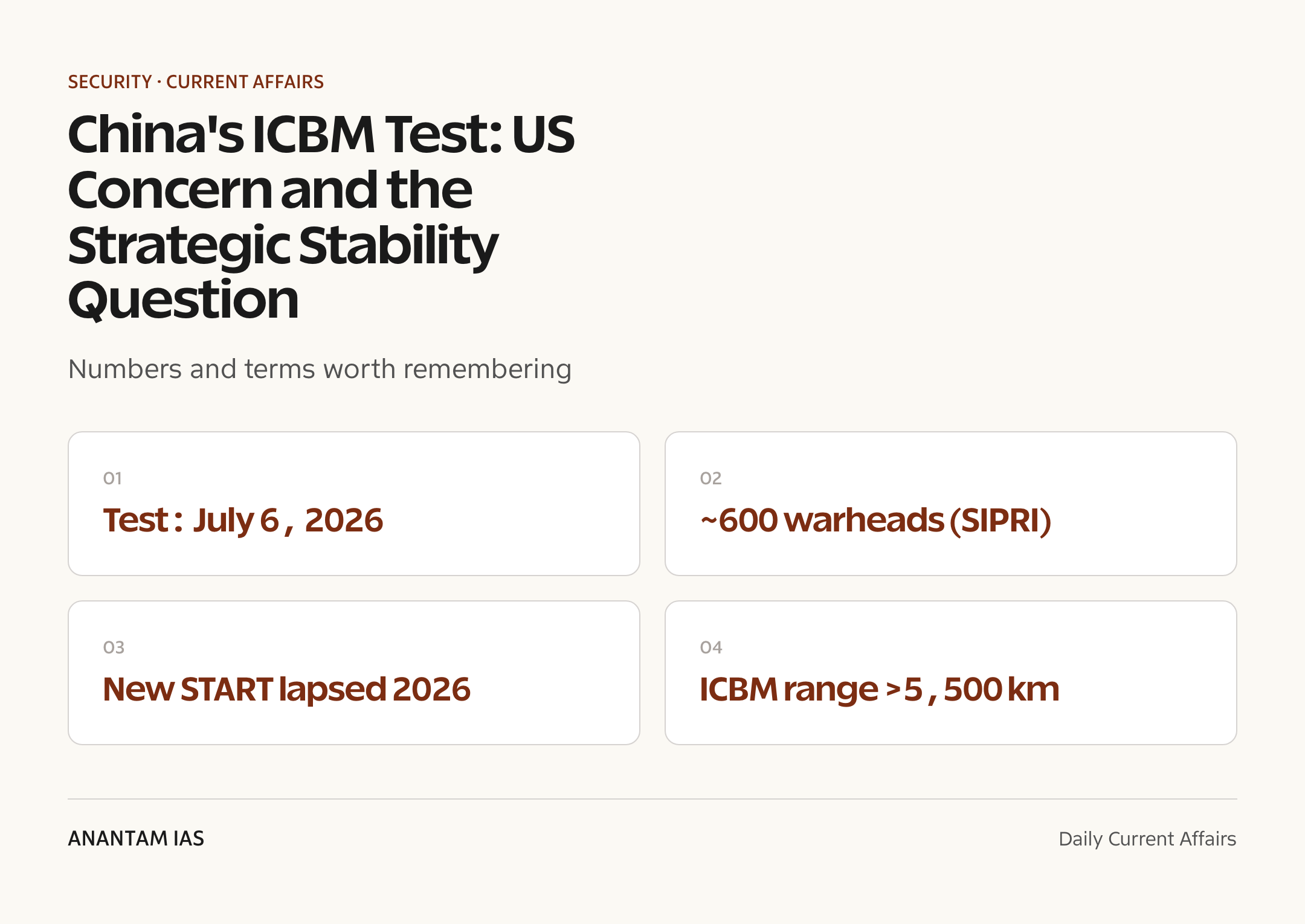
China on July 6, 2026 test-fired a long-range strategic missile carrying a dummy warhead from one of its nuclear-powered submarines in the Pacific Ocean. The Hindu, carrying an AP report, said the US State Department monitored the launch of an unarmed intercontinental-range ballistic missile that landed in the southern Pacific.
Washington voiced concern over Beijing’s “rapid and opaque nuclear weapons buildup“, urged “meaningful arms control discussions”, and pressed for a regularised launch-notification arrangement for intercontinental-range missile and space launches, consistent with commitments made by the other P5 members of the UN Security Council.
- Test date Monday, July 6, 2026: a dummy warhead, fired from a nuclear-powered submarine in the Pacific Ocean.
- Tommy Pigott, US State Department spokesperson, said the US “monitored” the launch of an unarmed intercontinental-range ballistic missile that “landed in the southern Pacific Ocean”.
- He called Beijing’s buildup “of great concern to the region and the world” and said the US “remains steadfast” in its defence commitments to allies and partners.
- Washington’s ask: a “regularized notification arrangement” for all ICBM and space launches, in line with commitments made by “all other P5 members”.
- China’s PLA Navy called the launch routine annual training, said “relevant countries” were notified in advance and that it targeted no one — without identifying the missile or its range.
The development matters in the context of:
- The exchange lands in an arms-control vacuum: New START, the last treaty capping US and Russian strategic arsenals, expired on February 5, 2026 without a successor.
- It is China’s second publicly confirmed intercontinental-range Pacific test in under two years, after the September 25, 2024 ICBM test — the first announced since 1980.
- For India, China’s expanding arsenal and the absence of India–China nuclear confidence-building measures form the backdrop to its own credible minimum deterrence.
UPSC Relevance
Prelims Relevance
- ICBM — a ballistic missile with range above 5,500 km; fired from a nuclear-powered submarine (SSBN) it is an SLBM.
- P5 — the five permanent UNSC members, also the five recognised nuclear-weapon states under the NPT (1968).
- Hague Code of Conduct (HCoC), 2002 — politically binding pre-launch notification regime; India subscribed in 2016; China is the only P5 state outside it.
- New START — 2010 US–Russia treaty capping each side at 1,550 deployed strategic warheads; expired February 5, 2026.
- SIPRI Yearbook 2025 — China at about 600 warheads, the fastest-growing arsenal, adding roughly 100 a year since 2023.
- India–Pakistan CBMs — the 2005 pre-notification agreement on missile flight tests; the 1988 Non-Attack Agreement (lists exchanged every January 1).
- Bilateral launch-notification pacts — US–Russia (1988), China–Russia (2009); none exists between the US and China, or India and China.
- India’s nuclear doctrine (2003) — credible minimum deterrence, No First Use, massive retaliation, Nuclear Command Authority.
- India’s nuclear triad — completed with INS Arihant’s first deterrence patrol in November 2018.
Mains Relevance
GS Paper 2
- US–China competition and extended deterrence: alliance reassurance in the Indo-Pacific order India operates in.
- Erosion of the arms-control architecture — INF gone (2019), New START lapsed (2026) — and the case for bringing China into P5-wide frameworks.
- Launch notifications and CBMs as low-cost risk reduction — lessons from the India–Pakistan 2005 agreement for India–China ties.
GS Paper 3
- Credible minimum deterrence under stress: what China’s buildup means for the survivability of India’s second-strike capability.
- India’s two-front nuclear environment and the maturation of the SSBN leg of the triad.
Essay
- “Trust, but verify”: transparency, not weaponry, is the true currency of strategic stability.
- Deterrence keeps the peace only as long as rivals keep talking — the paradox of nuclear order.
Background and Context
What China Tested: The Sea Leg of Deterrence
A submarine-launched intercontinental-range test is less about the missile and more about the message — a survivable second strike.
- The launch came from an SSBN; sea-based missiles are the most survivable leg of a nuclear triad — submarines are hard to find and destroy in a first strike.
- A secure second-strike capability is the bedrock of deterrence — if a state can absorb an attack and still retaliate, striking first gains nothing: strategic stability.
- The PLA Navy framed the launch as routine annual training, said “relevant countries” were notified in advance, and declined to identify the missile or its range — the opacity Washington highlighted.
- Precedent: the September 25, 2024 ICBM test into the Pacific was China’s first announced since 1980; July 2026 extends visible testing to the sea leg. Basics: the cruise missile vs ballistic missile explainer.
How Washington Responded: Assurance Plus Arms Control
The US reply had two audiences — allies who need reassurance, and Beijing, which it wants at the table.
- Reassurance first: the US “remains steadfast” in defence commitments — extended deterrence signalling to treaty allies such as Japan, South Korea and Australia.
- Pressure second: spokesperson Tommy Pigott said that while the US works to prevent nuclear proliferation, “China is doing the opposite”.
- The concrete ask: “meaningful arms control discussions” plus a “regularized notification arrangement” for all intercontinental-range missile and space launches.
- The benchmark of “all other P5 members”: the US, Russia, UK and France subscribe to the Hague Code of Conduct; Washington and Moscow have also exchanged notifications bilaterally since 1988.
- Dialogue is thin: a rare US–China arms-control consultation in November 2023 ended with Beijing suspending talks in July 2024 over US arms sales to Taiwan.
China's Arsenal: The Numbers Behind the Concern
Independent estimates back the US description of a fast-growing force, even as China professes restraint.
- The SIPRI Yearbook 2025 put China’s stockpile at about 600 warheads — the world’s fastest-growing arsenal, up roughly 100 a year since 2023.
- The US Department of Defense projects over 1,000 operational warheads by 2030, supported by new silo fields in China’s western deserts and a growing SSBN fleet.
- China trails the two superpowers — Russia and the US hold about 90% of all warheads — but is the only P5 state expanding at this pace.
- Beijing’s declared posture is restraint — an unconditional No First Use (NFU) pledge since October 1964 and a “lean and effective” deterrent.
- The credibility gap: China publishes no warhead numbers, joins no data exchanges and accepts no treaty caps — opacity, not size alone, anchors the US complaint.
The Arms-Control Architecture: What Is Left Standing
Five decades of treaty scaffolding has thinned to almost nothing, which raises the stakes of every new test.
- NPT (1968) — the cornerstone regime recognising five nuclear-weapon states and committing them to disarmament negotiations under Article VI; see the UN Office for Disarmament Affairs NPT page. India is not a party.
- INF Treaty — the US–Russia ban on intermediate-range land-based missiles collapsed in 2019.
- New START — the last US–Russia cap (1,550 deployed warheads each) expired on February 5, 2026, leaving the two largest arsenals unbound for the first time in over five decades.
- CTBT — never entered into force (China has signed but not ratified; India has not signed); a Fissile Material Cut-off Treaty (FMCT) stays stalled in the Conference on Disarmament.
- The P5 Joint Statement of January 3, 2022 — “a nuclear war cannot be won and must never be fought” — remains the rare common ground, and the political hook for the US notification proposal.
Launch Notifications: Small Measure, Big Stakes
Pre-launch notification is the cheapest insurance in the nuclear world — it stops a test being mistaken for an attack.
- Early-warning radars cannot easily tell a test from a strike; notification buys decision time and prevents escalation from misinterpretation.
- Hague Code of Conduct (HCoC), 2002 — over 140 states give pre-launch notifications of missile and space launches; it is politically, not legally, binding.
- India subscribed to the HCoC in June 2016, the year it also joined the MTCR; China is the only P5 member outside the Code.
- Bilateral pacts fill gaps: US–Russia (1988) and China–Russia (2009) exchange launch notifications — but no US–China arrangement exists.
- South Asia’s example: the India–Pakistan pre-notification agreement (2005) has survived every crisis, with the 1988 Non-Attack Agreement and its January 1 lists.
- The conspicuous gap: India and China have no nuclear or missile CBM at all — no pre-notification pact, no dedicated nuclear hotline.
The India Angle: Deterrence in a Two-Front Nuclear Environment
India reads China’s testing through the lens of its own doctrine of restraint and a hard two-front reality.
- India’s nuclear doctrine (January 2003) rests on credible minimum deterrence, No First Use, massive retaliation, and civilian control through the Nuclear Command Authority chaired by the Prime Minister.
- India completed its triad when INS Arihant finished its first deterrence patrol in November 2018; INS Arighaat followed in 2024 — see India’s nuclear triad and the submarine fleet of India.
- On land, Agni-V (range above 5,000 km) covers all of China, and Mission Divyastra (March 2024) tested MIRV technology — detailed in the Agni missile series explainer.
- The asymmetry is stark: SIPRI 2025 estimates India at about 180 warheads and Pakistan at about 170, against China’s ~600 and rising — India’s “minimum” must stay credible without triggering an arms race.
- China’s growing sea-based deterrent also deepens the anti-submarine-warfare challenge for India and its Quad partners; India’s wider positioning is mapped in India and the US–China–Russia triangle.
Way Forward
Rebuild the Arms-Control Conversation
- A P5-wide launch-notification arrangement is the lowest-hanging fruit — no cuts, only transparency, on the HCoC template four P5 peers follow.
- Resume the US–China strategic-stability dialogue, insulating risk reduction from disputes such as Taiwan arms sales.
- Open framework talks on a post-New START order that reflects a three-player nuclear balance.
Risk Reduction in Asia
- India and China should negotiate a missile pre-notification pact and dedicated hotline, mirroring the India–Pakistan 2005 model.
- Push HCoC universalisation through UN forums so pre-launch notification becomes a global norm.
- Keep conventional and nuclear signalling distinct in crises — ambiguity between the two invites inadvertent escalation.
India's Own Posture
- Consolidate a survivable second-strike — longer-range SLBMs, more SSBN patrols, hardened command and control — not warhead numbers.
- Invest in space-based early warning and maritime domain awareness to verify tests and deployments independently.
- Stay active in the Conference on Disarmament and keep championing the FMCT — a fissile-material cap bites hardest on the fastest-growing arsenal.
Conclusion
On its own terms, China’s July 6 test was routine — a dummy warhead, advance word to “relevant countries”, a training-cycle framing. What made it news is the world it landed in: no US–Russia treaty caps, no US–China dialogue, a fast-growing arsenal whose size Beijing won’t discuss. In that vacuum, even routine tests read as signals.
The US response asks for very little — not cuts, just talks and notifications. That even this is contested shows how far strategic trust among the P5 has fallen.
For India, the lesson is double-edged: keep the deterrent credible and survivable, and keep arguing — with the Pakistan-facing CBMs as proof — that transparency between nuclear neighbours is the cheapest form of security.
UPSC Practice Questions
Prelims MCQ 1
With reference to the Hague Code of Conduct against Ballistic Missile Proliferation (HCoC), consider the following statements:
- It is a legally binding treaty negotiated under the United Nations.
- China is not a subscribing state to the HCoC.
- India subscribed to the HCoC in 2016.
How many of the above statements are correct?
(a) Only one (b) Only two (c) All three (d) None
Answer: (b) Only two
Explanation:
The HCoC (2002) is politically binding, not a treaty — statement 1 is wrong. China is the only P5 state outside it, and India subscribed in June 2016 — statements 2 and 3 are correct.
Prelims MCQ 2
The New START treaty, which expired in February 2026, limited the deployed strategic nuclear arsenals of which of the following pairs of countries?
(a) The United States and China (b) The United States and Russia (c) Russia and China (d) The United States, Russia and China
Answer: (b) The United States and Russia
Explanation:
New START (2010) capped the US and Russia at 1,550 deployed strategic warheads each; it expired on February 5, 2026. China has never been party to any warhead-limiting treaty.
UPSC Mains Questions
- China’s rapid and opaque nuclear expansion is altering Asia’s deterrence calculus. Examine its implications for India’s credible minimum deterrence and the survivability of its second-strike capability. (250 words)
- With New START’s expiry in 2026, the global arms-control architecture has thinned dramatically. Can transparency measures such as launch-notification arrangements substitute for binding treaties in preserving strategic stability? Discuss. (250 words)
- India and Pakistan sustain missile pre-notification and non-attack agreements through crises, yet India and China have no nuclear CBMs. Analyse the case for, and obstacles to, India–China nuclear confidence-building. (250 words)
Source: The Hindu (AP report).
Frequently Asked Questions
What did China test on July 6, 2026?
China test-fired a long-range strategic missile with a dummy warhead from a nuclear-powered submarine in the Pacific Ocean. The US State Department said it monitored the launch of an unarmed intercontinental-range ballistic missile that landed in the southern Pacific. Beijing called it routine annual PLA Navy training, notified in advance to relevant countries.
Why did the United States object to the test?
Washington called Beijing’s nuclear buildup rapid and opaque, and of great concern to the region. It urged China to join meaningful arms-control talks and adopt a regularised notification arrangement for ICBM and space launches, matching commitments by the other P5 members, while reaffirming US defence commitments to allies.
What counts as an intercontinental-range ballistic missile?
By arms-control convention, an ICBM is a ballistic missile with a range above 5,500 km, able to cross continents on a high arcing trajectory. When fired from a nuclear-powered submarine it is called an SLBM, forming the most survivable, second-strike leg of a nuclear triad.
What is the Hague Code of Conduct?
The HCoC (2002) is a politically binding transparency regime with over 140 subscribing states. Members give pre-launch notifications of ballistic-missile and space launches and annual declarations. India subscribed in June 2016. China is the only P5 member that has stayed outside the Code.
What happened to the New START treaty?
New START (2010) capped the US and Russia at 1,550 deployed strategic warheads each. It expired on February 5, 2026 without a successor, leaving the world’s two largest nuclear arsenals without any legally binding limit for the first time in over five decades.
How does China’s test matter for India?
China’s roughly 600-warhead and growing arsenal, per SIPRI 2025, deepens India’s two-front nuclear environment. India relies on credible minimum deterrence, No First Use and a triad anchored by INS Arihant and INS Arighaat. The absence of any India-China nuclear CBM makes transparency diplomacy directly relevant to Indian security.