

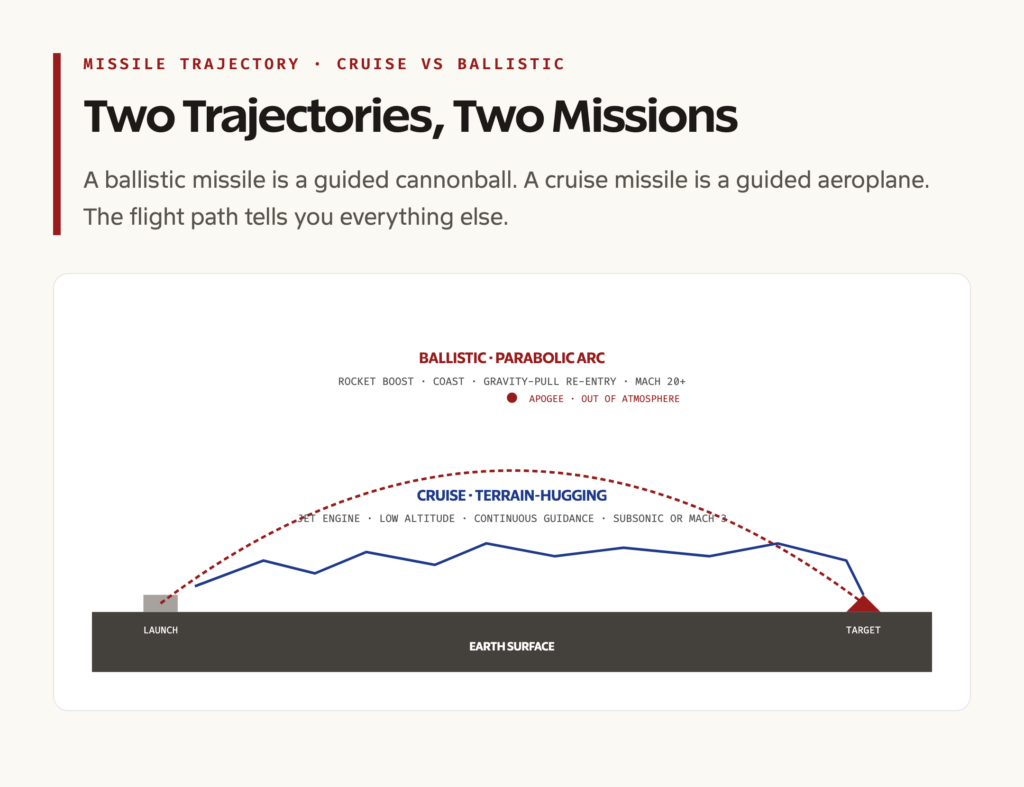
A missile is a guided weapon that delivers a payload from one point to another at a distance. Unguided rockets are not missiles. Artillery shells are not missiles. The defining property is the guidance system that corrects the flight path during one or more phases of the trajectory. The two great families of missiles are the ballistic missile and the cruise missile. They share the word “missile” and they share the broad mission of striking a target at long range. They are otherwise as different as a cannonball and an aeroplane.
A ballistic missile is a guided cannonball. It is hurled into the upper atmosphere or beyond, follows a parabolic arc shaped almost entirely by gravity, and falls back to its target at extreme speed. A cruise missile is a guided aeroplane. It flies low over the ground, follows the contours of the land, takes turns to evade defences, and arrives at the target at much slower speed but with much higher precision. The difference flows from physics. Once you decide whether your weapon will fly or fall, every other choice follows.
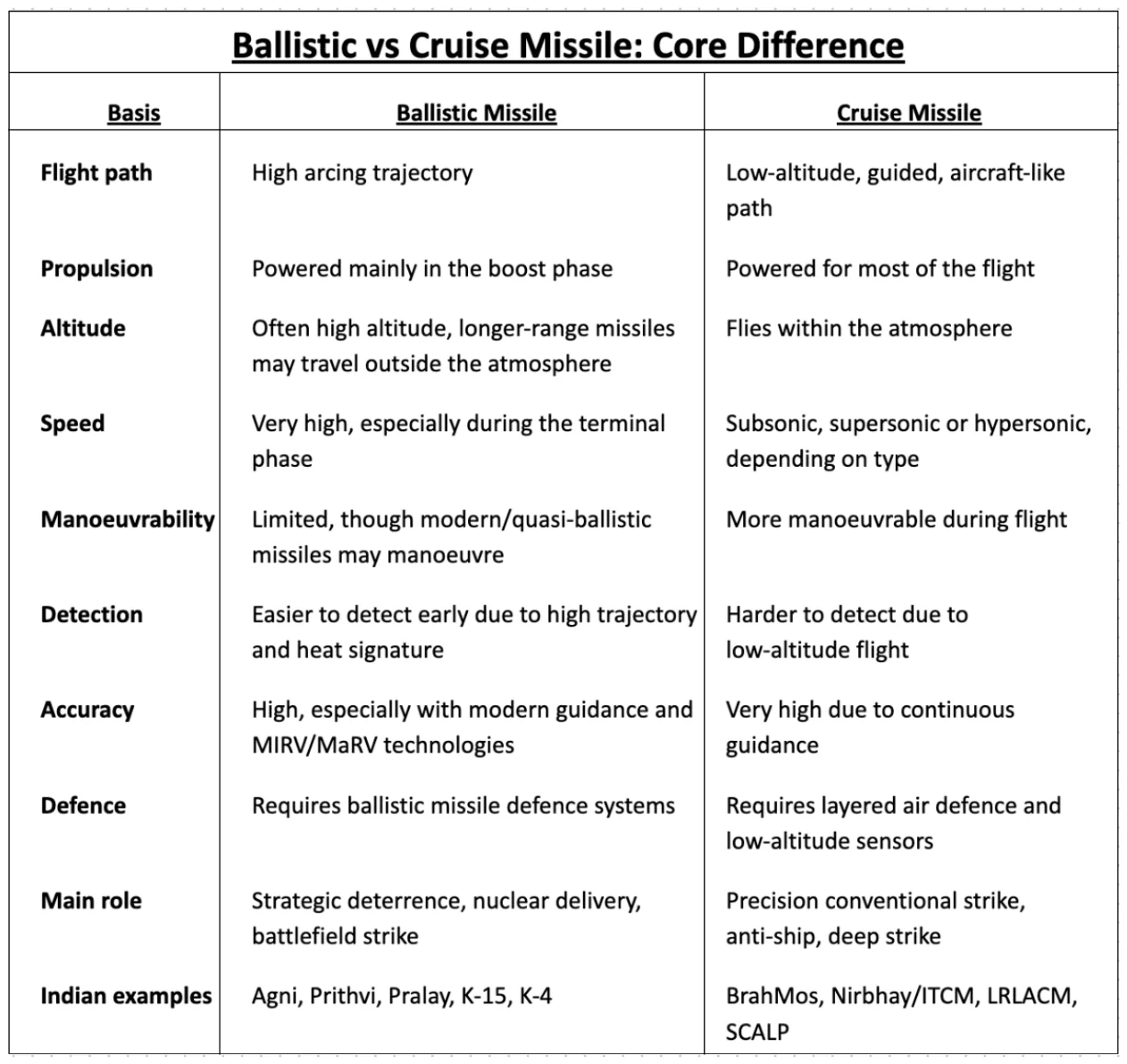
For UPSC GS-III, the topic spans defence technology, strategic posture, and the indigenous defence industry. The Indian missile portfolio includes both families and is one of the most diverse outside the United States, Russia, and China. This article walks through every defining contrast and maps it to the BrahMos, Nirbhay, Prithvi, Agni, and K-series weapons. For wider context see the defence budget, internal security, and SSN versus SSBN discussions.
Trajectory: The First and Largest Difference
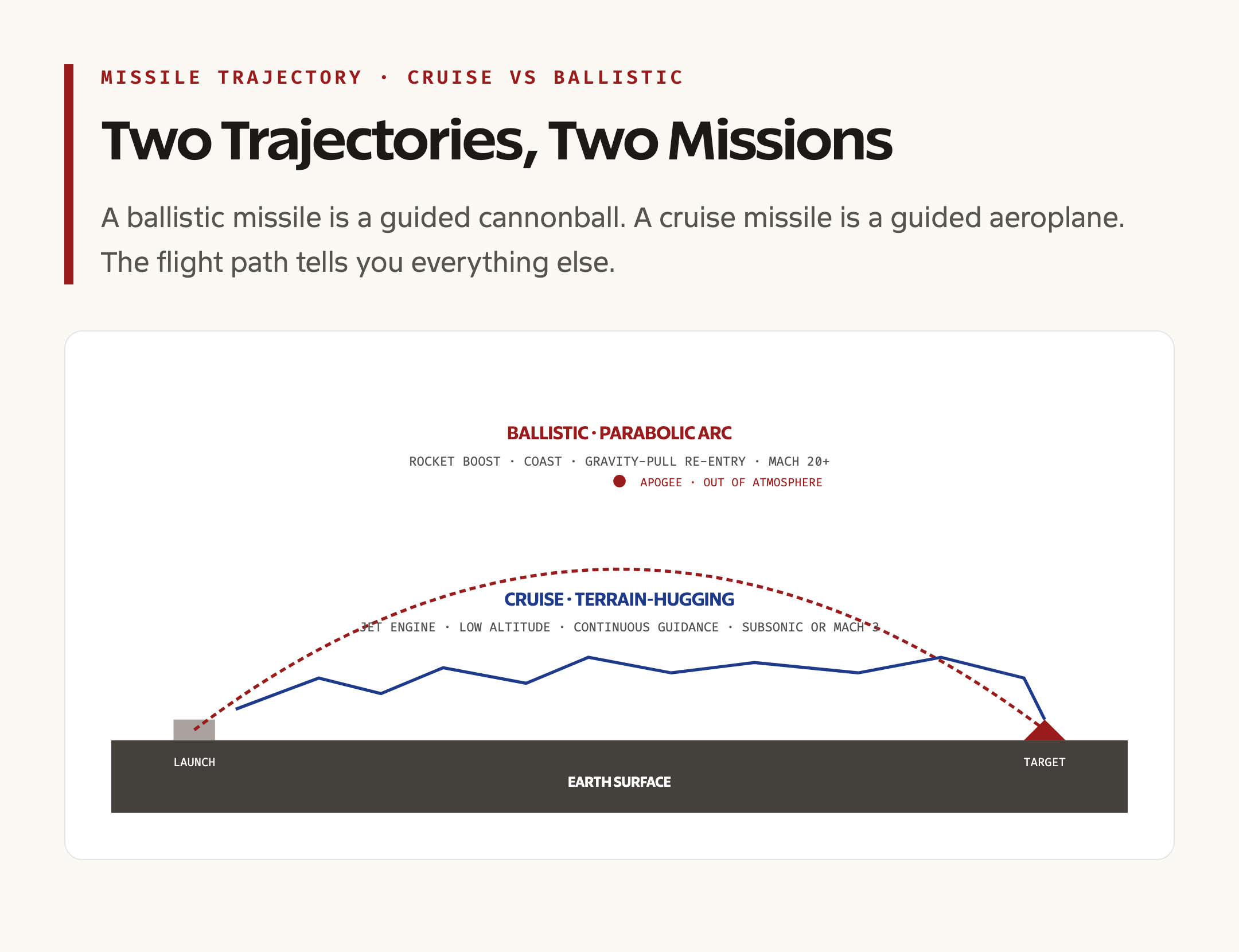
A ballistic missile follows a parabolic trajectory. The boost phase, lasting a few minutes, accelerates the missile through the atmosphere using a rocket engine. After the rocket cuts off, the missile coasts on a free-fall trajectory through space or the upper atmosphere. The terminal phase begins when the warhead re-enters the lower atmosphere and falls onto the target under the pull of gravity. The missile spends most of its flight either above or just below the boundary of the atmosphere, and the trajectory looks like a tall arc on a globe.
A cruise missile follows a flat, near-horizontal trajectory. After launch it climbs to its cruise altitude, which is typically only a few hundred metres above the surface. From there it flies straight to the target, navigating around obstacles and over terrain. The flight does not enter the upper atmosphere. The trajectory looks like a slightly wavy line on a globe, much like an aircraft route.
The two trajectories produce two completely different flight times. A ballistic missile delivers its warhead in tens of minutes. A cruise missile takes hours for the same range. A ballistic missile travels much faster because gravity has done most of the work in the terminal phase. A cruise missile travels much more slowly because it is fighting drag against the lower atmosphere all the way.
Engine: Rocket vs Jet
A ballistic missile is powered by a rocket engine. The rocket carries both fuel and an oxidiser, because there is no atmospheric oxygen to react with the fuel at high altitude. The engine fires only during the boost phase, which lasts a few minutes. After burnout, the missile coasts. Solid-propellant rockets are common in modern intermediate and intercontinental ballistic missiles because they can be stored loaded and ready to launch. Liquid-propellant rockets give better specific impulse but require fuelling before launch.
A cruise missile is powered by a jet engine. The engine breathes air from the atmosphere and burns it with onboard fuel, the same as a passenger aircraft engine. The engine runs continuously throughout the flight. This is why a cruise missile must stay in the lower atmosphere where there is enough oxygen for the jet to operate. Turbojet engines are common for subsonic cruise missiles. Ramjets and scramjets enable supersonic and hypersonic cruise missiles, but only above certain speed thresholds.
The propulsion choice ripples through every other parameter. Rocket propulsion delivers high speed in a short burn but limited overall fuel mass. Jet propulsion delivers sustained, efficient flight at moderate speed. The first is ideal for hurling a payload to a long range very quickly. The second is ideal for sneaking a payload to a long range at low altitude.
Speed: Hypersonic on Re-entry vs Subsonic on Cruise
The terminal speed of a ballistic missile depends on its range and apogee. A short-range ballistic missile, with a range of a few hundred kilometres, may re-enter at three to four times the speed of sound. An intermediate-range ballistic missile may re-enter at ten to fifteen times the speed of sound. An intercontinental ballistic missile re-enters at over twenty times the speed of sound, on the order of seven kilometres per second. The energy in the warhead at this speed is enormous, and the heat from atmospheric friction during re-entry must be managed by ablative shielding.
The cruise speed of a typical cruise missile is subsonic, typically around eight hundred to nine hundred kilometres per hour. Supersonic cruise missiles, of which the Indo-Russian BrahMos is the most prominent, operate at speeds approaching three times the speed of sound. Hypersonic cruise missiles, in development in several countries, aim for speeds above five times the speed of sound. The BrahMos-II programme, in cooperation with Russia, targets hypersonic speed and reduced size.
The speed difference matters because faster flight means shorter response time for the defender. A subsonic cruise missile gives the defender a long window in which to detect and engage. A supersonic cruise missile compresses the window. A hypersonic weapon collapses the window almost entirely. The high terminal speed of a ballistic re-entry vehicle is itself a defence-suppression feature, because conventional anti-aircraft systems cannot intercept a target moving that fast.
Detection: Visible Arc vs Hidden Hugger
A ballistic missile is easy to detect. The boost phase produces a bright infrared plume that satellites can spot from orbit. The arc rises high enough to be seen by long-range radars over the horizon. The trajectory is predictable from the moment of boost cutoff because gravity does the rest, so the impact point can be calculated with high confidence given a few seconds of tracking. The defence challenge is not detection. It is intercepting a fast-moving target with very little time.
A cruise missile is hard to detect. It flies so low that the curvature of the Earth hides it from long-range radar until it is very close. Ground clutter, the radar return from terrain features, masks the signal of a low-flying cruise missile in the noise floor. Modern airborne early warning aircraft with look-down radar are the primary defence, but they have to be in the right place at the right time. The cruise missile’s slow speed gives the defender a longer engagement window if the missile is detected, but the bigger challenge is detecting it at all.
The detection contrast is the basis of one strategic logic. A ballistic missile gives early warning that allows a launch under attack response from the defender. A cruise missile gives no warning until it is almost on top of the target. Combined with low radar cross-section, terrain hugging, and high terminal speed, a modern cruise missile can be very nearly impossible to defeat with conventional air defence.
Guidance: One-Shot vs Continuous
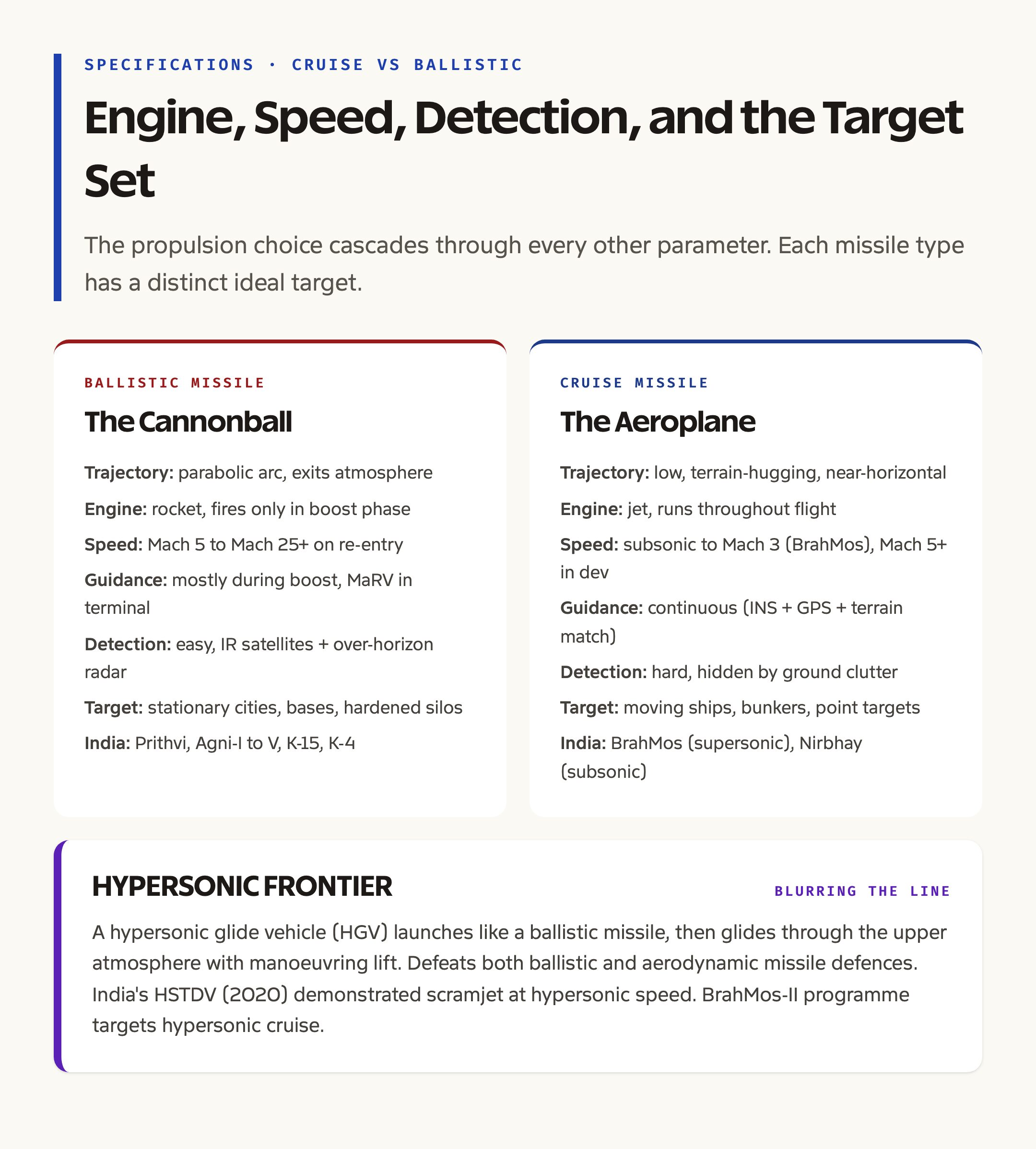
A ballistic missile is guided only during the boost phase, when the engine is firing. Once the engine cuts off and the missile is on a free-fall trajectory, the guidance is mostly fixed. Modern ballistic missiles have manoeuvrable re-entry vehicles, abbreviated MaRVs, that can adjust their trajectory in the terminal phase to improve accuracy and evade defences. But the bulk of the trajectory is unguided.
A cruise missile is guided continuously throughout its flight. The autopilot uses inertial navigation, GPS or GLONASS satellite signals, and terrain-matching against onboard maps to keep the missile on course. Modern cruise missiles can fly waypoints, take detours, attack from unexpected directions, and adjust the final approach based on terminal sensor data such as imaging infrared or radar. The continuous guidance gives the cruise missile its high accuracy, often within a few metres of the target.
The guidance difference produces an accuracy difference. A ballistic missile against a city or military base can hit within hundreds of metres of its aim point, which is fine for the intended payload. A cruise missile can hit a specific window of a specific building. This is why cruise missiles are preferred for moving targets such as ships, for hardened point targets such as bunkers, and for missions where collateral damage must be minimised.
Target Set: Cities vs Ships and Bunkers
The target set follows from the speed, accuracy, and detectability properties. A ballistic missile is best for stationary, large, soft targets. Cities and military bases. The high terminal speed and short flight time make it useful for time-sensitive strikes. The relatively low accuracy is acceptable because the warhead, often in the megaton range for a strategic system, has a very large effective radius.
A cruise missile is best for moving, small, hardened targets. Ships at sea, bunkers, command centres. The high accuracy and continuous guidance make it possible to hit a target the size of a vehicle from hundreds of kilometres away. The slower flight time is acceptable because the targets do not move far in those minutes.
The two weapon types are therefore complementary rather than substitutes. A modern military uses ballistic missiles for strategic deterrence and theatre strike against fixed targets, and cruise missiles for tactical strike against moving and hardened targets.
India’s Cruise Missile Family
The flagship Indian cruise missile is BrahMos, a joint venture between DRDO and Russia’s NPO Mashinostroyeniya. BrahMos is a supersonic cruise missile with a range of around three hundred kilometres in the original variant and extended to several hundred kilometres in newer variants. It is operational from land, ship, submarine, and air platforms. The Sukhoi Su-30MKI was integrated with the air-launched BrahMos. The submarine-launched variant fires from torpedo tubes. The land version is mounted on truck-launchers.
Nirbhay is a subsonic, long-range, indigenous cruise missile developed by DRDO. Range exceeds one thousand kilometres. The weapon completes the cruise missile portfolio at the longer-range, slower-speed end of the spectrum, complementing BrahMos at the shorter-range, faster-speed end. Nirbhay has been tested repeatedly across the late 2010s and 2020s, with progressive improvements in reliability and accuracy.
The BrahMos-II programme aims at a hypersonic cruise missile in cooperation with Russia. India also tested the Hypersonic Technology Demonstrator Vehicle (HSTDV) in 2020, demonstrating scramjet propulsion at hypersonic speed.
India’s Ballistic Missile Family
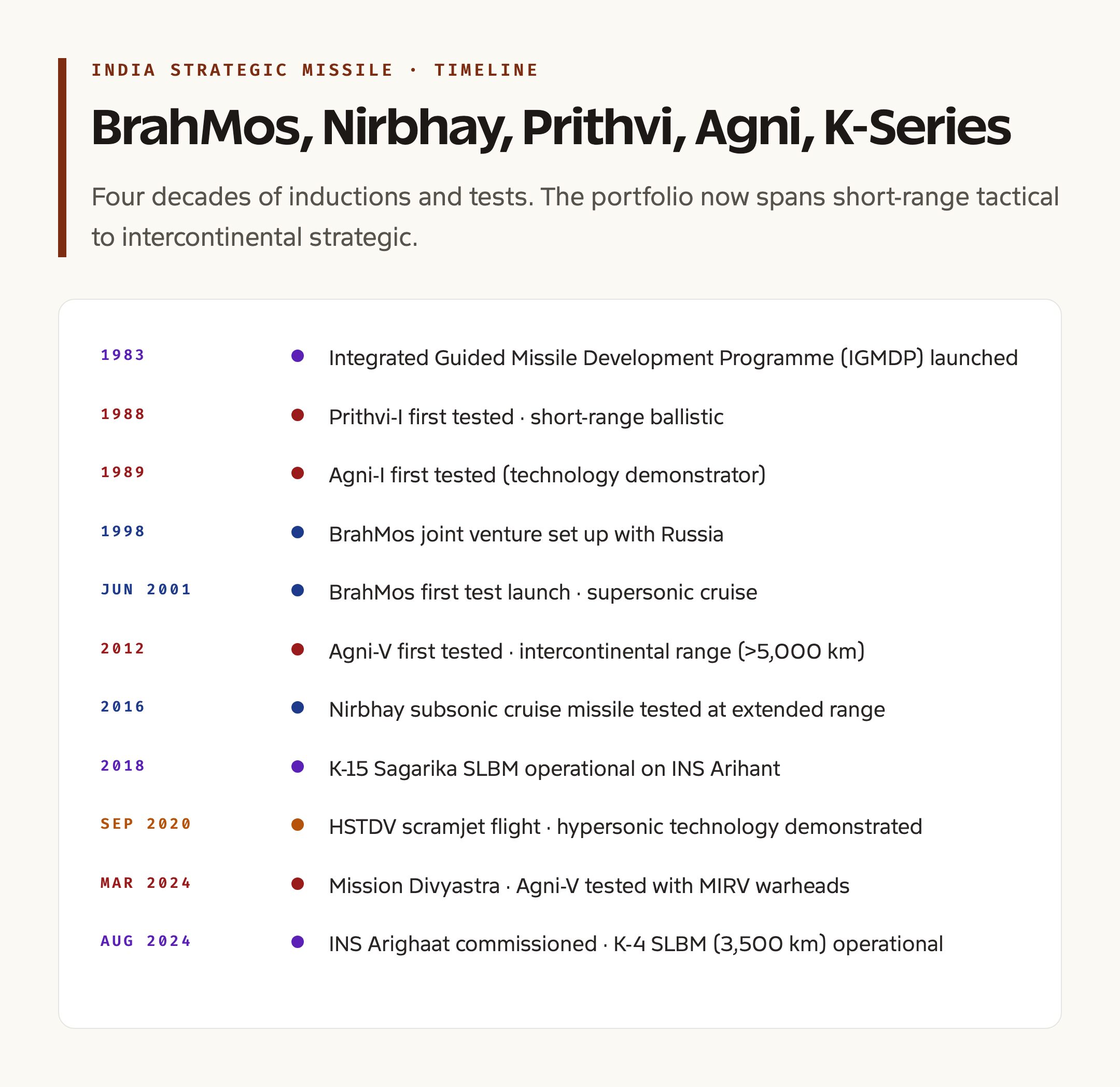
The Prithvi family is the short-range ballistic missile line, with ranges from one hundred and fifty to three hundred and fifty kilometres. Prithvi-II is the operational army weapon. Prithvi-III is the naval variant. The line provides theatre and tactical capability.
The Agni family is the longer-range ballistic missile line. Agni-I has a range of seven hundred kilometres. Agni-II ranges around two thousand kilometres. Agni-III, IV, and V extend progressively. Agni-V is the longest, with a range exceeding five thousand kilometres, and is the strategic weapon that can target most of Asia from Indian territory. Agni-V was tested with multiple independently targetable re-entry vehicles (MIRVs) in 2024 under Mission Divyastra.
The K-series is the submarine-launched ballistic missile family. K-15 Sagarika has a range of about seven hundred and fifty kilometres and arms the early Arihant-class boats. K-4 has a range of around three thousand five hundred kilometres. K-5 is in development with a longer range. The K-series is the third leg of the nuclear triad and operates from the Arihant-class SSBN line.
Hypersonic and Boost-Glide: Blurring the Line
A hypersonic weapon by definition flies above Mach 5. Two architectures dominate. The hypersonic cruise missile uses a scramjet engine to sustain flight at hypersonic speed. The hypersonic glide vehicle, abbreviated HGV, is launched on a ballistic trajectory and then glides through the upper atmosphere using aerodynamic lift. The HGV blurs the categories. It launches like a ballistic missile but flies a manoeuvring trajectory in the upper atmosphere, neither cleanly ballistic nor cleanly cruise. China and Russia have flown such systems. The United States is developing them. India’s HSTDV is the technology demonstrator for the scramjet path.
The defence implication is significant. Conventional missile defences are designed against either a ballistic re-entry vehicle, which follows a predictable trajectory, or against a slower aerodynamic threat such as an aircraft or cruise missile. A hypersonic glide vehicle that manoeuvres in the upper atmosphere fits neither model and currently has no proven defence.
Indigenous Defence Industry and the Ecosystem
The missile portfolio is the showcase of India’s indigenous defence industry. DRDO designs, BEL and BDL produce, ISRO contributes propulsion and re-entry technology, and the armed forces operate the deployed systems. Mission Divyastra and the BrahMos joint venture are the standout success stories. The supply chain has localised significantly over the past two decades, though some critical components and materials remain imported.
The integration of these weapons with platforms is the next layer of work. Mounting BrahMos on the Sukhoi-30MKI required structural modifications to the aircraft and weapons-system integration that took years. Submarine launch requires watertight launch tubes, ejection systems, and the safety protocols of underwater missile firing. The K-series integration with the Arihant-class boats is the most complex of these, because both the missile and the platform are indigenous.
Why It Matters for UPSC
Cruise versus ballistic is a classic comparison question. Prelims questions ask which engine is on which type, which trajectory is which, and which Indian missile fits which category. Mains questions are larger. Discuss the role of the missile programme in India’s strategic posture. Examine the differences between cruise and ballistic missiles in modern warfare. Evaluate the BrahMos joint venture as a model of indigenous defence collaboration.
The set of facts is small. Two missile families, several Indian weapons in each, one hypersonic frontier. The thematic depth runs through national security, foreign policy, science and technology, and the indigenous industrial base. The topic shows up across paper-III and frequently in essay and interview material.
Frequently Asked Questions
What is the main difference between a cruise missile and a ballistic missile?
Trajectory and propulsion. A ballistic missile is launched on a parabolic arc by a rocket engine and falls onto the target. A cruise missile flies a low, level path under continuous jet engine power.
Which is faster, a cruise or ballistic missile?
A ballistic missile reaches much higher terminal speed because gravity accelerates it during re-entry. Cruise missiles are typically subsonic or supersonic. Hypersonic cruise missiles narrow the gap.
Which is harder to detect?
A cruise missile, because it flies low and uses ground clutter to hide from radar. A ballistic missile is easily detected by infrared satellites and long-range radars during boost.
What category does BrahMos fall in?
BrahMos is a supersonic cruise missile.
What category does Agni fall in?
The Agni family consists of ballistic missiles, with ranges from intermediate to long.
What is the K-15 Sagarika?
A submarine-launched ballistic missile in the Indian K-series, with a range of about seven hundred and fifty kilometres, arming the early Arihant-class SSBNs.
Why is hypersonic glide a special category?
Because it is launched ballistically but glides through the upper atmosphere with manoeuvring capability, defeating both ballistic and aerodynamic missile defences.
Tell Google you want more of this.
Add Anantam IAS as a preferred sourceOne tap, and this site shows up more often in your own Top Stories, AI Overviews and AI Mode. Remove it any time.






