China’s military and space moves: What three new developments signal for India
Why in News?
The Indian Express reported three developments in China’s military and space sectors within one week of July 2026. On July 3, President Xi Jinping promoted two officers to general — the highest active rank in the People’s Liberation Army (PLA) — amid anti-corruption purges of the top brass. Days later, Xinhua announced that a PLA Navy strategic nuclear submarine had test-launched a missile, identified by Reuters as an intercontinental ballistic missile (ICBM), toward the high seas of the Pacific. And on July 10, the Long March-10B rocket achieved China’s first-ever controlled recovery of a rocket’s first stage.
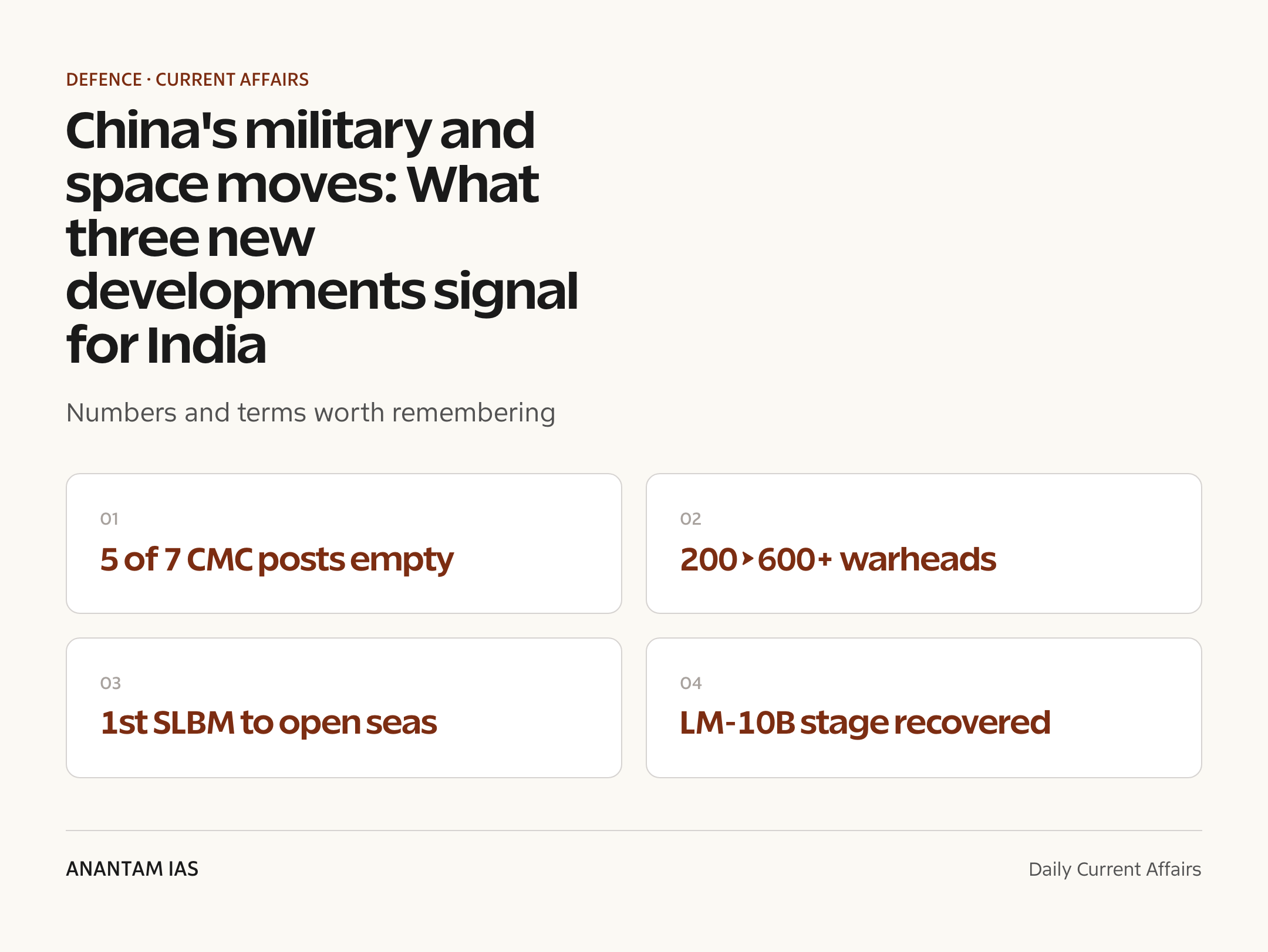
Each strand feeds India’s threat assessment. Analysts at the Center for Strategic and International Studies (CSIS) note China has tripled its nuclear arsenal from about 200 to over 600 warheads in six years, while reusable rockets promise cheaper, faster access to space for commercial and military payloads alike.
- On July 3, Xi Jinping promoted Zhang Shuguang, head of the CMC’s discipline inspection commission, and Wang Gang, commander of the PLA Air Force, to full general.
- Purges have left five of the seven Central Military Commission positions vacant; Generals Zhang Youxia and Liu Zhenli were removed in late January 2026 for “violating discipline” — a euphemism for corruption.
- The PLA Navy said its missile carried a dummy warhead and “landed precisely within the designated waters”; CSIS called it China’s first submarine-launched ballistic missile (SLBM) launch into international open waters.
- Japan, Australia and New Zealand criticised the test, which Beijing framed as routine, pre-notified annual training aimed at no country.
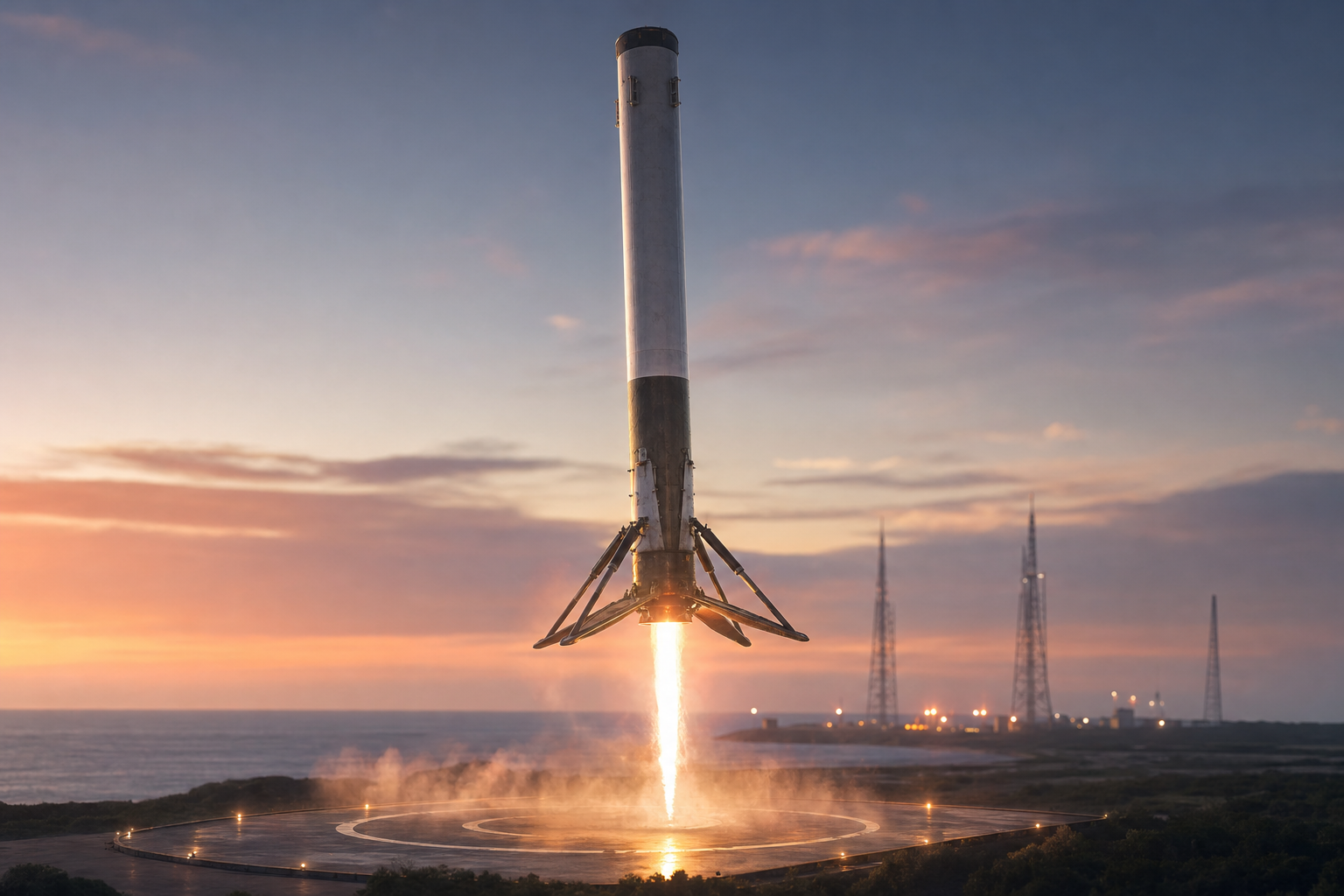
- The Long March-10B lifted off from Hainan province on July 10 and recovered its first stage under control — the manoeuvre that made SpaceX’s Falcon 9 cheap and prolific.
The development matters in the context of:
- China’s internal civil-military politics — who controls the PLA — shapes its assertiveness on Taiwan and along the Line of Actual Control (LAC): standing GS2 material.
- For GS3, the week showcases the sea leg of the nuclear triad and reusable launch technology — races in which India’s Agni-SSBN complex and ISRO’s NGLV are the direct comparatives.
- The Indo-Pacific security architecture, including the Quad, exists largely as a response to these capability shifts.
UPSC Relevance
Prelims Relevance
- Central Military Commission (CMC) — China’s apex military administration body, chaired by Xi Jinping; its discipline inspection commission, one of 15 CMC sections, runs anti-corruption work.
- ICBM — a ballistic missile with range conventionally beyond about 5,500 km; an SLBM is a ballistic missile launched from a submarine.
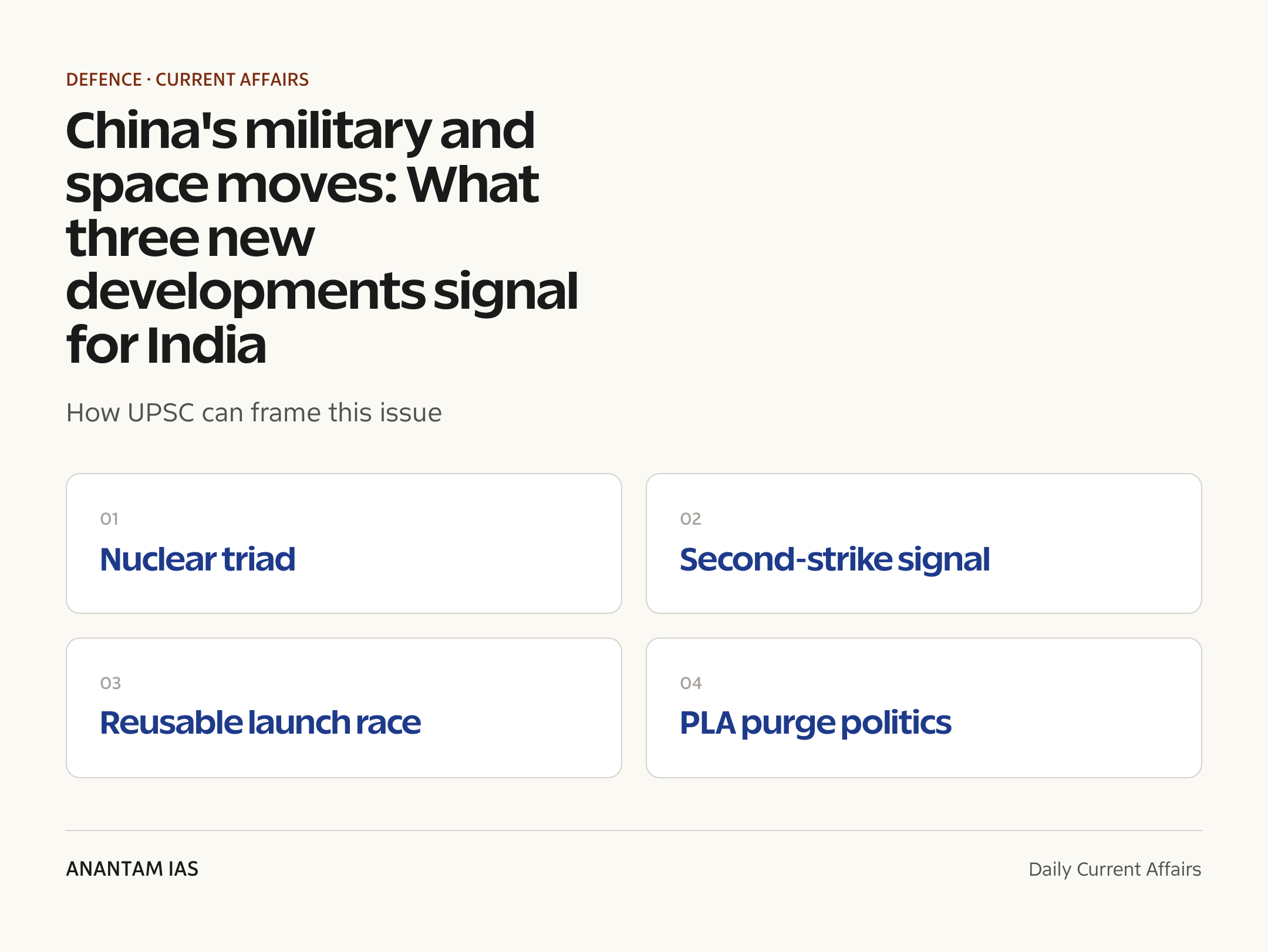
- Nuclear triad — land, sea and air delivery legs; the sea leg on SSBNs is the most survivable, guaranteeing second-strike capability.
- Long March-10 family (10A, 10B, 10C) — backbone of China’s future space transport and crewed programme; the 10B’s first-stage recovery (July 2026) was China’s first.
- Mission Divyastra (March 2024) — first flight test of India’s Agni-5 with MIRV technology.
- INS Arihant and INS Arighaat (commissioned August 2024) — India’s SSBNs; the K-4 SLBM ranges about 3,500 km.
- India’s nuclear doctrine (2003) — credible minimum deterrence, no first use, massive retaliation.
- SIPRI Yearbook 2025 — China roughly 600 warheads, India about 180.
- NGLV — approved by the Union Cabinet in September 2024 with a reusable first stage; ISRO’s RLV-LEX ‘Pushpak’ landing experiments concluded in June 2024.
Mains Relevance
GS Paper 2
- India-China relations: how opacity in PLA decision-making and a loyalist CMC concentrate Taiwan and LAC choices in one leader’s hands, raising miscalculation risks.
- Indo-Pacific diplomacy: the SLBM test as nuclear signalling to Japan, Australia and the US, and India’s alignment choices within the Quad.
- China’s party-army fusion as a contrast with democratic civilian control of the military.
GS Paper 3
- Nuclear deterrence: what a demonstrated sea-based second strike plus a tripled arsenal does to strategic stability in Asia and to India’s credible minimum deterrence.
- Space technology as security infrastructure: reusable rockets cut launch costs and raise cadence, accelerating military satellite constellations.
- Indigenisation: lessons from China’s state-backed technological self-reliance for India’s defence and space ecosystems.
Essay
- Twenty-first-century arsenals are built in laboratories and launchpads, not just barracks.
- Deterrence in an age of opacity: peace between powers that cannot read each other.
Background and Context
Three developments, one week, one message
Between July 3 and July 10, 2026, three announcements sketched the arc of China’s hard-power ambitions.
- July 3: promotion orders for Zhang Shuguang and Wang Gang — full general, the PLA’s highest active rank — amid an anti-corruption churn in the top brass.
- Days later: a strategic nuclear submarine launched a dummy-warhead missile toward the high seas of the Pacific; Reuters identified it as an ICBM.
- July 10: the Long March-10B flew from Hainan and achieved China’s first controlled recovery of a rocket first stage.
- The common thread: tightening political control over the PLA while demonstrating strategic nuclear and space capability to the region — and to Washington.
Inside the CMC: purges, promotions and Pekingology
The promotions matter because of where they land — a Central Military Commission gutted by investigations.
- The Central Military Commission (CMC) is China’s apex military administration body, chaired by Xi Jinping; its discipline inspection commission — one of 15 CMC sections — handles anti-corruption work.
- Zhang Shuguang heads that commission; Wang Gang commands the PLA Air Force.
- After Generals Zhang Youxia and Liu Zhenli were removed in late January 2026, five of seven CMC positions stand vacant, their occupants investigated for “violating discipline”.
- The South China Morning Post reported that at the Communist Party’s 105th founding anniversary gala, the two sat beside Defence Minister Dong Jun and theatre commander Han Shengyan — seating charts being a classic tell where processes are opaque.
- Analysts such as Lyle Morris of the Asia Society Policy Institute read the moves as Xi re-staffing the CMC with loyalists ahead of the party congress due in about a year — with sensitive Taiwan decisions in mind.
The submarine missile test: a nuclear signal in the Pacific
Beijing called it routine training; the firsts embedded in the test say otherwise.
- The PLA Navy said the missile carried a dummy warhead, “landed precisely within the designated waters”, was part of annual training, was aimed at no country, and had been notified to relevant states in advance.
- CSIS analysts called it China’s first SLBM launch into international open waters — and the first public demonstration of a strategic nuclear strike capability from a nuclear-powered submarine.
- A working sea leg is the heart of second-strike capability: submarines are hard to find, so retaliation survives a first strike.
- CSIS adds the wider context: China is undergoing the largest expansion of its nuclear arsenal ever, tripling from about 200 to over 600 warheads in six years.
- China last publicly fired an ICBM into the Pacific in September 2024; two rare public tests in two years read as deliberate signalling amid tensions over Taiwan.
Long March-10B: China joins the reusable-rocket club
Recovering a first stage is the single most consequential cost technology in spaceflight — and China has now demonstrated it.
- The Long March-10B flew from Hainan province on July 10, achieving China’s first controlled recovery of a carrier rocket’s first stage — the manoeuvre SpaceX’s Falcon 9 pioneered in December 2015.
- Reusability slashes per-launch costs and multiplies launch cadence; it underpins the US commercial space boom and mega-constellations like Starlink.
- A Chinese Academy of Engineering expert told Xinhua the Long March-10A, 10B and 10C will “collectively form the backbone of China’s space transportation system” and anchor its next-generation crewed rocket programme.
- State media framed the goals as boosting commercial space competitiveness, routinising reusable launches and cutting dependence on Western technology.
- The name carries party symbolism: the Long March was Mao Zedong’s 10,000-km trek of the mid-1930s — tech milestones fused with Communist Party founding mythology.
Why India must read the three together
Individually incremental, the three developments compound into a single strategic picture for New Delhi.
- A loyalist CMC concentrates decisions on Taiwan and the LAC in Xi’s hands; purge-era opacity raises the risk that Indian planners misread intent — a core problem in the US-China-Russia triangle India navigates.
- A demonstrated sea-based second strike, stacked on a tripling arsenal, widens the asymmetry: SIPRI 2025 pegs China at about 600 warheads against India’s 180 — and India must deter on two fronts.
- Cheap, reusable launch means faster deployment of military satellites — reconnaissance, communications and the BeiDou navigation constellation that guides PLA precision weapons.
- The October 2024 disengagement at Depsang and Demchok eased the LAC crisis, but capability trends like these outlast diplomatic thaws.
- China’s launch cadence runs above 60 orbital attempts a year — roughly ten times India’s — a gap reusability will widen unless India accelerates.
Where India stands: triad, doctrine and reusable tech
India holds a credible but much smaller deterrent, and its reusable-launch effort is a generation behind demonstration.
- Land leg: the Agni missile series tops out with Agni-5 (range over 5,000 km); Mission Divyastra (March 2024) flight-tested MIRV on it.
- Sea leg: India’s submarine fleet includes the SSBNs INS Arihant and INS Arighaat (commissioned August 2024); the K-4 SLBM (about 3,500 km) was test-fired from Arighaat in November 2024.
- Doctrine: the 2003 doctrine rests on credible minimum deterrence, no first use and massive retaliation — the sea leg is what makes the NFU pledge credible.
- Reusable tech: ISRO’s RLV-LEX series (‘Pushpak’) completed three landing experiments by June 2024; the Cabinet approved the NGLV in September 2024 at about ₹8,240 crore, with a reusable first stage — compared in GSLV vs NGLV vs Falcon Heavy.
- Private sector: IN-SPACe-era startups such as Skyroot and Agnikul have flown early vehicles, but no Indian rocket has yet attempted a first-stage recovery.
Way Forward
Harden the deterrent
- Deepen the sea leg: more SSBNs on patrol, longer-range SLBMs, survivable command-and-control — so credible minimum deterrence stays credible as China’s arsenal grows.
- Mature MIRV and penetration aids against expanding Chinese missile defences, without abandoning doctrinal restraint.
Win the launch-cost race
- Fast-track the NGLV and orbital re-landing demonstrations; treat reusability as strategic infrastructure, not prestige.
- Crowd in private launch firms through IN-SPACe and assured government demand; grow surveillance constellations and space situational awareness under the Defence Space Agency.
Watch, engage, hedge
- Institutionalise China-study capacity — language, PLA analysis — so assessments don’t hinge on seating charts alone.
- Keep LAC dialogue alive while deepening Quad partnerships; push for strategic-stability and risk-reduction talks with Beijing.
Conclusion
One week gave China-watchers a purge-reshaped high command, a first-of-its-kind submarine missile launch and a SpaceX-style rocket recovery. The thread is capability plus control: Xi Jinping is centralising the PLA’s leadership even as it demonstrates the tools of a first-rank strategic power.
For India, the lesson isn’t panic but pace. A credible sea-based deterrent, a reusable launch programme that reaches demonstration, and durable Indo-Pacific partnerships compound — and each runs on decisions taken now, not in a crisis.
UPSC Practice Questions
Prelims MCQ 1
With reference to recent developments in China’s military and space sectors (July 2026), consider the following statements:
- The Central Military Commission (CMC) is the apex military administration body of China.
- The missile test-launched by the PLA Navy from a strategic nuclear submarine carried a live nuclear warhead.
- The Long March-10B mission marked China’s first controlled recovery of a carrier rocket’s first stage.
How many of the above statements are correct?
(a) Only one (b) Only two (c) All three (d) None
Answer: (b) Only two
Explanation:
Statements 1 and 3 are correct. Statement 2 is wrong — Xinhua reported the missile carried a dummy warhead and landed in designated Pacific waters during what Beijing called routine annual training.
Prelims MCQ 2
‘Mission Divyastra’, sometimes seen in the news, is associated with which of the following?
(a) India’s first submarine-launched ballistic missile test (b) The first flight test of the Agni-5 missile with MIRV technology (c) India’s anti-satellite missile test (d) A DRDO directed-energy weapon programme
Answer: (b) The first flight test of the Agni-5 missile with MIRV technology
Explanation:
Mission Divyastra (March 2024) was DRDO’s first flight test of Agni-5 fitted with multiple independently targetable re-entry vehicles (MIRV), letting one missile deliver warheads to several targets.
UPSC Mains Questions
- China has demonstrated a sea-based nuclear strike capability while tripling its warhead stockpile within a decade. Examine the implications for strategic stability in Asia and for India’s doctrine of credible minimum deterrence and no first use. (250 words)
- Reusable launch vehicles are reshaping the economics and the military utility of access to space. Assess India’s preparedness in reusable launch technology in the light of recent advances by China and the United States. (250 words)
- Opacity in China’s civil-military politics complicates India’s strategic assessments. Discuss how leadership churn in the People’s Liberation Army affects India’s China policy on the Line of Actual Control and in the Indo-Pacific. (250 words)
Source: Indian Express Explained.
Frequently Asked Questions
What three Chinese developments are in the news?
Within one July 2026 week: Xi Jinping promoted two officers to general amid PLA purges; a PLA Navy nuclear submarine test-launched a missile, identified by Reuters as an ICBM, into the Pacific; and the Long March-10B achieved China’s first controlled recovery of a rocket first stage.
What is China’s Central Military Commission?
The Central Military Commission (CMC) is China’s apex military administration body, chaired by Xi Jinping, with 15 sections including a discipline inspection commission for anti-corruption work. After recent purges, five of its seven leadership positions stand vacant — which is why the new promotions drew such attention.
Why was the submarine missile test significant?
CSIS analysts say it was China’s first launch of a submarine-launched ballistic missile into international open waters, and the first public proof of a strategic nuclear strike capability from a nuclear-powered submarine — the survivable ‘second-strike’ sea leg of a nuclear triad.
How big is China’s nuclear arsenal now?
CSIS analysts estimate China tripled its arsenal from about 200 to over 600 warheads in six years — the fastest expansion by any nuclear power. SIPRI’s 2025 yearbook similarly puts China near 600 warheads, against roughly 180 for India.
What did the Long March-10B achieve?
Launched from Hainan on July 10, 2026, it performed China’s first controlled recovery of a carrier rocket’s first stage — the reusability manoeuvre SpaceX’s Falcon 9 pioneered in 2015. Reusable stages cut launch costs sharply and allow far more frequent launches.
What is India’s sea-based nuclear deterrent?
India operates the SSBNs INS Arihant and INS Arighaat (commissioned August 2024), armed with K-15 and K-4 submarine-launched ballistic missiles; the K-4 ranges about 3,500 km. This sea leg underwrites India’s no-first-use doctrine by guaranteeing retaliation.