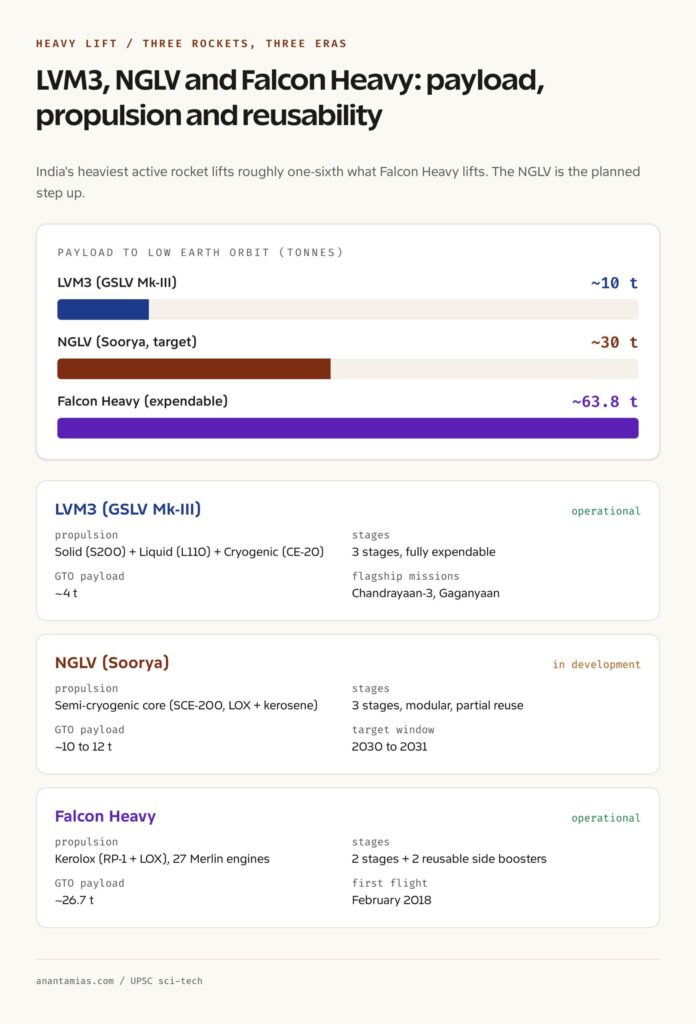
A heavy-lift rocket is a country’s ticket to the largest spacefaring activities. Geostationary satellites that take more than four tonnes, lunar and interplanetary missions, planned space stations, large constellation deployments, all require lift capacity that smaller rockets cannot provide. India’s current heaviest active rocket, the LVM3 (formerly known as GSLV Mk-III), can put about 10 tonnes into low earth orbit and 4 tonnes into geostationary transfer orbit. The next generation, the Next Generation Launch Vehicle or NGLV (the rocket informally called Soorya), is being developed to triple that capacity. By comparison, SpaceX’s Falcon Heavy already lifts 63.8 tonnes to LEO when flown in expendable mode. The gap is wide and the catch-up plan is specific.
For UPSC, this comparison appears in GS-III science and technology and in cross-cutting questions on space economy and indigenous capability. The exam often focuses on payload class, propulsion type, reusability and cost per kilogram. Each of these is a window into the underlying physics and economics of access to space.
This explainer walks through the LVM3, the NGLV roadmap and Falcon Heavy side by side, then goes a level deeper into the cryogenic versus semi-cryogenic engine choice that shapes India’s next decade in launch.
Quick Facts: LVM3 vs NGLV vs Falcon Heavy
- LVM3 (GSLV Mk-III) status: Operational, India’s heaviest active rocket
- LVM3 payload: Around 10 tonnes to LEO, around 4 tonnes to GTO
- LVM3 propulsion: Solid (S200 boosters) + liquid (L110 core) + cryogenic (CE-20 upper stage)
- NGLV (Soorya) status: Under development, target operational date around 2030 to 2031
- NGLV target payload: Around 30 tonnes to LEO, 10 to 12 tonnes to GTO
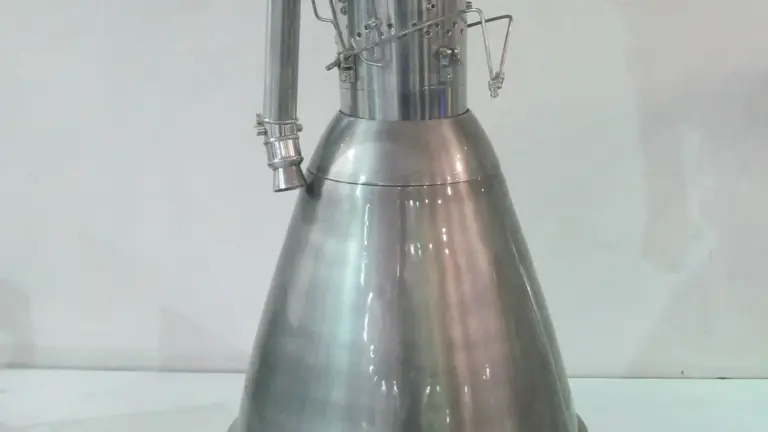
- NGLV propulsion: Semi-cryogenic core (LOX + kerosene, SCE-200 engine), modular, partially reusable
- Falcon Heavy status: Operational, world’s second most powerful active rocket
- Falcon Heavy payload: Around 63.8 tonnes to LEO (expendable), around 26.7 tonnes to GTO
- Falcon Heavy propulsion: Two-stage kerolox (RP-1 + LOX), Merlin engines, partially reusable side boosters
- Cryogenic engine: Both fuel and oxidiser at cryogenic temperatures (typical: LH2 + LOX)
- Semi-cryogenic engine: Only oxidiser cryogenic, fuel near room temperature (typical: kerosene + LOX)
What Are These Rockets?
The LVM3 is India’s heavy-lift launch vehicle, developed by ISRO and operational since 2017 (with development flights from 2014). It is a three-stage rocket. The first stage uses two large solid-propellant boosters known as S200, each 3.2 metres in diameter and burning composite propellant. The second stage is the L110, a liquid-fuelled core using two Vikas engines that burn unsymmetrical dimethyl hydrazine (UDMH) and dinitrogen tetroxide. The third stage is the C25 cryogenic upper stage, powered by the CE-20 engine that burns liquid hydrogen and liquid oxygen. LVM3 has launched Chandrayaan-2 (2019), Chandrayaan-3 (2023) and several OneWeb commercial constellation missions, and is the rocket planned for the Gaganyaan crewed mission.
The NGLV, also referred to as Soorya in some communications, is ISRO’s planned next-generation heavy-lift vehicle. Unlike LVM3, NGLV is being designed from the start with reusability in mind for at least the first stage, and with a semi-cryogenic core engine, the SCE-200, that ISRO has been developing for over a decade. The aim is roughly three times the payload capacity of LVM3 at substantially lower cost per kilogram, opening the door to a future Bhartiya Antariksha Station, lunar sample-return missions and large constellation launches.
The Falcon Heavy, developed by SpaceX, is essentially three Falcon 9 first stages strapped together with a single upper stage on top. It first flew in 2018, became operational, and as of recent flights has launched commercial geostationary satellites, US national security payloads, and the Psyche asteroid mission. The two side boosters are reusable and have flown back to landing zones at the launch site. The centre core, on most missions, has been expended.
Background and Historical Context
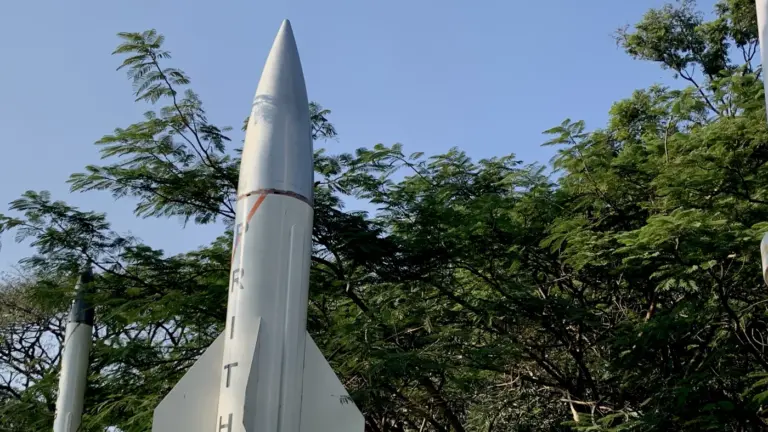
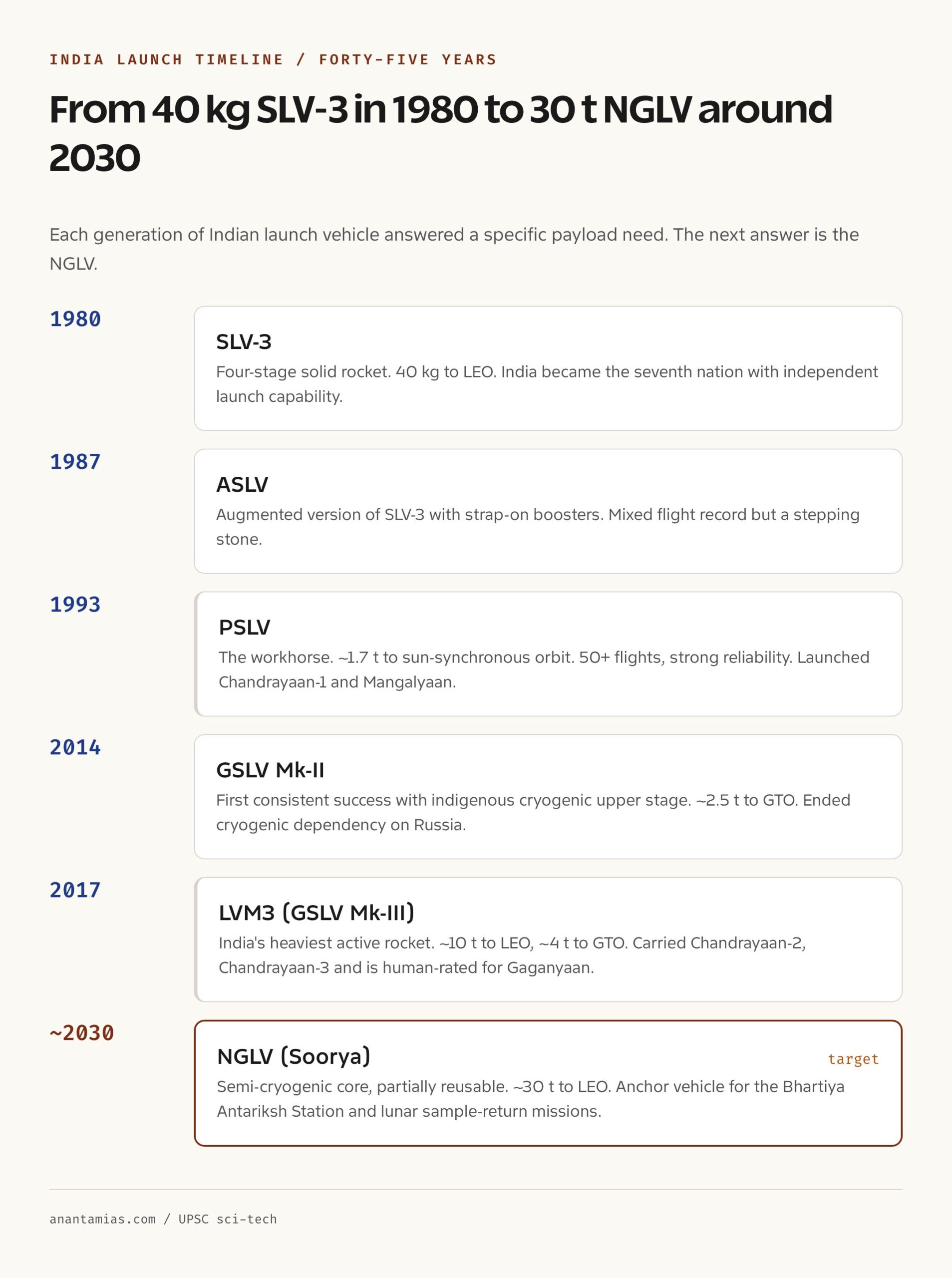
India’s path to heavy-lift began in the 1970s with the SLV-3, a four-stage solid rocket capable of lifting 40 kg into low earth orbit. The first successful flight in 1980 placed the Rohini satellite in orbit and made India the seventh nation with independent launch capability. The ASLV in the late 1980s and the PSLV from 1993 expanded this capability progressively. The PSLV became the workhorse, with over fifty flights and a strong reliability record, capable of about 1.7 tonnes to sun-synchronous orbit. The GSLV programme, intended for heavier geostationary payloads, encountered repeated failures in the 2000s before the Mk-II variant achieved consistent success with an indigenous cryogenic upper stage from 2014. The Mk-III, renamed LVM3, was a different rocket designed from scratch for higher payload, and entered service in 2017.
The Falcon Heavy story runs in parallel but in a different ecosystem. SpaceX, founded by Elon Musk in 2002, developed the Falcon 1, then the Falcon 9 (which entered service in 2010), and then announced the Falcon Heavy as a way to lift larger payloads using three Falcon 9 cores in parallel. The first Falcon Heavy flight in February 2018, which famously launched a Tesla Roadster to a heliocentric orbit, demonstrated that two side boosters could land back at Cape Canaveral. The technology of reusable rocket cores, first proven on Falcon 9, was carried over to Falcon Heavy.
The NGLV is India’s response to a global shift towards reusable, semi-cryogenic launchers. ISRO has been working on a semi-cryogenic engine, the SCE-200 of about 2,000 kN thrust, as a replacement for the L110 stage’s UDMH-based Vikas engines, which are toxic and give lower density-impulse than kerosene. Reusability work, including the RLV-TD test vehicle and ongoing technology development, is being merged with the heavy-lift roadmap. ISRO has indicated that the NGLV will be developed in partnership with the private sector, with a target operational window in the early 2030s. For broader context, see our pieces on ISRO missions, space technology and the Bharatiya Antariksh Station.
LVM3 (GSLV Mk-III): India’s Current Heavy-Lift
The LVM3 is the largest rocket India has ever flown. The two S200 solid boosters give the rocket most of its initial thrust, lifting it through the lower atmosphere. The L110 liquid core stage burns next, followed by the C25 cryogenic upper stage that places the payload in transfer orbit. Total height is about 43 metres and lift-off mass is around 640 tonnes.
LVM3 can lift about 10 tonnes to low earth orbit and about 4 tonnes to geostationary transfer orbit. This payload class made Chandrayaan-3 possible, replaces older GSLV Mk-II for heavier GTO missions, and supports the planned Gaganyaan crewed flight, which requires a human-rated version of the LVM3. The CE-20 cryogenic engine, India’s first indigenously developed high-thrust cryogenic engine, was a major technological milestone that ended a long dependency on imported cryogenic stages.
LVM3 is not reusable. Each flight is fully expendable, in line with the design philosophy of its time. Per-launch cost is a fraction of Falcon Heavy’s, though the difference is partly because LVM3 lifts a much smaller payload. On a per-kilogram-to-LEO basis, LVM3 is competitive with PSLV but not with reusable launchers like Falcon 9 or Falcon Heavy.
NGLV (Soorya): India’s Heavy-Lift Future
The NGLV is being designed to put India in the heavy-lift class. The target payload of about 30 tonnes to LEO would be roughly three times the LVM3’s capacity. The design uses a semi-cryogenic core stage powered by the SCE-200 engine, which burns refined kerosene (sometimes called Isrosene) and liquid oxygen. Around the core, strap-on boosters provide additional thrust at lift-off. The upper stage is expected to use a cryogenic LH2 + LOX engine, providing the high specific impulse needed for orbital insertion.
The NGLV is being designed for partial reusability, with the first stage envisioned to return for refurbishment and reflight. This is the design philosophy that has lowered SpaceX’s per-kilogram cost dramatically and is the only credible path for India to reduce its launch cost below the current frontier. Public indications suggest a target launch cost of less than half the per-kilogram rate of LVM3 once the rocket reaches operational maturity.
Development is in progress, with the SCE-200 engine undergoing ground testing. The first orbital flight of NGLV is expected in the early 2030s, with full operational capability later in that decade. Use cases will include the planned Bhartiya Antariksh Station, which is targeted for completion by 2035, and missions that LVM3 cannot support, including potential lunar surface and Mars missions of larger scale.
Falcon Heavy: The Reusable Reference Point
Falcon Heavy is the comparison point that puts the others in context. Its 63.8 tonnes to LEO in fully expendable mode is more than six times the LVM3’s capacity and roughly twice what NGLV is targeting. In its standard partially reusable configuration, in which both side boosters are recovered and the centre core may also return, payload to LEO is somewhat lower but launch cost is correspondingly reduced. SpaceX has marketed Falcon Heavy missions in the range of $90 to $150 million, depending on configuration, which translates to a per-kilogram cost in the low thousands of dollars to LEO when flown with a heavy payload.
The technology that makes Falcon Heavy work is essentially the technology of Falcon 9. The same Merlin engines, same kerolox propellants, same recovery techniques. The challenge of strapping three cores together is real but is more an integration problem than a fundamental new technology. The reusable boosters are what differentiates SpaceX from most competitors. As of recent flights, individual Falcon 9 first-stage cores have flown more than 20 times.
Falcon Heavy is not the largest rocket in the world. SpaceX’s own Starship, in development, is targeted at over 100 tonnes to LEO when fully reusable. NASA’s Space Launch System (SLS) is a heavy-lift vehicle for Artemis. China’s Long March 5 and the planned Long March 9 also occupy this class. But Falcon Heavy is currently the second most powerful active rocket and remains the canonical reusable heavy-lift reference.
Cryogenic vs Semi-Cryogenic Engines
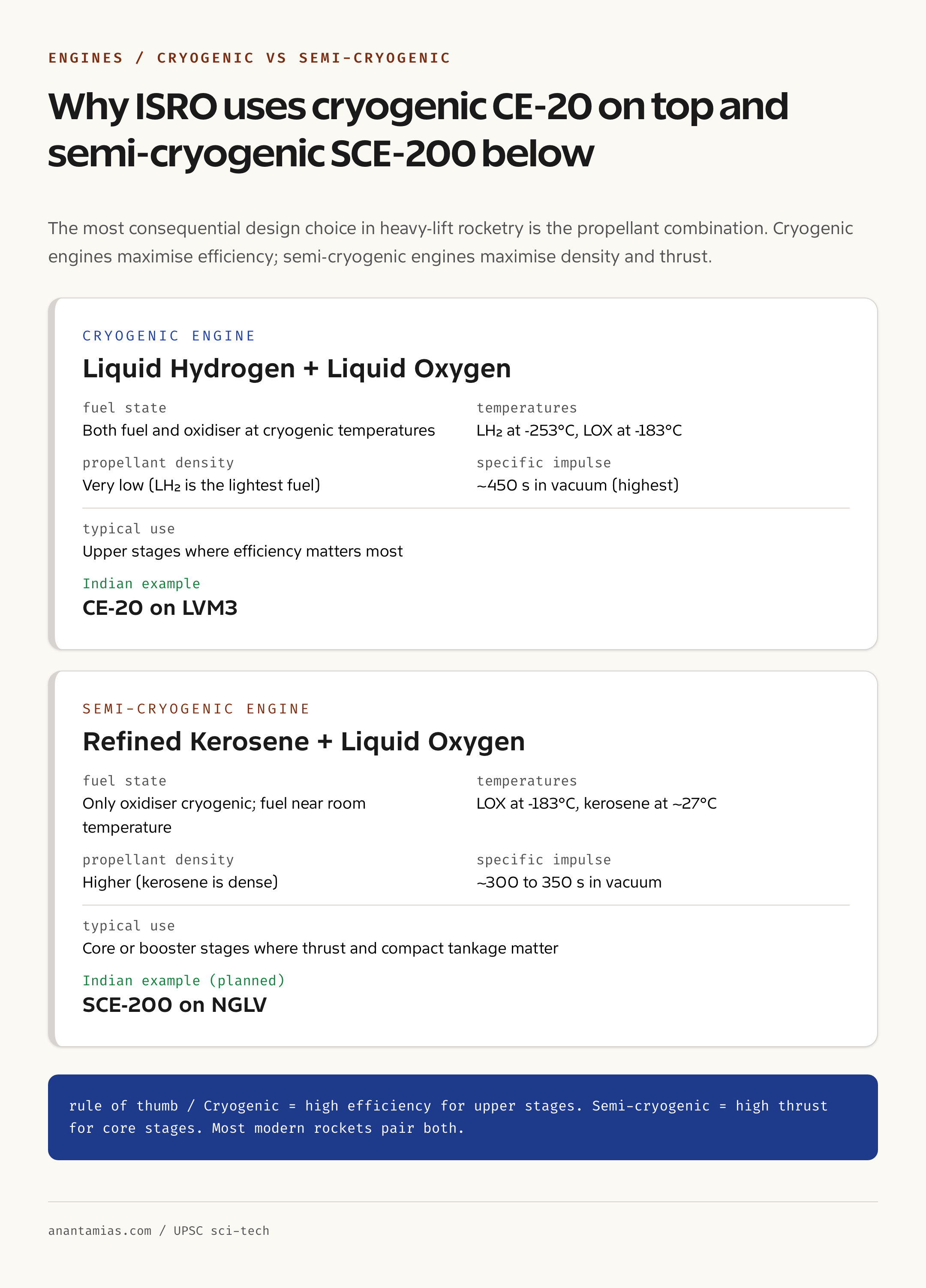
The most consequential design choice in heavy-lift rocketry is the propellant combination, and the cryogenic versus semi-cryogenic distinction is at the heart of it. A cryogenic engine uses both fuel and oxidiser at cryogenic temperatures, typically liquid hydrogen at minus 253 degrees Celsius and liquid oxygen at minus 183 degrees Celsius. The advantage is the highest specific impulse achievable with chemical rockets, around 450 seconds in vacuum, because hydrogen has the lowest molecular weight of any chemical fuel. The disadvantage is density. Liquid hydrogen is so light that the tanks have to be enormous, which forces a large structural mass, and it is difficult to store for long periods. Cryogenic engines are best for upper stages, where their efficiency advantage is most useful and tank size is less of a structural penalty.
A semi-cryogenic engine uses a cryogenic oxidiser (LOX) and a non-cryogenic fuel, typically refined kerosene such as RP-1 (in the US), naphthyl (in Russia), or the Indian Isrosene. The fuel is liquid at room temperature, which simplifies storage and ground handling. Specific impulse is lower than for hydrogen-based engines, around 300 to 350 seconds in vacuum, but density is much higher, which means the tanks are smaller and the rocket structure is more compact. Semi-cryogenic engines are well suited to first and core stages, where high thrust and compact tankage matter more than ultimate specific impulse.
The Indian story is illustrative. The CE-20 (used on the LVM3 upper stage) is a cryogenic LH2 + LOX engine. The SCE-200 (planned for NGLV core stage) is a semi-cryogenic LOX + kerosene engine. By using the right engine type at each stage, the rocket optimises overall performance: a high-thrust dense-fuel core for the boost phase and a high-specific-impulse hydrogen upper stage for orbit insertion. SpaceX, by contrast, uses kerolox throughout Falcon 9 and Falcon Heavy, accepting a lower specific impulse on the upper stage in exchange for engine commonality and operational simplicity.
Why It Matters for India
The next decade of Indian space policy hinges on heavy-lift capacity. The Bhartiya Antariksh Station, the lunar sample-return missions including Chandrayaan-4 and possible Chandrayaan-7 onward, the planned Mars orbiter and lander, and any future crewed lunar mission all require rockets larger than LVM3. Without NGLV, India would either have to depend on foreign launchers for these missions or scope down national ambitions. The economic dimension is equally important. India’s commercial launch market is small compared to its potential, and per-kilogram launch costs determine competitiveness. Falcon 9 and Falcon Heavy have set a benchmark that India can match only with reusable, semi-cryogenic technology.
The strategic dimension is also significant. National independence in launch capability is a geopolitical asset, particularly in light of the militarisation of space and the increasing role of constellations for navigation, communications and surveillance. Heavy-lift capacity allows India to deploy and maintain its own constellations rather than depending on others.
Challenges
NGLV faces real challenges. Reusability is technically demanding. SpaceX took multiple iterations and several failures before achieving reliable first-stage recovery. The SCE-200 engine, while extensively tested at the component level, has not yet flown. Integration of new engines into a flying vehicle typically takes longer than initial schedules suggest. Funding has historically been a constraint for ISRO, and NGLV is a multi-billion-dollar undertaking that will need sustained budgetary commitment, ideally with private-sector participation as the new space-policy framework allows.
The competitive landscape is also shifting. By the time NGLV flies, SpaceX’s Starship is intended to be operational with payloads above 100 tonnes to LEO. China is developing the Long March 9 in a similar class. The bar will keep rising, and India’s catch-up cannot stop with NGLV.
UPSC Prelims Pointers
- LVM3 (formerly GSLV Mk-III) is India’s heaviest active rocket
- LVM3 lifts about 10 t to LEO and 4 t to GTO
- LVM3 has three stages: S200 solid boosters + L110 liquid core + C25 cryogenic upper
- C25 is powered by the indigenous CE-20 cryogenic engine
- LVM3 launched Chandrayaan-2, Chandrayaan-3 and is planned for Gaganyaan
- NGLV (Soorya) is ISRO’s next heavy-lift vehicle, target around 2030-31
- NGLV target: 30 t to LEO, 10-12 t to GTO; partially reusable
- NGLV core stage: SCE-200 semi-cryogenic engine (LOX + kerosene/Isrosene)
- Falcon Heavy: SpaceX, ~63.8 t to LEO expendable, ~26.7 t to GTO
- Falcon Heavy: two reusable side boosters, kerolox Merlin engines
- Cryogenic engines: both propellants cryogenic, highest specific impulse, used on upper stages
- Semi-cryogenic engines: only LOX cryogenic, denser fuel, used on core stages
UPSC Mains Practice Questions
- Compare LVM3, the planned NGLV, and Falcon Heavy in terms of payload, propulsion and reusability. What does the comparison reveal about India’s heavy-lift gap?
- Discuss the technical and economic advantages of reusability in launch vehicles. Why has India chosen partial reusability for the NGLV?
- Distinguish between cryogenic and semi-cryogenic engines. Why does ISRO use the cryogenic CE-20 in the LVM3 upper stage and the semi-cryogenic SCE-200 for the NGLV core stage?
- “Heavy-lift capacity is a precondition for India’s space ambitions in the 2030s.” Examine this claim with reference to the Bhartiya Antariksh Station, lunar sample-return missions and commercial launch services.
Way Forward
The NGLV is the single most important rocket in India’s near-term space programme, because it determines what missions are possible after 2030. Its success requires three things. First, sustained funding through the development and testing phase, with private-sector partnerships under the new space-policy framework providing additional capacity. Second, parallel development of the supporting infrastructure, including launch pads at Sriharikota that can handle a larger rocket, and recovery infrastructure for reusable first stages. Third, a clear pipeline of payloads, from the Bhartiya Antariksh Station modules to commercial constellation contracts, that justify the investment.
For students, the GSLV/NGLV/Falcon Heavy comparison is a good lens on what determines a country’s space capability. Engines, structures, propellants and reusability are not abstract; each choice has consequences for what missions are possible and at what cost. The race is real, the gaps are real, and the next decade will tell whether India closes them.
Frequently Asked Questions
What is the difference between LVM3 and GSLV Mk-III?
They are the same rocket. ISRO renamed the GSLV Mk-III to LVM3 (Launch Vehicle Mark 3) to indicate that it is a distinct vehicle from the GSLV programme rather than a variant of GSLV Mk-II. The two names are used interchangeably in older and newer documents respectively, but they refer to the same rocket with two solid boosters, a liquid core stage, and a cryogenic upper stage.
How much can NGLV lift compared to LVM3?
The NGLV target payload is about 30 tonnes to low earth orbit, compared to about 10 tonnes for LVM3. That is roughly three times the capacity. To geostationary transfer orbit, NGLV is targeted at 10 to 12 tonnes versus LVM3’s 4 tonnes. The increase opens up a much wider range of mission classes, including space-station modules and large planetary missions.
Why is Falcon Heavy so much bigger than India’s rockets?
Falcon Heavy uses three Falcon 9 first stages strapped together, each with nine Merlin engines, for 27 first-stage engines in total at lift-off. The total thrust is enormous, allowing payloads of up to 63.8 tonnes to LEO. SpaceX has been operating in a different scale of investment and a different regulatory environment, which has allowed faster iteration. India’s NGLV is the planned response in the heavy-lift class, though at a smaller payload target than Falcon Heavy.
What is a cryogenic engine?
A cryogenic engine is one in which both the fuel and the oxidiser are stored at cryogenic temperatures, typically liquid hydrogen at minus 253 degrees Celsius and liquid oxygen at minus 183 degrees Celsius. The advantage is very high specific impulse, around 450 seconds in vacuum, because hydrogen is the lightest possible fuel. The disadvantage is the very low density of liquid hydrogen, which forces large tanks. Cryogenic engines are typically used on upper stages.
What is a semi-cryogenic engine?
A semi-cryogenic engine uses a cryogenic oxidiser, typically liquid oxygen, but a non-cryogenic fuel, typically refined kerosene. The fuel is liquid at room temperature, simplifying storage and handling. Specific impulse is lower than for hydrogen-based engines (around 300 to 350 seconds), but propellant density is much higher, which makes the tanks smaller and the rocket more compact. Semi-cryogenic engines are well suited to first and core stages.
What is the SCE-200?
The SCE-200 is ISRO’s semi-cryogenic engine, in development for years. It produces around 2,000 kN of thrust, burns refined kerosene (Isrosene) with liquid oxygen, and is intended to power the core stage of the NGLV. It will replace the older Vikas engines, which use the toxic and lower-performance UDMH and N2O4 propellants. Ground testing has been progressing, and the engine is scheduled for first flight as part of NGLV.
Is LVM3 reusable?
No. LVM3 is fully expendable. Each flight uses new hardware throughout. The reusability technology that lowers SpaceX’s costs has not been built into LVM3. The next generation, NGLV, is being designed for at least first-stage reusability.
What is Soorya in the context of NGLV?
Soorya is the informal name that has been used for the NGLV in some communications, evoking the Sun. The official designation remains NGLV (Next Generation Launch Vehicle). Public references to a heavy-lift rocket called Soorya generally refer to the same project.
When will NGLV fly?
ISRO has indicated a target operational window of around 2030 to 2031 for NGLV’s first orbital flight. Full operational maturity, including reusable booster recovery and a stable launch cadence, is expected through the rest of the 2030s. Schedules in launch vehicle development typically slip, so the actual dates may be later, but the order of magnitude is the early to mid 2030s.
Tell Google you want more of this.
Add Anantam IAS as a preferred sourceOne tap, and this site shows up more often in your own Top Stories, AI Overviews and AI Mode. Remove it any time.