Constitutional Morality: Doctrine, Core Pillars & Latest 2025–26 Supreme Court Cases
Context: The relationship between the Constitution and constitutional morality is intrinsic and dynamic. Constitutional morality is the ethical and philosophical foundation that animates the Constitution, ensuring its provisions are applied in a way that upholds justice, equality, dignity, and the rule of law. In 2025 and 2026, the Supreme Court has invoked constitutional morality to rule on the Tamil Nadu Governor’s pocket veto, on mental health as a fundamental right in Sukdeb Saha, on transgender equality in private workplaces in Jane Kaushik, and on the limits of Article 142 itself. This article explains the doctrine, traces its core elements, and walks you through the latest cases an aspirant must know.
UPSC relevance
Mains 2025: “Constitutional morality is the fulcrum which acts as an essential check upon the high functionaries and citizens alike….” In view of the above observation of the Supreme Court, explain the concept of constitutional morality and its application to ensure balance between judicial independence and judicial accountability in India. (150 words, 10 marks)
Mains 2021: ‘Constitutional Morality’ is rooted in the Constitution itself and is founded on its essential facets. Explain the doctrine of ‘Constitutional Morality’ with the help of relevant judicial decisions. (150 words, 10 marks)
GS Paper II: Indian Constitution — historical underpinnings, evolution, features, amendments, significant provisions, basic structure; functions and responsibilities of the Union and the States; separation of powers; appointment to constitutional posts.
What is constitutional morality?
Constitutional morality means doing things the constitutional way, both in letter and in spirit. It asks citizens, officials, and institutions to follow due process, respect rights, and exercise power with restraint, even when “popular opinion” is demanding shortcuts. The phrase is older than our Constitution. Ambedkar borrowed it from the British historian George Grote, who used it to describe a settled, almost reflexive obedience to constitutional forms, combined with the freedom to criticise the authority that acts under those forms. Ambedkar then planted it firmly inside our Indian setting in his now-famous Constituent Assembly speech of 4 November 1948.
Think of it this way. The Constitution is the script. Constitutional morality is the discipline of actually following the script, even when no one is watching, even when the audience would clap for an off-script performance. A magistrate who sticks to due process during a politically charged trial is practising it. A citizen who accepts a court verdict they personally disagree with is practising it. A government that respects a state law it does not like, instead of starving it through delay, is practising it.
Constitutional morality is not a natural sentiment. It has to be cultivated. We must realise that our people have yet to learn it. Democracy in India is only a top-dressing on an Indian soil, which is essentially undemocratic.
— B. R. Ambedkar, Constituent Assembly, 1948
That last line still does the heavy lifting. Ambedkar was telling the House that writing a fine document is not the same as building a constitutional culture. The document gives us forms. Constitutional morality is what makes those forms come alive in everyday governance.
Where the idea comes from: Ambedkar, Grote, and the Indian context
Grote, writing about ancient Athens in the 1840s, used “constitutional morality” to describe a paradoxical mood: total reverence for the Constitution combined with the freedom to argue with anyone in authority. Ambedkar saw the same paradox as the missing piece in Indian democracy. Indian society, he argued, was steeped in hierarchy, hero-worship, and what he called “graded inequality.” A written Constitution could not survive that soil unless an active culture of constitutional morality grew over it.
Three pieces of his argument matter for us as students of polity:
- The form is fragile. Constitutional procedures, once broken casually, are very hard to repair. A bypassed convention almost never returns by itself.
- Bhakti is dangerous. “Bhakti or hero-worship,” Ambedkar warned, “is a sure road to degradation and to eventual dictatorship.” This is why constitutional morality treats no leader as larger than the office.
- Citizens are not bystanders. Constitutional morality is not a duty owed only by judges and ministers. It is what makes ordinary citizens capable of holding the system to account without burning it down.
For more on how this idea took shape across our Republic, see our deeper read on India’s constitutional journey and the early-republic struggles around Ambedkar’s Mahad Satyagraha, where the demand for equal access to public water was, in spirit, a demand for constitutional morality long before the Constitution existed.
The four core elements of constitutional morality
You can keep these four pillars in mind. Every Mains answer on constitutional morality usually folds back into one or more of them.
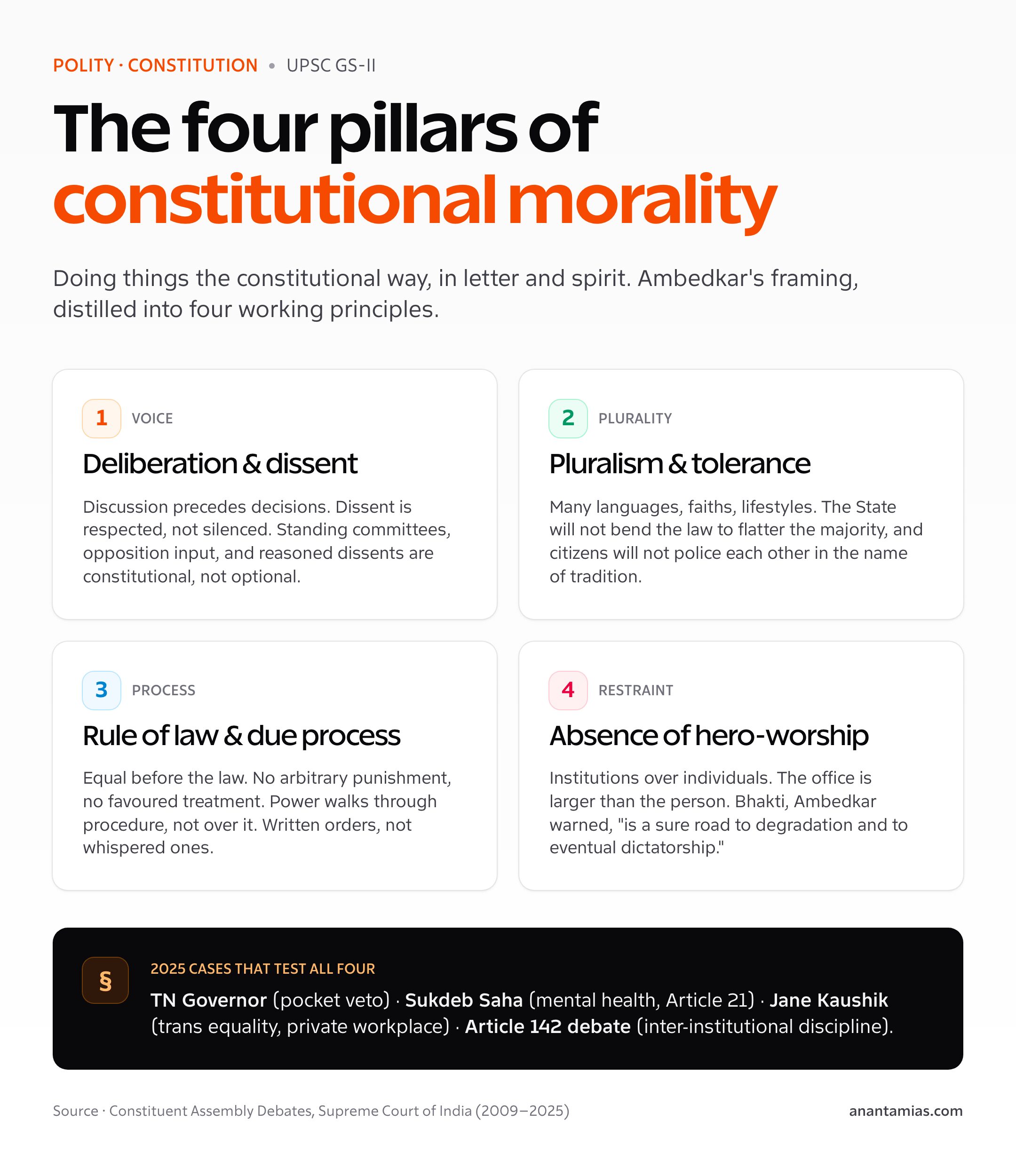
1. Deliberation and dissent — argue, don’t bulldoze
Discussion and debate must precede decisions. Dissent must not just be tolerated, it must be respected. Constitutional morality assumes that the right answer is more likely to emerge from honest argument than from majoritarian noise. This is why Parliamentary committees, judicial benches, and even cabinet meetings exist in the first place.
Examples:
- A Parliamentary Standing Committee dissecting a Bill clause-by-clause before the House votes.
- A Constitution Bench writing a long dissent. The dissent does not change the immediate outcome, but it preserves a path for the future court to correct course.
- A housing society where the secretary insists on hearing the loudest objector before the resolution is signed.
- A classroom where students can question the teacher’s reasoning without fear of being marked down.
2. Pluralism and tolerance — respect for diversity
India is a constitutional democracy because it accepts many languages, faiths, foods, and ways of being. Constitutional morality treats this diversity as a feature, not a bug. The state may not bend the law to please a numerical majority at the expense of a smaller community, and citizens may not police each other’s lifestyles in the name of “tradition.”
Examples:
- A school that celebrates Diwali, Eid, and Christmas with the same warmth.
- A municipal corporation that allots park slots to all communities for cultural programmes without political filtering.
- A workplace that updates its leave policy to cover regional and religious festivals beyond a “default” calendar.
- The 2018 Sabarimala verdict, where the Court held that the bar on women of a certain age age violated constitutional morality, even though “popular morality” wanted the practice to continue. The pending Sabarimala reference in 2025 keeps that conversation alive.
3. Rule of law and due process — no arbitrariness
Everyone is equal before the law. No one can be punished or favoured arbitrarily. Power must walk through procedure, not jump over it. This is the workhorse element of constitutional morality, the one that decides whether ordinary administration is constitutional or merely legal-on-paper.
Examples:
- A student cannot be expelled without a fair chance to explain her side. That is due process.
- A traffic constable fining a businessman and a rickshaw-puller equally for the same red-light jump.
- An IAS probationer following written orders only, refusing to act on an unrecorded phone call from a senior politician.
- The Supreme Court’s 2026 reading-down of Section 294 BNS on “vulgar language”, which insisted that criminal law cannot punish speech without proper standards. That is rule of law in everyday motion.
4. Absence of hero-worship — institutions over individuals
Institutions and laws must be respected more than individuals. Power has to flow through procedure, not through personal charisma or popularity. The moment a system protects a person because of who they are rather than because the rules require it, constitutional morality has slipped.
Examples of erosion:
- An institution hesitates to question the executive because the leader is too popular to embarrass.
- Citizens defend every action of a political leader, even when it clearly violates constitutional norms.
- Officers act on a minister’s verbal instruction and skip the file note that would have created a paper trail.
- A party in power changes its own rulebook the moment its leader is in trouble. The leader is being placed above the institution.
Constitutional morality vs popular morality
This is the cleanest distinction you can carry into a Mains answer. Popular morality is what the majority feels at a given time. Constitutional morality is what the Constitution requires regardless of how the majority feels at that moment. The two often agree, but the doctrine only earns its keep when they collide.
Three quick illustrations, all real:
- Navtej Johar v Union of India (2018): Section 377 fell because constitutional morality, not majority sentiment, was held to be the test of equal citizenship.
- Joseph Shine v Union of India (2018): The Court struck down adultery as a crime, refusing to let a patriarchal social consensus override the constitutional guarantee of equality and personal autonomy for women.
- Triple talaq, Shayara Bano (2017): Instantaneous divorce was rejected even though a section of the community defended it on tradition. Constitutional morality made the call, not custom.
Pratap Bhanu Mehta has written a careful caution alongside this enthusiasm. We have summarised it in a modest plea for constitutional morality: the doctrine is most powerful when judges use it to expand liberty, and most contested when it is used as a vague philosophical override of legislative choice. Hold both ideas at the same time.
Recent 2025 and 2026 cases that test constitutional morality
This is the section that turns a generic Mains answer into a high-scoring one. Four developments stand out from the last two years.
State of Tamil Nadu v Governor of Tamil Nadu (8 April 2025) — no pocket veto
A two-judge bench of Justices J. B. Pardiwala and R. Mahadevan ruled that a Governor cannot sit indefinitely on State Bills. Article 200 uses the words “shall declare” and “as soon as possible,” which means inaction itself is unconstitutional. The Court called the practice of an open-ended, silent veto a “pocket veto” that has no place in our scheme. It also laid down indicative timelines and held that, in extreme cases, courts can deem assent granted under Article 142.
Why it is a constitutional morality case: A Governor who refuses to act is not breaking the text of the Constitution in any single, dramatic way. He is breaking its spirit. The doctrine of constitutional morality is what allows the Court to say, “the Constitution does not contemplate inaction” even though it does not say so in those exact words.
Sukdeb Saha v State of Andhra Pradesh (July 2025) — mental health is a fundamental right
The case arose from the death of a 17-year-old NEET aspirant in a Visakhapatnam hostel. The Court held that mental health is an integral part of the right to life under Article 21. It then issued the binding “Saha Guidelines,” requiring schools, colleges, hostels, and coaching institutes above a threshold size to appoint counsellors, frame mental health policies, and submit to district-level monitoring committees chaired by district magistrates.
Constitutional morality angle: Article 21 is one short sentence. Reading mental health into “life and personal liberty” is a moral move as much as a textual one. The Court’s reasoning is that a Republic that promises dignity cannot watch coaching factories grind teenagers down and call it private affairs. That is constitutional morality at work, holding the Constitution to its own promise of dignity.
Jane Kaushik v Union of India (17 October 2025) — equality reaches private workplaces
Jane Kaushik, a transgender teacher, was terminated by a private school in Delhi soon after her gender identity became known. The Supreme Court held that her dismissal violated Articles 14, 15, and 21 read with the Transgender Persons (Protection of Rights) Act, 2019. Crucially, the bench applied the equality command to a private employer, embracing the doctrine of indirect horizontality. The judgment, citing Navtej Johar, reaffirmed that equality is grounded in constitutional morality, not majoritarian comfort.
Read this alongside the Transgender Persons (Protection of Rights) Amendment Act, 2026, which has now codified parts of the Court’s reasoning into statute. Together, the case and the amendment show how constitutional morality moves from court to code.
The Article 142 controversy — VP Dhankhar and the “nuclear missile” remark
On 17 April 2025, Vice President Jagdeep Dhankhar called Article 142 a “nuclear missile against democratic forces” while addressing Rajya Sabha interns, days after the Tamil Nadu Governor verdict. He argued that the Court was acting like a “super Parliament.” Senior advocates including Kapil Sibal disagreed, calling the remark itself a violation of constitutional morality, since it pulled a high constitutional functionary into open hostility with another organ of the State.
The lesson for an aspirant: Constitutional morality is also an inter-institutional discipline. It tells the executive not to weaponise public office against the judiciary, and it tells the judiciary not to use Article 142 as a shortcut around legislative choice. Both organs are bound by the same script.
For the wider 2025 jurisprudence on Article 21, see our note on safe travel on highways as part of Article 21, and on the expanding meaning of “State” in cooperative societies under Article 12.
Older landmark cases on constitutional morality
The doctrine did not appear in 2025. It has been quietly building since the early 2010s, and the older cases are still the backbone of any Mains answer.
- Naz Foundation v NCT of Delhi (2009): The Delhi High Court used “constitutional morality” to read down Section 377. The phrase entered modern jurisprudence here, even though the SC reversed the decision in 2013 before reviving it later.
- Manoj Narula v Union of India (2014): A Constitution Bench held that constitutional morality binds those who occupy high office and must inform their choices, even where the Constitution is silent on a specific qualification.
- Government of NCT of Delhi v Union of India (2018): Justice Dipak Misra wrote that constitutional morality requires high functionaries to act within the four corners of the Constitution and not arbitrarily, especially in centre–state relations.
- Indian Young Lawyers Assn. v State of Kerala (2018), the Sabarimala judgment: The Court held that the bar on women aged 10–50 was a violation of constitutional morality and could not be saved by popular morality.
- K. S. Puttaswamy v Union of India (2017–18): The privacy and Aadhaar judgments. The Court confirmed privacy as a fundamental right and used constitutional morality to set boundaries around state surveillance and data collection.
- Navtej Johar v Union of India (2018): Constitutional morality was described as “the soul of the Constitution,” embracing justice, equality, and human dignity.
- Joseph Shine v Union of India (2018): Adultery as a crime was struck down. Married women, the Court said, are not the property of their husbands. Constitutional morality requires personal autonomy as a non-negotiable.
- Namit Sharma v Union of India (2013): Transparent functioning of public institutions was anchored in constitutional morality and made intrinsic to the rule of law.
For a parallel debate on faith, custom, and morality, see our explainer on the SC ruling on Scheduled Caste status after religious conversion. It is the same fault line: constitutional morality versus social custom.
Why constitutional morality matters more in 2026 than ever
The pressures on the Indian system in 2026 are different from those of 1950. The forms have held, but they are under stress.
- Speed of governance. Bills move fast, ordinances move faster, and digital platforms move faster than both. Constitutional morality is the brake that says “deliberate before you decide.”
- Hyper-personalised politics. When leaders dominate the news cycle, hero-worship spreads quickly. Constitutional morality keeps the office larger than the person occupying it.
- Federal frictions. Centre–state relations are increasingly contested. The TN Governor judgment shows why an unwritten norm of timely action is itself a constitutional value.
- Digital state power. The Draft IT (Second Amendment) Rules 2026 and earlier debates around digital constitutionalism are testing whether the Constitution’s spirit can govern algorithms, takedowns, and surveillance.
Criticisms and limits of constitutional morality
A good answer must also include the critiques. Three lines of criticism stand out.
- Vagueness. Critics argue the phrase has no fixed content. A judge can pour almost any value into it. The remedy is rigorous reasoning that ties constitutional morality back to specific articles, not free-floating philosophy.
- Counter-majoritarian risk. The doctrine can override democratically expressed preferences. This is a feature when fundamental rights are at stake, but it must not become a habit. Pratap Bhanu Mehta and others have argued for restraint in invoking the doctrine outside the rights core.
- Selective application. If courts invoke constitutional morality only to expand liberty in some cases and stay silent in others, the doctrine can look opportunistic. Consistency is the cure.
The honest position is that constitutional morality is a powerful judicial tool with genuine risks of misuse, and that those risks are best contained by reasoned judgments, clear textual anchors, and self-restraint by all three organs of state.
How citizens, officials, and institutions can practise it
This is where the doctrine stops being abstract. Constitutional morality is built or eroded one decision at a time.
- For citizens: Accept court verdicts even when you disagree. Argue against them in print, in protest, in petition. Do not break them quietly. Vote on policy, not on personality cult.
- For civil servants: Insist on written orders. Maintain file notes. Treat the rulebook as a shield, not an inconvenience. The Saha Guidelines style of compliance, paper trail, monitoring committees, named officers, is constitutional morality in administrative form.
- For ministers and legislators: Refer Bills to standing committees. Respect parliamentary time. Do not use ordinances as the default route. Recognise that opposition is not betrayal.
- For courts: Use Article 142 sparingly. Anchor every invocation of constitutional morality to specific articles or doctrines. Write reasoned judgments that future benches and ordinary readers can both follow.
- For the press and academia: Distinguish between popular outrage and constitutional principle. Both have a place. They should not be mistaken for each other.
How to write a high-scoring Mains answer on constitutional morality
If you have a 150-word, 10-mark question, here is a structure that has consistently worked in our classroom evaluations.
- Definition (1–2 lines): Constitutional morality means doing things the constitutional way, in letter and spirit, with reverence for procedure and freedom to criticise authority.
- Roots (1 line): Borrowed from George Grote, deepened by Ambedkar in the Constituent Assembly on 4 November 1948.
- Four elements (compressed): Deliberation and dissent, pluralism and tolerance, rule of law and due process, absence of hero-worship.
- Two old plus two new cases: Navtej Johar and NCT Delhi v Union of India for the foundation. Tamil Nadu Governor (2025) and Sukdeb Saha (2025) for currency. Add Jane Kaushik (2025) if word count allows.
- One critique (1 line): Risk of vagueness and counter-majoritarian misuse, hence the need for reasoned, text-anchored application.
- Conclusion (1 line): Constitutional morality is the bridge between the written Constitution and a living democracy. Without it, the Constitution becomes a document; with it, the Constitution becomes a practice.
Key takeaways
- Constitutional morality is the ethic of obeying constitutional forms while retaining the right to criticise authority.
- Its four pillars are deliberation and dissent, pluralism and tolerance, rule of law and due process, and absence of hero-worship.
- It is most powerful when it expands liberty against majoritarian sentiment, and most contested when it overrides legislative choice.
- The 2025–26 calendar has produced four moments to remember: Tamil Nadu Governor, Sukdeb Saha, Jane Kaushik, and the Article 142 controversy around the Vice President’s remarks.
- Constitutional morality is built one decision at a time, by citizens, civil servants, legislators, judges, and the press together.
Frequently asked questions
Who first used the phrase “constitutional morality” in India?
Dr. B. R. Ambedkar used the phrase in his speech to the Constituent Assembly on 4 November 1948, drawing on the British historian George Grote’s writing on ancient Athens. In modern Indian jurisprudence, the Delhi High Court’s Naz Foundation verdict in 2009 brought the phrase back into active legal use.
What does constitutional morality actually mean?
It means doing things the constitutional way, in letter and spirit. Citizens, officials, and institutions are expected to follow due process, respect rights, and exercise power with restraint, even when popular opinion is demanding shortcuts. It is the discipline of obeying the script while keeping the freedom to criticise it.
How is constitutional morality different from popular morality?
Popular morality is what the majority feels at a given time. Constitutional morality is what the Constitution requires regardless of that feeling. Sabarimala (2018), Navtej Johar (2018), and Joseph Shine (2018) are textbook examples of constitutional morality prevailing over popular morality.
Is constitutional morality the same as the basic structure doctrine?
No. The basic structure doctrine, from Kesavananda Bharati (1973), tells Parliament what it cannot amend away. Constitutional morality is a broader interpretive ethic that informs how the Constitution is read and applied in everyday life. The two often work together, but they are not identical.
Is constitutional morality binding law?
It is not codified as a stand-alone provision, but courts use it as an interpretative principle to read fundamental rights, federal balance, and procedural fairness into constitutional articles. When a judgment relies on constitutional morality, the holding becomes binding precedent under Article 141.
What did the Naz Foundation case do for constitutional morality?
The Delhi High Court’s 2009 Naz Foundation v NCT of Delhi ruling reintroduced “constitutional morality” into modern Indian jurisprudence while reading down Section 377. The Supreme Court reversed it in 2013, but the doctrine survived and was vindicated in Navtej Johar (2018).
Why is the 2025 Tamil Nadu Governor case important for constitutional morality?
On 8 April 2025 the Supreme Court ruled that a Governor cannot exercise a pocket veto over State Bills. Article 200 uses the words “shall declare” and “as soon as possible,” which means inaction itself is unconstitutional. The Court held that, in extreme cases, courts can deem assent granted under Article 142. The judgment is constitutional morality applied to centre–state relations.
How does the Jane Kaushik (2025) judgment extend constitutional morality?
On 17 October 2025 the Supreme Court held that a private school’s termination of a transgender teacher violated Articles 14, 15, and 21 read with the Transgender Persons (Protection of Rights) Act, 2019. The bench applied the equality command to a private employer through the doctrine of indirect horizontality, anchoring it in constitutional morality rather than majoritarian comfort.
What was the Article 142 “nuclear missile” controversy in 2025?
On 17 April 2025, Vice President Jagdeep Dhankhar called Article 142 a “nuclear missile against democratic forces” days after the Tamil Nadu Governor verdict. Senior advocates such as Kapil Sibal called the remark itself a violation of constitutional morality. The episode underlined that constitutional morality is also an inter-institutional discipline binding the executive and the judiciary.
How can a UPSC aspirant use constitutional morality in a Mains answer?
Define it in 1–2 lines, name Ambedkar and Grote, list the four pillars (deliberation and dissent, pluralism and tolerance, rule of law and due process, absence of hero-worship), cite two old cases (Navtej Johar, NCT Delhi v Union of India) and two new ones (Tamil Nadu Governor 2025, Sukdeb Saha 2025), add one critique on counter-majoritarian risk, and conclude that constitutional morality is the bridge between the written Constitution and a living democracy.