Why in News?
In April 2026, a five-judge Constitution Bench of the Supreme Court delivered a long-awaited verdict on whether cooperative societies registered under state Cooperative Societies Acts can be treated as “State” within the meaning of Article 12 of the Constitution. The question determines whether aggrieved members, employees and third parties can invoke writ jurisdiction under Article 32 or Article 226, or must instead approach civil courts and the registrar of cooperative societies for redress.
The ruling refines two foundational precedents. It reads down the sweeping six-factor test laid out in Ajay Hasia v Khalid Mujib Sehravardi (1981) and aligns it with the narrower “cumulative functional test” in Pradeep Kumar Biswas v Indian Institute of Chemical Biology (2002). The Bench also situates its answer against the backdrop of Union of India v Rajendra N Shah (2021), which struck down the cooperative provisions of the 97th Constitutional Amendment Act 2011 to the extent they intruded upon the state list.
For a sector that now spans over 8.5 lakh registered societies, two flagship multi-state cooperatives (IFFCO, KRIBHCO), India’s largest dairy federation (Amul/GCMMF) and a new Union Ministry of Cooperation headed since 2021 by Amit Shah, the verdict has immediate consequences for governance, accountability and the path of litigation.
UPSC Relevance at a Glance
| Dimension | Details |
|---|---|
| GS Paper | GS2 — Polity, Constitution, Judiciary |
| Prelims | Article 12, Part IXB, 97th CAA, Art 32 vs Art 226, Ministry of Cooperation, IFFCO/KRIBHCO/Amul |
| Mains | Meaning of “State” and “other authorities”; writ jurisdiction; cooperative federalism |
| Syllabus Tags | Fundamental Rights, Judicial Review, Federalism, Constitutional Amendments |
| Key Cases | Rajasthan SEB v Mohan Lal (1967); Ajay Hasia (1981); Pradeep Biswas (2002); Zee Telefilms (2005); Rajendra N Shah (2021) |
Background and Context
Article 12 defines “the State” as the Government and Parliament of India, the Government and Legislature of each State, all local authorities, and “other authorities” within the territory of India or under the control of the Government of India. The phrase “other authorities” has generated one of the richest veins of constitutional interpretation in Indian jurisprudence, because only entities that qualify as “State” can be directly sued for violations of fundamental rights through writs.
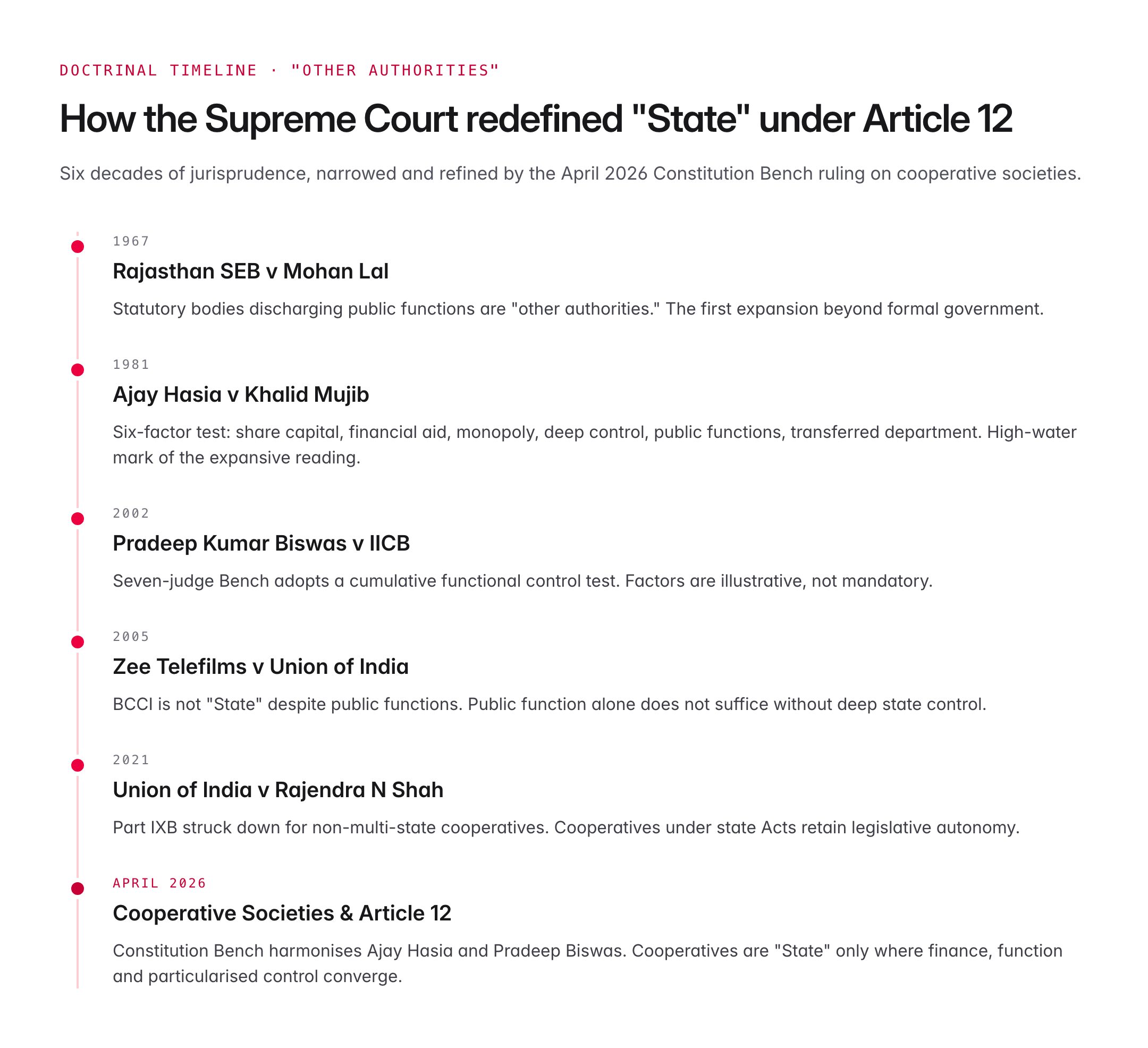
Early readings were narrow. In Rajasthan State Electricity Board v Mohan Lal (1967), the Court held that statutory bodies performing public functions qualified. Sukhdev Singh v Bhagatram (1975) extended the net to LIC, ONGC and IFC on the logic of deep governmental control. The high-water mark came in Ajay Hasia (1981), where Justice P N Bhagwati articulated a six-factor test: entire share capital held by government; financial assistance so substantial as to meet almost all expenditure; monopoly status conferred or protected by the State; deep and pervasive control; functions of public importance closely related to governmental functions; and the body being a transferred government department.
Two decades later, a seven-judge Bench in Pradeep Kumar Biswas (2002) moved away from a mechanical checklist. It held that the Ajay Hasia factors were illustrative and that the real question was whether, cumulatively, a body was financially, functionally and administratively dominated by, or under the control of, the government — and whether that control was “particular” to the body, not general regulation applicable to all. Zee Telefilms v Union of India (2005) further clarified that BCCI, though performing public functions, was not “State” because it lacked deep state control.
Cooperative societies sit awkwardly in this architecture. They are voluntary, member-owned bodies registered under state Acts, but they are simultaneously regulated, part-financed and sometimes operationally directed by governments. The 97th Constitutional Amendment Act 2011 inserted Part IXB (Articles 243-ZH to 243-ZT) to give cooperatives a constitutional floor, and Article 19(1)(c) was amended to include the right to form cooperative societies. In Rajendra N Shah (2021), a 2:1 majority struck down Part IXB insofar as it applied to cooperatives not falling within the Union’s legislative competence, preserving it only for multi-state cooperatives. The April 2026 judgment now completes the map by answering who these entities are answerable to under Part III.
Key Features of the 2026 Judgment
1. The Restated Test
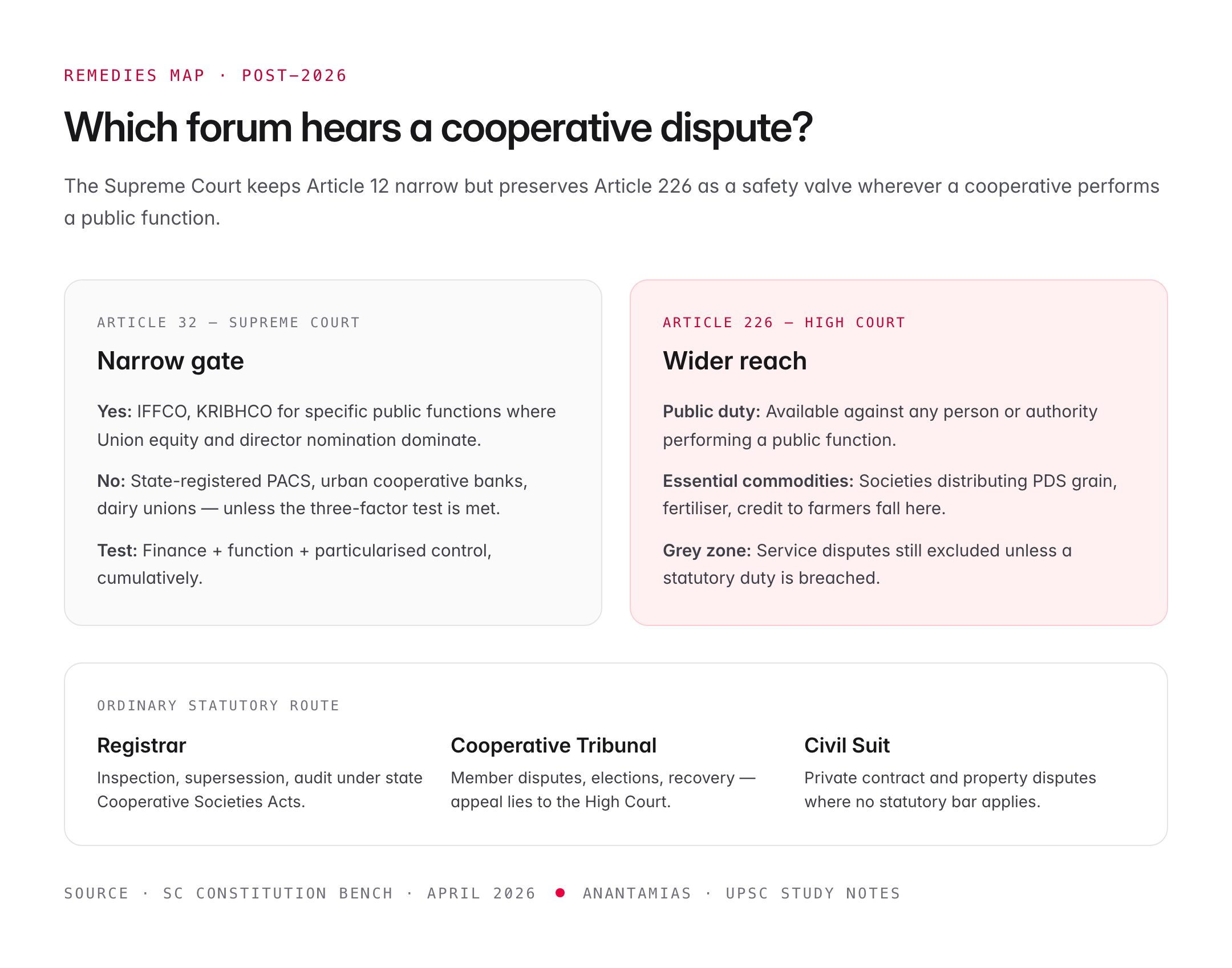
The Bench holds that the question “is a cooperative society State under Article 12” cannot be answered by form or by a single factor. The controlling test is the Pradeep Biswas cumulative functional test, read in light of Ajay Hasia’s illustrative indicators. A society is “State” only where three elements converge:
- Financial dominance — substantial or near-total state funding that is not merely subsidy or statutory support available to all societies.
- Functional essentiality — the society discharges a function that is public in nature and integral to governmental obligations (distribution of essential commodities, credit to farmers, public housing, public health).
- Particularised administrative control — directions, supersession powers, appointment of directors or nominees, and audit powers that go beyond the regulatory scheme of the Cooperative Societies Act itself.
2. Regulation Alone Is Not Control
The Court draws a sharp line. Provisions of a Cooperative Societies Act empowering the Registrar to inspect accounts, supersede boards in case of default, or call for returns are regulatory and general. They apply to every society and do not make each one an instrumentality of the State. This is consistent with Zee Telefilms and with Federal Bank v Sagar Thomas (2003), which held private banks were not “State” despite RBI regulation.
3. The Multi-State Cooperative Carve-Out
Societies incorporated under the Multi-State Cooperative Societies Act 2002 — IFFCO, KRIBHCO, the National Cooperative Development Corporation, national federations — receive closer scrutiny. Where the Union holds equity, nominates a majority of directors or uses the society as a channel for a public distribution or procurement function, the society will be treated as “State” for those functions.
4. Amenability to Article 226
Even where a society is not “State” under Article 12, it may still be amenable to writ jurisdiction under Article 226 if it discharges a public duty or a function of public importance. Article 226, the Bench reiterates, is wider than Article 32 and reaches “any person or authority.” This preserves member remedies against arbitrariness without expanding the Article 12 definition indiscriminately.
5. Employee and Member Disputes
Pure service disputes between a cooperative and its employees, and pure member disputes over share allotment, dividends or expulsion, remain outside writ jurisdiction unless a statutory duty is in issue. The appropriate forum continues to be the Cooperative Tribunal, the Registrar, or a civil suit.
Significance
- Doctrinal clarity. The ruling ends nearly two decades of inconsistent High Court outcomes, where some benches applied Ajay Hasia mechanically and others followed Pradeep Biswas. A single, cumulative test is now binding.
- Federalism-sensitive. By refusing to treat every state-registered society as “State,” the Court respects the cooperative sector’s autonomy and the state legislature’s primary competence over List II Entry 32.
- Protection of fundamental rights preserved. Article 226 remains available wherever a cooperative performs a public function, so citizens are not left without a constitutional remedy.
- Litigation discipline. Thousands of writ petitions filed by members, employees and borrowers of cooperative banks and credit societies will now be screened against a clearer threshold, reducing docket pressure on High Courts.
- Accountability of flagship cooperatives. IFFCO, KRIBHCO and bodies acting as procurement or distribution arms of government become more directly answerable under Part III for the specific public functions they perform.
- Signal to the Ministry of Cooperation. The 2021-created Ministry, which has driven initiatives such as the model bye-laws, computerisation of PACS and the “Sahakar se Samriddhi” programme, now operates against a clearer constitutional boundary.
Concerns and Challenges
Several legitimate concerns flow from the ruling.
First, the cumulative test is inherently fact-intensive. Whether a society’s state funding is “substantial” or its control “particularised” will turn on the record in each case, creating scope for divergent High Court findings until appellate jurisprudence catches up. This reproduces, in a softer form, the uncertainty the Court sought to remove.
Second, the Article 226 safety valve is real but uneven. Not every citizen can litigate a writ of mandamus to compel a cooperative to perform a public duty; legal aid in rural cooperative disputes is thin, and tribunal remedies are slow. For members of primary agricultural credit societies and urban cooperative banks, delay in statutory forums has historically translated into loss.
Third, the ruling coexists with the partial invalidation of Part IXB in Rajendra N Shah. State-level cooperative societies no longer enjoy a uniform constitutional floor on matters such as board tenure, number of directors or reservation for women and SC/ST members, except where state legislatures choose to legislate equivalently. The absence of a constitutional minimum weakens internal democracy in many states.
Fourth, the line between regulation and control is thin in sectors like cooperative banking, where the RBI and the Registrar exercise overlapping powers under the Banking Regulation (Amendment) Act 2020. Classification of urban cooperative banks may generate fresh rounds of litigation.
Finally, critics argue the ruling privileges institutional form over substantive power. A society performing an essential public function with modest state equity may still influence livelihoods of millions — think of dairy federations or state-level marketing cooperatives — yet escape Article 12. The minority view in earlier cases, that public function alone should suffice, has been decisively rejected.
Comparative / Historical Perspective
The Indian trajectory tracks a broader global debate on whether private-law entities performing public functions should be bound by constitutional rights.
| Jurisdiction | Doctrine | Application to Cooperatives |
|---|---|---|
| India (post-2026) | Cumulative financial, functional, administrative control | Only society-by-society; Art 226 available for public functions |
| United States | State action doctrine; “symbiotic relationship” and “public function” tests (Marsh, Jackson) | Rarely extended to cooperatives |
| South Africa | Section 8(2) of the 1996 Constitution applies rights to private bodies to the extent appropriate | Direct horizontal effect possible |
| United Kingdom | “Public authority” under s.6 Human Rights Act 1998; hybrid body test (YL v Birmingham) | Functional test, case-by-case |
| European Union | Foster v British Gas test — emanation of the State | Close parallel to Ajay Hasia |
Historically, the Indian shift from Mohan Lal (1967) to Ajay Hasia (1981) mirrored the expansion of the welfare state. The shift from Ajay Hasia to Pradeep Biswas (2002) and Zee Telefilms (2005) coincided with liberalisation and the rise of private actors in regulated sectors. The 2026 ruling reflects a third phase, where cooperative institutions are once again policy instruments — particularly in agriculture, credit and food processing — but courts resist treating them as government by another name.
Way Forward
- The Ministry of Cooperation should publish a framework distinguishing regulatory powers from operational control, so societies, members and courts apply consistent markers of “particularised” control.
- Parliament should consider a fresh constitutional amendment to restore a minimum democratic floor for state cooperatives (tenure, reservations, independent elections) in the wake of Rajendra N Shah, using the consultation mechanism under Article 252.
- The Supreme Court’s e-Courts mission should issue a standard pro forma for Article 226 petitions against cooperatives, distinguishing public function claims from private disputes.
- State Registrars of Cooperative Societies should be empowered as quasi-judicial authorities with fixed timelines under each state Act, reducing the pressure on writ courts.
- The RBI and the National Bank for Agriculture and Rural Development (NABARD) should issue a joint circular on grievance redress in urban and rural cooperative banks that reflects the 2026 boundary, ensuring depositors retain effective remedies.
- The Law Commission of India may examine whether a statutory ombudsman for the cooperative sector, on the lines of the banking ombudsman, would address the Article 226 access gap.
- Legal services authorities should notify panels dedicated to cooperative disputes, especially for small borrowers and women members.
Conclusion
The April 2026 judgment settles a long-running question without collapsing the delicate balance between fundamental rights and institutional autonomy. It keeps Article 12 tethered to the idea of government by substance, not form, while preserving the reach of Article 226 wherever a cooperative performs a public function. In doing so, it treats cooperatives as a distinctive species of organisation — voluntary in origin, democratic in design, and occasionally instrumental in public delivery — rather than forcing them into a binary of State or non-State.
For the UPSC aspirant, the verdict is a case study in how constitutional doctrine evolves through small, careful refinements rather than wholesale replacement. It invites engagement with the textual, structural and functional approaches to Article 12, and rewards the ability to connect the dots between the 97th Amendment, Rajendra N Shah, the cooperative banking reforms of 2020, and the cumulative test of Pradeep Biswas. It is a reminder that the definition of the State in India is not a closed list but a living inquiry into who wields public power.
Prelims Pointers
- Article 12 defines “State” to include Government, Parliament, State Governments, State Legislatures, local and other authorities.
- Six-factor Ajay Hasia test laid down in 1981 by Justice P N Bhagwati.
- Pradeep Kumar Biswas (2002), a seven-judge Bench, adopted the cumulative functional control test.
- Zee Telefilms v Union of India (2005) held BCCI is not “State” under Article 12.
- 97th Constitutional Amendment Act 2011 inserted Part IXB (Articles 243-ZH to 243-ZT) and amended Article 19(1)(c).
- Union of India v Rajendra N Shah (2021) struck down Part IXB for non-multi-state cooperatives.
- Multi-State Cooperative Societies Act 2002 governs societies operating in more than one state.
- Ministry of Cooperation was created in July 2021; Union Minister is Amit Shah.
- IFFCO is the largest fertiliser cooperative; KRIBHCO specialises in urea; Amul is a brand of the Gujarat Cooperative Milk Marketing Federation.
- Article 32 is available only against the “State”; Article 226 is wider and reaches any person or authority.
- Banking Regulation (Amendment) Act 2020 brought urban and multi-state cooperative banks under RBI supervision.
- NABARD is the apex body for rural credit and supervises State Cooperative Banks and District Central Cooperative Banks.
Mains Practice Question
Q. “The expression ‘other authorities’ in Article 12 is not a fixed catalogue but a functional inquiry into the distribution of public power.” In light of the Supreme Court’s 2026 ruling on cooperative societies, critically examine the evolution of this expression. (15 marks, 250 words)
Answer skeleton:
- Trace the jurisprudence: Mohan Lal (1967) → Ajay Hasia (1981) → Pradeep Biswas (2002) → Zee Telefilms (2005) → 2026 cooperative societies ruling; show the shift from formal to cumulative functional tests.
- Apply to cooperatives: explain how financial dominance, functional essentiality and particularised control now operate together; contrast multi-state cooperatives with state-registered societies; locate the role of Article 226 as a residual safeguard.
- Evaluate: balance between federalism (List II Entry 32, Rajendra N Shah) and fundamental rights protection; note concerns around fact-intensive litigation and the democratic deficit after Part IXB was partly struck down; suggest a role for Parliament, the Ministry of Cooperation and the Law Commission.
Related reads: Right to Information to Right to Deny Information, Secularism, A Modest Plea for Constitutional Morality, HC Justice Verma Resigns: Judicial Accountability Gap, SC Status After Religious Conversion, Right to Safe Roads Under Article 21.
Frequently Asked Questions
What is Article 12 of the Indian Constitution?
Article 12 defines ‘the State’ for the purpose of Part III (Fundamental Rights). It includes the Government and Parliament of India, the Government and Legislature of each State, all local authorities, and ‘other authorities’ within the territory of India or under the control of the Government of India. Only ‘State’ bodies can be directly challenged for violating fundamental rights through Article 32.
Why is the cooperative societies ruling in the news?
In April 2026 a five-judge Constitution Bench of the Supreme Court clarified when cooperative societies registered under state or central Acts qualify as ‘State’ under Article 12. The ruling refines the Ajay Hasia (1981) and Pradeep Kumar Biswas (2002) tests and decides whether members and employees can approach writ courts directly.
What was the Ajay Hasia test?
Ajay Hasia v Khalid Mujib (1981) laid down six indicators to decide if a body is ‘State’: full government share capital, deep financial assistance, state-conferred monopoly, deep and pervasive control, public importance of functions, and whether the body was a transferred government department. The 2026 ruling treats these as illustrative, not mandatory.
How is Pradeep Kumar Biswas different?
Pradeep Kumar Biswas v IICB (2002), a seven-judge Bench, replaced the mechanical Ajay Hasia checklist with a cumulative functional control test. A body is ‘State’ only if it is financially, functionally and administratively dominated by or under the particularised control of the government. The 2026 Bench has made this the controlling test.
Does the ruling apply to IFFCO, KRIBHCO and Amul?
Flagship multi-state cooperatives such as IFFCO and KRIBHCO may be treated as ‘State’ for the specific public functions they perform, especially where the Union holds equity or nominates directors. Amul (GCMMF) is a state-registered federation and will generally fall outside Article 12, though Article 226 remains available if it discharges a public duty.
What is Part IXB of the Constitution?
Part IXB, inserted by the 97th Constitutional Amendment Act 2011, contains Articles 243-ZH to 243-ZT dealing with the incorporation, governance and audit of cooperative societies. In Union of India v Rajendra N Shah (2021) the Supreme Court struck it down for non-multi-state cooperatives, holding that it trespassed on state legislative competence under List II Entry 32.
What is the difference between Article 32 and Article 226?
Article 32 allows a citizen to approach the Supreme Court directly for enforcement of fundamental rights, but only against the ‘State’ as defined in Article 12. Article 226 empowers High Courts to issue writs against any person or authority for enforcement of fundamental rights or for any other purpose, making it wider than Article 32.
How does this topic help UPSC aspirants?
The ruling is a high-yield GS2 topic touching fundamental rights, judicial review, federalism and constitutional amendments. Prelims can ask about Article 12, Part IXB, the 97th Amendment and landmark cases. Mains answers can trace the doctrinal evolution from Mohan Lal to the 2026 judgment and link it with cooperative federalism and the Ministry of Cooperation.
Tell Google you want more of this.
Add Anantam IAS as a preferred sourceOne tap, and this site shows up more often in your own Top Stories, AI Overviews and AI Mode. Remove it any time.