Adaptive Traffic Signals: From Fixed Timings to Live Coordination
Why in News?
On 30 September 2026, the Cabinet Committee on Economic Affairs approved Delhi’s Intelligent Traffic Management System, including adaptive traffic signals and performance-dependent implementation phases.
- The approved project covers 42 traffic corridors through three phases; approval does not establish that the proposed system is already operational.
- Delhi Police will implement the project through a competitively selected Master System Integrator, with C-DAC providing technical support as Project Management Consultant.
- Each subsequent phase depends on evaluation against prescribed testing, commissioning, acceptance and performance parameters; smoother journeys remain an expected benefit.
- Adaptive control seeks better use of existing road space by responding to observed conditions rather than relying only on scheduled signal timings.
- Public value depends on measurable journey improvements, maintained equipment and safe crossings, not simply the number of cameras or connected junctions.
UPSC Relevance
Prelims Relevance
- Adaptive Traffic Control System: timings respond to current traffic demand.
- Fixed-time control: predefined signal timings rather than continuous demand-based adjustment.
- Corridor coordination: linked timing decisions across successive junctions.
- C-DAC: technical scrutiny, monitoring, validation and acceptance support for Delhi ITMS.
Mains Relevance
GS Paper 2
- Performance-based procurement and accountable urban service delivery.
- Data safeguards and accessible remedies in automated enforcement.
GS Paper 3
- Feedback control and efficient use of transport infrastructure.
Essay
- Technology earns public trust through outcomes people can verify.
Background and Context
What changes when a junction becomes adaptive?
Adaptive traffic signals change the relationship between road conditions and signal decisions; they do not remove the physical limits of the intersection.
- Fixed-time plans allocate signal periods in advance, potentially using different schedules across the day. When actual demand departs from that schedule, a lightly used approach can receive time that congested approaches need.
- Adaptive control uses fresh traffic observations to revise timings. Its defining feature is the link between observed demand and subsequent control decisions, rather than simply installing electronic signal heads or surveillance cameras.
- Corridor coordination considers successive junctions together. Releasing traffic rapidly at one intersection can merely move the queue downstream if the receiving junction cannot accommodate those vehicles, leaving the wider journey unimproved.
- Road capacity remains constrained by junction geometry, obstructions and competing movements. Better timing can reduce avoidable waiting, but cannot guarantee unrestricted flow when demand persistently exceeds the space available to carry vehicles.
- Approval versus delivery is the central news distinction: Delhi has an approved implementation project. Announced expectations of smoother traffic are prospective benefits, not measured results from an already completed citywide deployment.

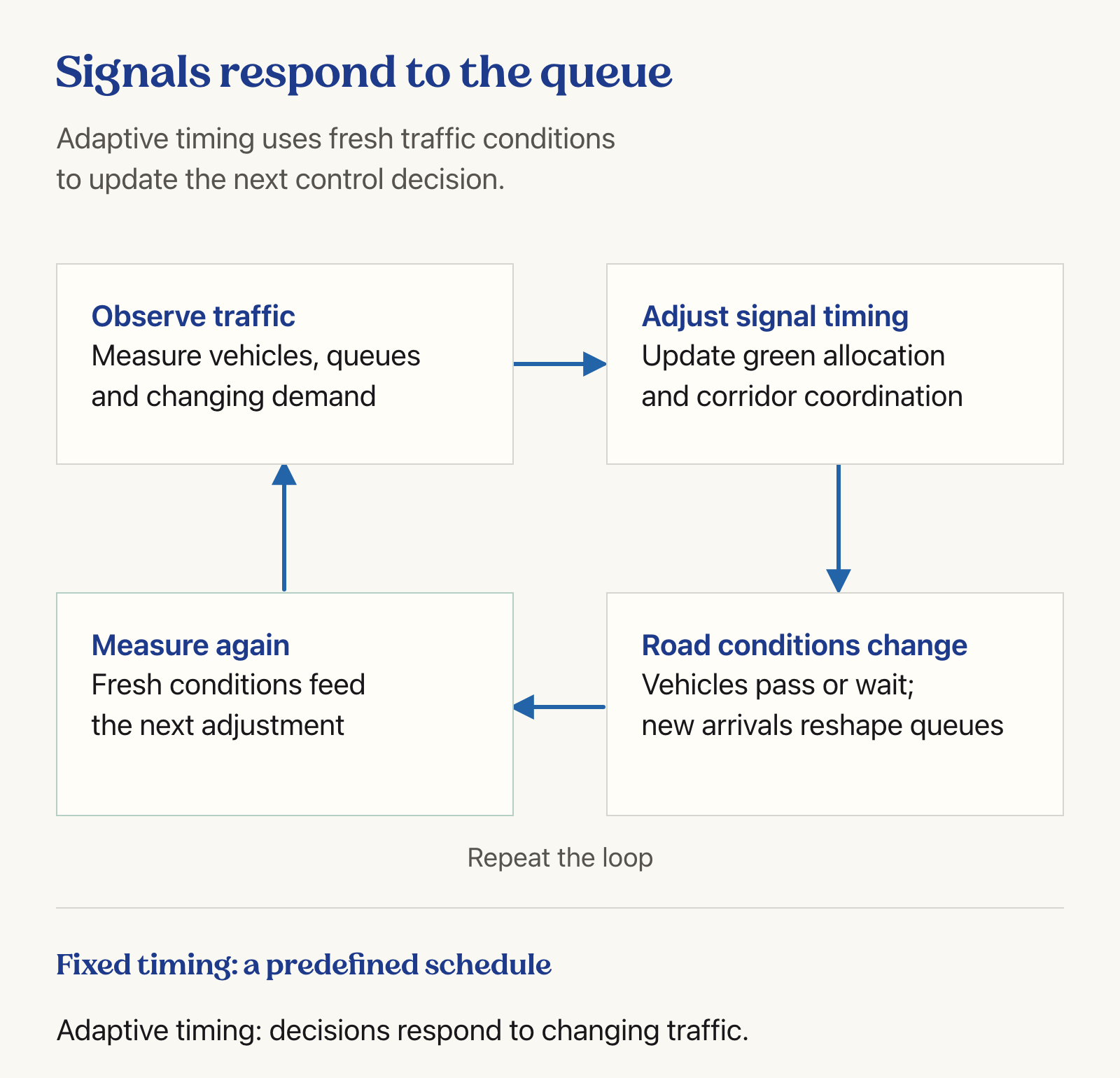
The observe-adjust-measure feedback loop
The general mechanism is a repeating feedback loop; the announcement does not identify a particular algorithm or publish detailed operating thresholds.
- Observe demand: traffic sensors collect information about approaching vehicles and road conditions. This provides the changing input for control decisions; a scheduled plan alone cannot reveal whether the present queue differs from expectations.
- Evaluate and adjust: control software assesses conditions against its operating objectives and modifies signal timing. The Federal Highway Administration describes this sequence without implying that every adaptive system uses the same algorithm.
- Measure again: fresh observations show what happened after the adjustment. Those observations inform later decisions, completing the feedback loop; the system should respond to changing conditions rather than assume its earlier decision remains suitable.
- Coordinate the corridor: linked signals need to account for traffic arriving from upstream junctions. Giving a single approach more green time is not automatically useful if it sends vehicles towards an already blocked exit.
- Maintain dependable inputs: dirty, failed or poorly positioned sensors can weaken decisions. As with reliable sensor measurement, collecting data and obtaining trustworthy information are different tasks requiring technical checks and ongoing maintenance.
Why later phases must earn expansion
Performance gates create an opportunity to test whether installed equipment produces a useful service before the project expands across more corridors.
- Implementation gates link each subsequent Delhi phase to evaluation of its predecessor. Testing that equipment switches on is only part of acceptance; the announcement also explicitly requires assessment against prescribed performance parameters.
- Institutional roles separate implementation by Delhi Police from technical support through C-DAC. The latter’s stated responsibilities include scrutiny, monitoring, validation and acceptance during implementation and operation, rather than merely supplying a general endorsement.
- Evaluation design should compare similar traffic periods and record changes in demand or road works. This is an analytical recommendation: the approval release does not disclose the detailed method or numerical acceptance thresholds.
- Outcome measures should examine delays, queue spillback and journey reliability alongside safe pedestrian movement. The distinction between infrastructure completion and usable access also appears in evaluating rural road outcomes.
- Data governance deserves separate scrutiny because automated enforcement can identify vehicles. Purpose limits, restricted access, retention rules and error appeals are recommended safeguards here, not claims about detailed protections notified with this approval.
Way Forward
Make expansion conditional on service evidence
- Publish intelligible acceptance results for each phase, including reliability and unresolved failures, before expanding deployment.
- Require maintenance and fallback arrangements so defective inputs or communication failures do not leave traffic management dependent on unreliable automated decisions.
- Assess pedestrian and public-transport needs alongside vehicle flow; a shorter car queue alone is an incomplete measure of urban mobility.
- Specify data access controls and error review for enforcement, distinguishing recommended safeguards from protections actually adopted in binding project arrangements.
Conclusion
- Adaptive signalling is a feedback-based allocation of limited junction capacity, not a promise to eliminate congestion. Delhi’s approval makes performance validation especially important because expansion is explicitly tied to preceding-phase assessment.
- In an urban-governance answer, connect observations, control decisions and measured outcomes. Judge procurement by the dependable service delivered to road users, with maintenance and accountability treated as operating requirements rather than later additions.
UPSC Practice Questions
Prelims MCQ 1
With reference to adaptive traffic control, consider the following statements:
- It uses current traffic observations to inform signal-timing adjustments.
- Corridor coordination concerns only one isolated junction.
- Delhi ITMS expansion to subsequent phases depends on evaluation of the preceding phase.
How many of the above statements are correct?
(a) Only one (b) Only two (c) All three (d) None
Answer: (b) Only two
Explanation:
Statements 1 and 3 are correct. Corridor coordination links decisions across successive junctions, so statement 2 is incorrect.
Prelims MCQ 2
Which observation most directly demonstrates the need for corridor-level signal coordination?
(a) Every traffic signal has an electronic display. (b) Faster release at one junction enlarges the queue at the next. (c) A city installs additional administrative computers. (d) A control room receives a new project name.
Answer: (b) Faster release at one junction enlarges the queue at the next.
Explanation:
A junction can improve its own throughput while transferring congestion downstream. Coordination evaluates the linked corridor rather than an isolated signal.
UPSC Mains Questions
- Explain how adaptive traffic signals use feedback to manage urban road demand. Why does corridor coordination matter?
- How can performance-gated procurement improve accountability in intelligent traffic management projects? Discuss measurement, maintenance and data safeguards.
Sources: PIB, Cabinet Committee on Economic Affairs and US Federal Highway Administration.
Frequently Asked Questions
Is Delhi’s approved ITMS already fully operational?
The announcement approves implementation and describes phased delivery. It does not establish that the full system is operating or that projected reductions in traffic delays have already been achieved.
How do adaptive signals differ from fixed-time signals?
Fixed-time signals follow predefined timings. Adaptive systems use current traffic observations to assess conditions and revise timings, repeating the process as demand changes rather than relying entirely on a predetermined schedule.
Does adaptive signalling guarantee congestion-free roads?
No. It can improve the allocation of available signal time, but junction geometry, blocked exits and demand beyond road capacity can still produce congestion even when signal control works properly.
What does C-DAC do in the Delhi project?
C-DAC will provide technical support as Project Management Consultant. Its announced functions include technical scrutiny, monitoring, validation and acceptance during implementation and the operation and maintenance period of the project.