Why in News?
The Technology Development Board announced support on 29 September 2026 for an indigenous multi-gas sensor platform combining a MEMS sensing element with a custom front-end chip.
- Multi Nano Sense Technologies is developing the platform for applications including leak detection, process control and health and safety monitoring.
- The programme aims to advance from TRL-4 to TRL-9; the announcement does not establish that the final readiness level has been achieved.
- Proposed features include auto-calibration, environmental compensation and software-based gas-library processing.
- Integration, testing, validation and scale-up remain part of the supported development programme.
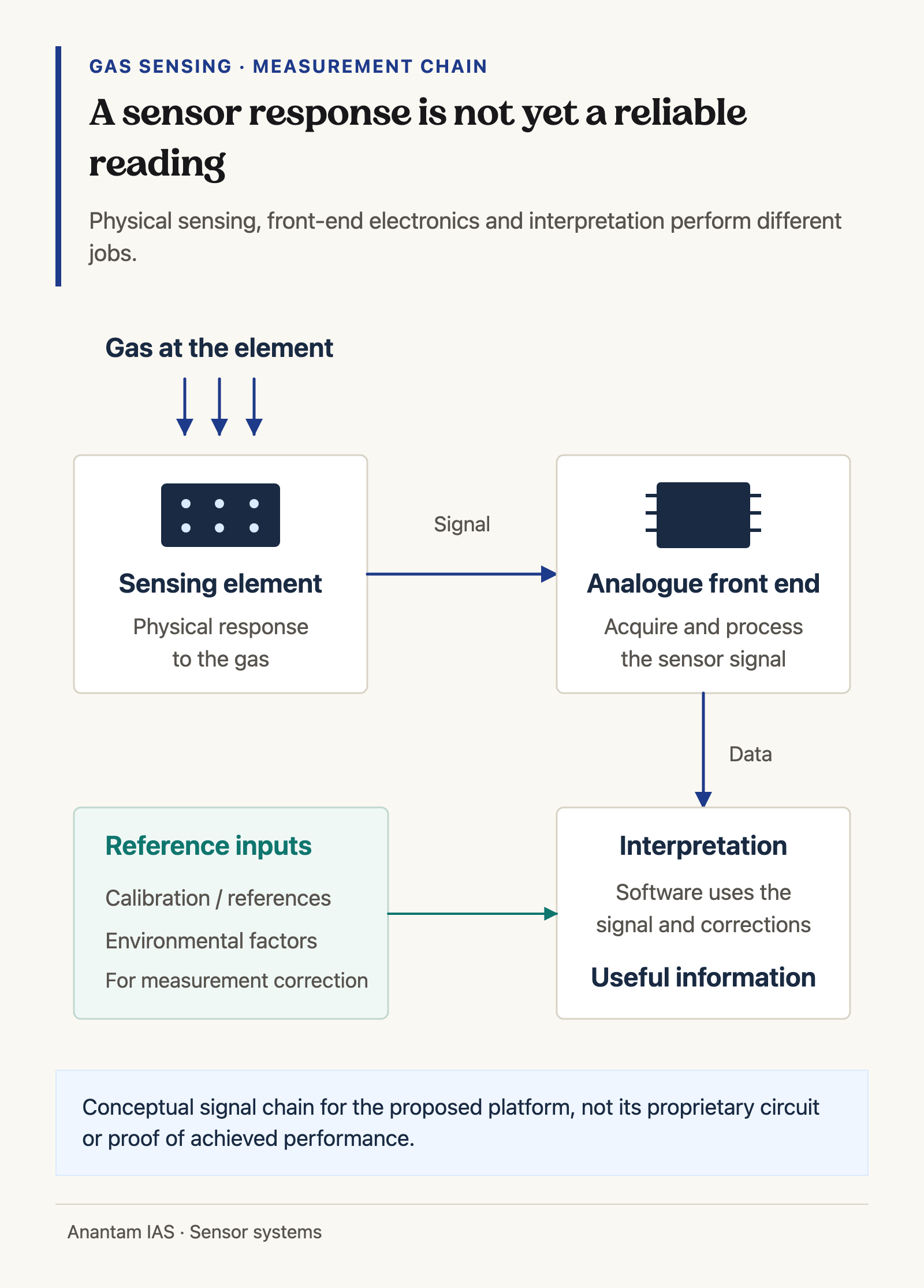
- Sensor reliability depends on the complete measurement chain: a small sensing element is useful only when its response can be acquired and interpreted consistently.
- Indigenous capability involves sensor fabrication, electronics, software and testing together; a funding agreement is an enabling step rather than proof of field performance.
UPSC Relevance
Prelims Relevance
- MEMS: microelectromechanical systems.
- AFE: analogue front end; SoC: system-on-chip.
- Sensing element versus signal acquisition and processing.
- Calibration against reference standards.
- Technology readiness target versus achieved deployment.
Mains Relevance
GS Paper 3
- Domestic capabilities in sensors and semiconductor systems.
- Validation, calibration and industrial adoption of emerging technologies.
Essay
- Trust in technology depends on reliable measurement, not merely smaller devices.
Background and Context
The sensing element and electronics perform different jobs
The proposed platform joins a miniature sensing element to dedicated electronics.
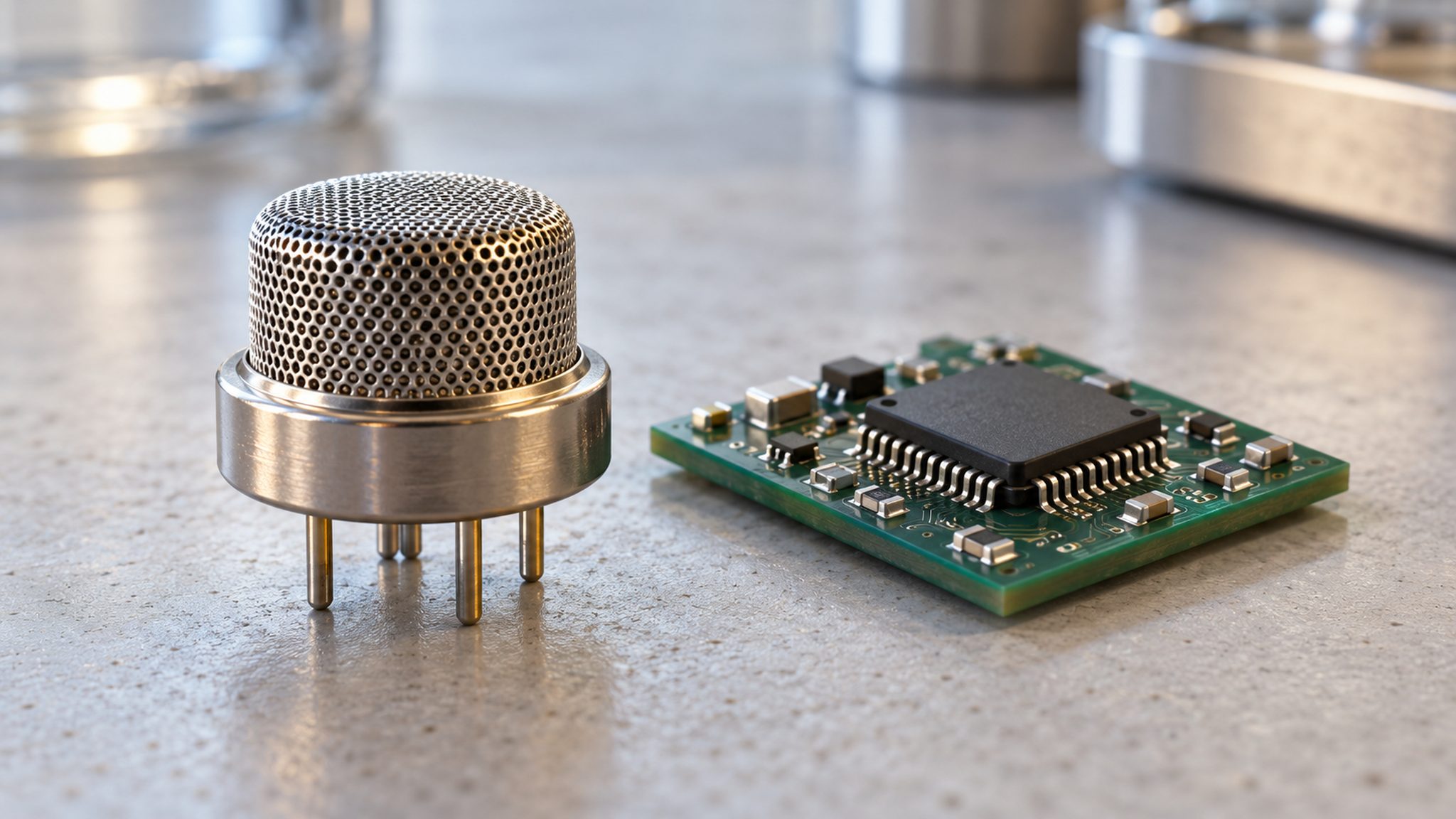
- MEMS stands for microelectromechanical systems, a class of miniature devices combining small physical structures with electronics. The announcement describes a MEMS-based gas-sensing element, rather than an already deployed universal detector.
- The sensing element responds to the gas-related quantity being measured. That response must enter a measurement chain before it can support a useful reading, alarm or process-control decision.
- The analogue front end handles the signal close to the sensor. Here, a custom system-on-chip is being developed for acquisition and processing, connecting the sensing element to subsequent interpretation.
- Integration means designing the element and its electronics to work together. A compact package alone cannot show that the resulting readings are accurate across the intended gases and operating environments.
- The release names a particular sensor architecture but does not explain its detailed physical detection mechanism. Avoid assigning an optical, thermal or quantum operating principle without additional technical documentation.
Calibration connects a response to a meaningful measurement
A signal becomes useful when its relationship to the measured quantity is established and relevant environmental effects are addressed.
- Calibration relates an instrument response to reference standards or a designated measurement process. NIST describes this relationship as the basis for assigning values, rather than treating an unexplained signal as a trustworthy measurement.
- Auto-calibration is a planned feature of this platform. Automation can support the calibration process, but the announcement does not provide a validated protocol or establish that reference checks will never be needed.
- Environmental compensation is also proposed because the platform is intended for demanding industrial conditions. Correction for environmental parameters must be tested; naming the feature does not establish accuracy under every condition.
- Gas-library processing uses software in interpreting the sensor response. The release identifies this feature without publishing a complete validated gas list, concentration range or interference performance for each intended application.
- Multi-gas does not mean every gas. A buyer needs evidence for the gases and conditions relevant to the installation, rather than assuming that a platform label guarantees universal detection capability.
Industrial use makes the whole measurement chain important
Leak detection and process monitoring require evidence tied to their operating conditions.
- For leak detection, a reading must help identify an abnormal release in the intended setting. The announcement identifies this use case; it does not certify the platform for a particular safety installation.
- For process control, measurements inform how an industrial process is operated. Consistent interpretation matters because an output can influence an action, rather than merely appear as a number on a display.
- Low power consumption and a compact architecture are development aims relevant to battery-operated or embedded applications. Their usefulness must be assessed alongside the sensing function, operating conditions and maintenance requirements.
- The targeted rapid response is an engineering objective, not an independently demonstrated result in the announcement. Avoid presenting proposed response time or package dimensions as specifications of a proven commercial product.
- Hydrogen infrastructure, refineries and energy systems appear among potential applications. This indicates the intended market breadth, not completed deployment, procurement, approval or proven performance in every listed industry.
Readiness advances through evidence, not announcements
The supported programme includes further development, integration, testing, validation and scale-up before its stated final readiness objective.
- Technology readiness levels describe maturity. The stated movement from TRL-4 to TRL-9 is the programme objective; it must not be reported as a journey already completed when the agreement is announced.
- Validation should address the intended application and operating conditions. For public assessment, distinguish a proposed feature, a laboratory finding and demonstrated use; each supports a different strength of claim.
- Scale-up concerns making the integrated platform reproducibly, beyond an individual working device. This makes manufacturing consistency and testability relevant to industrial capability alongside the originality of the sensing design.
- The release places the project in a funding Quantum Technology sub-sector, but describes MEMS and semiconductor electronics. An administrative classification alone does not establish that the gas sensor uses a quantum-sensing mechanism.
Way Forward
Specify the evidence required for adoption
- Publish the validated gas list, measurement ranges and operating conditions so users can assess suitability for a particular application.
- Report calibration and interference testing alongside response performance; separate design targets from measured outcomes.
- Require application-specific validation before safety-critical deployment, with documented maintenance and verification procedures.
Conclusion
- A multi-gas sensor platform combines sensing, electronics and interpretation. Its value depends on whether that chain produces reliable information for a defined application, not only on miniaturisation or the funding announcement.
- Use this example to connect semiconductor capability with measurement science: calibration and validation turn an engineering design into evidence that industry can assess. The announced readiness goal remains a goal.
UPSC Practice Questions
Prelims MCQ 1
With reference to the proposed MEMS multi-gas sensing platform, consider the following statements:
- The sensing element is combined with a custom front-end chip for signal acquisition and processing.
- The agreement establishes that TRL-9 has already been achieved.
- The expression multi-gas establishes detection of every gas.
How many of the above statements are correct?
(a) Only one (b) Only two (c) All three (d) None
Answer: (a) Only one
Explanation:
Only the first statement is correct. TRL-9 is an objective, and the release does not establish universal gas detection.
Prelims MCQ 2
Which statement best describes calibration in a measurement system?
(a) Reducing a device to the smallest possible package. (b) Relating instrument response to reference standards or a designated measurement process. (c) Removing the need for future performance assessment. (d) Establishing that every gas produces the same response.
Answer: (b) Relating instrument response to reference standards or a designated measurement process.
Explanation:
Calibration establishes the relationship used to assign measurement values. It is distinct from miniaturisation and does not by itself prove performance under every operating condition.
UPSC Mains Questions
- Explain how sensing elements, front-end electronics and calibration together determine the usefulness of industrial gas sensors.
- Why should support for indigenous sensor technologies be assessed through validation and scale-up evidence as well as design capability?
Sources: PIB, Ministry of Science and Technology and NIST: Calibration.
Frequently Asked Questions
What does MEMS mean in this sensor project?
MEMS means microelectromechanical systems. The proposed platform combines a miniature gas-sensing element with dedicated semiconductor electronics for acquisition and processing; the announcement does not establish completed commercial deployment.
What does the analogue front end do?
The analogue front end handles signals close to the sensing element. In this project, a custom front-end system-on-chip is being developed for signal acquisition and processing within the integrated gas-sensing platform.
Has the platform already reached TRL-9?
No such achievement is established by the announcement. Advancing from TRL-4 to TRL-9 is the programme objective, with further development, integration, testing, validation and scale-up included in the supported work.
Does multi-gas mean the sensor detects every gas?
No. The term indicates an intended capability involving multiple gases. The release does not provide a complete validated gas list or establish detection performance for every gas, concentration or industrial environment.
Tell Google you want more of this.
Add Anantam IAS as a preferred sourceOne tap, and this site shows up more often in your own Top Stories, AI Overviews and AI Mode. Remove it any time.