Why in News?
On 29 September 2026, the Ministry of Rural Development announced an NRIDA-IIM Kolkata agreement for a four-year rural roads impact assessment covering PMGSY-IV and PM-JANMAN.
- The longitudinal study will collect baseline information before road construction and endline information after construction.
- Its proposed outcomes include travel time, transport costs, livelihoods and access to essential services.
- The assessment will examine differences across regions and vulnerable groups, alongside the sustainability of benefits.
- The announcement commissions research; it does not report measured improvements or completed evaluation findings.
- A completed road is an infrastructure output; dependable access to a clinic or market is an outcome requiring further evidence.
- Repeated observation can reveal changes over time, but isolating the road’s contribution requires attention to other simultaneous changes.
UPSC Relevance
Prelims Relevance
- NRIDA: National Rural Infrastructure Development Agency, under the Ministry of Rural Development.
- Baseline: measurement before the intervention being assessed.
- Endline: follow-up measurement after the intervention.
- Longitudinal assessment: observation across time rather than a single snapshot.
- Output versus outcome: completed infrastructure versus changes experienced by people.
Mains Relevance
GS Paper 3
- Rural connectivity, market access and complementary services.
- Infrastructure outcomes and sustained benefits.
GS Paper 2
- Evidence-based policy evaluation and unequal access across vulnerable groups.
Essay
- Development should be judged by usable opportunities, not only by completed assets.
Background and Context
How roads can change access
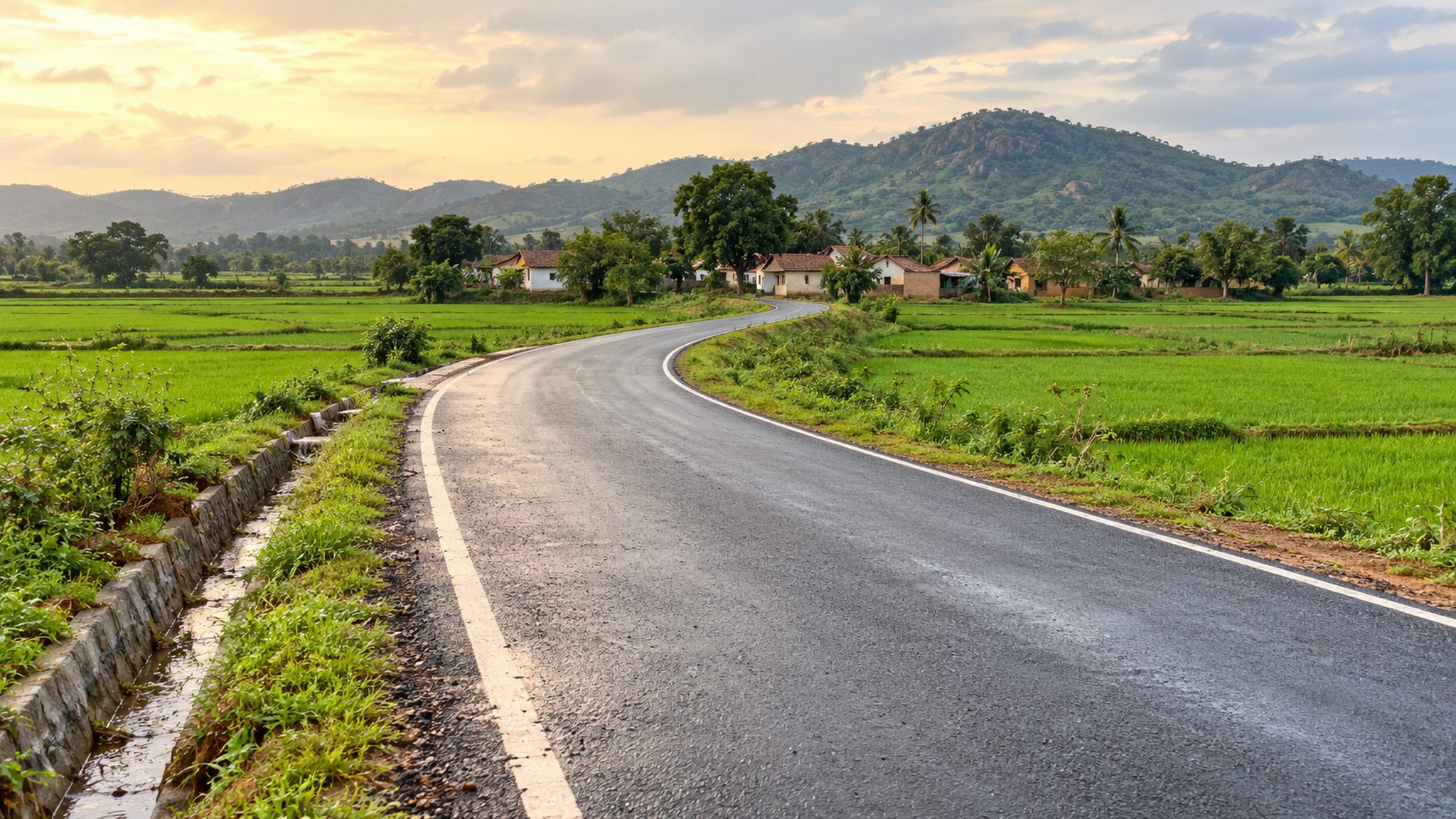
A rural road matters through the journeys it enables, so the study must connect construction with changes in everyday access.
- Physical connectivity can reduce the difficulty of reaching markets, schools and health facilities. The relevant question is whether households can make these journeys reliably.
- Travel time and transport costs are useful intermediate outcomes: they show whether connecting a settlement makes movement easier before assuming that household incomes or welfare have improved.
- For farm households, easier movement may widen choices of buyers and input suppliers. Whether this raises earnings also depends on prices, production conditions and the availability of affordable transport services.
- For healthcare and education, a shorter route is only part of effective access. A usable facility, suitable opening hours and transport must also be available at the destination when needed.
- The announced study includes employment, migration and income diversification. These are outcomes to investigate, rather than benefits already established by the signing of the agreement or the completion of roads.
What baseline and endline surveys establish
The proposed design starts before construction, giving later observations a reference point rather than relying entirely on memories of earlier conditions.
- A baseline survey records conditions before the road intervention. Later measurements can then examine how mobility, access and household circumstances changed from that starting point.
- An endline survey records conditions after construction. Its value depends on measuring comparable concepts, such as the journey to a health facility, consistently across the observations used in the analysis.
- Longitudinal evidence places observations in sequence. This helps distinguish an initial change after construction from a benefit that persists, although the release does not provide the complete survey instrument.
- Seasonal comparability matters when interpreting rural access: a dry-season journey and a monsoon journey may differ even without construction. Evaluators should account for survey timing before attributing the difference to roads.
- Household follow-up also needs care if people move or become difficult to contact. Losing some respondents can change the apparent results if those missing differ systematically from those still observed.
Why change does not automatically establish causation
A before-and-after difference describes change; identifying how much the road caused requires a stronger account of what else changed.
- Other influences, including harvest conditions, employment opportunities and new public services, can affect household outcomes during construction. An income increase afterwards cannot automatically be assigned entirely to the new road.
- The counterfactual is what would have happened without the intervention. It cannot be observed directly for the same household at the same time, which creates the central challenge of impact evaluation.
- Comparable areas with different construction timing could help assess broader trends, if chosen carefully. This is a methodological recommendation; the announcement does not establish that such comparison groups are included.
- Selection differences need attention because connected and unconnected settlements may differ before construction. Simply comparing their later incomes can confuse the road’s contribution with advantages or disadvantages already present beforehand.
- Transparent limitations make findings more useful. As with local labour estimates, readers need to know which population the evidence represents before extending conclusions beyond the people and places actually studied.
Who benefits, and whether benefits last
The study also proposes examining vulnerable groups and sustainability, which adds an inclusion question beyond average improvements in access.
- Average outcomes can conceal unequal gains. A useful assessment should ask whether women and disadvantaged households experience improved access, rather than assuming a settlement-level connection changes everybody’s opportunities equally.
- Affordability and safety can constrain use even when a route exists. Evaluators should distinguish being physically connected from being able to make a necessary journey under realistic household conditions.
- Service continuity matters after construction: disruptions can reverse an initial improvement in access. Follow-up evidence should examine whether useful journeys remain possible instead of treating opening-day connectivity as a lasting result.
- Outcome evaluation complements independent checks on programme assets. Verifying that infrastructure exists and examining how people’s lives change answer related questions, but neither task fully substitutes for the other.
Way Forward
Design evidence for decisions
- Publish measurement definitions, survey timing and analytical limitations so programme managers can judge what observed changes establish.
- Use credible comparison strategies where feasible, explaining how selection differences and wider economic changes are addressed.
- Report distributional results alongside averages, and investigate the transport or service constraints that prevent households from using improved connectivity.
Conclusion
- Rural road evaluation should follow the chain from a completed route to usable journeys and sustained household opportunities. Each step requires evidence rather than an assumption of automatic benefits.
- The proposed study creates an opportunity for better outcome evidence; it has not yet demonstrated impact. In a Mains answer, distinguish measured change from a defensible estimate of causation.
UPSC Practice Questions
Prelims MCQ 1
With reference to the announced rural roads impact assessment, consider the following statements:
- Baseline information is to be collected before road construction.
- Endline information is to be collected after road construction.
- The agreement announcement establishes that household incomes have already increased because of the roads.
How many of the above statements are correct?
(a) Only one (b) Only two (c) All three (d) None
Answer: (b) Only two
Explanation:
The proposed study includes pre-construction baseline and post-construction endline surveys. The announcement describes a commissioned assessment, not completed impact findings.
Prelims MCQ 2
Why does a rise in household income after road construction not, by itself, establish the road’s causal impact?
(a) Income cannot be studied through household surveys (b) Roads cannot influence market access (c) Other changes may also have affected income during the same period (d) Baseline measurements are always unnecessary
Answer: (c) Other changes may also have affected income during the same period
Explanation:
Before-and-after change can reflect the road, wider economic conditions or other interventions. Causal assessment must consider what would likely have happened without the road.
UPSC Mains Questions
- Distinguish infrastructure outputs from development outcomes. How can a longitudinal assessment improve the evaluation of rural road connectivity?
- Why is a before-and-after comparison insufficient to establish causal impact? Discuss the methodological and inclusion safeguards required when evaluating rural infrastructure.
Source: PIB, Ministry of Rural Development.
Frequently Asked Questions
What has been announced for rural road evaluation?
NRIDA and IIM Kolkata have signed an agreement for a four-year longitudinal assessment of roads under PMGSY-IV and PM-JANMAN. It proposes examining changes in access, mobility and household conditions.
What is the difference between baseline and endline surveys?
A baseline records conditions before the intervention. An endline records conditions afterwards. Comparable measurements help identify changes, but that difference alone does not establish how much the intervention caused.
What outcomes will the study examine?
The announced scope includes travel time, transport costs, livelihoods, employment, education, healthcare and access to public and financial services. It also proposes examining vulnerable groups and the sustainability of benefits.
Does the announcement confirm that comparison groups will be used?
No. The release describes baseline and endline surveys without specifying a comparison-group design. Suitable comparisons are a recommended evaluation safeguard, not a confirmed feature of the announced study.
Tell Google you want more of this.
Add Anantam IAS as a preferred sourceOne tap, and this site shows up more often in your own Top Stories, AI Overviews and AI Mode. Remove it any time.