Brazil Suspends a Dengue Vaccine: What It Means for India’s DengiAll
Why in News?
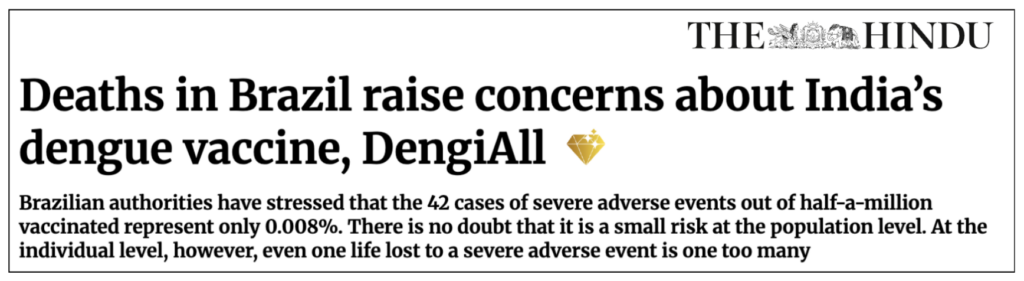
In mid-June 2026, Brazil temporarily suspended its national rollout of a single-dose dengue vaccine made by the Butantan Institute, after pharmacovigilance data flagged two deaths and a cluster of serious adverse events among people already vaccinated. The Health Minister stressed the pause is precautionary and that there is not yet enough data to prove the vaccine caused the deaths.
The episode draws Indian attention because the Butantan vaccine and India’s own indigenous candidate, DengiAll (developed by the ICMR with Panacea Biotec), trace back to the SAME parent strain — the TV003/TV005 live-attenuated tetravalent strain originally engineered by the U.S. National Institutes of Health (NIH).
DengiAll is in late-stage Phase 3 trials in a high-dengue-burden country, so a safety signal in a sister vaccine is a watch-point, not a verdict.
- The suspended product is the Butantan Institute’s single-dose vaccine, approved by Brazil’s regulator ANVISA in late 2025 and rolled out from February 2026.
- About 501,000 people had been vaccinated; pharmacovigilance recorded 2 deaths and roughly 42 severe adverse cases (intense abdominal pain, persistent vomiting, bleeding).
- Officials called it a precautionary suspension — no causal link established — while ANVISA and the health ministry analyse the data.
- This is a DIFFERENT vaccine from Takeda’s two-dose Qdenga (TAK-003), which continues to be used in Brazil and is unaffected by this pause.
The development matters in the context of:
- Dengue vaccines are famously hard to design because the virus has four serotypes, and prior immunity can paradoxically worsen later infection through antibody-dependent enhancement (ADE).
- India carries one of the world’s heaviest dengue burdens, so the safety and roll-out path of any tetravalent vaccine is a major public-health and regulatory question.
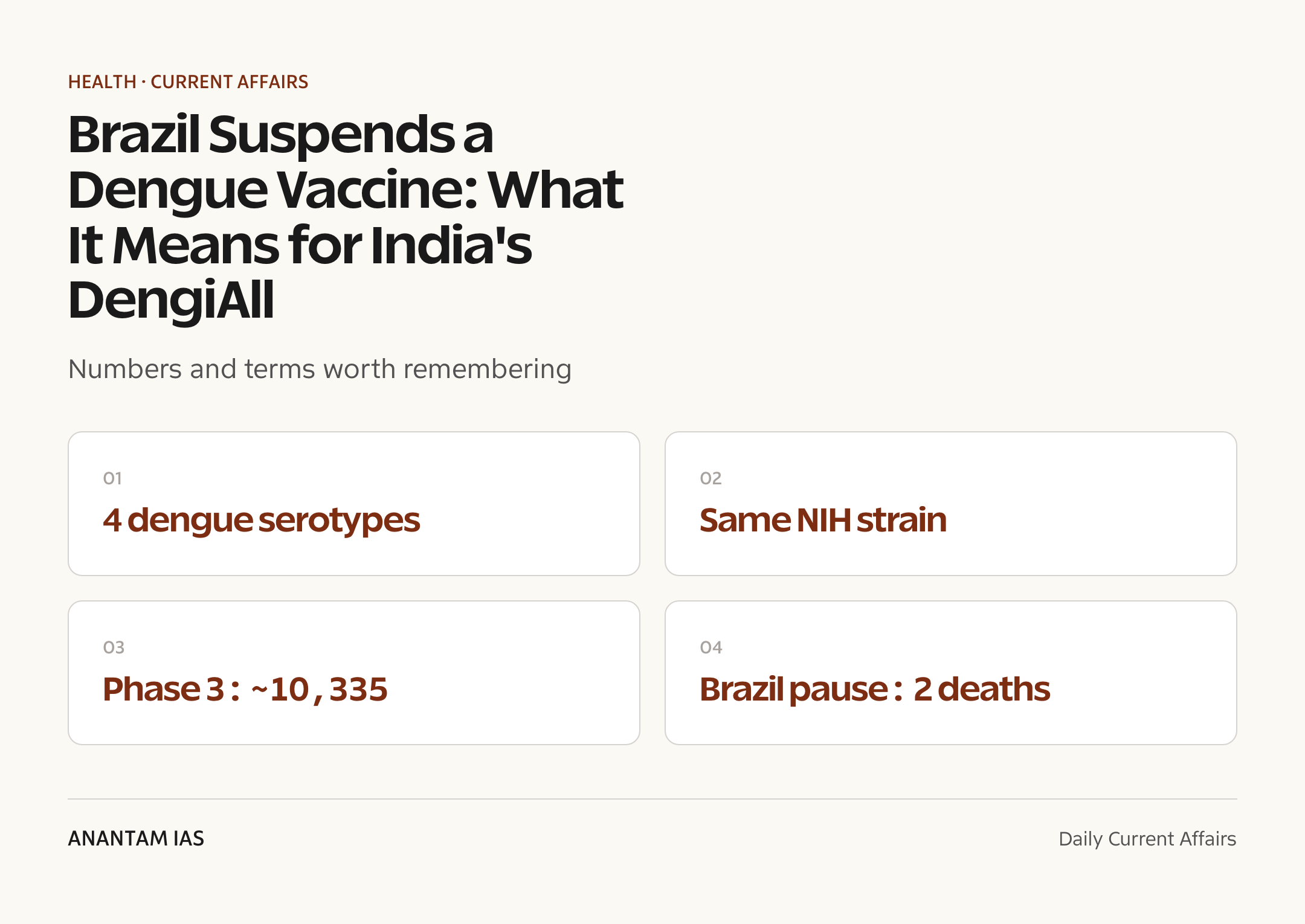
UPSC Relevance
Prelims Relevance
- Dengue — a viral disease spread by Aedes aegypti mosquitoes; four serotypes: DENV-1 to DENV-4
- Antibody-Dependent Enhancement (ADE) — antibodies from one serotype worsen a later infection by a different serotype
- DengiAll — India’s indigenous tetravalent live-attenuated dengue vaccine (ICMR + Panacea Biotec)
- TV003/TV005 — parent strain developed by the U.S. NIH, licensed to both Panacea Biotec and Butantan in 2008
- ICMR — Indian Council of Medical Research, apex biomedical research body
- CDSCO and the DCGI — India’s drug regulator and Drugs Controller General for vaccine approval
- Qdenga (TAK-003) — Takeda’s two-dose dengue vaccine; Dengvaxia (CYD-TDV) — Sanofi’s vaccine restricted to seropositives
- WHO SAGE and GACVS — WHO advisory bodies on immunisation and vaccine safety
- Pharmacovigilance — monitoring of adverse events following immunisation (AEFI)
- Live-attenuated vaccine — uses a weakened virus to trigger immunity without causing disease
Mains Relevance
GS Paper 3
- Indigenisation of technology and developing new vaccines; India’s biotechnology and public-health R&D capacity.
- Science and ethics of clinical trials, Phase 3 design, and post-marketing safety surveillance.
GS Paper 2
- Issues relating to development and management of the health sector; the role of regulators (CDSCO/DCGI) and global bodies (WHO).
- Government policies for a high-burden vector-borne disease and the public-trust dimension of vaccine roll-outs.
Essay
- Science advances by learning from failure as much as from success.
- Self-reliance in health: the promise and the responsibility of an indigenous vaccine.
Background and Context
What Brazil actually suspended — and what it did not
The pause hit one specific vaccine; precision matters because several dengue vaccines coexist.
- The suspended product is the Butantan Institute’s single-dose tetravalent vaccine, the world’s first single-dose dengue shot, approved by ANVISA in late 2025.
- Roll-out began in February 2026; by mid-June, about 501,000 people had received it, mostly priority groups such as health workers.
- Pharmacovigilance flagged 2 deaths and around 42 severe adverse cases; the health ministry ordered a precautionary suspension pending analysis.
- Officials, including Health Minister Alexandre Padilha, were explicit that no cause-and-effect link has been established — the deaths are a signal to investigate, not a proven harm.
- Takeda’s two-dose Qdenga (TAK-003) is a separate product and was NOT suspended; this is not a blanket dengue vaccine ban.
Why dengue vaccines are uniquely hard
Dengue defeats the usual one-virus-one-vaccine logic, which is why safety signals are watched so closely.
- Dengue has four distinct serotypes (DENV-1 to DENV-4); recovering from one gives only short-lived cross-protection against the others (see our explainer on dengue in India).
- Antibody-Dependent Enhancement (ADE) means antibodies raised against one serotype can bind a different serotype and help it enter cells more efficiently, making a SECOND infection more severe.
- A vaccine that primes the immune system imperfectly can mimic a first infection and risk worsening a later natural infection — the core safety puzzle.
- This is why a dengue vaccine must be truly tetravalent — protecting against all four serotypes in balance — rather than dominant against just one.
- Long-term post-marketing surveillance matters more than for most vaccines, because risks like enhanced disease can appear only years after vaccination.
The Dengvaxia precedent — the cautionary tale
An earlier dengue vaccine showed exactly how ADE can turn protection into harm, shaping today’s caution.
- Dengvaxia (CYD-TDV), made by Sanofi Pasteur, was rolled out in a school programme in the Philippines in 2016.
- Follow-up data showed higher rates of severe dengue and hospitalisation among seronegative children — those with no prior dengue infection — consistent with ADE.
- The Philippines suspended the programme in 2017 after more than 800,000 children had received at least one dose, triggering a major public-trust crisis.
- The WHO now recommends Dengvaxia only for people with a confirmed prior dengue infection (seropositives).
- The lesson embedded in modern dengue R&D: balanced tetravalent immunity and rigorous safety monitoring are non-negotiable.
India’s DengiAll — the indigenous candidate
DengiAll is India’s bid for an affordable, home-made dengue vaccine, now in its decisive trial phase.
- DengiAll is a tetravalent, live-attenuated dengue vaccine co-developed by the ICMR and Panacea Biotec (compare the major vaccine types).
- It is built on the TV003/TV005 strain from the U.S. NIH, the SAME parent strain that Butantan licensed — both companies took it up in 2008.
- Panacea Biotec re-engineered the formulation so it can be stored at routine 2–8 degrees Celsius, instead of the deep-freeze the original NIH strain needed.
- The Phase 3 trial enrolled about 10,335 healthy adult participants across roughly 19 sites in 18 states/UTs, with two years of follow-up.
- Earlier Phase 1 and Phase 2 trials (2018–19) gave encouraging immunogenicity results; market availability is anticipated around 2027 if data hold.
Why the Brazil signal is relevant — and why it is not a DengiAll verdict
Shared genetics create a watch-point, but the two vaccines are not identical products.
- The shared TV003/TV005 backbone means Indian regulators and ICMR will study Brazil’s safety data for any common mechanism.
- But formulation, manufacturing, dosing schedule and the trial populations differ — a signal in one is a prompt to verify, not proof for the other.
- DengiAll’s own Phase 3 data and India-specific safety monitoring, not Brazil’s roll-out, will decide its fate.
- India’s regulator CDSCO (via the DCGI) and an independent data-safety board are the gatekeepers before any approval.
- Transparent, timely communication — as Brazil attempted — is itself part of protecting public trust in a future Indian roll-out.
India’s dengue burden — the stakes
A working dengue vaccine would matter enormously because India faces large, recurring outbreaks.
- India reports lakhs of dengue cases each monsoon; the NCVBDC (National Centre for Vector-Borne Diseases Control) recorded over 1.8 lakh cases in 2024 by late October.
- DENV-2 has been the predominant circulating serotype across many Indian states in recent seasons, with newer lineages emerging.
- All four serotypes circulate in India, so any vaccine must protect broadly to be useful — raising the ADE stakes.
- Current control relies almost entirely on vector management (source reduction, fogging) and supportive clinical care, with no vaccine in routine use.
- An affordable indigenous vaccine like DengiAll could be a major addition to the public-health toolkit and India’s wider science and technology capacity, which is exactly why its safety bar is set high.
Way Forward
Investigate transparently
- Let ANVISA and Brazil’s health ministry complete the causality analysis; India’s ICMR should review the findings for any strain-level lessons.
- Share pharmacovigilance data openly so that a precautionary pause does not harden into avoidable vaccine hesitancy.
Strengthen India’s safety machinery
- Reinforce AEFI surveillance and an independent data-safety monitoring board around the DengiAll trial.
- Ensure CDSCO/DCGI evaluate India-specific Phase 3 and long-term follow-up data before any approval.
Pair vaccines with vector control
- Keep investing in Aedes source reduction, community sanitation and early-warning surveillance — a vaccine complements, not replaces, vector control.
- Build clear public communication so a future roll-out is trusted and well-targeted.
Conclusion
Brazil’s pause is a textbook example of vaccine pharmacovigilance working as intended — a signal triggers a precautionary halt and an investigation, before any causal claim is made. For a disease as immunologically tricky as dengue, that caution is a feature, not a failure.
For India, the message is one of attentive optimism. DengiAll shares a strain with Brazil’s vaccine but is its own product, and only its own Phase 3 and safety data can decide its future. The episode underlines that an indigenous dengue vaccine is worth pursuing precisely because India’s burden is huge — and that it must clear an unusually high safety bar before reaching the public.
UPSC Practice Questions
Prelims MCQ 1
With reference to dengue and dengue vaccines, consider the following statements:
- The dengue virus has four distinct serotypes, DENV-1 to DENV-4.
- Antibody-Dependent Enhancement (ADE) refers to a phenomenon where prior antibodies can make a subsequent dengue infection more severe.
- India’s DengiAll and Brazil’s Butantan dengue vaccine are derived from the same NIH TV003/TV005 parent strain.
How many of the above statements are correct?
(a) Only one (b) Only two (c) All three (d) None
Answer: (c) All three
Explanation:
All three are correct. Dengue has four serotypes; ADE explains why a second, different-serotype infection can be worse; and both DengiAll and the Butantan vaccine trace to the NIH-developed TV003/TV005 strain licensed in 2008.
Prelims MCQ 2
Which one of the following statements about DengiAll is correct?
(a) It is an inactivated (killed-virus) vaccine targeting only DENV-2.
(b) It is a tetravalent, live-attenuated vaccine developed by ICMR with Panacea Biotec.
(c) It is manufactured by Takeda and marketed as Qdenga.
(d) It has already received WHO prequalification and is in routine use in India.
Answer: (b) It is a tetravalent, live-attenuated vaccine developed by ICMR with Panacea Biotec.
Explanation:
DengiAll is a tetravalent live-attenuated candidate from ICMR and Panacea Biotec, in Phase 3 trials. Qdenga is Takeda’s separate vaccine, and DengiAll is not yet in routine use.
UPSC Mains Questions
- Dengue vaccines are uniquely difficult to develop. Explaining the roles of serotype diversity and antibody-dependent enhancement, discuss the safety challenges that India’s indigenous dengue vaccine programme must address. (250 words)
- “A precautionary suspension is a sign that pharmacovigilance is working, not failing.” Examine this statement in the context of recent dengue vaccine safety signals and India’s regulatory readiness. (250 words)
- Why does India need an affordable indigenous dengue vaccine, and what institutional safeguards should accompany its roll-out? Critically analyse. (150 words)
Sources: The Hindu and The Hindu.
Frequently Asked Questions
Which vaccine did Brazil suspend?
Brazil temporarily suspended the single-dose dengue vaccine made by its Butantan Institute, after pharmacovigilance flagged two deaths and several severe adverse events among the roughly 501,000 people vaccinated. The health ministry called it a precautionary pause, stressing that no causal link to the vaccine has yet been established. Takeda’s separate Qdenga vaccine was not affected.
Is this the same as India’s DengiAll?
No, but they are related. DengiAll, developed by ICMR and Panacea Biotec, and Brazil’s Butantan vaccine are both built on the same parent strain, TV003/TV005, originally engineered by the U.S. NIH. However, the formulation, dosing and manufacturing differ, so a safety signal in one is a prompt to investigate, not proof of risk in the other.
What is antibody-dependent enhancement (ADE)?
ADE is the reason dengue vaccines are so hard to make. After infection with one of the four dengue serotypes, the antibodies you develop can bind a different serotype during a later infection and actually help the virus enter cells, making that second infection more severe. A vaccine that mimics a first infection imperfectly can risk the same effect.
What is DengiAll and what stage is it at?
DengiAll is India’s first indigenous dengue vaccine, a tetravalent live-attenuated shot from ICMR and Panacea Biotec. It is in Phase 3 trials, which enrolled about 10,335 adult participants across roughly 19 sites in 18 states and union territories, with two years of follow-up. If the data hold, market availability is anticipated around 2027.
Why does India need a dengue vaccine?
India carries one of the world’s heaviest dengue burdens, with lakhs of cases each monsoon and all four serotypes in circulation. Control today relies on mosquito management and supportive care, with no vaccine in routine use. An affordable, home-made vaccine like DengiAll could be a major public-health tool, which is exactly why its safety bar is set so high.
Who decides if DengiAll is safe to use in India?
India’s drug regulator, the CDSCO, acting through the Drugs Controller General of India (DCGI), evaluates the trial data before any approval. An independent data-safety monitoring board oversees the trial, and AEFI surveillance tracks adverse events. Global bodies like the WHO’s SAGE and GACVS also shape best practice, but the national approval decision rests with CDSCO.