Digitalising India’s Dairy Sector: Data, Traceability and Farmer Incomes
Why in News?
India’s dairy economy is being rewired around digital public infrastructure. The Department of Animal Husbandry and Dairying (DAHD) and the National Dairy Development Board (NDDB) are scaling animal tagging, a unique-ID livestock database and electronic milk-procurement systems to raise productivity, build disease traceability and protect farmer incomes.
India remains the world’s largest milk producer, accounting for roughly 24% of global milk output, with the sector anchored in millions of small and marginal households organised through dairy cooperatives such as Amul and the wider NDDB network.
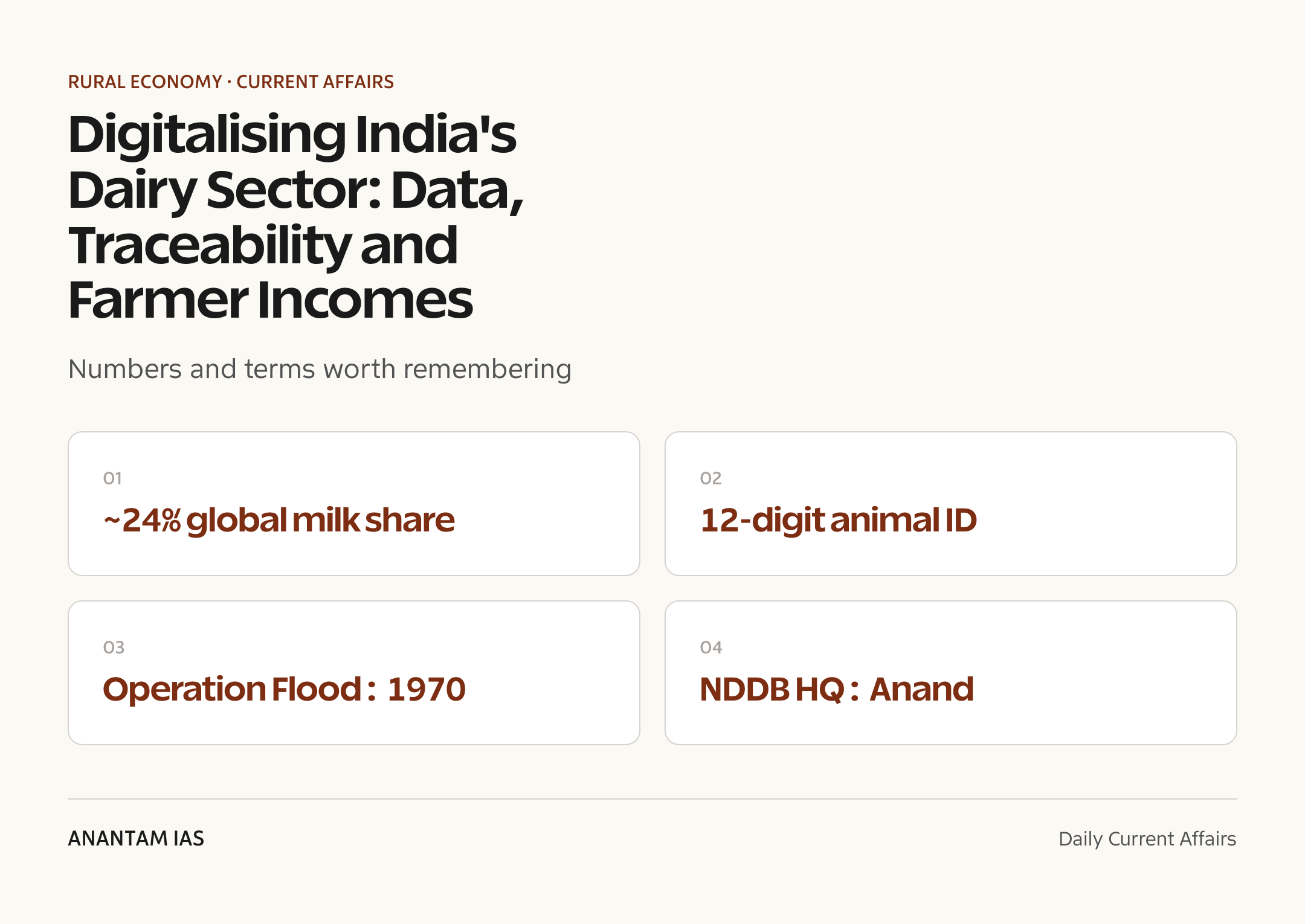
- Pashu Aadhaar: Each bovine receives a 12-digit unique identification number linked to a polyurethane ear tag for nationwide tracking.
- INAPH database: The Information Network for Animal Productivity and Health records breeding, nutrition and health data animal-by-animal.
- NDLM: The National Digital Livestock Mission aims to build a unified data architecture for the livestock and dairy sector.
- Largest producer: India produces about 24% of global milk, the single biggest national share.
- e-markets: Electronic milk-collection units and automated fat/SNF testing speed up transparent, real-time payments to farmers.
The development matters in the context of:
- Smallholder base: Dairying is mostly a side-occupation for small, marginal and landless households, making it a key rural livelihood and income smoother.
- Cooperative spine: The Anand pattern of cooperatives links village societies to district unions and state federations, cutting out middlemen.
- Productivity gap: Indian milk yield per animal is below the global average, so breeding and feeding data are central to closing the gap.
UPSC Relevance
Prelims Relevance
- Operation Flood and the White Revolution — Verghese Kurien and the Anand pattern of dairy cooperatives.
- National Dairy Development Board (NDDB) — statutory body under an Act of Parliament (1987), headquartered at Anand, Gujarat.
- Rashtriya Gokul Mission — conservation and development of indigenous bovine breeds.
- INAPH — Information Network for Animal Productivity and Health, maintained for breeding and health records.
- National Digital Livestock Mission (NDLM) and the unique animal-ID tagging (Pashu Aadhaar) system.
- National Programme for Dairy Development (NPDD) — strengthens milk procurement, processing and chilling infrastructure.
- Department of Animal Husbandry and Dairying (DAHD) sits under the Ministry of Fisheries, Animal Husbandry and Dairying.
- India’s share in global milk production (about 24%) and its status as the largest producer.
Mains Relevance
GS Paper 3
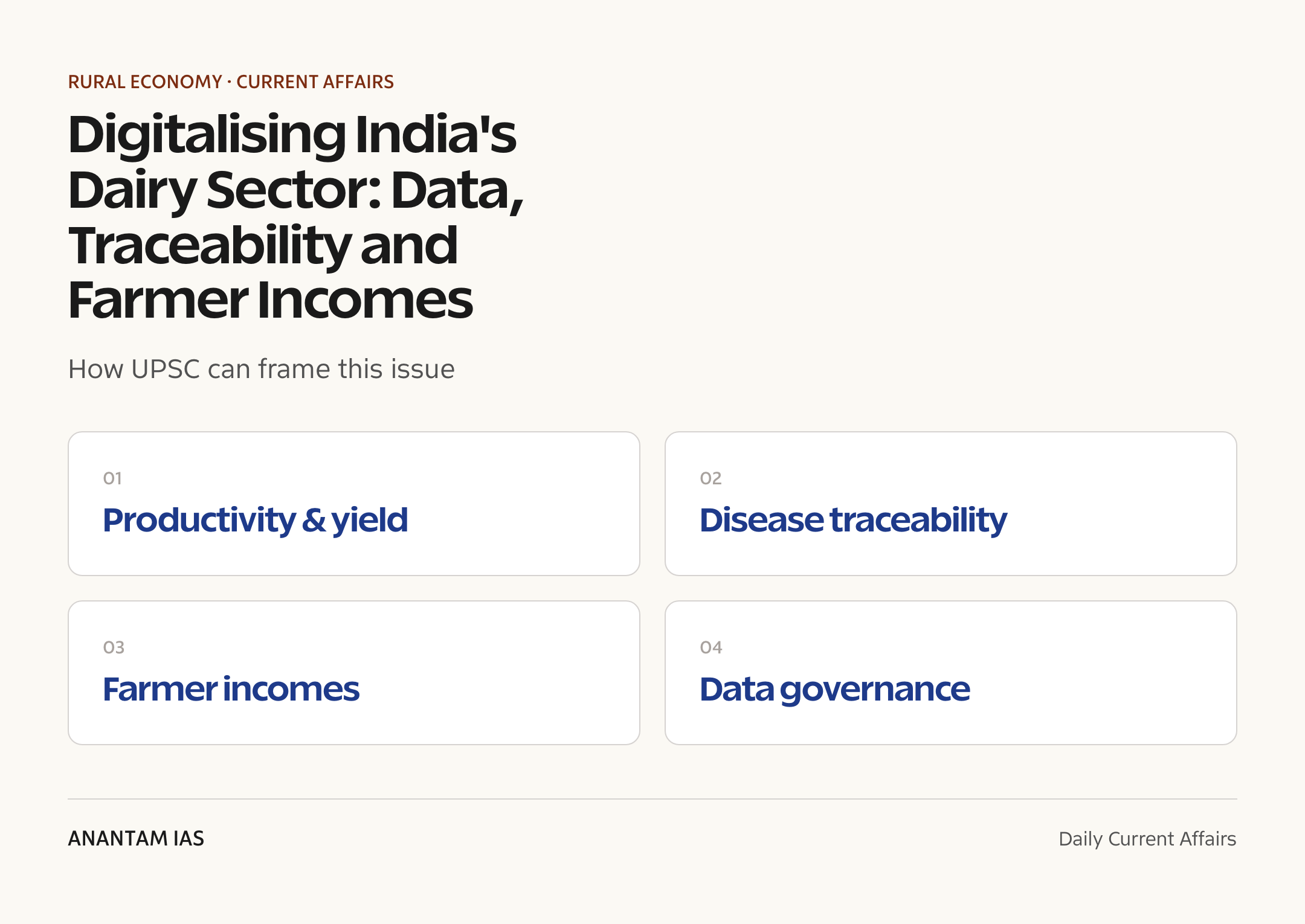
- Examine how digital public infrastructure in animal husbandry can raise productivity and farmer incomes.
- Assess the role of dairy cooperatives in inclusive rural growth and the post-harvest value chain.
- Discuss disease traceability and food safety as economic and public-health priorities for the dairy sector.
GS Paper 2
- Evaluate the design and delivery of livestock-sector government schemes and the data-privacy questions a national animal database raises.
Essay
- Use as evidence in essays on technology and rural transformation, the digital economy, or doubling farmer incomes.
- Relevant to themes on cooperatives, self-reliance and inclusive growth in the agrarian economy.
Background and Context
From Operation Flood to a digital dairy
The sector’s foundations sit in the cooperative White Revolution.
- Operation Flood: Launched in 1970 under Verghese Kurien and the NDDB, the White Revolution made India self-sufficient in milk through the Anand pattern of cooperatives.
- White Revolution: It linked village producers directly to urban demand and turned dairying into a mass rural livelihood.
- Today’s shift: The next phase layers data and digital tools onto this cooperative base to lift yield and transparency.
- Why it matters: With millions of smallholders, marginal gains in productivity and payment efficiency scale into large income effects.
Animal tagging and the unique-ID database
A national livestock database underpins every other intervention.
- Pashu Aadhaar: A 12-digit unique ID on a tamper-evident ear tag identifies each animal across its lifetime.
- INAPH: The Information Network for Animal Productivity and Health stores breeding, artificial-insemination, nutrition and vaccination records per animal.
- Use cases: Tagging enables targeted breeding advice, ration balancing and disease surveillance at the individual-animal level.
- Market trust: Verified identity supports insurance claims, credit, and authentic provenance for buyers.
Schemes driving the digital push
Several government programmes converge on data and infrastructure, building on India’s broader digital public infrastructure.
- National Digital Livestock Mission: Builds a unified data architecture linking animals, owners, traders and services.
- Rashtriya Gokul Mission: Conserves and develops indigenous breeds and improves bovine productivity through scientific breeding.
- National Programme for Dairy Development: Strengthens milk procurement, testing, chilling and processing capacity.
- DAHD oversight: The Department coordinates these under the Ministry of Fisheries, Animal Husbandry and Dairying.
Traceability and food safety
Digital records turn the milk chain into a traceable, auditable system.
- Disease control: Animal-level data speeds outbreak detection and vaccination drives for foot-and-mouth and brucellosis.
- Quality testing: Automated fat and SNF (solids-not-fat) analysers at collection points price milk objectively.
- Provenance: End-to-end traceability supports export standards and consumer confidence in safety.
- Adulteration check: Digital logging of volumes and tests reduces leakage and tampering in procurement.
Farmer incomes and inclusion
The income case rests on faster, fairer and data-led payments across the wider animal husbandry and dairy sector.
- Real-time payment: Electronic milk-collection units transfer dues quickly, often to bank accounts, improving cash flow.
- Higher yield: Breeding and feeding advice from INAPH data can raise per-animal milk output over time.
- Women’s role: Women dominate dairy labour, so transparent income flows strengthen household and gender outcomes.
- Risk cover: Verified identity links animals to livestock insurance and institutional credit.
Challenges and limits
Scaling a national data system faces real friction.
- Connectivity: Patchy rural internet and electricity can stall data uploads and device uptime.
- Data governance: A large database raises questions on privacy, consent and who controls farmer and animal data.
- Tag durability: Ear-tag retention, re-tagging and clean data entry remain field-level hurdles.
- Fragmentation: Many small herds and informal sales outside cooperatives stay hard to digitise.
Way Forward
Strengthen data infrastructure
- Interoperability: Make the livestock database talk to credit, insurance and extension platforms through open standards.
- Offline-first tools: Design field apps that work with poor connectivity and sync later.
Protect farmers and animals
- Data safeguards: Clear consent, security and ownership rules for animal and household records.
- Capacity building: Train cooperative staff and farmers to use devices and read advisories.
Close the productivity gap: Tie breeding data to ration-balancing and fodder programmes so digital records translate into measurable yield gains.
Deepen the cooperative model: Extend e-payment and testing to weaker unions so transparency benefits reach the smallest producers.
Conclusion
Core idea: Digital public infrastructure can convert India’s scale in milk into better breeding, cleaner traceability and faster farmer payments.
The balance: Gains depend on field-level connectivity, data safeguards and reaching the smallest, often informal producers.
Bottom line: Building on the cooperative White Revolution, a well-governed digital layer can raise rural incomes while strengthening food safety.
UPSC Practice Questions
Prelims MCQ 1
With reference to digital initiatives in India’s livestock and dairy sector, consider the following statements:
- INAPH records animal-level breeding, nutrition and health data.
- The National Dairy Development Board is headquartered at Anand, Gujarat.
- Rashtriya Gokul Mission focuses on the conservation and development of indigenous bovine breeds.
How many of the above statements are correct?
(a) Only one (b) Only two (c) All three (d) None
Answer: (c) All three
Explanation:
INAPH maintains per-animal records; NDDB is based at Anand, Gujarat; and the Rashtriya Gokul Mission targets indigenous breed conservation and development. All three statements are correct.
Prelims MCQ 2
India’s approximate share in global milk production is closest to:
(a) 8% (b) 15% (c) 24% (d) 40%
Answer: (c) 24%
Explanation:
India is the world’s largest milk producer, accounting for roughly 24% of global milk output.
UPSC Mains Questions
- Digital public infrastructure is reshaping India’s dairy economy. Examine how animal tagging, a national livestock database and electronic procurement can raise productivity, traceability and farmer incomes, and identify the main implementation challenges.
- The White Revolution made India the world’s largest milk producer through cooperatives. Discuss how a digital layer can build on this cooperative model to deliver inclusive rural growth.
- A national animal-identification database promises better disease control and credit access but raises data-governance concerns. Evaluate the trade-offs and suggest a balanced policy approach.
Sources: Department of Animal Husbandry and Dairying, Ministry of Fisheries, Animal Husbandry and Dairying and National Dairy Development Board (NDDB).
Frequently Asked Questions
Why is India’s dairy sector in the news?
Government agencies are scaling digital tools across the dairy economy — animal tagging, a national livestock database and electronic milk procurement. The aim is to improve breeding, build disease traceability and ensure faster, fairer payments to the millions of small farmers who anchor India’s milk output.
What is Pashu Aadhaar?
Pashu Aadhaar is a unique 12-digit identification number assigned to individual cattle and buffaloes, linked to a tamper-evident ear tag. It lets authorities track an animal’s breeding, health and vaccination history over its lifetime and connects the animal to schemes, insurance and credit.
What is INAPH?
INAPH stands for the Information Network for Animal Productivity and Health. It is a database that records animal-level data on breeding, artificial insemination, nutrition and health, helping deliver targeted advice that can raise per-animal milk yield and improve disease surveillance.
How does digitalisation help dairy farmers’ incomes?
Electronic collection units with automated fat and SNF testing price milk objectively and transfer payments quickly, often straight to bank accounts. Data-driven breeding and feeding advice can lift yields, while verified animal identity unlocks livestock insurance and institutional credit.
What is the link to Operation Flood?
Operation Flood, launched in 1970 under Verghese Kurien and the NDDB, created the cooperative White Revolution that made India self-sufficient in milk. Today’s digital push builds on that same cooperative base, layering data and technology onto the Anand pattern of dairy societies.
What are the main challenges in digitalising dairying?
Key hurdles include patchy rural internet and power, ear-tag durability and accurate data entry, and the difficulty of reaching small, informal herds outside cooperatives. A large animal-and-owner database also raises questions of data privacy, consent and ownership that need clear safeguards.