
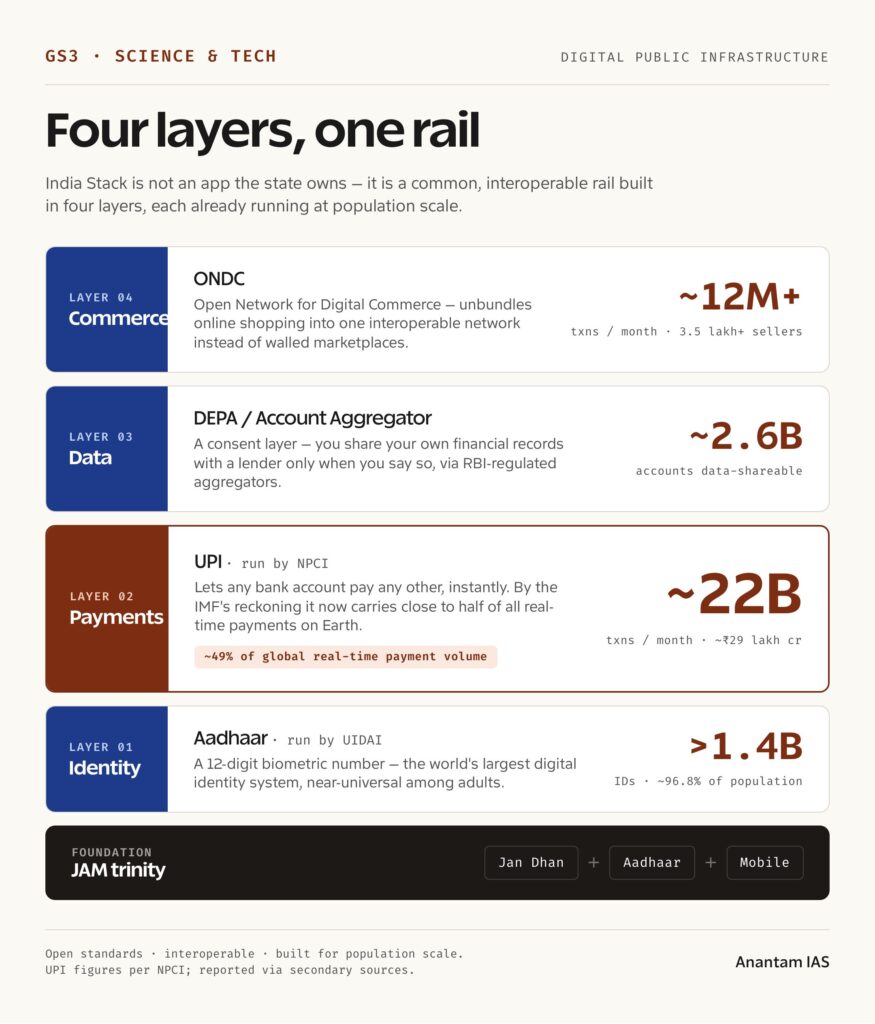
In April 2026, one piece of public plumbing moved about 22.35 billion payments worth roughly ₹29.03 lakh crore in a single month. That’s the Unified Payments Interface, and by the IMF’s reckoning it now carries close to 49 percent of all real-time payment transactions on Earth. No other country runs anything at this scale. So when officials call India Stack a model the rest of the world should copy, they’re not bluffing. The rails are real, they’re cheap, and they reach almost everyone. The harder question for a future administrator is the one the celebration skips: a model worth exporting has to protect the people riding the rails, and on that test India’s record is far more uneven than the transaction graphs suggest.
That gap is the whole topic. The technology scaled for more than a decade before the law meant to govern it became operational. India built the world’s largest digital identity system and its busiest payment network, and only on 14 November 2025 did it notify the rules that put a real data-protection regime into force. The rails came first. The rights are still catching up. And the distance between the two is where the inclusion failures, the privacy gaps, and the concentration risks all live.
The Issue, Framed
Strip away the jargon and the argument is simple. India has proven that public digital infrastructure works at population scale. The open question is whether rights, redress, and competition can keep pace with the rails, or whether the speed itself has built in harms we’re only now naming.
Fix the vocabulary first, because most of the confusion comes from people using “DPI” to mean whatever suits them. Digital Public Infrastructure (DPI) is the set of shared, foundational digital systems that society runs on, the way roads and the power grid are physical infrastructure. The G20 settled on a working definition under India’s 2023 presidency: secure, interoperable systems built on open standards that deliver public and private services at societal scale, governed by law. The key words are open standards and interoperable. So DPI isn’t a single app the government owns. It’s a common rail anyone, public or private, can build on top of.
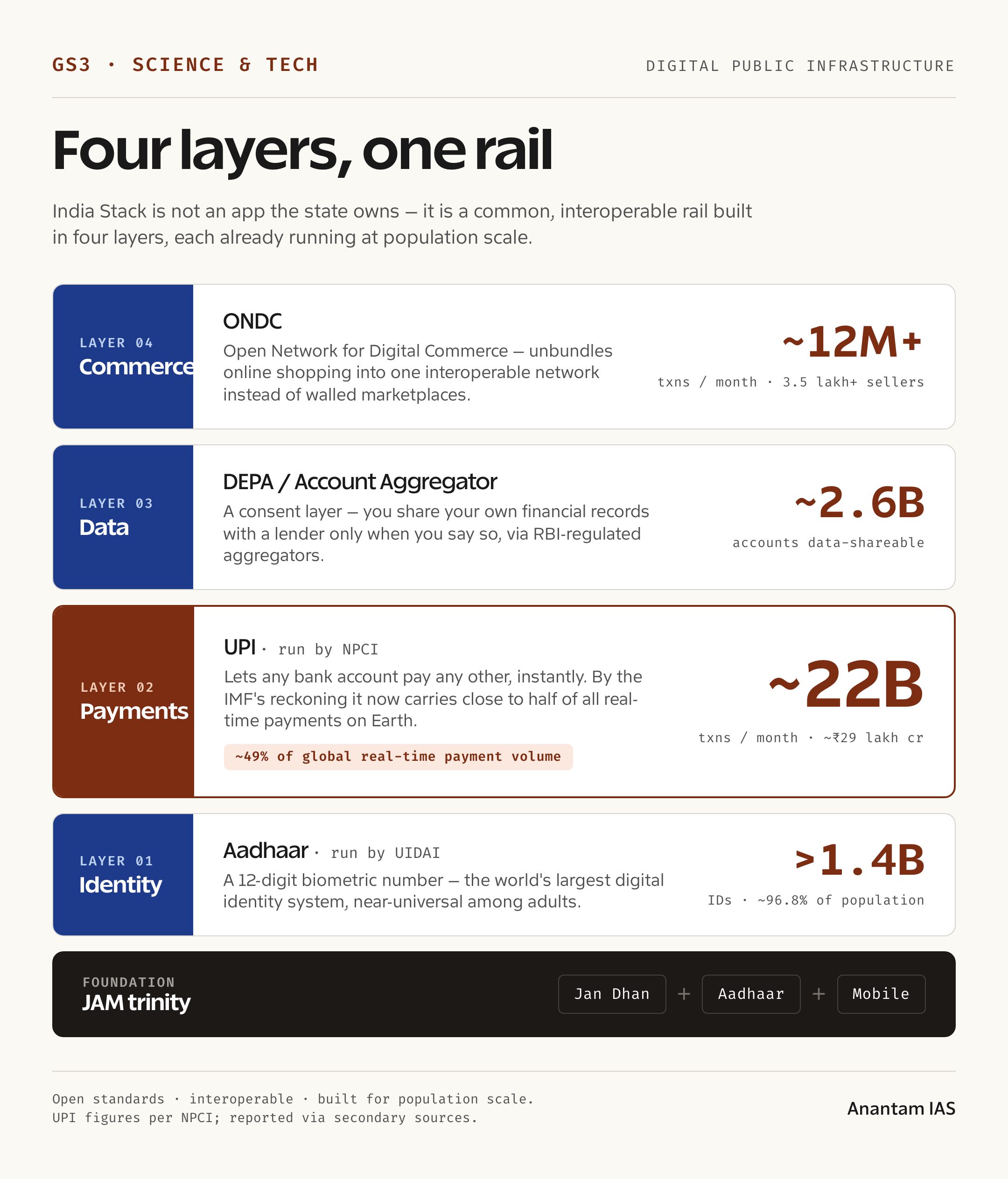
India Stack is the name for India’s version of that rail, and it’s built in four layers. The first is identity: Aadhaar, the 12-digit biometric number run by the UIDAI, now issued to over 1.4 billion people, near-universal among adults. The second is payments: UPI, run by the National Payments Corporation of India (NPCI), which lets any bank account talk to any other instantly. The third is data: the Data Empowerment and Protection Architecture, or DEPA, a consent layer that lets you share your own financial records with a lender through RBI-regulated intermediaries called Account Aggregators, so the data moves only when you say so. The fourth is commerce: the Open Network for Digital Commerce (ONDC), which tries to unbundle online shopping into an open network instead of a few walled marketplaces.
Underneath all of it sits the JAM trinity, the foundation everything else stands on. JAM stands for Jan Dhan (the no-frills bank accounts opened from 2014), Aadhaar (the identity), and Mobile (the connectivity). Link those three and you can move money to a verified person who can actually receive it. That’s the trick that made the rest possible.
Here’s the tension that runs through the whole topic. The same architecture that delivered financial inclusion at record speed also created a single, linked identity that, if mishandled, can exclude the poorest and profile everyone. Both things are true at once. So the mark-scoring question is never “is India Stack good or bad?” It’s “what has to change for a genuinely world-class rail to also be a safe one?”
What the Data Says
The scale numbers are the easy part, and they’re genuinely staggering. Take payments first. UPI handled about 22.35 billion transactions worth roughly ₹29.03 lakh crore in April 2026, near the all-time record set a month earlier at about 22.64 billion transactions worth ₹29.53 lakh crore in March 2026. That’s around 745 million payments a day. Banks live on the network grew from 44 in 2016-17 to roughly 703 in 2025-26. And the IMF recognised in June 2025 that UPI accounted for about 49 percent of global real-time payment volume, the largest such platform anywhere. A developing economy built the world’s busiest real-time payment rail in a decade. That deserves to be stated plainly before anything else.
Identity scaled the same way. Over 1.4 billion Aadhaar numbers have been generated since 2009, and about 96.8 percent of the population now holds a digital ID. The data layer is catching up: as of 31 December 2025, roughly 2.61 billion financial accounts were enabled for consent-based data sharing through the Account Aggregator framework. ONDC, the commerce layer, was running about 12 million-plus transactions a month with over 3.5 lakh sellers onboarded as of early 2025.
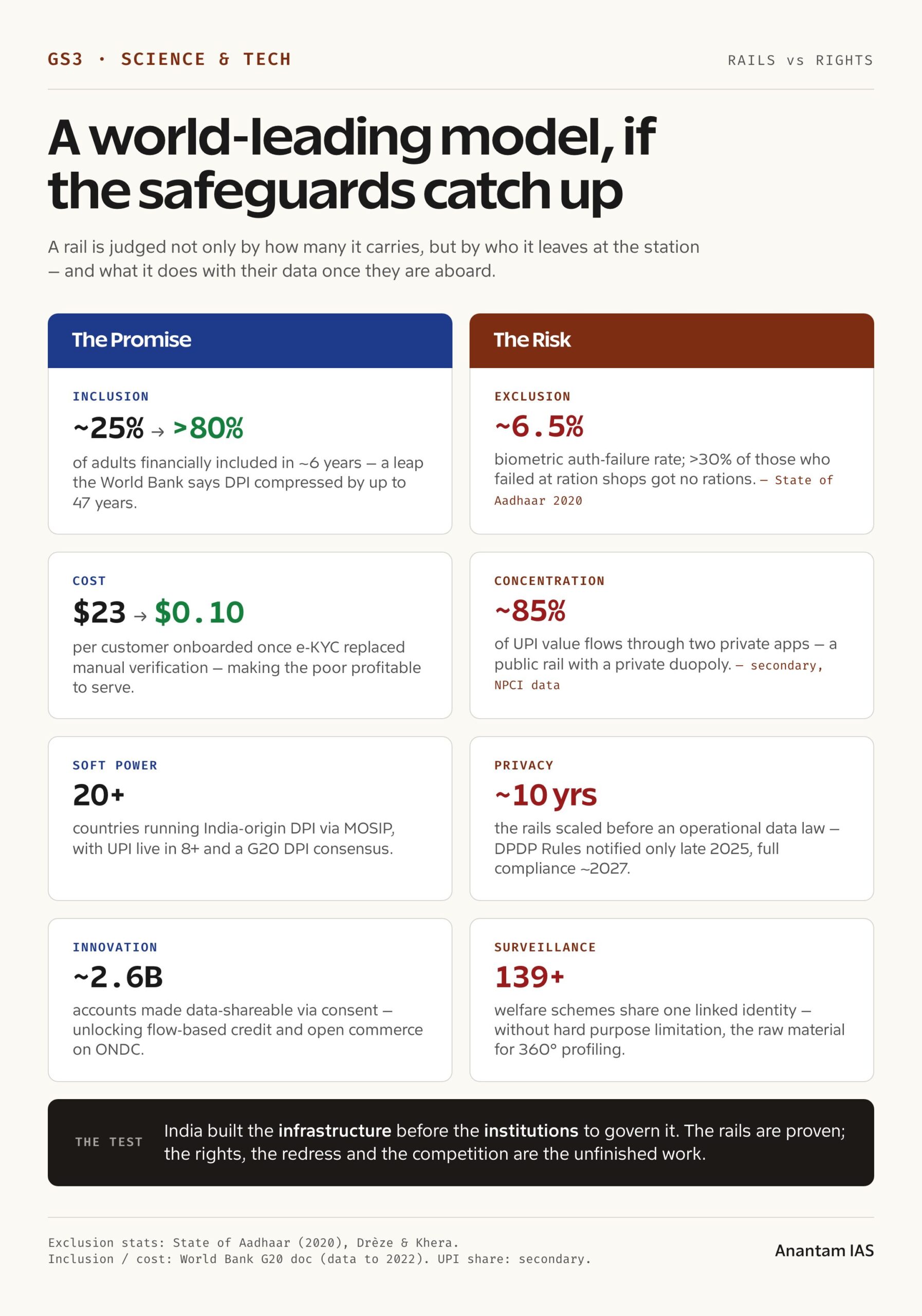
But the number that should anchor your answer isn’t a transaction count. It’s the inclusion leap. India’s financial inclusion rose from about 25 percent of adults in 2008 to over 80 percent, a jump the World Bank says DPI compressed “by up to 47 years”. Bank-account ownership among adults went from 35 percent in 2011 to 77.5 percent in 2021. And the cost of bringing a new customer onto a bank’s books collapsed from about $23 to roughly $0.10 once e-KYC, the paperless Aadhaar-based verification, replaced manual onboarding. That cost compression is the real engine. It made low-income customers profitable to serve for the first time.
The leakage savings tell the same story. By March 2022, Direct Benefit Transfer, the system that sends welfare money straight to a beneficiary’s account, had moved about $361 billion across 53 ministries and over 300 schemes, with documented savings of roughly $33 billion, about 1.14 percent of GDP, from plugging duplicate and ghost claims. So the headline is honest: India Stack works, it reaches people, and it saves public money.
The Case For
The case for India Stack as a model is strong on its own terms, and an answer that treats it as hype misses the point. So state it at full strength.
It delivered inclusion at a speed no other route has matched. The 25-percent-to-80-percent leap in roughly six years isn’t a marketing line. It’s the difference between a citizen who can receive a pension in her own account and one who waits for a middleman to hand over part of it. The World Bank’s “47 years saved” framing means India did in a decade what the slow grind of branch banking would have taken two generations to do. So this is development, not just digitisation.
The architecture is open, and that’s the deliberate design choice that sets it apart. Compare it with China’s payment giants, Alipay and WeChat Pay, which are closed walled gardens owned by single corporations. India Stack runs on open standards and interoperability, so a startup can build a lending app on the same rails a public-sector bank uses. Analysts at Institut Montaigne make exactly this contrast: India chose public rails with private innovation on top, not platform capture. So the model isn’t only about scale. It’s about who controls the plumbing.
The cost compression makes the whole thing financially sustainable. When onboarding falls from $23 to $0.10, serving a poor customer stops being charity and becomes a viable business. That’s why fintech lending, micro-insurance, and cash-flow-based credit for small businesses became possible at all. The DEPA consent layer and ONDC extend it: a small shopkeeper can share verified transaction data to get a loan, or list on an open commerce network without paying a marketplace’s gatekeeping fee.
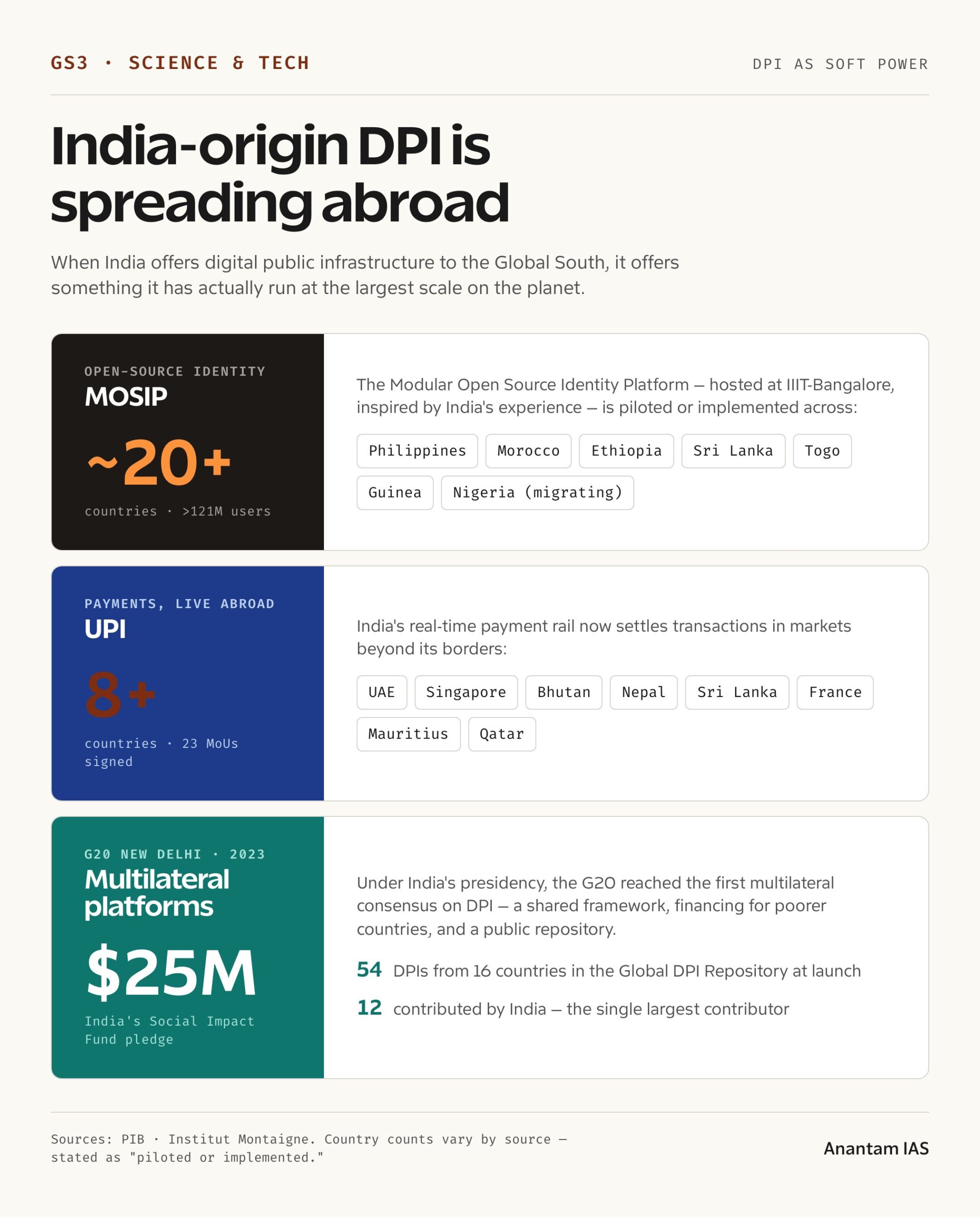
And it’s become India’s strongest piece of digital diplomacy. At the G20 New Delhi summit in 2023, India brokered the first-ever multilateral consensus on DPI, with ministers endorsing a shared framework, a financing mechanism for poorer countries, and the Global DPI Repository, which launched with 54 DPIs from 16 countries, India contributing 12. India committed $25 million to a Social Impact Fund to help the Global South build its own DPI. The reach is real: MOSIP, the Modular Open Source Identity Platform hosted at IIIT-Bangalore and inspired by India’s experience, is piloted or implemented in around 20-plus countries serving over 121 million users, and UPI is live in eight-plus countries including the UAE, Singapore, Bhutan, Nepal, and France. So when India offers DPI to a developing nation, it’s offering something it has actually run at the largest scale on the planet.
The Case Against
Here’s what the celebration walks past. A rail is judged not only by how many people it carries, but by who it leaves at the station and what it does with their data once they’re aboard. On both counts, India Stack has real, documented problems.
Start with exclusion, because this is the failure that matters most for a future administrator. Aadhaar biometric authentication doesn’t work every time. Success rates have hovered around 93.5 to 95 percent, which means roughly a 6.5 percent failure rate. That sounds small until you multiply it across the hundreds of millions of authentications attempted every month for welfare and banking. The people who fail aren’t random. They’re the elderly, manual labourers with worn fingerprints, and households with weak connectivity, the very citizens welfare exists to serve. And the consequences have been severe. The State of Aadhaar Report (2020) found that more than 30 percent of people who faced authentication failure at ration shops received no rations at all. Economists Jean Drèze and Reetika Khera, studying the public distribution system in Jharkhand, found sampled cardholders receiving only about 33 to 35 percent of their grain entitlement after Aadhaar-PDS linkage, and the Right to Food Campaign documented 20-plus alleged starvation deaths in 2017 where Aadhaar problems blocked food access. Exclusion isn’t an edge case here. It’s a structural feature of a system that treats biometric success as the gate to survival.
Then there’s the timing problem, the one the news peg makes unavoidable. Aadhaar scaled for roughly 13 years and UPI for about 9 before India had an operational data-protection law. The DPDP Rules were notified only on 14 November 2025, and full compliance won’t arrive until around May 2027. So the country built one of the world’s largest citizen-data systems first and wrote the rights regime second. That’s the opposite of how you’d design it if dignity came first.
And the law that finally arrived has gaps. A data fiduciary is the entity that decides why and how your personal data gets processed, the bank, the app, the agency, and the DPDP framework is meant to bind it with duties. But analysts note the DPDP Act, 2023 actually reduced obligations on businesses compared with earlier drafts, and it hands the government wide, lightly-guided exemptions on grounds like national security. Measure that against Puttaswamy v. Union of India (2017), the nine-judge bench that made privacy a fundamental right under Article 21 and ruled any intrusion must pass tests of legality, legitimate aim, and proportionality. Broad, unguided exemptions sit uneasily with proportionality. So the safeguard exists on paper, but its teeth are debatable.
The surveillance risk follows directly. A single linked identity stretched across more than 139 welfare schemes, joined to financial and increasingly health data, creates the raw material for 360-degree profiling. Without strong purpose limitation, the rule that data collected for one reason can’t be quietly used for another, the same plumbing that delivers a subsidy can map a person’s entire life. That’s not a hypothetical the architecture rules out. It’s a risk the architecture makes easy.
Concentration is the quieter problem. UPI is a public rail, but two private apps, PhonePe and Google Pay, together handle roughly 85 percent of its value. So a system designed to avoid platform capture has, on the consumer side, produced a duopoly. If either app stumbles, a huge share of the nation’s payments stumbles with it. NPCI announced a 30 percent market-share cap years ago and has kept deferring it. A public good with two private gatekeepers isn’t the open-competition story the model promises.
And accountability diffuses across the whole stack. When a payment fails or an authentication is wrongly rejected, the bank blames the app, the app blames NPCI, the agency blames the network. With so many actors between the state and the citizen, no one clearly owns the harm. Both Carnegie and ORF flag this as a problem to be “proactively addressed,” not assumed away. So the redress question, who fixes it when it breaks, stays largely unanswered.
The Deeper Structural Read
Step back from the layers and one pattern explains almost all the trouble. India built the infrastructure before it built the institutions to govern it. The rails are world-class. The stewardship is still under construction. That sequencing, tech first and rights second, is the structural fault running underneath every specific risk.
See it in each layer. The identity layer scaled to 1.4 billion before a privacy law existed. The payments layer hit 22 billion monthly transactions before a market-share cap was enforced. The data layer enabled 2.6 billion accounts for sharing before an independent regulator was fully resourced to police consent. Each time, capability outran control. So the exclusion errors, the surveillance risk, and the duopoly aren’t separate bugs. They’re three faces of the same design decision: ship the rail, govern it later.
There’s a constitutional reading underneath that an examiner will reward. Puttaswamy didn’t ban large data systems. It said the state may run them, but only within legality, legitimate aim, and proportionality. So the DPI question is really the proportionality question applied to plumbing. Is it proportionate to make biometric success the single gate to a citizen’s rations, when 6.5 percent will fail and a manual fallback could catch them? Is it proportionate to link an identity across 139 schemes without a hard purpose-limitation rule? The architecture is constitutional only if it’s designed to fail safe, and right now it too often fails against the weakest user.
The accountability gap is the second structural seam, and it’s a governance problem before it’s a technical one. DPI deliberately spreads function across many actors to avoid a single point of control, and that openness is a virtue. But openness without a clear locus of responsibility means harm lands on the citizen with no one to answer for it. The fix isn’t to re-centralise. It’s to build what analysts call independent DPI steward institutions, bodies accountable to a broad set of stakeholders rather than controlled by one entity, so the rail has an owner for its failures the way it has builders for its successes.
And the export question carries the same lesson abroad. India sells the model to the Global South through MOSIP and the G20 platforms, and the temptation is to ship the tech and skip the governance, because the tech is what’s finished. But Carnegie warns that DPI without adequate safeguards, sustained financing, and technical assistance produces “poorly developed DPI”, systems with data breaches and unchecked access baked in. So exporting the rails without the rights doesn’t spread a model. It spreads the same unfinished bargain to countries with even weaker institutions to absorb the harm. The honest export pitch bundles the safeguards with the software.
What Should Be Done
So what does a finished version of India Stack look like? Not a vague call for “balance,” but a set of fixes you could brief a secretary on tomorrow. None of them slows the rail. Every one makes it safer.
- Make entitlements independent of biometric success. No citizen should lose rations, a pension, or a service because a fingerprint reader failed. Mandate a statutory manual or offline fallback at every welfare touchpoint, so authentication failure triggers a backup, not a denial. The Supreme Court has already pushed in this direction on cancelled ration cards. Build it into the rules, and read the DPDP Act and what real privacy requires as the companion guarantee on the data side.
- Treat exclusion as a tracked metric, not a footnote. Publish last-mile dashboards of authentication-failure and exclusion rates by district, the way we publish UPI volumes, and fold them into how we measure financial inclusion in India. A system proud enough to announce 22 billion transactions can afford to announce how many people it shut out.
- Enforce DPDP fully, credibly, and on schedule. Stand up the Data Protection Board of India as a genuinely independent, well-resourced regulator, not a thinly-staffed body. Narrow the government’s blanket exemptions so they satisfy the Puttaswamy proportionality test rather than swallow it. And keep the phased rollout to May 2027 on time, because a privacy law that arrives a decade late can’t also arrive slowly.
- Break the duopoly before it hardens. Enforce the deferred market-share cap on UPI apps and keep third-party access genuinely open, so a public rail doesn’t entrench two private gatekeepers. Keep ONDC open in practice, not just in branding, so the commerce layer doesn’t drift toward the same concentration.
- Write purpose limitation into law with teeth. Put statutory limits on linking identity and financial data across domains, and publish audits of who accessed what data and why. A linked identity across 139 schemes is only safe if cross-domain profiling is illegal, logged, and reviewable.
- Build independent DPI stewards. Create institutions that own the stack’s failures, accountable to citizens, courts, and industry together, so redress has a clear address when a transaction breaks. Diffuse function, but concentrate accountability.
- Export the governance, not just the tech. When India ships DPI through MOSIP and the Global DPI Repository, bundle the safeguards, the financing, and the technical assistance with the software. A model worth exporting includes how to govern it, or it isn’t a model at all.
Every one of these strengthens the system rather than slowing it. A rail that reaches everyone, drops no one, and can’t be quietly turned into a surveillance map is a rail other countries should copy. That’s the whole point of being a model.
For Your Mains Answer
This topic is a GS3 anchor with a strong GS2 spine. It lets you write economy, technology, governance, and rights in one frame, which is exactly what a high-scoring answer does.
GS paper mapping: GS3: Indian economy and inclusive growth, science and technology, indigenous innovation, cybersecurity, mobilisation of resources. GS2: government policies for welfare delivery, transparency and accountability, fundamental rights (right to privacy), and India’s soft power and digital diplomacy.
Likely question frames:
- India’s Digital Public Infrastructure is a global model, yet its safeguards lag its scale. Critically examine.
- “India built the rails before it built the rights.” Discuss with reference to India Stack and the DPDP framework.
- Digital Public Infrastructure has compressed India’s financial-inclusion journey by decades. Analyse the inclusion gains against the exclusion and privacy risks.
- Evaluate India Stack as an exportable model of digital governance for the Global South.
Quotable data points:
- UPI handled about 22.35 billion transactions worth roughly ₹29.03 lakh crore in April 2026, near a record set in March 2026.
- UPI carried about 49 percent of global real-time payment volume by 2024, IMF-recognised in June 2025.
- Over 1.4 billion Aadhaar numbers; about 96.8 percent of the population holds a digital ID.
- Financial inclusion rose from about 25 percent (2008) to over 80 percent, a leap the World Bank says DPI shortened “by up to 47 years”.
- e-KYC cut customer onboarding cost from about $23 to roughly $0.10.
- DBT moved about $361 billion and saved roughly $33 billion, about 1.14 percent of GDP, by March 2022.
- More than 30 percent of those who faced Aadhaar authentication failure at ration shops received no rations; Drèze and Khera found cardholders getting only about 33 to 35 percent of grain in Jharkhand.
- DPDP Rules notified 14 November 2025; full compliance only by around May 2027.
- Two private apps handle roughly 85 percent of UPI value.
Keywords to use: Digital Public Infrastructure, India Stack, JAM trinity, interoperability, open standards, data fiduciary, purpose limitation, proportionality, Puttaswamy, financial inclusion, Direct Benefit Transfer, digital divide.
Syllabus linkages: inclusive growth and financial inclusion; science and technology and indigenous development; cybersecurity and citizen-data repositories; government policies and welfare delivery; transparency and accountability; fundamental rights and the right to privacy; India and the world and digital diplomacy.
Balanced conclusion line: India Stack has proven the rails can reach a billion people in a decade; the next decade’s test is whether the rights, the redress, and the competition can reach them too, because a model the world should copy is one that drops no one and surveils none.
How to Build the Answer
Open with the tension, not a definition. The strongest first line states that India has the world’s best digital rails and an unfinished governance layer, and that both facts are true. That tells the examiner in one sentence that you’ve grasped the model and the risk. The definition of DPI and India Stack can follow in the second and third sentences. Lead with the conflict, define on the move.
Bring data in early, but make each number do work. A strong opening body paragraph can carry three figures: the 25-to-80-percent inclusion leap, the $23-to-$0.10 onboarding cost, and the 22-billion monthly UPI count. Then say what they prove, that cheap rails made the poor profitable to serve. UPSC rewards the move from fact to inference, so never let a number sit without a “this means”.
Steelman the model before you criticise it. If your stance is critical, first establish, fairly, why India Stack is genuinely world-leading, the inclusion speed, the open architecture, the soft power. Only then introduce the exclusion, privacy, and concentration risks. An answer that reads balanced has argued both sides in good faith.
Group the way forward, don’t scatter it. Cluster the fixes: rights-based design with manual fallback, exclusion as a tracked metric, full DPDP enforcement, breaking the duopoly, statutory purpose limitation, independent stewards, and exporting governance with the tech. Use the topic’s vocabulary, proportionality, purpose limitation, interoperability, so the answer reads like governance analysis, not a news recap.
Close on judgment tied to the syllabus. The last line should not echo the introduction. It should show where you stand: the rails are proven, the rights are the unfinished work. The reliable pattern is “the achievement is X; the test now is Y”, which lets you honour the model while naming what it still owes its weakest user.
Common Mistakes to Avoid
- Don’t write a tech-celebration essay. The transaction numbers are the easy half. A Mains answer needs the inclusion, privacy, and accountability analysis layered on top, or it reads like a press release.
- Don’t confuse the layers. Identity (Aadhaar), payments (UPI), data (DEPA/Account Aggregator), and commerce (ONDC) are distinct. Mislabelling them signals shallow preparation. Name each one correctly.
- Don’t treat exclusion as a rounding error. A 6.5 percent failure rate is millions of people. Attribute the PDS denial and Jharkhand grain figures to State of Aadhaar and to Drèze and Khera, and present the starvation-death claims as documented or alleged, never as established government fact.
- Don’t ignore the law’s gaps. “India now has a privacy law” is incomplete. The mark is in noting the wide exemptions and the proportionality tension with Puttaswamy.
- Don’t end on a slogan. Close with an implementable principle, fail-safe design, purpose limitation, independent stewardship, not a flourish about “the digital future”.
A Compact Answer Spine
- Introduction: Open with the rails-versus-rights tension in one sentence; define DPI and the four India Stack layers in the next two.
- Evidence: Use two or three attributed figures, each tied to an implication, inclusion speed, cost compression, scale.
- The case for: Inclusion at record speed, open interoperable architecture, soft power and exportability.
- The case against: Exclusion errors, rails built before the rights, weak exemptions, concentration, diffused accountability.
- Structural diagnosis: Infrastructure built before institutions; proportionality (Puttaswamy) applied to plumbing.
- Way forward: Grouped fixes, each with a clear actor, government, regulator, NPCI, steward institution.
- Conclusion: Adapt the balanced line to the exact question wording.
Diagram or Flowchart Idea
For a 15-marker, draw the four-layer stack as a labelled vertical block: JAM trinity (foundation) → Identity (Aadhaar) → Payments (UPI) → Data (DEPA/Account Aggregator) → Commerce (ONDC), with a side arrow marked “open standards, interoperable”. The examiner reads the whole architecture in five seconds, and it shows you understand DPI as layers, not as one thing.
For a 10-marker, skip the stack and draw a two-column table instead, “The Promise” against “The Risk”, inclusion versus exclusion, low cost versus concentration, soft power versus weak safeguards. It’s faster to evaluate and it proves you can hold both sides at once.
Ethics and Governance Angle
Add one ethical line even in a GS3 answer. The deepest question here isn’t efficiency. It’s who carries the cost when the system fails, and the answer is a concrete person: the labourer whose worn fingerprint is rejected at the ration shop, the elderly pensioner timed out by weak connectivity. Naming that citizen turns a technology answer into a governance one.
Then convert the empathy into design, which is the move examiners reward. Don’t just say “protect vulnerable users”. Say how: mandate a manual fallback so no fingerprint failure means no food, publish district-level exclusion dashboards, write purpose limitation into law. That’s the shift from moral language to administrative maturity.
A sentence pattern that travels across DPI, privacy, and welfare topics: “The aim is legitimate; its legitimacy depends on proportionality, redress, and the protection of the last user.” It accepts the state’s objective without handing it a blank cheque, which is exactly the balance a values-based question is testing.
How to Use Data Without Sounding Mechanical
Use fewer numbers than you know. Three well-explained figures beat ten dumped in a row. Lead with one big scale number (22 billion monthly UPI transactions, or 1.4 billion Aadhaar IDs), use a second for the inclusion story (25 percent to over 80 percent), and use a third for the risk (6.5 percent biometric failure, or two apps holding 85 percent of value). One scale figure, one inclusion figure, one risk figure is usually enough.
Never leave a statistic standing alone. Follow it with “this means” or “the policy implication is”. The 6.5 percent failure rate means millions of denied entitlements. The $23-to-$0.10 drop means the poor became profitable to serve. That tiny move turns a fact sheet into analysis.
And date-stamp the older figures. The “47 years saved”, the $33 billion in DBT savings, and the $361 billion transferred all come from a 2023 World Bank G20 document with data to 2022, so say so. Flag the UPI monthly numbers as secondary reporting of NPCI data, because they shift every month. Showing you know which numbers are current and which are dated is itself a mark of preparation.
One last sweep before you move on: cut any line that sounds impressive but does no work, and replace it with a fact, a cause, a consequence, or a fix. That habit separates an answer that feels informed from one that feels memorised. Write for marks, not for noise.
FAQ
What is Digital Public Infrastructure, and what is India Stack?
Digital Public Infrastructure is the set of shared, foundational digital systems, secure, interoperable, and built on open standards, that a society runs services on, much like roads or the power grid. India Stack is India’s version, built in four layers: identity (Aadhaar), payments (UPI), data sharing through consent (DEPA and Account Aggregators), and commerce (ONDC), all resting on the JAM trinity of Jan Dhan accounts, Aadhaar, and Mobile.
Why is India’s DPI called a global model?
Because it scaled faster and wider than anything comparable. Financial inclusion rose from about 25 percent of adults to over 80 percent in roughly six years, UPI handles about 49 percent of global real-time payments, and onboarding costs fell from about $23 to $0.10. India also exports the model through the G20 Global DPI Repository, a $25 million Social Impact Fund, MOSIP in around 20-plus countries, and UPI live in eight-plus countries.
What are the main risks of India Stack?
Three stand out. Exclusion: a roughly 6.5 percent biometric authentication failure rate has denied rations and pensions to the poorest, with the State of Aadhaar report and economists Drèze and Khera documenting serious welfare losses. Privacy: the rails scaled for over a decade before the DPDP Rules became operational on 14 November 2025, with full compliance only around May 2027, and the law carries wide government exemptions. Concentration: two private apps handle roughly 85 percent of UPI value.
Does India now have a real data-protection law?
Partly. The DPDP Act, 2023 and its Rules, notified on 14 November 2025, create a Data Protection Board and bind data fiduciaries, the entities that decide how your data is used, with penalties up to ₹250 crore. But full compliance only arrives around May 2027, and analysts argue the wide national-security and government exemptions sit uneasily with the proportionality standard the Supreme Court set in Puttaswamy (2017). So India has a privacy law on paper; whether it has real privacy depends on how independently it’s enforced.
Tell Google you want more of this.
Add Anantam IAS as a preferred sourceOne tap, and this site shows up more often in your own Top Stories, AI Overviews and AI Mode. Remove it any time.





