Draft CAFE-III Norms: Passenger-Vehicle Efficiency for 2027-32
Why in News?
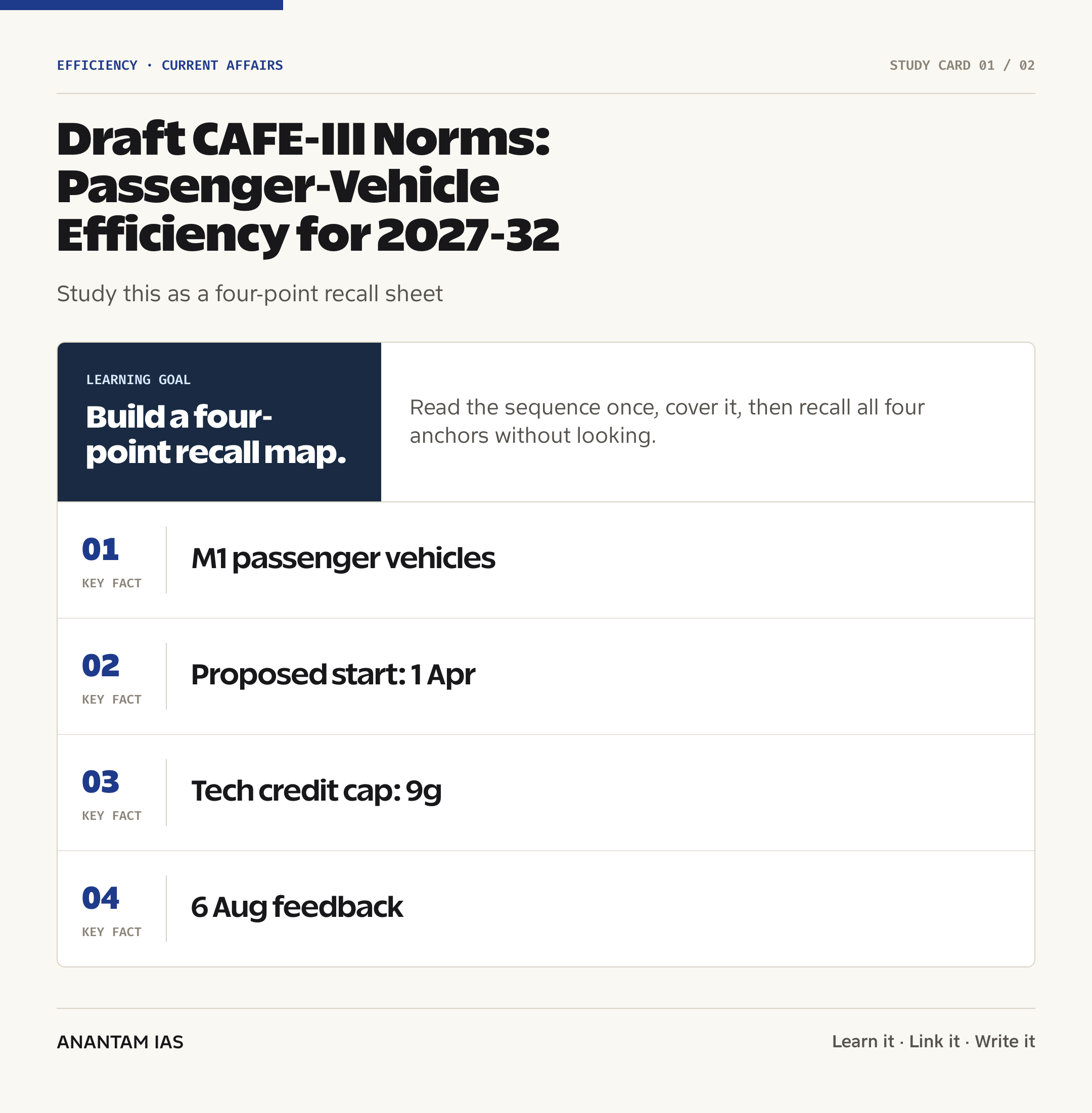
The Draft CAFE-III norms, formally described as CAFE 2027, were circulated by the Ministry of Power on 16 July 2026 for public and stakeholder consultation. PIB confirmed that the proposed standards would cover M1 passenger vehicles manufactured or imported for sale in India from 2027-28 to 2031-32.
The Bureau of Energy Efficiency draft notification proposes manufacturer-specific, sales-weighted fleet targets rather than one identical fuel-consumption ceiling for every model. It combines progressively tighter annual standards with technology adjustments, renewable-fuel factors, super credits, a credit-debit passbook and penalties under the Energy Conservation Act, 2001.
- Consultation deadline: The Ministry invited objections and suggestions up to 6 August 2026.
- Proposed start: The standards are intended to take effect on 1 April 2027 and operate through 31 March 2032.
- Coverage: They apply to M1 vehicles manufactured or imported for domestic sale, subject to the final notification.
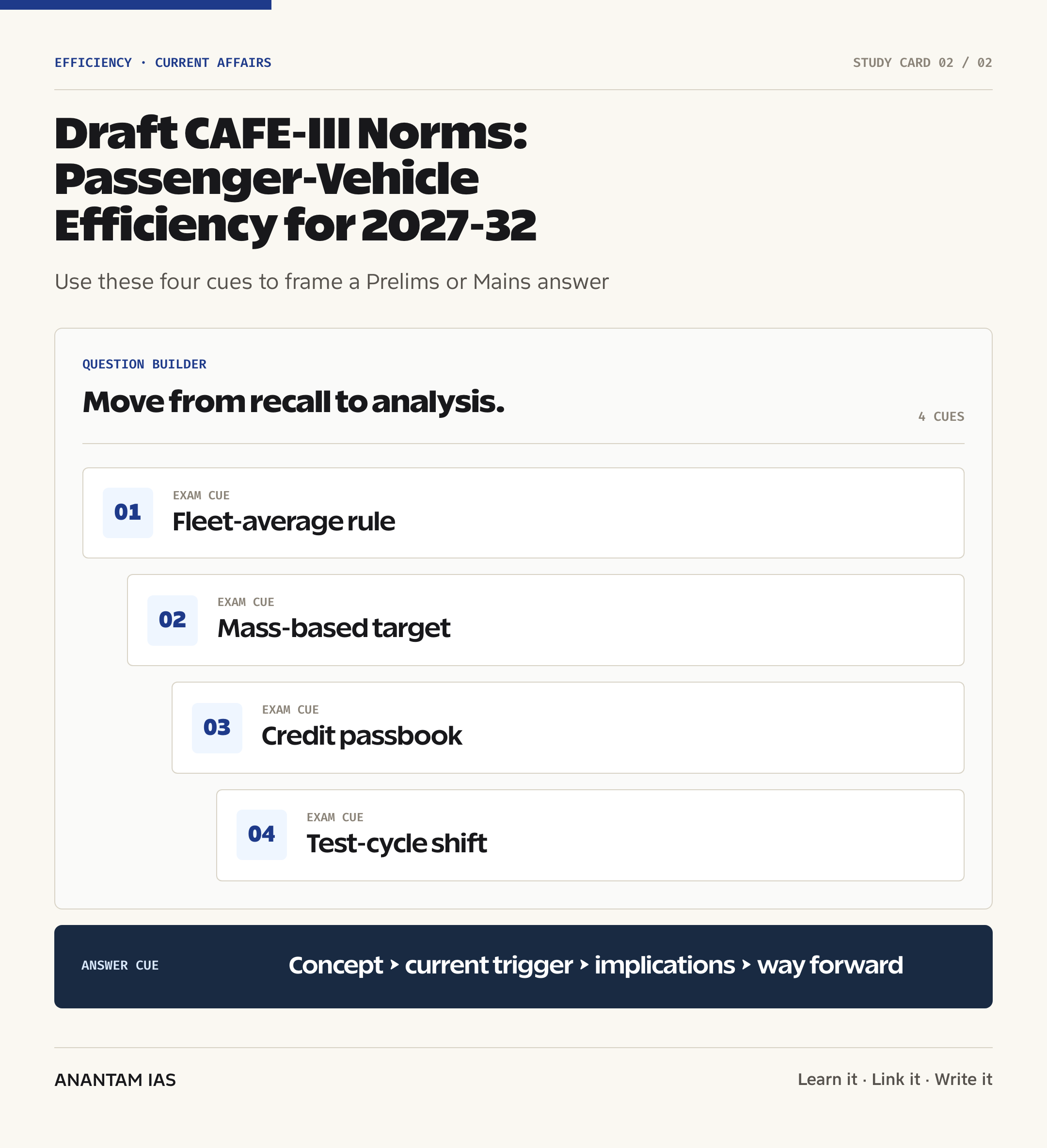
- Core test: A manufacturer’s sales-weighted actual fleet consumption must be lower than or equal to its mass-based annual standard.
- Status: These are draft norms open to consultation, not a final legal obligation yet.
The development matters in the context of:
- Energy security: Better fleet efficiency can reduce petroleum use and exposure to imported crude oil.
- Climate policy: The framework links tailpipe carbon dioxide, alternative fuels and electrified powertrains within one compliance method.
- Industrial transition: Five annual steps give automobile manufacturers a product-planning signal while making compliance progressively stricter.
- Regulatory design: Flexibilities can lower transition costs, but weak or excessive credits may dilute real-world fuel savings.
UPSC Relevance
Prelims Relevance
- CAFE stands for Corporate Average Fuel Economy; it regulates a manufacturer’s fleet average, not only an individual model.
- M1 category covers passenger vehicles with not more than eight seats in addition to the driver’s seat.
- The proposed cycle runs from 2027-28 to 2031-32 and is called CAFE 2027 in the draft.
- The draft draws authority from Sections 14 and 18 of the Energy Conservation Act, 2001.
- The Bureau of Energy Efficiency is a statutory body established under the Energy Conservation Act, 2001.
- MIDC means Modified Indian Driving Cycle; WLTP means Worldwide Harmonized Light Vehicles Test Procedure.
- Fuel consumption is expressed as petrol-equivalent litres per 100 km; a lower value indicates better efficiency.
- Carbon Neutrality Factors are proposed for specified renewable-fuel pathways before compliance assessment.
- Super credits use volume derogation factors that give eligible cleaner vehicle types extra weight in the fleet calculation.
- A small-volume manufacturer with fewer than 1,000 eligible vehicles in a reporting period is proposed to be exempt from the specific target.
Mains Relevance
GS Paper 3
- Environment: Transport decarbonization, fuel efficiency and the relationship between tailpipe regulation and lifecycle emissions.
- Energy security: Lower petroleum consumption, reduced import dependence and exposure to global oil-price shocks.
- Science and technology: Hybrid and electric powertrains, regenerative braking, efficient accessories and test-cycle reform.
- Industrial policy: Technology-neutral standards, innovation incentives and compliance costs for automobile manufacturers.
GS Paper 2
- Governance: Consultation, delegated legislation, inter-ministerial coordination and credible monitoring.
- Regulatory capacity: Roles of the Ministry of Power, BEE, MoRTH, type-approval agencies and the designated compliance agency.
Essay
- Efficiency and sufficiency: Cleaner technology matters, but total travel demand and vehicle size also shape environmental outcomes.
- Rules that reward outcomes: Performance standards can encourage innovation when measurement and enforcement remain credible.
Background and Context
What CAFE Regulates and Which Vehicles It Covers
Corporate Average Fuel Economy is a fleet-performance rule designed to improve the average efficiency of vehicles sold by each manufacturer.
- Corporate average: Compliance is assessed across a manufacturer’s eligible domestic-sales fleet, so efficient models can balance less efficient ones within the prescribed calculation.
- Not a per-model ban: A particular model may consume more than the fleet target, but the sales-weighted average for the manufacturer’s full eligible fleet must meet its standard.
- M1 scope: Under the Central Motor Vehicles Rules, M1 means a passenger vehicle with no more than eight seats in addition to the driver’s seat.
- Domestic market: The draft covers eligible vehicles manufactured or imported for sale in India and includes variants for which the relevant duty has been paid.
- Manufacturer definition: Both manufacturers and importers whose vehicles require type approval can fall within the framework.
- Longer policy arc: BEE records CAFE Stage I from 2017-18 and Stage II from 2022-23; the proposed CAFE-III cycle would follow them from 2027-28.
Legal and Institutional Architecture
The proposal divides standard-setting, testing, administration and enforcement across energy and transport institutions.
- Statutory basis: The Central Government issued the draft using clauses (a), (b) and (c) of Section 14 read with Section 18 of the Energy Conservation Act, 2001.
- Ministry of Power: It proposes the energy-consumption standards in consultation with the Bureau of Energy Efficiency.
- BEE: The statutory efficiency body would administer the compliance-credit mechanism and maintain the regulatory framework with the designated agency.
- MoRTH: The Ministry of Road Transport and Highways would enforce testing, calculation, reporting, production conformity and technology-adjustment methods under the Central Motor Vehicles Rules.
- Type-approval agencies: Notified testing bodies verify model-level fuel-use and carbon-dioxide values under standardized laboratory procedures.
- Public consultation: The 21-day objection-and-suggestion window is part of pre-publication rule-making; the final standard may differ from the draft.
- Related foundation: See how BEE uses standards and labeling to shape energy demand across other sectors.
Fleet-Average Logic: Target Versus Actual Performance
The compliance test compares a manufacturer-specific target with its sales-weighted actual petrol-equivalent fuel consumption.
- Target formula: The annual standard is calculated as a × (W – b) + c, where W is the sales-weighted average unladen mass of the manufacturer’s eligible vehicles.
- Mass adjustment: The formula recognizes differences in fleet weight, but annual constants tighten the standard over time so efficiency pressure continues.
- Actual average: Each model’s petrol-equivalent fuel use is weighted by its eligible volume, with applicable carbon-neutrality, technology and super-credit adjustments.
- Common unit: Petrol, diesel, LPG, CNG and electricity are converted into petrol-equivalent litres per 100 km so diverse powertrains can enter one fleet calculation.
- Direction of compliance: Lower consumption is better; the actual annual average must be less than or equal to the applicable annual standard.
- Credit or debit: Better-than-target performance creates a credit, while consumption above the target creates a debit recorded in the manufacturer’s passbook.
- Exam method: In an answer, write the chain as model data → sales weighting → fleet average → target comparison → credit, debit or penalty.
Five Annual Steps and the Test-Cycle Transition
CAFE-III proposes year-by-year tightening while collecting parallel data for a later move from MIDC to WLTP.
- Five-year horizon: Separate formula constants are prescribed for each fiscal year from 2027-28 through 2031-32 instead of one unchanged target for the entire cycle.
- Progressive tightening: The multiplier a falls from 0.00158 in 2027-28 to 0.00131 in 2031-32, while c falls from 3.9960 to 3.3273 litres per 100 km.
- MIDC basis: The draft’s target and initial performance calculations continue to use the Modified Indian Driving Cycle.
- Dual reporting: For models sold from 1 April 2026, manufacturers are proposed to report carbon-dioxide performance measured on both MIDC and the notified WLTP.
- WLTP purpose: The newer test procedure uses a more varied standardized driving profile intended to better represent real-world operation than the older cycle.
- Unfinished transition: The Ministry of Power would separately notify the MIDC-to-WLTP conversion factor after BEE receives the required data.
- Regulatory caution: Until that conversion is notified, the draft should not be described as a complete immediate switch to WLTP.
Technology, Fuel and Powertrain Adjustments
The proposal uses several adjustments to reward fuel-saving equipment, renewable fuels and cleaner propulsion choices.
- Technology derogation: Certified fuel-saving technologies may receive a 1 g CO2/km benefit each, subject to an overall cap of 9 g CO2/km on MIDC.
- Eligible examples: The indicative list includes start-stop systems, tire-pressure monitoring, regenerative braking, efficient transmissions, LED lighting, advanced glazing, electric pumps and efficient air-conditioning.
- Carbon Neutrality Factor: The draft proposes specified discounts to declared tailpipe carbon dioxide for E20 or higher petrol blends, flex-fuel ethanol pathways, CNG with biomethane and notified diesel biofuel blends.
- Illustrative factors: It proposes 8% for E20-or-higher petrol vehicles, 22.3% for flex-fuel ethanol and strong-hybrid flex-fuel vehicles, and at least 5% for CNG subject to notified CBG blending.
- Super credits: Battery electric and range-extended electric vehicles receive a proposed volume factor of 3.0; plug-in hybrids receive 2.5, strong hybrids 1.6 and flex-fuel ethanol vehicles 1.1.
- Policy purpose: These adjustments can speed technology adoption, but the accounting benefit must stay aligned with verifiable energy and emissions gains.
- Study links: Compare the treatment of electric vehicles and India’s support ecosystem with the E20 ethanol-blending debate.
Passbooks, Pooling, Buyout and Penalty
CAFE-III combines annual measurement with block-period settlement and several proposed routes for resolving a compliance shortfall.
- Annual assessment: Credits and debits are calculated each year and entered in a passbook maintained for each manufacturer or importer.
- Compliance blocks: The first block covers three years from 2027-28; the second covers two years from 2030-31. Unused credits lapse at the end of the relevant block.
- Pooling: Manufacturers may exchange or trade credits with one another on mutually agreed terms and report the result to the designated agency.
- BEE buyout: The draft allows debit settlement by buying credits from BEE, with proposed prices rising from ₹2,500 per g CO2/km for FY 2028 to ₹4,500 for FY 2032.
- Trading window: Exchange or buyout is proposed within 30 days, up to 30 September of each assessment year, followed by a final passbook before 31 October.
- Penalty stage: Compliance is measured annually, but the draft proposes penalties at the end of a block after credit settlement, under Sections 26 to 28 of the Energy Conservation Act.
- Fund flow: Penalties and buyout receipts would enter the Central Energy Conservation Fund, with 90% proposed for states and 10% retained by the Centre.
- Small-volume exemption: A manufacturer with fewer than 1,000 eligible vehicles in a reporting year would be exempt from the specific fleet target.
Significance, Risks and Answer-Building Guidance
A strong UPSC assessment should connect energy security and innovation with the integrity of measurement and the risk of accounting dilution.
- Energy-security gain: Lower fleet fuel use can reduce oil demand, the import bill and vulnerability to international supply and price shocks.
- Climate co-benefit: More efficient vehicles can reduce carbon dioxide per kilometre, supporting the wider net-zero transition when electricity and fuel pathways also decarbonize.
- Technology signal: Annual tightening can steer product planning toward lighter design, efficient engines, hybrids, electric vehicles and lower-loss accessories.
- Consumer benefit: Better fuel economy can lower running costs, though vehicle purchase price, rebound in travel and real-world driving conditions affect net savings.
- Credit-integrity risk: Super credits and deemed technology benefits may make regulatory compliance easier without an equal fall in actual fleet energy use if calibration is too generous.
- Test-gap risk: Laboratory performance can differ from on-road consumption, making WLTP transition, production conformity and public reporting important.
- Equity issue: Mass-based standards should avoid locking in a shift toward ever-heavier vehicles while still accounting for safety, utility and market diversity.
- Answer structure: Define fleet-average regulation, explain the calculation and institutions, weigh benefits against flexibilities, and end with test integrity plus transparent annual disclosure.
Way Forward
Finalize a Transparent Metric
- Publish the final annual coefficients, conversion factors and worked examples in a machine-readable format so manufacturers and the public can reproduce calculations.
- Notify the MIDC-to-WLTP conversion method before the transition affects compliance and disclose the supporting evidence.
Protect Environmental Integrity
- Review super-credit, carbon-neutrality and technology benefits against measured fleet outcomes and reduce any factor that over-rewards accounting rather than fuel savings.
- Separate tailpipe accounting from lifecycle analysis so policy claims don’t confuse vehicle emissions with upstream fuel and electricity emissions.
Strengthen Monitoring
- Require reliable model-wise sales, mass, fuel-use and carbon-dioxide data, with independent verification and production-conformity checks.
- Publish manufacturer-level targets, actual averages, credits, debits, trades and penalties through a concise annual compliance dashboard.
Align the Wider Transport Strategy
- Coordinate CAFE with vehicle-emission standards, fuel quality, EV charging, public transport and scrappage policy instead of treating efficiency as a stand-alone solution.
- Track real-world fuel use and rebound effects while supporting affordable, safe and efficient mobility rather than only higher vehicle sales.
Use Consultation Well
- Publish a response-to-comments document explaining which stakeholder proposals were accepted, modified or rejected and why.
- Give manufacturers regulatory certainty without weakening the year-on-year efficiency trajectory needed for energy security and climate goals.
Conclusion
The Draft CAFE-III norms shift the focus from a single headline mileage number to a structured five-year fleet-compliance system. Their strongest feature is outcome-oriented regulation: each manufacturer’s sales mix, vehicle mass, fuel pathway and technology choices feed into an annual average that becomes a credit or debit.
The final rule will be credible only if test cycles, conversion factors and flexibilities reflect actual fuel savings. Transparent data, periodic recalibration and firm end-of-block enforcement can turn CAFE-III into an energy-security and industrial-innovation instrument rather than an accounting exercise.
UPSC Practice Questions
Prelims MCQ 1
With reference to the proposed CAFE-III norms, consider the following statements:
- They apply to the corporate average of a manufacturer’s eligible M1 vehicle fleet rather than imposing one identical limit on every model.
- The manufacturer-specific target is linked to the sales-weighted average unladen mass of its eligible vehicles.
- The draft proposes an immediate and complete replacement of MIDC by WLTP from the first compliance year.
How many of the above statements are correct?
(a) Only one (b) Only two (c) All three (d) None
Answer: (b) Only two
Explanation:
Statements 1 and 2 are correct. CAFE is a fleet-average rule, and the annual standard uses weighted average unladen mass. Statement 3 is incorrect: the draft retains MIDC for the initial calculation, requires parallel MIDC and WLTP reporting, and leaves the conversion factor for separate notification.
Prelims MCQ 2
Which one of the following institutions is proposed to enforce vehicle testing, calculation methods and conformity of production under CAFE-III?
(a) Ministry of Road Transport and Highways (b) Central Electricity Regulatory Commission (c) Petroleum and Natural Gas Regulatory Board (d) National Highways Authority of India
Answer: (a) Ministry of Road Transport and Highways
Explanation:
The draft assigns MoRTH responsibility for testing and calculation methodologies, reporting, conformity of production and related adjustment methods under the Central Motor Vehicles Rules. BEE’s role centers on energy-efficiency administration and the credit mechanism.
UPSC Mains Questions
- CAFE-III is best understood as a fleet-governance framework, not a mileage limit for each car. Explain its manufacturer-specific calculation, institutional architecture and credit-debit system. Assess how this design can improve energy security without allowing compliance flexibilities to displace real fuel savings.
- India’s passenger-vehicle efficiency policy must balance industrial transition, consumer mobility and climate integrity. Evaluate the proposed CAFE-III treatment of test cycles, alternative fuels, hybrids, electric vehicles and fuel-saving technologies. Suggest safeguards for transparent, verifiable and technology-neutral implementation.
Sources: PIB, Ministry of Power and Bureau of Energy Efficiency draft notification.
Frequently Asked Questions
What are CAFE-III norms?
CAFE-III is India’s proposed third phase of Corporate Average Fuel Economy regulation for M1 passenger vehicles. It measures each manufacturer’s sales-weighted fleet average in petrol-equivalent fuel consumption and compares it with a manufacturer-specific annual target. The July 2026 text is a draft for consultation, not the final enforceable standard.
When would CAFE-III apply?
The draft proposes application from 1 April 2027 through 31 March 2032, covering fiscal years 2027-28 to 2031-32. It sets different formula constants for each year. Public comments were invited before the final notification, so operative dates and detailed provisions should be checked against the final rule once issued.
Does every car get the same target?
No. The standard is calculated for each manufacturer’s fleet using its sales-weighted average unladen mass. Actual performance is also sales weighted across eligible models and converted into petrol-equivalent consumption. A less efficient model can remain in the fleet if the manufacturer’s overall adjusted average still meets its annual standard.
How are electric and hybrid vehicles treated?
The draft proposes volume derogation factors, often called super credits, for battery electric, range-extended, plug-in hybrid, strong-hybrid and flex-fuel vehicles. It also provides technology and renewable-fuel adjustments. These can encourage cleaner technologies, but regulators must compare the accounting benefits with actual fleet energy and emissions outcomes.
What happens if a manufacturer misses its target?
A shortfall becomes a debit in the manufacturer’s compliance passbook. The draft permits carry-forward within a block, voluntary pooling or credit exchange with other manufacturers, and purchase of credits from BEE during a defined window. Any unresolved non-compliance can attract an end-of-block penalty under the Energy Conservation Act.
What is the MIDC-WLTP issue?
MIDC is India’s older standardized driving cycle, while WLTP uses a broader speed-and-load profile intended to better represent real driving. The draft retains MIDC for the initial standard but requires dual reporting for relevant models. A separate government notification would establish the conversion factor for the transition to WLTP.