Air conditioning is no longer a luxury in India. It is the single fastest-growing source of household electricity demand, and the country is on track to install close to a billion new cooling units by mid-century. That makes cooling a climate problem dressed up as a comfort problem. The India Cooling Action Plan, released in March 2019, was the first national document anywhere in the world to take a system-wide view of cooling demand across air conditioning, cold chain, refrigeration, and transport.
The plan sits on top of a much older institutional architecture built around the Bureau of Energy Efficiency, the statutory body that runs the Star Labelling Programme, the Perform Achieve and Trade scheme, and the State Energy Efficiency Index. For UPSC GS-III, the cooling and BEE story is a case study in how a regulatory agency can shape consumer behaviour, push manufacturers toward better technology, and link energy efficiency to the broader climate commitments under the Paris Agreement.
Quick Facts on Cooling and BEE
The India Cooling Action Plan was released by the Ministry of Environment, Forest and Climate Change in 2019 and runs on a twenty-year horizon to 2037 to 2038. The Bureau of Energy Efficiency is a statutory body under the Ministry of Power, set up under the Energy Conservation Act, 2001. The Star Labelling Programme covers more than thirty product categories, with two tiers, mandatory and voluntary. The State Energy Efficiency Index is published jointly by BEE and the Alliance for an Energy Efficient Economy.
GRIHA, the Green Rating for Integrated Habitat Assessment, is India’s national green building rating system, developed by TERI and adopted by the government in 2007. LEED is the global counterpart developed by the U.S. Green Building Council, and the Indian Green Building Council, set up in 2001 under the Confederation of Indian Industry, runs its own family of green building certifications.
What the India Cooling Action Plan Is
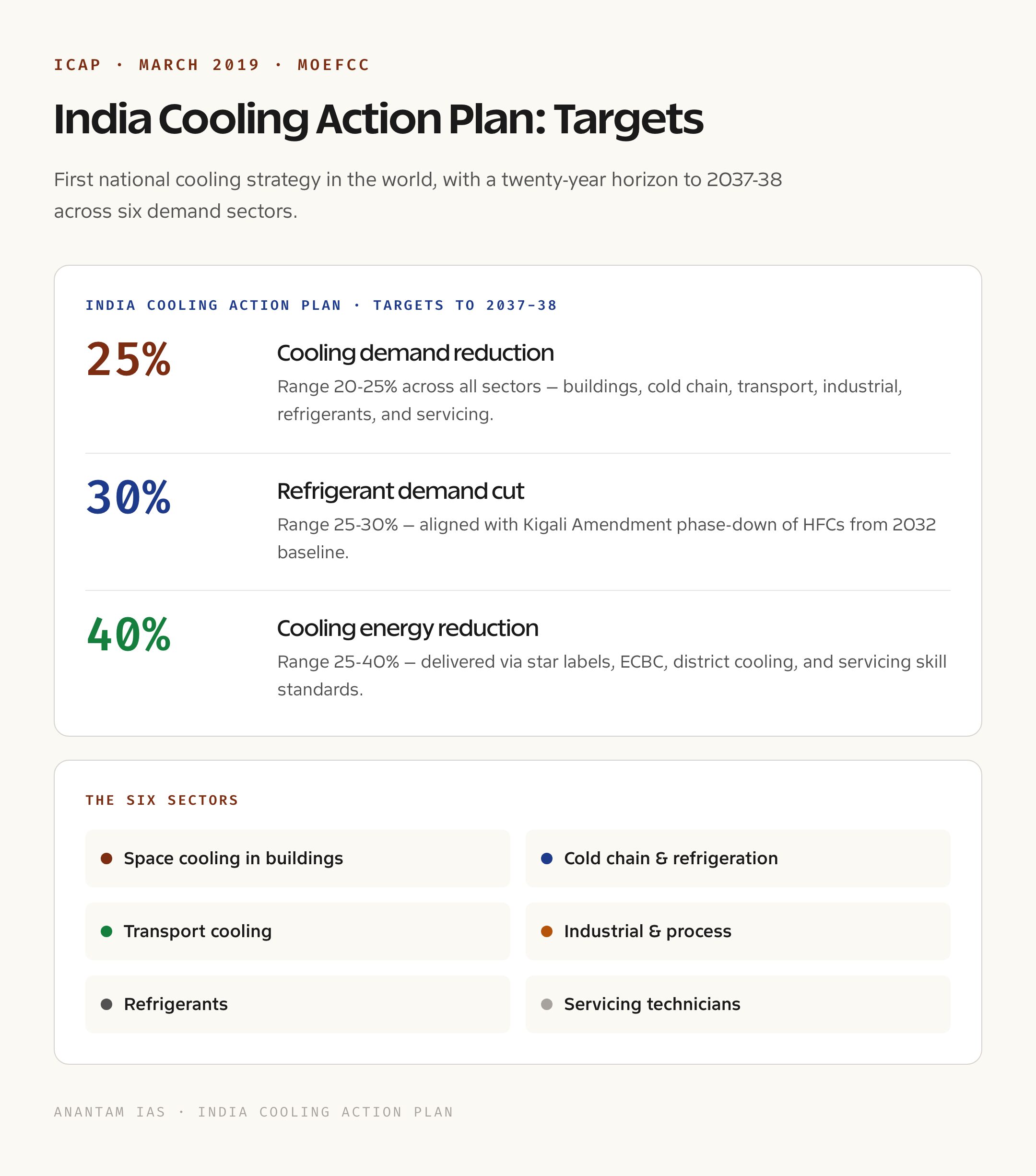
The India Cooling Action Plan is a strategy document with three core targets. By 2037 to 2038, it aims to cut overall cooling demand by 20 to 25 percent, reduce refrigerant demand by 25 to 30 percent, and reduce cooling energy requirements by 25 to 40 percent. It is not a regulation, which means none of these targets are legally binding. They function instead as a policy benchmark that other instruments, like the BEE star ratings and the Energy Conservation Building Code, are expected to deliver against.
The plan covers six sectors. Space cooling in buildings, the largest component, is the focus of star labels and building codes. Cold chain and refrigeration cover food, vaccines, and pharmaceuticals. Transport cooling covers vehicle air conditioning. Industrial cooling and process cooling cover manufacturing. The two cross-cutting components are refrigerants and servicing technicians, with the latter recognizing that a poorly serviced AC leaks refrigerant and consumes more energy than a well-serviced one.
Background and Historical Context
India’s energy efficiency journey began with the Energy Conservation Act, 2001, which created the Bureau of Energy Efficiency as the statutory implementing agency under the Ministry of Power. Before 2001, energy efficiency was a fragmented effort spread across different ministries and state agencies. The Act gave BEE four core mandates: setting standards and labels for appliances, mandating energy audits for designated consumers, developing the Energy Conservation Building Code, and certifying energy auditors.
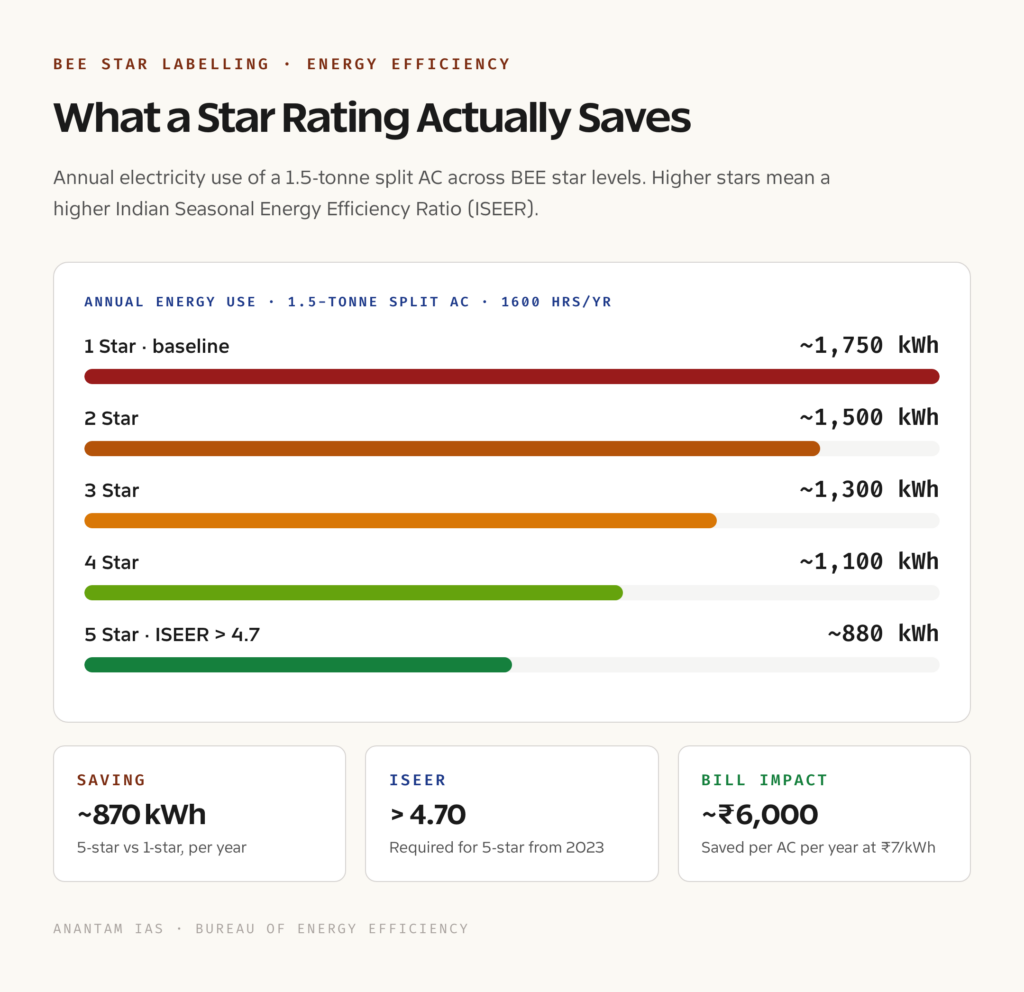
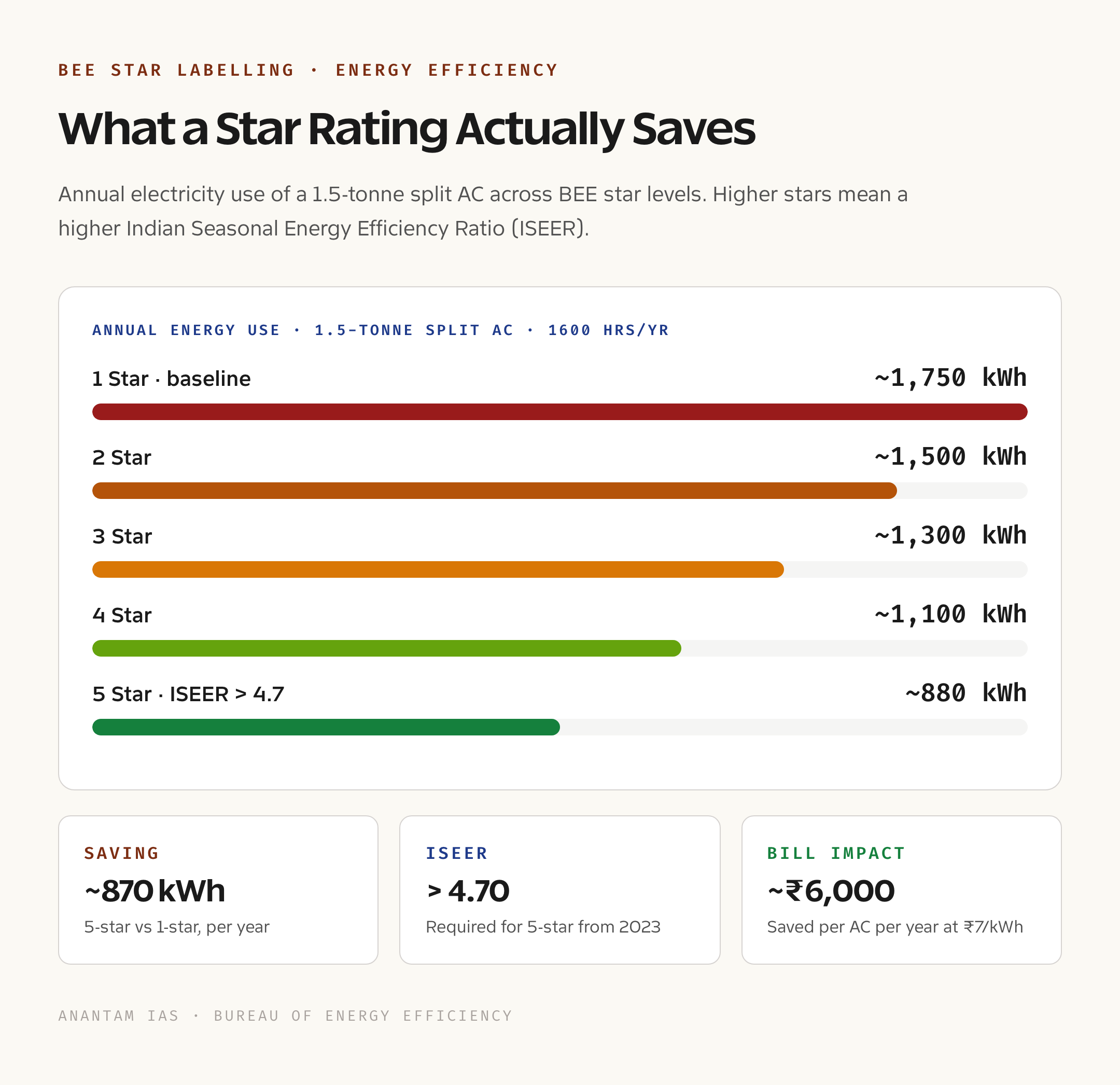
The Star Labelling Programme was launched in 2006, initially as a voluntary programme covering room ACs, refrigerators, tubular fluorescent lamps, and distribution transformers. Over the next decade, more product categories were added and the most widely used ones were moved from voluntary to mandatory. The programme uses a one-to-five-star rating with one star representing the minimum efficiency level allowed in the market and five stars representing the most efficient. Every two to three years, the rating thresholds are revised upward, which means a five-star AC sold in 2014 may now rate as a three-star unit.
The 2019 Cooling Action Plan came at a moment when room AC sales in India were doubling roughly every five years and when global negotiations under the Kigali Amendment to the Montreal Protocol were closing in on hydrofluorocarbon refrigerants. India ratified the Kigali Amendment in 2021, committing to a phase-down of HFCs starting in 2028, which makes the refrigerant component of the Cooling Action Plan a binding international obligation in addition to a domestic policy goal. The cooling sector has since become a focal point in COP climate negotiations involving India.
Key Provisions of the BEE Framework
The Bureau of Energy Efficiency operates through four main instruments. The Standards and Labelling Programme is the most visible. Mandatory labelling currently applies to products with high market penetration, including room air conditioners, frost-free refrigerators, tube lights, LED lamps, color televisions, distribution transformers, and electric geysers. Voluntary labelling applies to product categories that are still emerging in the market or where rating schemes are being piloted, such as ceiling fans, computers and laptops, washing machines, microwave ovens, induction motors, and storage water heaters.
The Energy Conservation Building Code, first issued in 2007 and revised in 2017, sets minimum efficiency standards for the building envelope, lighting, HVAC, and electrical systems of large commercial buildings. The 2017 revision introduced two tiers above the base code, called ECBC Plus and Super ECBC, which roughly correspond to a 25 percent and 50 percent improvement over the base.
The Perform Achieve and Trade scheme covers the largest energy-consuming industrial units in nine sectors, including thermal power, cement, steel, fertilizer, and aluminium. Each unit gets a specific energy consumption target. Units that beat their target earn tradeable energy savings certificates, while units that miss have to buy them. PAT is one of the few examples of a working market-based environmental instrument in India and is closely linked to the carbon credit trading scheme being developed under the 2022 Energy Conservation Amendment Act.
The fourth instrument is the State Energy Efficiency Index, published jointly by BEE and the Alliance for an Energy Efficient Economy. It scores states and union territories on the implementation of energy efficiency policies and programmes across buildings, industry, municipal services, transport, agriculture, and discoms. The 2022 edition placed Andhra Pradesh, Karnataka, and Kerala among the front-runner states, with Delhi and Chandigarh leading the union territories.
Why Cooling Policy Matters
Two numbers explain why cooling sits at the centre of India’s climate policy. The first is that cooling is responsible for roughly 7 to 8 percent of national greenhouse gas emissions today and is projected to account for more than half the growth in electricity demand between now and 2050. The second is that an inefficient cooling stock locks in emissions for the lifetime of the equipment. A room AC sold today will be in service for ten to fifteen years, which means a 2026 sale of a one-star unit creates emissions through 2040.
The Cooling Action Plan also recognizes the equity dimension. Heatwaves are a public health emergency for low-income urban households who cannot afford air conditioning. The plan promotes passive cooling design in housing, including reflective roofs, ventilated walls, and shaded windows, as a way of cutting heat exposure without expanding electricity demand. This dovetails with the air pollution in India story, since coal-fired power plants are the backbone of the cooling-driven electricity demand.
Detailed Analysis of the Star Labelling Programme
The Star Labelling Programme works through a carefully tuned threshold system. For each product category, BEE defines an Indian Seasonal Energy Efficiency Ratio for ACs or a similar performance metric and then sets star bands at fixed efficiency intervals. A one-star unit barely meets the minimum allowed efficiency, while a five-star unit delivers two to three times the cooling per unit of electricity.
The programme has been particularly successful in shifting the AC market. When mandatory labelling was introduced for fixed-speed room ACs, the average efficiency in the market jumped within two years, partly because manufacturers stopped making the very lowest-efficiency models. The introduction of separate ratings for inverter ACs in 2018 then created a new ladder for variable-speed compressors, which now dominate the urban market.
Refrigerator labelling has been similarly transformative. The 2014 revision of frost-free refrigerator standards effectively eliminated single-star units from the mandatory market, and the 2020 revision raised the bar again. The State Energy Efficiency Index uses BEE-labelled appliance penetration as one of its scoring metrics, which gives state governments an incentive to run awareness campaigns and bulk procurement programmes.
Comparative View: GRIHA, LEED, and IGBC
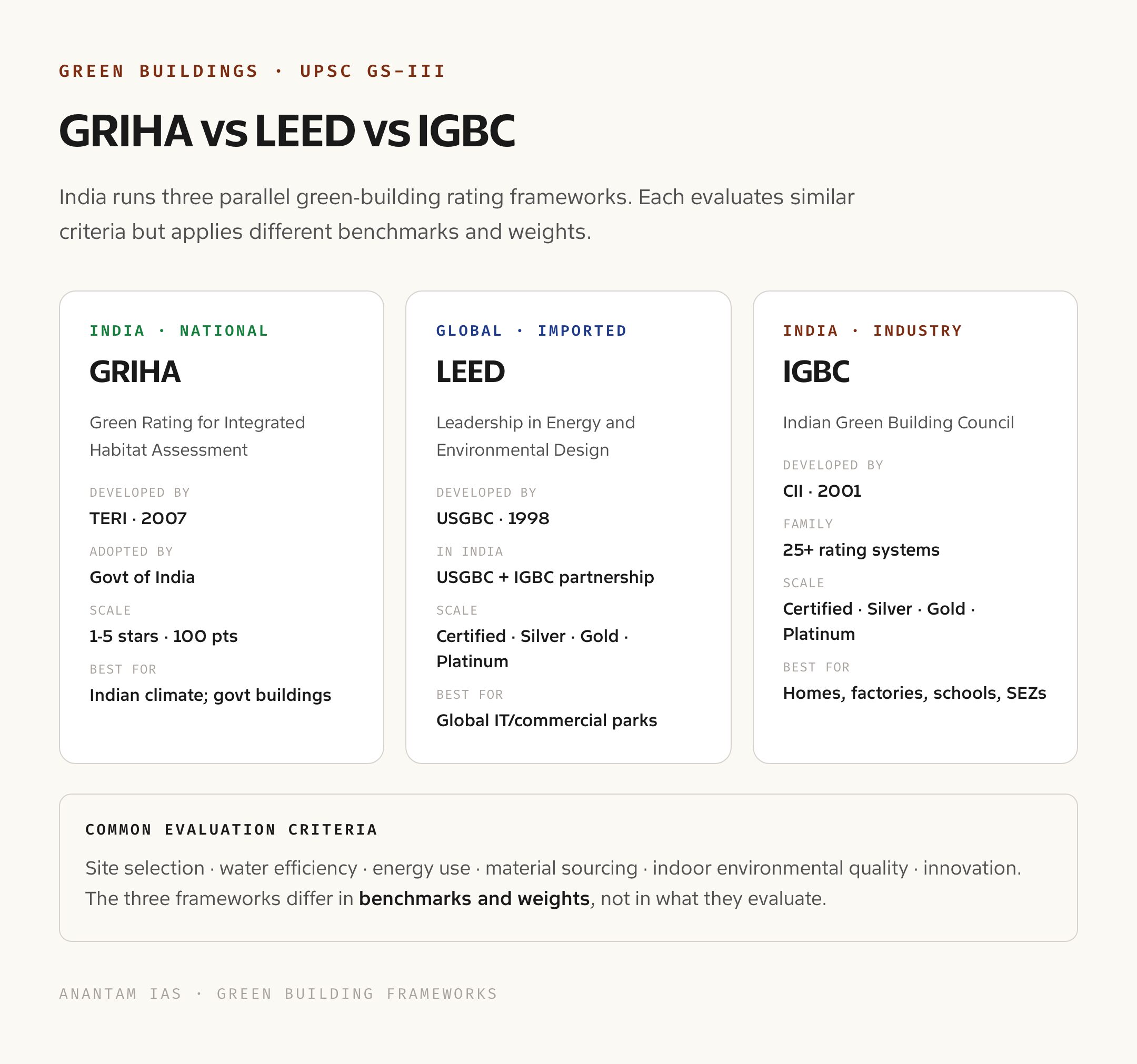
India has three major green building rating systems, each with its own logic. GRIHA, developed by TERI and launched in 2007, is the national rating system adopted by the government and is administered by GRIHA Council under the Ministry of New and Renewable Energy. It uses a five-star scale and assesses buildings across a hundred-point matrix covering site selection, energy performance, water conservation, materials, and indoor environmental quality. GRIHA is mandatory for central government buildings above a specified size.
LEED, or Leadership in Energy and Environmental Design, is the global system run by the U.S. Green Building Council and is widely used in India for commercial buildings, particularly IT parks and corporate offices that want international recognition. LEED uses a four-tier scale of Certified, Silver, Gold, and Platinum and assesses similar parameters to GRIHA but with a stronger focus on operational performance and metering.
The Indian Green Building Council was set up in 2001 under the Confederation of Indian Industry. IGBC operates a family of more than thirty rating systems for different building types, including IGBC Green Homes, IGBC Green Townships, and IGBC Green Schools. It is the most widely used green building system in India by total floor area certified, partly because its ratings are tailored to Indian climate zones.
Challenges and Criticisms
The cooling and BEE story has gaps. The first is that the Star Labelling Programme covers the regulated sales market but not the second-hand and informal repair market, which keeps inefficient old ACs in service well beyond their design life. The second is that voluntary labelling on ceiling fans, despite covering an enormous installed base, has had limited consumer pickup because power-saving fans cost two to three times more upfront.
Implementation of the Energy Conservation Building Code has been weak in most states, since it has to be adopted into local building bye-laws to be enforceable, and many municipal corporations have not done so. The Cooling Action Plan itself has no statutory backing, so its 2037 to 2038 targets depend on continued political commitment and on subordinate instruments like star ratings and ECBC delivering on their pieces.
There is also the refrigerant problem. India’s HFC phase-down begins in 2028 under the Kigali Amendment, but the domestic AC industry is still heavily dependent on R-32 and R-410A. The Cooling Action Plan recommends accelerated transition to lower-GWP refrigerants like HFO blends and natural refrigerants such as propane, but the manufacturing supply chain is not yet ready at scale.
Prelims Pointers on Cooling and BEE
The India Cooling Action Plan was released in 2019 by the Ministry of Environment, Forest and Climate Change with a horizon of 2037 to 2038. The Bureau of Energy Efficiency is a statutory body under the Ministry of Power, established under the Energy Conservation Act, 2001. The Star Labelling Programme uses a one-to-five-star scale and has both mandatory and voluntary categories. The State Energy Efficiency Index is jointly published by BEE and AEEE. GRIHA was launched in 2007 by TERI under the Ministry of New and Renewable Energy. LEED is administered by the U.S. Green Building Council. IGBC operates under the Confederation of Indian Industry and was set up in 2001. The Kigali Amendment to the Montreal Protocol governs the phase-down of HFC refrigerants and was ratified by India in 2021.
Mains-Level Questions
A typical mains question might ask whether the India Cooling Action Plan can deliver its 2037 to 2038 targets given current trends in AC sales. A strong answer would walk through the targets, examine the role of star labelling and ECBC in delivering them, flag the refrigerant transition under Kigali, and end with the equity gap in cooling access.
Another framing asks about the role of BEE in India’s climate policy. Here the answer can move from the statutory mandate under the Energy Conservation Act to the four operational instruments, and then connect to the broader renewable energy push and the carbon credit trading scheme.
Way Forward
A coherent forward path needs to do four things. First, accelerate the refrigerant transition by aligning import duties and manufacturing incentives with the Kigali phase-down schedule. Second, mandate ECBC adoption in state building bye-laws within a fixed timeline, perhaps tied to access to centrally sponsored housing schemes. Third, expand the State Energy Efficiency Index into a formal performance-based fiscal incentive, so that better-scoring states receive a share of central funds for cooling and energy efficiency projects. Fourth, integrate passive cooling and shading requirements into the Pradhan Mantri Awas Yojana housing standards, which would reach low-income households that are unlikely to ever own an AC but are exposed to dangerous heat.
Behavioural change is the missing piece. Setting AC thermostats to 24 degrees Celsius rather than 18 degrees Celsius alone can cut national cooling electricity by an estimated 4 to 6 percent. BEE has run public campaigns on this, but adoption remains uneven. A push toward smart thermostats, time-of-use tariffs, and demand-response programmes could close that gap over the next decade.
Frequently Asked Questions
What is the India Cooling Action Plan?
The India Cooling Action Plan is a national strategy released in 2019 by the Ministry of Environment, Forest and Climate Change. It targets a 20 to 25 percent reduction in overall cooling demand and a 25 to 30 percent reduction in refrigerant demand by 2037 to 2038, covering space cooling, cold chain, transport, and industrial cooling.
What does the Bureau of Energy Efficiency do?
BEE is a statutory body under the Ministry of Power, set up under the Energy Conservation Act, 2001. It runs the Star Labelling Programme, the Energy Conservation Building Code, the Perform Achieve and Trade scheme for industries, and the State Energy Efficiency Index.
How does the BEE star rating work?
The star rating is a one-to-five-star label assigned to appliances based on their energy efficiency. One star is the minimum allowed efficiency, five stars is the most efficient. Thresholds are revised every two to three years to push the market toward higher efficiency.
Which appliances have mandatory star labelling?
Mandatory labelling currently applies to room air conditioners, frost-free refrigerators, tube lights, LED lamps, color televisions, distribution transformers, and electric geysers, among other categories.
What is GRIHA?
GRIHA is the Green Rating for Integrated Habitat Assessment, India’s national green building rating system. It was developed by TERI in 2007 and is adopted by the central government for assessing the environmental performance of buildings.
How does GRIHA differ from LEED?
GRIHA is the Indian system, designed for Indian climate zones and procurement realities, and is administered by GRIHA Council. LEED is a global system run by the U.S. Green Building Council and is widely used in India for projects seeking international certification.
What is the State Energy Efficiency Index?
The State Energy Efficiency Index is an annual ranking of states and union territories on the implementation of energy efficiency policies. It is jointly published by BEE and the Alliance for an Energy Efficient Economy and covers buildings, industry, transport, agriculture, and municipal services.
Why is cooling a climate policy issue?
Cooling drives a rapidly growing share of electricity demand, which translates into more coal-fired power generation and higher emissions. Refrigerants used in ACs and refrigerators are also potent greenhouse gases that are being phased down under the Kigali Amendment.
What is the Kigali Amendment?
The Kigali Amendment to the Montreal Protocol was adopted in 2016 and commits countries to a phase-down of hydrofluorocarbon refrigerants, which have a high global warming potential. India ratified it in 2021 and begins its phase-down in 2028.
What are passive cooling techniques?
Passive cooling reduces indoor temperature without using energy-intensive equipment. Examples include reflective roofs, cross-ventilation, courtyard design, shading devices, vegetation, and high thermal mass walls. The Cooling Action Plan promotes passive cooling as a low-cost, equity-friendly intervention for low-income housing.
Tell Google you want more of this.
Add Anantam IAS as a preferred sourceOne tap, and this site shows up more often in your own Top Stories, AI Overviews and AI Mode. Remove it any time.