DRDO Financial Powers 2026: Faster Defence R&D Execution
Why in News?
PIB confirmed that Raksha Mantri Rajnath Singh released the Delegation of Financial Powers to DRDO 2026 in New Delhi on June 29, 2026.
The revised framework is meant to speed up strategic R&D projects, improve accountability, and move systems, platforms, and technologies from the R&D ecosystem into the Defence Forces faster.
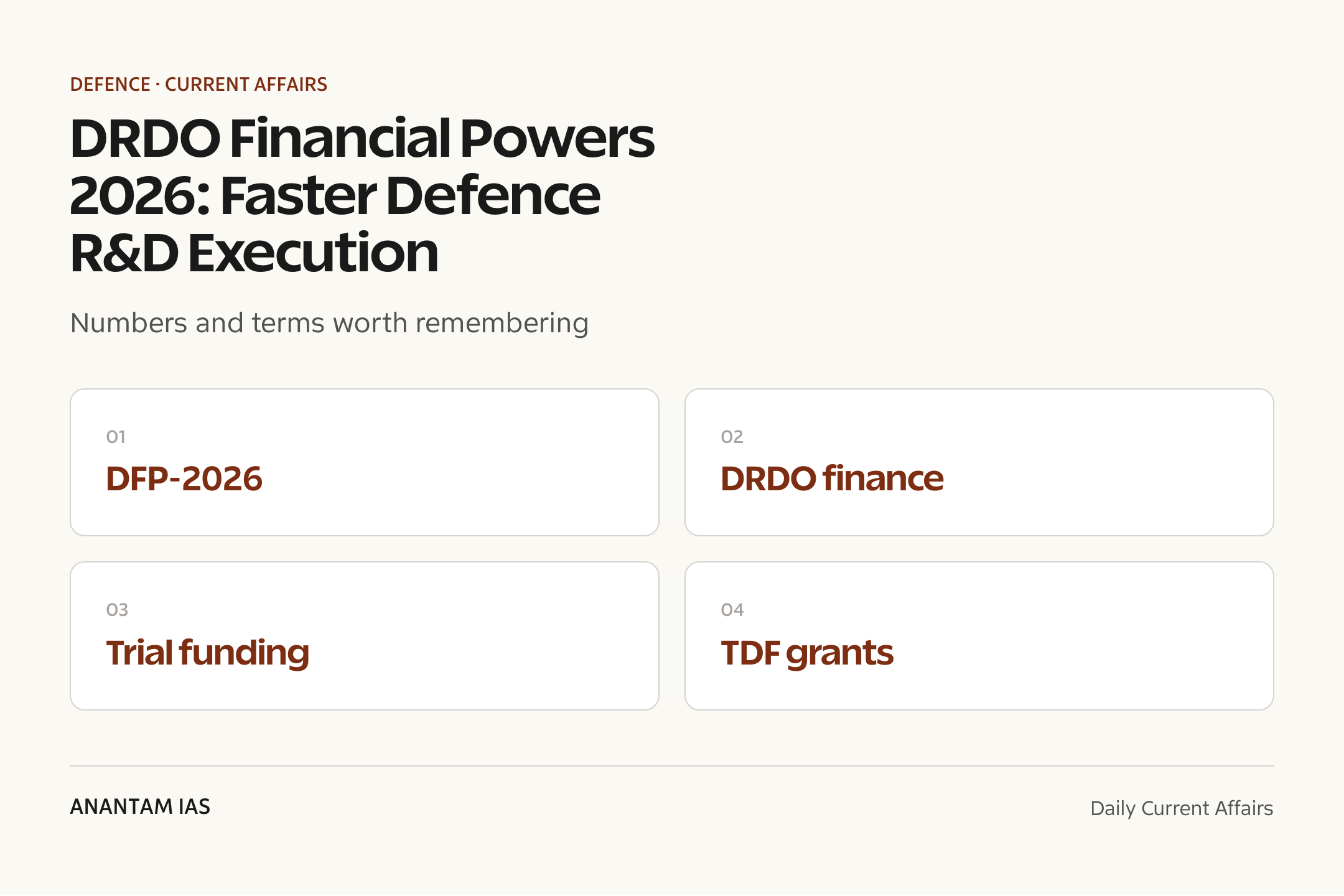
- DFP-2026 updates financial delegation within the Department of Defence R&D and DRDO-linked project structures.
- It creates dedicated financial provisions for trial campaigns, tests, and evaluation activities.
- It authorises sanctioning of pre-project R&D initiatives, reducing the delay before a formal project begins.
- It separates financial powers for grants-in-aid linked to Extra-Mural Research Projects, DIA-CoEs, and the Technology Development Fund.
- PIB said the reform supports Aatmanirbhar Bharat and stronger defence preparedness.
The development matters in the context of:
- Defence R&D often suffers when trial funding, testing authority, and early-stage approval move slower than the technology cycle.
- DRDO-industry-academia collaboration needs predictable funding authority because prototypes, field trials, and design improvements are iterative.
- Internal security and external defence now depend on faster induction of missiles, sensors, drones, cyber tools, and electronic systems.
- Procurement reform is not only about buying weapons; it also shapes how quickly indigenous technology becomes deployable capability.
UPSC Relevance
Prelims Relevance
- DRDO works under the Department of Defence R&D in the Ministry of Defence.
- DFP-2026 refers to the revised delegation of financial powers for DRDO-related R&D execution.
- Extra-Mural Research supports research outside DRDO labs, including academic and specialist institutions.
- Defence Innovation Accelerator-Centres of Excellence link defence innovation with institutions, industry, and startups.
- Technology Development Fund supports development of defence technologies by industry, especially MSMEs and startups.
- Trial campaigns, tests, and evaluation activities are key stages before induction of a defence system.
- Aatmanirbhar Bharat in defence means domestic design, development, production, and supply-chain resilience.
- GS3 Science and Technology connects this topic with indigenous defence technology, innovation, and security.
Mains Relevance
GS Paper 3
- Internal security: Faster R&D execution can reduce capability gaps in surveillance, air defence, missiles, drones, and electronic warfare.
- Science and technology: DFP-2026 shows how institutional finance rules affect innovation outcomes, not just lab capacity.
- Defence indigenisation: Delegated powers can support quicker movement from prototype to production and induction.
GS Paper 2
- Governance: The reform tests the balance between functional autonomy, financial accountability, audit discipline, and outcome-based administration.
- Public institutions: DRDO’s link with academia and industry raises questions about grant design, transparency, and collaboration models.
Essay
- Self-reliance is built through institutions, not slogans alone.
- Speed and accountability can coexist when rules define authority clearly.
- Technology sovereignty depends on research finance, talent, testing infrastructure, and procurement confidence.
Background and Context
What DFP-2026 Changes
The core reform is administrative: give DRDO-linked decision-makers clearer authority to fund critical stages of R&D.
- Delegation of Financial Powers means specified officers or bodies can approve defined expenditure without routing every decision to the top.
- DFP-2026 focuses on strategic R&D execution, where delays in approvals can slow tests, vendor work, design iterations, and field validation.
- PIB described it as a reform for efficiency, accountability, and timely execution, not as a new weapon system or new organisation.
- Functional empowerment is the key phrase: the reform aims to let the right level approve the right expenditure at the right project stage.
- Accountability remains central because delegated powers work only when expenditure heads, schedules, and competent authorities are clearly defined.
Why DRDO Needs Faster Financial Authority
Defence technology moves through uncertain stages, so rigid finance channels can become a bottleneck before the science itself fails.
- Strategic R&D involves design, simulation, prototype fabrication, field trials, redesign, user feedback, and production readiness.
- Trial campaigns need travel, range access, instrumentation, test assets, specialist support, and repeated evaluation windows.
- Pre-project R&D matters because early feasibility work often decides whether a full project deserves sanction.
- Defence systems such as missiles, radars, UAVs, electronic warfare suites, and sensors need fast iteration after test data.
- Procurement speed at the R&D stage can directly shape operational readiness because delayed testing delays induction.
Link With Aatmanirbhar Bharat
The reform supports defence self-reliance by improving the route between laboratory work, industry capacity, and military use.
- Aatmanirbhar Bharat in defence requires domestic design and development, not only local assembly of imported technology.
- DRDO supplies the institutional backbone for many indigenous platforms, but induction needs production partners and user confidence.
- Industry collaboration becomes stronger when funding decisions for tests, prototypes, and technology development are predictable.
- Academia can contribute advanced research in materials, propulsion, AI, cyber systems, quantum technologies, and electronics.
- Self-reliance improves when promising technologies do not remain trapped between proof-of-concept and field-ready systems.
- Students can connect this to Science and Technology preparation because defence R&D is a high-yield current-affairs area.
Grant Schedules And Innovation Channels
PIB highlighted clearer segregation of financial powers for major defence innovation and research grant channels.
- Extra-Mural Research Projects allow defence-linked research to be supported beyond DRDO’s own labs.
- Defence Innovation Accelerator-Centres of Excellence connect defence needs with universities, innovation hubs, and technology ecosystems.
- Technology Development Fund supports defence technology development, especially where industry can build usable systems.
- Separate schedules reduce ambiguity over which authority can approve which grant or expenditure category.
- Grant clarity is important for startups and research teams because uncertain approvals can break project timelines and cash flow.
Internal Security And Strategic Preparedness
The GS3 value lies in linking financial delegation with capability development and national security outcomes.
- Internal security now overlaps with drones, encrypted communications, border surveillance, cyber tools, and electronic warfare.
- External defence needs indigenous air defence, long-range strike, naval systems, space support, and secure communications.
- Critical systems are useful only after they clear trials, tests, evaluation, production, and user induction.
- DFP-2026 tries to shorten the administrative distance between R&D output and Defence Forces’ use.
- This theme also links with recent defence technology notes such as DRDO’s ballistic missile defence test and air-defence preparedness.
Governance Risks To Watch
Delegation can improve speed, but it must be backed by transparent process, audit discipline, and measurable project outcomes.
- Financial autonomy can fail if powers are unclear, duplicated, or used without milestones.
- Audit discipline matters because strategic urgency cannot become a shield for weak documentation.
- Vendor selection and research grants need safeguards against favouritism, poor peer review, and fragmented project ownership.
- User feedback from the armed forces must be built into testing so R&D does not drift away from operational needs.
- Outcome tracking should focus on trial completion, prototype maturity, transfer of technology, production readiness, and induction.
How To Use This In Answers
For Mains, DFP-2026 is best used as a governance example inside a larger defence modernisation answer.
- Institutional reform example: Use it to show that capability development needs better rules, not only higher budgets.
- Science-to-security link: Connect the reform with how lab research becomes deployable technology through testing, evaluation, and production.
- Public finance angle: Delegation should be presented as controlled decentralisation, where speed is paired with audit and defined schedules.
- Indigenisation example: Cite DRDO, industry, academia, Extra-Mural Research, DIA-CoEs, and TDF as parts of one defence innovation chain.
- Balanced critique: Add that faster sanctions alone cannot fix weak project management, delayed trials, user-service mismatch, or production bottlenecks.
Way Forward
Make Delegation Outcome-Linked
- Tie delegated approvals to defined milestones such as feasibility proof, prototype readiness, trial completion, and user evaluation.
- Use project dashboards inside the Ministry of Defence to track delays, cost changes, trial status, and technology maturity.
- Publish broad non-sensitive performance indicators so Parliament and citizens can assess reform outcomes without exposing classified details.
- Map each financial approval to a project stage so reviewers can see whether spending helped a trial, prototype, grant, or induction pathway.
Strengthen Innovation Interfaces
- Give industry and academia predictable grant timelines, clear eligibility rules, and standard reporting formats.
- Support MSMEs and startups through faster test access, intellectual property clarity, and realistic procurement pathways after successful trials.
- Build stronger links between DRDO labs, service headquarters, private manufacturers, and testing ranges.
- Create a clearer route for successful prototypes to move from grant support to limited series production and user trials.
Protect Accountability
- Keep audit trails strong even when approval authority is pushed downward.
- Separate technical evaluation from financial approval where conflict of interest may arise.
- Use post-project reviews to identify why some projects miss timelines, fail trials, or do not reach induction.
- Require lessons-learned notes after major tests so repeated delays in materials, ranges, vendors, or user feedback are not normalised.
Conclusion
DFP-2026 is an institutional reform with direct security relevance: it tries to make DRDO’s R&D pipeline faster without abandoning financial discipline.
For UPSC, the issue is not the finance rule alone. The exam angle is how governance design shapes defence innovation, self-reliance, industry collaboration, and timely military preparedness.
The reform will matter most if delegated powers translate into tested systems, cleaner collaboration, faster induction, and stronger accountability across the defence R&D ecosystem.
UPSC Practice Questions
Prelims MCQ 1
With reference to the Delegation of Financial Powers to DRDO 2026, consider the following statements:
- It was released by the Raksha Mantri on June 29, 2026.
- It includes dedicated financial provisions for trial campaigns, tests, and evaluation activities.
- It creates a new armed force under the Ministry of Defence.
How many of the above statements are correct?
(a) Only one (b) Only two (c) All three (d) None
Answer: (b) Only two
Explanation:
Statements 1 and 2 are correct as per PIB. Statement 3 is incorrect because DFP-2026 is a financial delegation framework for DRDO-related R&D execution, not a new armed force.
Prelims MCQ 2
Which one of the following is most directly associated with grants and technology development support mentioned in DFP-2026?
(a) Technology Development Fund (b) Finance Commission (c) Inter-State Council (d) National Disaster Response Force
Answer: (a) Technology Development Fund
Explanation:
PIB referred to clear segregation of financial powers for grants-in-aid linked to Extra-Mural Research Projects, DIA-CoEs, and Technology Development Fund projects.
UPSC Mains Questions
- DFP-2026 shows that defence preparedness depends as much on institutional finance rules as on scientific capability. Discuss with reference to DRDO, strategic R&D execution, trials, and defence indigenisation.
- Examine how clearer financial delegation can improve collaboration among DRDO, industry, academia, and the armed forces. What accountability safeguards are needed when speed becomes an explicit objective?
- Defence self-reliance requires faster movement from prototype to induction. Analyse the role of procurement reform, testing infrastructure, and technology development funds in achieving this goal.
Sources: PIB, Ministry of Defence and Indian Express.
Frequently Asked Questions
What is DFP-2026?
DFP-2026 is the Delegation of Financial Powers to DRDO 2026. PIB described it as a revised framework to improve efficiency, accountability, and timely execution of strategic defence R&D projects within the Department of Defence R&D.
Who released DFP-2026?
Raksha Mantri Rajnath Singh released DFP-2026 on June 29, 2026, in New Delhi. PIB said the reform is meant to support faster production and induction of systems, platforms, and technologies into the Defence Forces.
Why is it important for UPSC?
It connects GS3 internal security, science and technology, and defence indigenisation. It also has a GS2 governance angle because it deals with delegation, accountability, audit discipline, and public-sector institutional reform.
How does it help Aatmanirbhar Bharat?
The framework can support self-reliance by reducing administrative delay in trials, pre-project R&D, grants, and technology development. Faster approvals can help indigenous systems move from labs and industry partners to military users.
What are DIA-CoEs?
Defence Innovation Accelerator-Centres of Excellence are defence innovation channels that connect research institutions, innovation ecosystems, and defence needs. DFP-2026 gives clearer financial treatment to grants linked with such projects.
What risks should be watched?
The main risks are weak documentation, poor outcome tracking, unclear authority, and rushed approvals without technical discipline. Delegation works best when financial powers are linked with milestones, audits, and user evaluation.