Why in News?
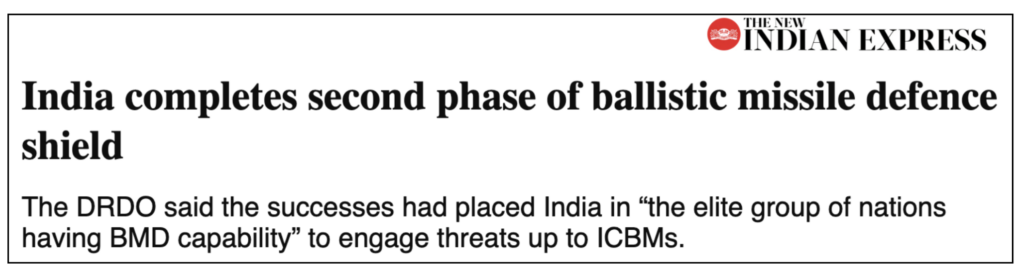
The Defence Research and Development Organisation (DRDO) demonstrated a ballistic-missile-defence (BMD) interception capability— an indigenous interceptor engaging a simulated incoming missile in a controlled trial conducted from a launch complex off the eastern coast.
This is a home-grown interceptor, distinct from the imported S-400 Triumf and from offensive systems like the Agni family. BMD is about shooting down an enemy ballistic missile in flight, not launching one — a defensive, hit-to-kill capability that very few nations possess.
- DRDO validated an interceptor missile against a target replicating an incoming ballistic-missile trajectory.
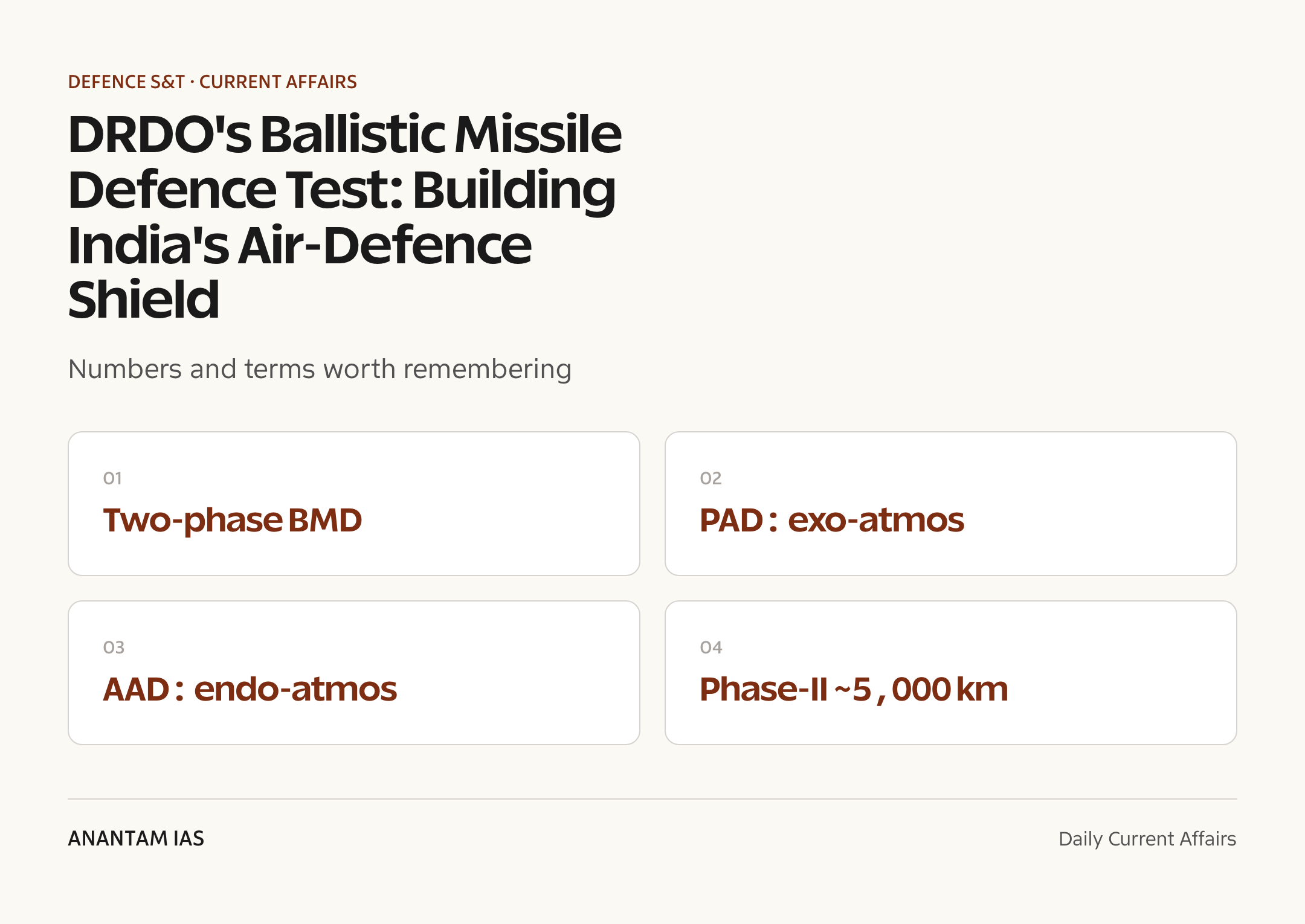
- The test fits India’s two-phase BMD programme — Phase I (already proven against shorter-range threats) and the more capable Phase II (AD-1 / AD-2).
- Phase-I pairs the Prithvi Air Defence (PAD) for high-altitude exo-atmospheric kills with the Advanced Air Defence (AAD) for lower endo-atmospheric intercepts.
- Phase-II targets longer-range and Intermediate-Range Ballistic Missile (IRBM)-class threats out to roughly the 5,000 km band.
- The capability feeds India’s emerging multi-tier shield concept under Mission Sudarshan Chakra, alongside the Army’s Akashteer air-defence control network.
The development matters in the context of:
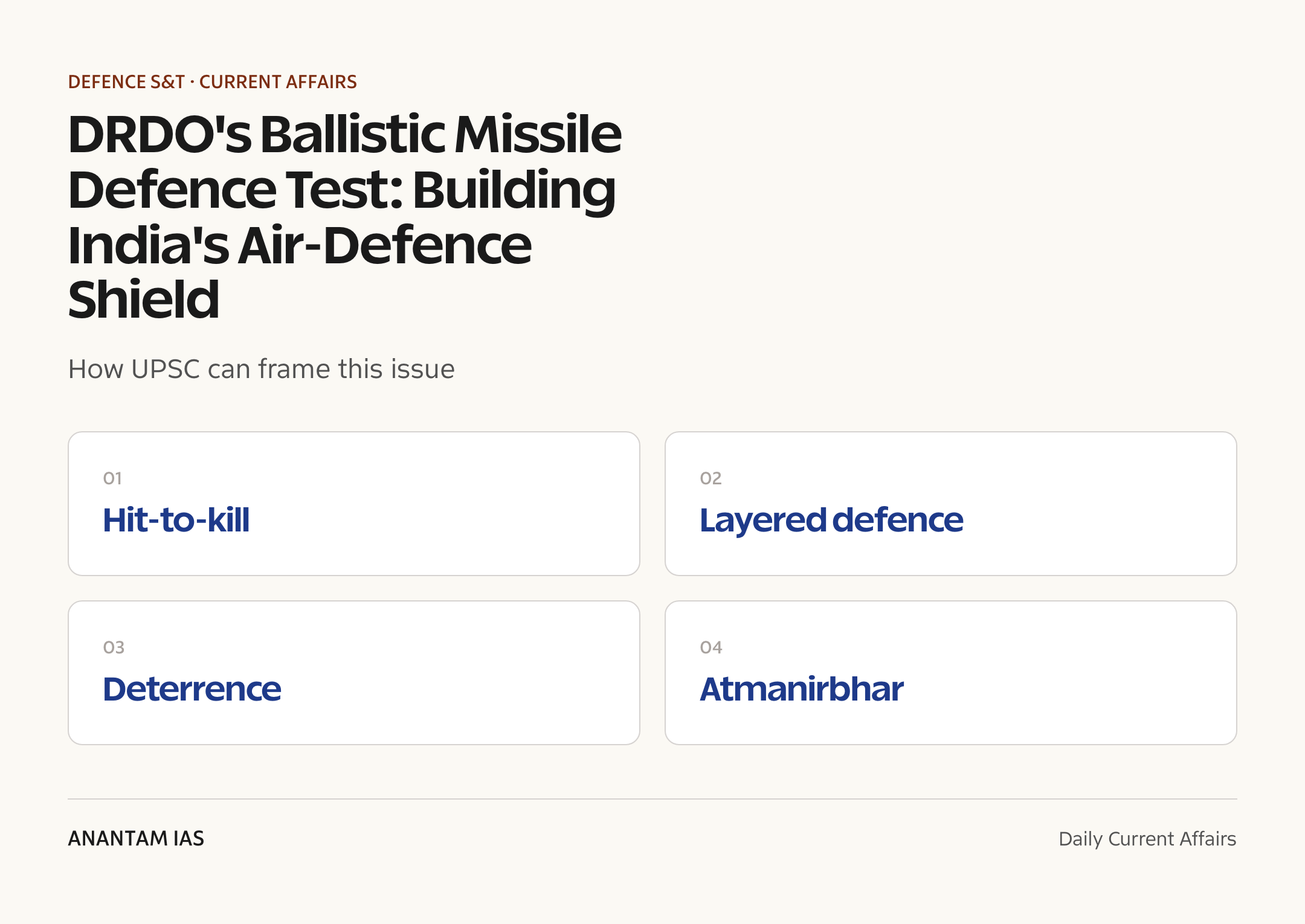
- Matters because India faces ballistic-missile arsenals on two fronts, making credible missile defence central to strategic stability and deterrence.
- Matters because BMD technology is tightly controlled by regimes like the Missile Technology Control Regime (MTCR), so indigenous mastery beats technology denial.
- Matters because it pushes India toward self-reliance (Atmanirbharta) in the most demanding category of defence electronics and interception.
UPSC Relevance
Prelims Relevance
- DRDO — R&D wing of the Ministry of Defence; BMD is a flagship programme.
- Two-phase BMD: Phase I (PAD + AAD), Phase II (AD-1, AD-2).
- PAD (Prithvi Air Defence) — exo-atmospheric interception (above ~50 km).
- AAD (Advanced Air Defence) — endo-atmospheric interception (within the atmosphere).
- Exo- vs endo-atmospheric: outside vs inside the atmosphere.
- AD-1 / AD-2 — Phase-II interceptors for longer-range and IRBM-class threats.
- Difference: Agni = offensive ballistic missile; BMD interceptor = defensive.
- S-400 Triumf = imported Russian system; BMD = indigenous interception.
- MTCR — export-control regime India joined in 2016.
- Mission Sudarshan Chakra and Akashteer — integrated air-defence context.
Mains Relevance
GS Paper 3
- Indigenous BMD as a marker of self-reliance in strategic technology and the role of DRDO.
- Layered air defence: how interceptors, S-400, Akash and control networks fit a multi-tier shield.
GS Paper 2 / IR
- Missile defence, deterrence and strategic stability in a two-front threat environment.
- Technology-denial regimes (MTCR) versus indigenous mastery.
Essay
- Self-reliance and security: can a nation buy deterrence, or must it build it?
- Technology as the new currency of strategic autonomy.
Background and Context
What does ballistic missile defence actually do?
BMD is the art of hitting a bullet with a bullet — destroying an incoming warhead in flight.
- A ballistic missile climbs on a rocket boost, coasts through space on a high arc, then falls on its target under gravity at hypersonic speed.
- BMD intercepts it in one of three flight phases — boost, midcourse, or terminal — ideally before re-entry.
- The interceptor uses radar tracking, a command-and-control chain and a fast kill vehicle to close the gap in seconds.
- Most modern interceptions are hit-to-kill — destroying the target by direct collision rather than a blast — demanding extreme accuracy.
- It is one of the hardest defence problems on earth: tiny reaction windows, decoys, and warheads arriving at several kilometres per second.
Exo- versus endo-atmospheric interception
The shield works in two layers — one above the atmosphere, one inside it.
- Exo-atmospheric interception happens in space, typically above roughly 50 km, where there is no air drag.
- Endo-atmospheric interception happens within the atmosphere, lower down, as the warhead re-enters — a last line of defence.
- India’s PAD handles the high, exo-atmospheric kill; the AAD handles the lower, endo-atmospheric kill.
- Two layers raise the kill probability — if the upper shot misses, the lower interceptor gets a second attempt.
- This two-tier logic mirrors global systems and underpins the idea of a layered air defence.
India’s two-phase BMD programme
DRDO structured the programme in two phases of rising range and capability.
- Phase-I targets shorter-range ballistic-missile threats and combines PAD (exo) with AAD (endo); both have been flight-proven over repeated trials.
- Phase-II raises the bar to Intermediate-Range Ballistic Missile (IRBM)-class threats in roughly the 5,000 km band.
- Phase-II rests on the AD-1 and AD-2 interceptors designed for both endo- and exo-atmospheric engagements.
- The programme’s roots trace to lessons from the Integrated Guided Missile Development Programme (IGMDP) launched under A.P.J. Abdul Kalam.
- Success here makes India one of a handful of states — alongside the United States, Russia and Israel — with a credible indigenous BMD.
Defence, not offence — and not imported
Three categories often get confused; the distinction is the whole point of this test.
- The Agni and other offensive ballistic missiles are launched at an adversary — they are the threat BMD is built to stop.
- The S-400 Triumf is a capable but imported Russian air-defence system covering aircraft, cruise missiles and some ballistic threats.
- The DRDO interceptor is indigenous — designed, built and validated in India, reducing dependence and sanction risk.
- Cruise missiles (like BrahMos) fly low and powered throughout; ballistic missiles arc through space — each needs a different defensive answer.
- Indigenous BMD complements, rather than replaces, imported and point-defence systems in a layered grid.
Deterrence, technology denial and strategic stability
A working shield changes the strategic maths between rivals.
- Credible missile defence strengthens deterrence by denial — an adversary cannot be sure its strike will land.
- But it can also unsettle strategic stability: rivals may build more missiles or decoys to overwhelm the shield (the offence-defence spiral).
- BMD electronics, seekers and propulsion fall under export curbs like the MTCR, so India had to develop them indigenously.
- India is a member of the MTCR (since 2016), which also eases access to high-end dual-use technology.
- Mastering BMD signals strategic autonomy and feeds India’s broader Atmanirbhar Bharat defence push.
How does it fit the wider air-defence shield?
BMD is one tier of an integrated, networked defence being assembled.
- India’s layered air defence stacks long-range (S-400), medium-range (Akash, Barak-8) and BMD interceptors against different threats and altitudes.
- The Army’s Akashteer automated control system fuses radar feeds to manage the airspace and direct the right weapon.
- Mission Sudarshan Chakra envisions a national integrated air-defence shield knitting these elements together by the next decade.
- Effective BMD also rests on the detection layer — long-range tracking radars and early-warning sensors feeding the kill chain.
- The goal is a single, networked grid where sensors, command nodes and interceptors act as one system.
Way Forward
Mature and induct
- Move Phase-II AD-1 / AD-2 from trials to series production and induction with repeatable, multi-target validation.
- Build numbers and stockpile depth so the shield can absorb saturation and decoy attacks, not just single shots.
Integrate and network
- Knit BMD into Akashteer and Mission Sudarshan Chakra so radars, command nodes and interceptors operate as one fused grid.
- Strengthen the early-warning sensor chain — long-range radars and space-based detection — to widen the reaction window.
Sustain the ecosystem
- Deepen private-industry and startup participation (via routes like iDEX) for seekers, propulsion and electronics.
- Keep strategic-stability diplomacy alive so missile defence does not trigger a destabilising arms build-up.
Conclusion
An indigenous BMD interception is more than a successful trial — it is proof that India can build, not just buy, the hardest category of strategic defence. It moves the country into a small club of nations able to credibly attempt to stop an incoming ballistic missile.
The harder work lies ahead: turning a validated interceptor into a deployed, networked, multi-tier shield that holds up against decoys and salvos, while managing the deterrence dynamics a shield inevitably sets in motion.
UPSC Practice Questions
Prelims MCQ 1
With reference to India’s ballistic-missile-defence (BMD) programme, consider the following statements:
- Phase-I combines the Prithvi Air Defence (PAD) for exo-atmospheric interception with the Advanced Air Defence (AAD) for endo-atmospheric interception.
- Phase-II is designed to counter Intermediate-Range Ballistic Missile (IRBM)-class threats.
- The S-400 Triumf is the indigenous interceptor at the core of the BMD programme.
How many of the above statements are correct?
(a) Only one (b) Only two (c) All three (d) None
Answer: (b) Only two
Explanation:
Statements 1 and 2 are correct. Statement 3 is wrong — the S-400 Triumf is an imported Russian system, not the indigenous BMD interceptor; India’s BMD rests on PAD/AAD (Phase-I) and AD-1/AD-2 (Phase-II).
Prelims MCQ 2
Endo-atmospheric interception in a ballistic-missile-defence system refers to destroying the incoming missile:
(a) outside the earth’s atmosphere, in space (b) within the earth’s atmosphere, at lower altitude (c) during its powered boost phase only (d) before it is launched, on the ground
Answer: (b) within the earth’s atmosphere, at lower altitude
Explanation:
Endo-atmospheric interception occurs inside the atmosphere as the warhead re-enters; exo-atmospheric interception occurs above the atmosphere (roughly above 50 km). India’s AAD is the endo-atmospheric layer, PAD the exo-atmospheric one.
UPSC Mains Questions
- India’s ballistic-missile-defence programme reflects a shift from buying to building strategic capability. Examine the design of India’s two-phase BMD and the strategic significance of indigenous interception. (250 words)
- Discuss how a layered air-defence shield is constructed, and analyse the place of indigenous BMD interceptors within it alongside imported and point-defence systems. (150 words)
- Missile defence can strengthen deterrence yet unsettle strategic stability. Critically analyse this tension in the context of India’s security environment. (250 words)
Sources: Indian Express and DRDO, Ministry of Defence.
Frequently Asked Questions
What is ballistic missile defence (BMD)?
BMD is a defensive system that detects, tracks and destroys an incoming ballistic missile in flight before it reaches its target. It uses radars, a command-and-control chain and a fast interceptor that strikes the warhead — usually by direct collision (hit-to-kill). It is among the hardest problems in defence because warheads arrive at hypersonic speed within very short reaction windows.
How is India’s BMD different from the Agni missiles?
The Agni family are offensive ballistic missiles meant to be launched at an adversary. A BMD interceptor is the opposite — it is fired to shoot down an incoming enemy missile. One delivers a strike; the other defends against one. Both are DRDO products, but they sit on opposite sides of the offence-defence divide.
Is India’s BMD the same as the S-400?
No. The S-400 Triumf is an imported Russian air-defence system that India bought. The BMD interceptor is indigenous — designed and built in India by DRDO. They complement each other in a layered shield, but indigenous BMD reduces dependence on foreign suppliers and the risk of sanctions or supply disruption.
What is the difference between exo- and endo-atmospheric interception?
Exo-atmospheric interception happens above the atmosphere, in space (roughly above 50 km), where there is no air drag — India’s PAD handles this. Endo-atmospheric interception happens lower down, inside the atmosphere, as the warhead re-enters — India’s AAD handles this. Using both layers raises the chance of a successful kill.
What are Phase-I and Phase-II of the programme?
Phase-I targets shorter-range ballistic-missile threats and pairs the exo-atmospheric PAD with the endo-atmospheric AAD; both are flight-proven. Phase-II is more ambitious, designed to counter longer-range, IRBM-class threats in roughly the 5,000 km band, built around the AD-1 and AD-2 interceptors for both endo- and exo-atmospheric engagements.
Why does an indigenous BMD test matter for UPSC?
It links several syllabus threads — defence S&T, self-reliance (Atmanirbhar Bharat), layered air defence, deterrence and strategic stability, and technology-denial regimes like the MTCR. It also places India among the few nations with a credible indigenous capability to intercept ballistic missiles, a recurring theme in GS Paper 3 and security questions.
Tell Google you want more of this.
Add Anantam IAS as a preferred sourceOne tap, and this site shows up more often in your own Top Stories, AI Overviews and AI Mode. Remove it any time.