Electronics Components Manufacturing Scheme (ECMS): Deepening India’s Electronics Value Chain
Why in News?
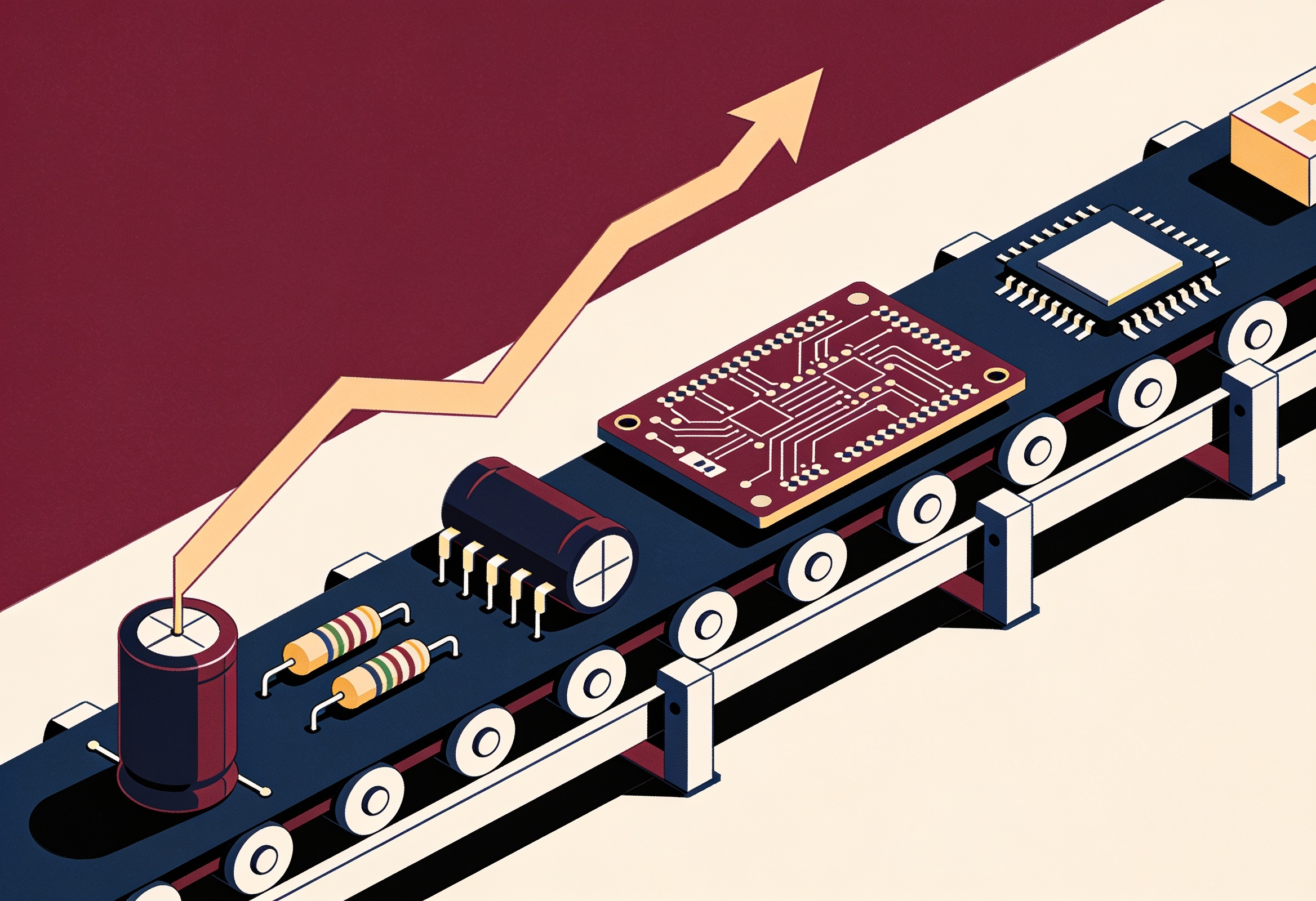
The Union Cabinet has approved the Electronics Components Manufacturing Scheme (ECMS), a dedicated incentive programme run by the Ministry of Electronics and Information Technology (MeitY) to grow domestic manufacture of the electronic components that sit beneath finished devices.
The scheme targets the long-missing components layer of India’s electronics chain — passive parts, printed circuit boards and sub-assemblies — that are still imported in bulk, mostly from China, even as final-device assembly has scaled under the Production Linked Incentive (PLI) route.
- Covers passive components (resistors, capacitors, inductors), printed circuit boards (PCBs), camera modules, and display and other sub-assemblies.
- Designed to lift Domestic Value Addition (DVA) in electronics, where India’s value capture stayed low despite record assembly output.
- Blends turnover-linked and capital-expenditure-linked incentives so both high-volume passives and capital-heavy sub-assemblies qualify.
- Sits alongside the India Semiconductor Mission (ISM) and the Design Linked Incentive (DLI) scheme, completing the device-to-chip ladder.
- Anchored in the Atmanirbhar Bharat goal of cutting strategic import dependence in a sector flagged for supply-chain risk.
The development matters in the context of:
- India became a large mobile-phone assembler under PLI, but most value stayed offshore because components were imported.
- A components base is a precondition for genuine supply-chain resilience and for moving up the electronics value ladder.
UPSC Relevance
Prelims Relevance
- ECMS — administered by MeitY, not by the Ministry of Commerce or Heavy Industries
- Difference between active and passive components (passives: resistors, capacitors, inductors)
- PCB = printed circuit board; the substrate that interconnects components
- Domestic Value Addition (DVA) as the metric for value capture
- India Semiconductor Mission (ISM) targets fabs/ATMP; DLI targets chip design
- PLI rewards incremental sales/turnover; ECMS adds a capex-linked track
- Sub-assemblies covered: camera modules, display modules
- Atmanirbhar Bharat framing of import-substitution in electronics
Mains Relevance
GS Paper 3
- Why deepening the components layer matters more than headline assembly output for value capture and jobs.
- Electronics as a strategic sector — import dependence on a single source country and supply-chain resilience.
- How ECMS, PLI, ISM and DLI fit together as a layered industrial-policy stack.
GS Paper 2
- Design choices in incentive schemes — turnover-linked versus capex-linked support and their trade-offs.
Essay
- Self-reliance and the limits of assembly-led growth in a globalised value chain.
- Can industrial policy build durable capability, or only subsidised output?
Background and Context
What ECMS covers
The scheme is built around the parts that finished electronics are assembled from, not the finished devices themselves.
- Passive components — resistors, capacitors and inductors — high-volume, low-unit-value parts India imports in vast quantities.
- Printed circuit boards (PCBs) — the boards on which components are mounted and interconnected; bare-board and multilayer types.
- Sub-assemblies and modules — camera modules, display modules and similar partly-built units that feed final assembly.
- Selected bare components and supporting materials needed to localise the upstream chain.
- The aim is a deeper components ecosystem beneath the assembly lines that Make in India and PLI already built.
Why the components layer was the gap
India’s electronics story so far has been one of assembly volume without matching value capture.
- Under PLI for Large-Scale Electronics, mobile-phone assembly and exports rose sharply.
- But Domestic Value Addition stayed modest because components were shipped in and merely fitted together here.
- Most passives, PCBs and modules came from China and a few East Asian hubs, concentrating supply-chain risk.
- Without a components base, the higher-margin, higher-skill rungs of the value ladder stayed offshore.
- ECMS goes straight at this missing middle so more of each device’s worth is created in India.
How the incentives are structured
The scheme mixes two incentive logics so that very different kinds of component makers can both qualify.
- A turnover-linked track suits high-volume passives where margins are thin and scale is everything.
- A capital-expenditure-linked track suits capital-heavy sub-assemblies and PCB lines where upfront investment is the barrier.
- Hybrid support recognises that one flat formula cannot fit both ends of the components spectrum.
- Eligibility ties to committed investment, output and employment, keeping the payout outcome-linked.
- MeitY runs the scheme, continuing its lead role across India’s electronics policy stack.
Where ECMS sits in the policy stack
ECMS is the components rung in a deliberately layered set of electronics schemes.
- PLI — rewards finished-device assembly and incremental sales.
- ECMS — the new layer for passive components, PCBs and sub-assemblies beneath that.
- India Semiconductor Mission (ISM) — supports fabrication and assembly-test-mark-pack (ATMP/OSAT) units.
- Design Linked Incentive (DLI) — backs domestic chip design and IP.
- Together they trace the chain from chip design to fabrication to components to final assembly.
Strategic and economic stakes
Components are a question of resilience and capability, not just of import bills.
- A domestic components base reduces exposure to a single supplier country during shocks or curbs.
- It deepens technology absorption and creates higher-skill manufacturing jobs than bare assembly.
- It improves the trade math by cutting the import content of every device exported.
- It supports the broader Atmanirbhar Bharat aim of strategic autonomy in critical sectors.
- It is a precondition for credibly entering global electronics supply chains as a maker, not just an assembler.
Risks and the critique
Component depth is hard to engineer with subsidies alone, and earlier schemes carry cautionary lessons.
- Passive-component making is a scale-and-margin game where incumbents enjoy decades of cost advantage.
- Incentives can buy output without building durable capability if technology and design stay imported.
- Disbursement and verification delays dogged some earlier PLI rounds; design clarity matters.
- Genuine value addition must be measured carefully so re-labelling does not pass as localisation.
- Sustained gains need skilling, logistics, power reliability and stable input duties, not subsidy alone.
Way Forward
Make value addition the real test
- Tie incentives to verified Domestic Value Addition, not just turnover, so localisation is genuine.
- Track component-level import substitution rather than headline device output.
Build the enabling base
- Pair ECMS with skilling, testing labs and stable input-duty structures.
- Strengthen logistics and power reliability so component lines stay cost-competitive.
Anchor to global chains
- Court anchor investors and technology partners so domestic firms climb the value ladder.
- Sequence ECMS with ISM and DLI so design, chips and components reinforce one another.
Conclusion
ECMS is an attempt to fix the structural weakness that assembly-led growth exposed — India built the factories but imported the parts, so the value walked away. By targeting passive components, PCBs and sub-assemblies, the scheme goes after the rung that actually decides how much of an electronic device is made in India.
The test will be capability, not output. If incentives translate into real Domestic Value Addition, a skilled workforce and durable supply-chain resilience, ECMS can move India from assembler to maker. If they only subsidise re-labelled imports, the import bill will simply shift one layer up the chain.
UPSC Practice Questions
Prelims MCQ 1
With reference to the Electronics Components Manufacturing Scheme (ECMS), consider the following statements:
- It is administered by the Ministry of Electronics and Information Technology.
- It supports manufacture of passive components, printed circuit boards and sub-assemblies.
- It funds the setting up of semiconductor fabrication plants.
How many of the above statements are correct?
(a) Only one (b) Only two (c) All three (d) None
Answer: (b) Only two
Explanation:
Statements 1 and 2 are correct — ECMS is a MeitY scheme for the components layer. Statement 3 is wrong: fabrication plants fall under the India Semiconductor Mission (ISM), not ECMS.
Prelims MCQ 2
Which one of the following is a passive electronic component?
(a) Transistor (b) Capacitor (c) Integrated circuit (d) Microprocessor
Answer: (b) Capacitor
Explanation:
A capacitor is a passive component (it stores or filters energy without amplification). Transistors, ICs and microprocessors are active devices.
UPSC Mains Questions
- India scaled electronics assembly but captured little value. Examine how the Electronics Components Manufacturing Scheme (ECMS) seeks to correct this, and discuss the conditions needed for it to raise domestic value addition.
- Discuss how ECMS, the PLI scheme, the India Semiconductor Mission and the Design Linked Incentive together form a layered industrial-policy stack for electronics. What are the risks of incentive-led capability building?
- Self-reliance in strategic sectors needs depth, not just volume. Critically analyse this statement with reference to India’s electronics component manufacturing ecosystem.
Sources: PIB, Ministry of Electronics and Information Technology and Press Information Bureau.
Frequently Asked Questions
What is the Electronics Components Manufacturing Scheme?
ECMS is a Cabinet-approved incentive scheme run by MeitY to grow domestic manufacture of electronic components — passive parts like resistors and capacitors, printed circuit boards, camera and display modules and other sub-assemblies. It targets the components layer that sits beneath finished-device assembly, aiming to cut import dependence and raise the value made in India.
How is ECMS different from the PLI scheme?
PLI for electronics mainly rewards finished-device assembly and incremental sales, such as mobile phones. ECMS targets the layer below that — the components and sub-assemblies those devices are built from. The two are complementary: PLI built the assembly base, while ECMS tries to localise the parts that assembly still imports.
Why does India need a domestic components base?
Despite record assembly output, most components were imported, mainly from China, so domestic value addition stayed low and supply-chain risk stayed high. A components base captures more value at home, creates higher-skill jobs, improves the trade balance and reduces exposure to a single supplier country during shocks or curbs.
How does ECMS relate to the India Semiconductor Mission?
They cover different rungs of the same chain. ISM supports semiconductor fabrication and assembly-test units, and the Design Linked Incentive backs chip design, while ECMS handles passive components, PCBs and sub-assemblies. Together with PLI they form a layered stack from chip design through fabrication and components to final assembly.
What kinds of incentives does ECMS offer?
The scheme blends a turnover-linked track, suited to high-volume passive components with thin margins, and a capital-expenditure-linked track, suited to capital-heavy sub-assemblies and PCB lines. This hybrid design lets very different kinds of component makers qualify, with payouts tied to committed investment, output and employment.
What are the main risks for ECMS?
Passive-component making is a scale-and-margin game dominated by long-established global players, so incentives may buy output without building durable capability if technology stays imported. Disbursement delays seen in earlier schemes, weak value-addition checks, and gaps in skilling, logistics and power reliability could blunt the scheme’s impact.