Ethanol Blending Debate: E20 rollout, mileage worries and the road to E25
Why in News?
The Indian Express has published a detailed explainer on why mileage-conscious motorists are resisting the ethanol mandate, months after India completed its transition to E20 petrol — 80% petrol blended with 20% ethanol — in 2025, a full five years ahead of the original 2030 target. E20 is now the standard petrol sold nationwide, with no unblended alternative.
The debate has sharpened because the government is preparing the next leg: a move toward E25, and the launch of E85 fuel (85% ethanol) for flex-fuel vehicles by Petroleum Minister Hardeep Singh Puri on 5 June 2026. Motorists complain of lower fuel economy and possible engine damage, while industry voices such as Toyota Kirloskar’s Vikram Gulati call ethanol the fastest and cheapest way to decarbonise road mobility.
- India achieved 20% ethanol blending in 2025 — the average blend doubled from 10% to 20% in about three years, a shift originally planned over eight years.
- The Indian Express reported that motorists with E10-era vehicles face a real drop in fuel economy, harder cold starts and worries over corrosion, with no cheaper blended-fuel option at the pump.
- E85 fuel for flex-fuel vehicles was launched on 5 June 2026 and is expected to be priced about ₹20 per litre below E20 petrol to begin with.
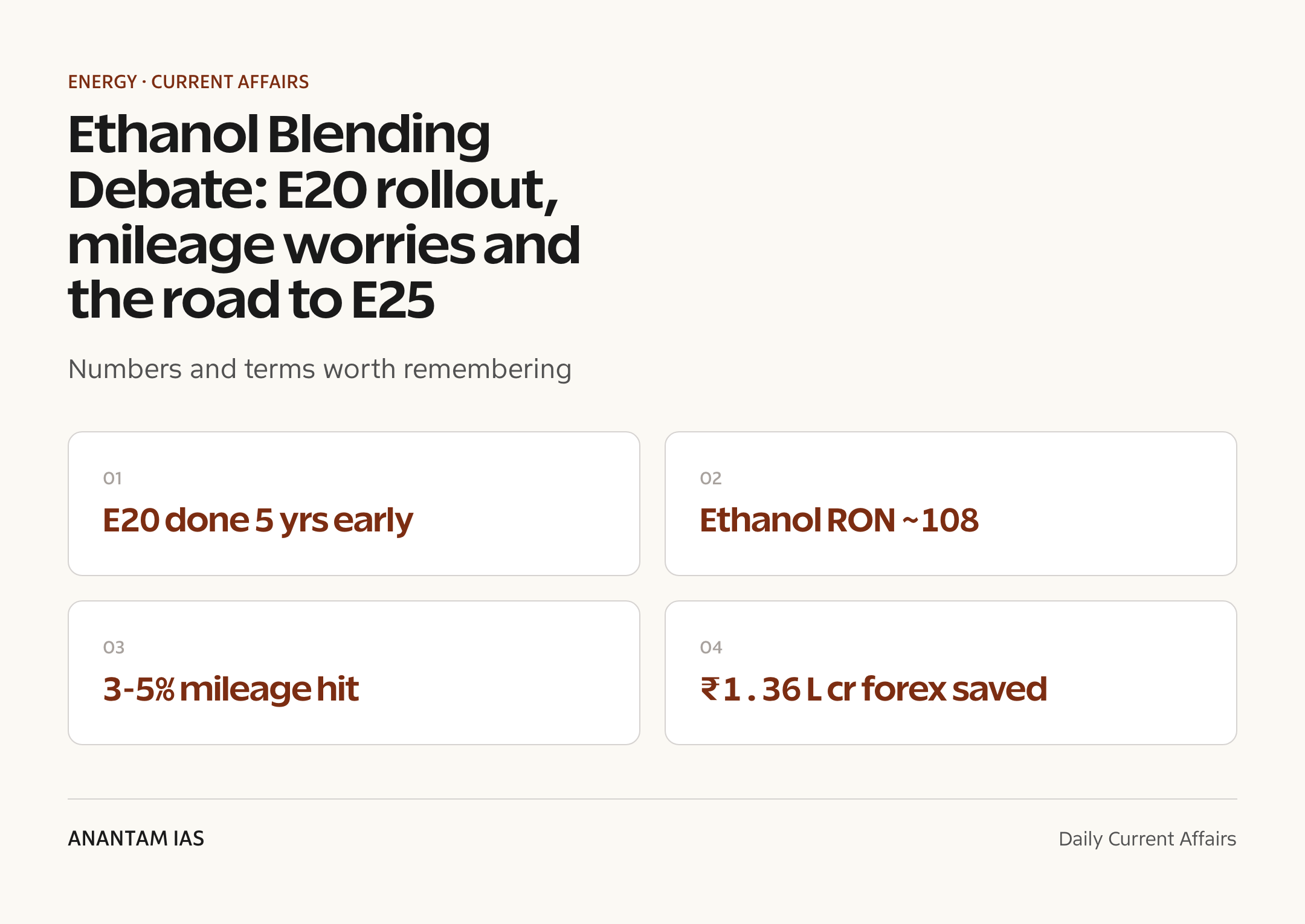
- Toyota Kirloskar’s Vikram Gulati told The Indian Express the E10-to-E20 shift caused negligible material impact and a fuel-efficiency loss of around 3–5%, but said E25 needs fresh testing on both new and older vehicles.
- Carmakers say the E25 transition will demand engine recalibration, fuel-system durability work, corrosion-resistance checks and fresh homologation — certification of vehicles for safety and emissions compliance.
- PIB data show ethanol blending by public-sector oil companies substituted about 245 lakh tonnes of crude between 2014-15 and July 2025, saving over ₹1.36 lakh crore in foreign exchange.
The development matters in the context of:
- The row sits at the junction of three GS3 themes: energy security, farm incomes (sugarcane and maize offtake) and decarbonisation of road transport.
- It’s also a consumer-policy question for GS2: the costs of the fuel transition — lower mileage, possible engine wear, costlier vehicles — fall on the motorist, who gets no fuel choice and no price discount at the pump.
- Brazil’s five-decade ethanol experience, built on flex-fuel vehicles and mandated price differentials, is the template India is urged to study before pushing beyond E20.
UPSC Relevance
Prelims Relevance
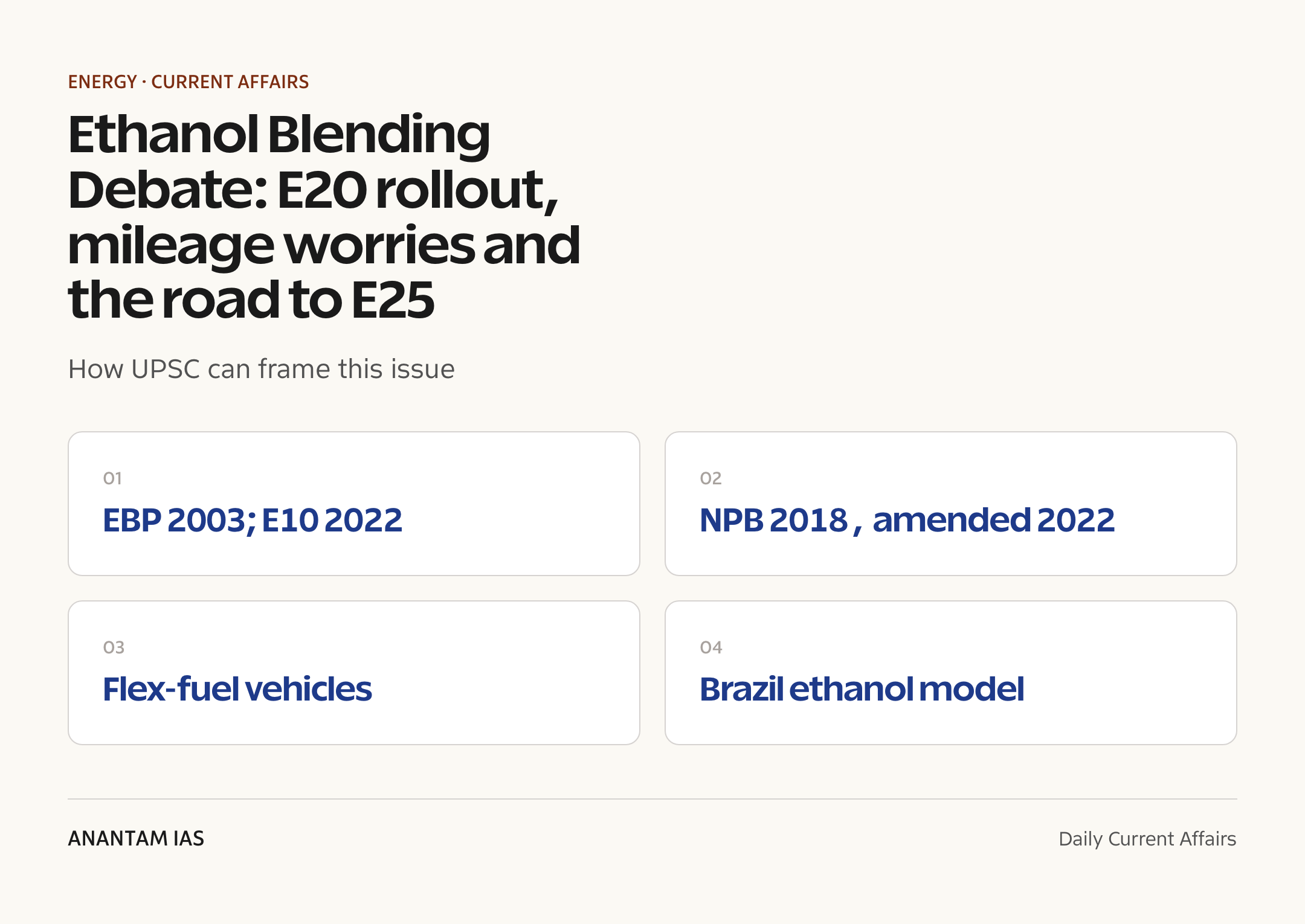
- Ethanol Blended Petrol (EBP) Programme — launched in 2003; blending was just 1.53% in 2013-14, reached 10% (E10) in June 2022, and 20% (E20) in 2025.
- National Policy on Biofuels, 2018 — amended in 2022 to advance the E20 target from 2030 to Ethanol Supply Year (ESY) 2025-26; the ESY runs November to October.
- Eligible feedstocks include sugarcane juice, B-heavy and C-heavy molasses, maize, damaged and surplus food grains, rotten potatoes and agricultural residues (for 2G ethanol).
- E20 = 80% petrol + 20% ethanol; E85 = 85% ethanol, usable only in flex-fuel vehicles (FFVs) designed for variable blends.
- Ethanol is C2H5OH, a two-carbon alcohol, against petrol’s C8–C12 hydrocarbons; it has a high octane number of about 108 RON but a lower calorific value — roughly a third less energy per litre.
- Ethanol is hygroscopic — it attracts and holds water — driving corrosion worries in fuel systems not designed for high blends.
- ARAI (Automotive Research Association of India, Pune) tested 8 metals, 6 elastomers and 4 plastics with E20 and found the corrosion impact on metals insignificant.
- The first National Policy on Biofuels (2009) set an indicative 20% target by 2017; a 2009-10 study by Indian Oil, ARAI and SIAM cleared E10 as feasible.
- GST on ethanol supplied for the EBP programme was cut from 18% to 5%.
- Brazilian pumps offer a choice between blended petrol (27–35% ethanol) and E100 hydrous ethanol, with legally mandated price discounts for higher blends.
Mains Relevance
GS Paper 3
- Energy security and import substitution: ethanol as a domestic fuel that trims the crude bill and hedges against West Asia supply shocks.
- Agriculture linkage: assured ethanol offtake supports sugarcane and maize farmers, but raises food-vs-fuel, water-use and cropping-pattern concerns.
- Decarbonisation pathways: comparing ethanol, EVs, hybrids, CNG, compressed biogas and hydrogen as complementary — not competing — routes to net zero by 2070.
- Infrastructure and technology: flex-fuel vehicles, engine recalibration, homologation and the industrial ecosystem needed for blends beyond E20.
GS Paper 2
- Governance and consumer interest: designing fuel transitions so that costs (mileage loss, engine risk) aren’t silently shifted onto citizens without choice or compensation.
- Evidence-based policymaking: the role of ARAI-type testing, transparent data and public communication in countering misinformation while retaining trust.
Essay
- Energy transitions succeed when the citizen, not just the state, sees value in them.
- Annadata to Urjadata: can the Indian farmer fuel the Indian economy?
Background and Context
The EBP journey: from 1.53% to E20, five years early
India’s Ethanol Blended Petrol programme moved from token blending to a nationwide E20 standard in barely a decade.
- The EBP Programme began in 2003, but blending languished at 1.53% as late as 2013-14 because of feedstock and pricing bottlenecks.
- The National Policy on Biofuels, 2018 set an E20 target for 2030; its 2022 amendment advanced this to ESY 2025-26 and widened the feedstock basket.
- E10 was achieved in June 2022, months ahead of schedule; blending rose to 12.06% in ESY 2022-23, 14.60% in ESY 2023-24 and touched 20% in 2025 — five years early.
- The blend share thereby doubled in about three years, a compression the Indian Express notes was originally meant to play out over eight — leaving owners of older, E10-certified vehicles little time to adjust.
- Enablers: a GST cut to 5%, interest-subvention schemes for distilleries, differential pricing for B-heavy molasses and grain ethanol, and permission to use maize and damaged food grains.
- An earlier note on the programme’s farm linkage is on our site: Ethanol — Annadata se Urjadata.
Why the government is betting on ethanol
The official case rests on import savings, farm incomes and carbon cuts.
- PIB data show blending substituted about 245 lakh tonnes of crude between 2014-15 and July 2025, saving upwards of ₹1.36 lakh crore in foreign exchange — significant for a country importing over 85% of its crude.
- Ethanol procurement has channelled roughly ₹1.18 lakh crore to farmers, creating an assured market for sugarcane and grain.
- Ethanol burns with less CO2 than the petrol it replaces, supporting India’s net zero by 2070 pledge and its NDCs under the UNFCCC — background: UNFCCC explained.
- Toyota’s Vikram Gulati calls ethanol “the fastest as well as cheapest way to decarbonise road mobility” — it needs no new charging or hydrogen infrastructure and rides on the existing fuel-retail network.
- There’s a political economy too: the Indian Express notes the sugarcane lobby in Maharashtra and Uttar Pradesh, sitting on distilling overcapacity, is pushing for blends beyond E20, while West Asia tensions and firm crude prices strengthen the import-substitution case.
The chemistry: why E20 dents mileage
Ethanol’s molecular profile explains both its promise and the motorist’s complaint.
- Ethanol (C2H5OH) is a short, two-carbon molecule against petrol’s C8–C12 chains, so each molecule burnt releases less CO2 — the core climate case.
- Its octane number of about 108 RON gives a cleaner, knock-free burn; turbocharged and high-compression engines worldwide use ethanol blends for anti-knock performance and the cooling effect of its high latent heat of vaporisation.
- But ethanol’s calorific value is lower — roughly a third less energy per litre than petrol — so a tank of high-blend fuel simply carries fewer kilometres.
- For vehicles calibrated for E10 or pure petrol, the penalty is real: Gulati puts the E10-to-E20 loss at around 3–5%; older-vehicle owners report more, and the drop worsens non-linearly as blends rise.
- Ethanol is hygroscopic — it draws in water — raising corrosion concerns for rubber parts, fuel pumps, valves and piston heads in engines not built for it; its higher burn temperature also makes winter cold-starts harder.
- Engines designed for high blends can claw the loss back: carmakers told The Indian Express that ethanol’s high octane lets them build higher-compression engines — but that fleet is still in the future.
What the studies actually found
Official testing says the E20 scare is overblown; the mileage hit, though, is conceded.
- The ARAI materials study immersed 8 metals, 6 elastomers and 4 plastics used in fuel systems in E20, against an E10 baseline: corrosion impact on metals was insignificant, though some elastomers showed greater change in tensile strength and volume.
- The government maintains viral clips alleging engine damage rely on unverified claims and click-bait framing; manufacturers on record report no major E20 issues, though privately they flag risks for older cars and two-wheelers at higher blends.
- A senior auto-industry expert told The Indian Express there are no conclusive long-term studies on blended fuel’s impact on non-compliant vehicles — engine life, rubber parts, valves and piston heads remain open questions.
- Two-wheelers are the soft underbelly: older bikes often lack the high-grade aluminium or steel engine castings that tolerate aggressive blends, and India is overwhelmingly a two-wheeler market.
The road to E25 and E85: who pays for the transition?
The next jump is where automakers, and consumers, get nervous.
- Moving to E25 requires fresh engineering and validation — engine calibration, fuel-system durability, corrosion resistance, material compatibility — capped by homologation, the official certification of vehicles for safety, emissions and road-worthiness on the new fuel.
- Every vehicle now on sale was certified on E20; re-certification for E25 means cost increases that will likely pass to buyers, on top of the mileage penalty owners already absorb.
- Vehicle makers privately warn the E20-to-E25 impact could exceed the E10-to-E20 experience, especially for older engines and two-wheelers; Gulati says E25 “requires adequate testing” on new and old vehicles alike.
- E85, launched in June 2026, is meant only for flex-fuel vehicles (FFVs); it’s expected to start about ₹20 per litre cheaper than E20, but with a fuel-efficiency loss above 25%, it pays only when the discount is steep — in Brazil the switch works when E85 is at least 30% cheaper.
- Unlike Brazil, Indian motorists get no choice of blends and no mandated discount for a lower-energy fuel — the Indian Express calls this a cost “forced down the throat” of the motorist.
- Government sources counter that the move beyond E20 is not being rushed, with time promised for automakers and oil companies to prepare.
The Brazil template: what a mature ethanol market looks like
Brazil shows that consumer economics, not mandates alone, mainstream high blends.
- Brazil’s ethanol push began in the 1970s in response to the oil shocks; five decades on, nearly every pump offers blended petrol (27–35% ethanol) alongside E100 hydrous ethanol.
- The breakthrough was the flex-fuel vehicle: once customers could fill whichever fuel was cheaper that day, adoption soared — by the late 1980s, nine in ten new Brazilian cars could run on ethanol alone.
- Brazilian law mandates a pricing discount for higher blends; E100 often retails 25–35% below blended petrol, making the mileage trade-off visibly worthwhile.
- Gulati’s lesson for India: make FFV technology customer-friendly and affordable, and let policy create economic value at purchase and at the pump — scale will then cut flex-fuel engine costs.
- India’s contrast is stark: one fuel, one price, no discount — consumer buy-in is assumed, not earned.
Criticisms beyond the fuel pump
The programme’s costs aren’t only mechanical; they run through water, grain and land.
- Food vs fuel: diverting sugarcane juice, molasses, maize and surplus grains to distilleries links fuel policy to the food economy; ethanol demand for maize has tightened domestic grain supplies and pushed up imports.
- Water stress: sugarcane, the dominant feedstock, is among India’s thirstiest crops, concentrated in water-scarce Maharashtra and Uttar Pradesh — an ecological cost the blending arithmetic ignores.
- Equity: the fuel-efficiency loss is a regressive, invisible tax — heaviest on owners of older two-wheelers and small cars, the most price-sensitive motorists.
- Technology-neutrality: Gulati frames the transition as “EVs and hybrids” plus flex fuels, CNG, biogas and hydrogen together; see our explainers on electric vehicles in India and the National Green Hydrogen Mission.
- Hybrids’ claim: certified data cited by Toyota show hybrids deliver 40–50% better fuel efficiency and run nearly 60% of city time in EV mode on a 1–2 kWh battery — industry wants policy support for them too.
Way Forward
Give the consumer a choice and a price signal
- Offer at least two blend options at major pumps, Brazil-style, with a mandated price differential that compensates for ethanol’s lower energy content.
- Publish transparent, vehicle-category-wise mileage-impact data so buyers can make informed decisions rather than rely on viral videos.
Test first, then transition
- Complete E25 validation on both new and legacy fleets — material compatibility, durability, emissions — before any rollout, as was done for E20, and publish the findings.
- Sequence homologation timelines with automakers so certification costs don’t cascade abruptly into vehicle prices.
Fix the feedstock mix
- Shift incentives from water-hungry sugarcane toward maize, damaged grains and 2G ethanol from crop residues, easing food-vs-fuel and water-stress pressures.
- Accelerate flex-fuel vehicle manufacturing at scale with fiscal support so the fleet, not just the fuel, becomes blend-agnostic.
Conclusion
India’s E20 milestone is a genuine energy-security achievement: a domestically produced fuel now displaces a fifth of the petrol pool, saving foreign exchange and paying farmers. Getting there five years early showed administrative muscle.
But the E10-to-E20 compression also revealed the programme’s blind spot — the consumer. Mileage losses, engine anxieties and the absence of choice or discount at the pump have turned a decarbonisation success into a trust problem.
The road to E25 and E85 will be smoother if India borrows Brazil’s real lesson: mandates create supply, but only visible consumer value — flexible vehicles, fuel choice and honest pricing — creates demand.
UPSC Practice Questions
Prelims MCQ 1
With reference to India’s Ethanol Blended Petrol (EBP) Programme, consider the following statements:
- India achieved 20% ethanol blending in petrol about five years ahead of the original 2030 target.
- The 2022 amendment to the National Policy on Biofuels, 2018 advanced the E20 target to Ethanol Supply Year 2025-26.
- Ethanol has a lower octane number than petrol, which is why it reduces vehicle mileage.
How many of the above statements are correct?
(a) Only one (b) Only two (c) All three (d) None
Answer: (b) Only two
Explanation:
Statements 1 and 2 are correct: E20 was reached in 2025 against the original 2030 target, advanced to ESY 2025-26 by the 2022 amendment. Statement 3 is wrong — ethanol has a HIGHER octane number (~108 RON) than petrol; mileage falls because of ethanol’s LOWER calorific value.
Prelims MCQ 2
Which one of the following best explains why E20 petrol gives lower mileage in vehicles designed for E10 or unblended petrol?
(a) Ethanol increases the sulphur content of the fuel blend (b) Ethanol has a lower calorific value, so each litre of blend carries less energy (c) Ethanol lowers the octane rating, causing engine knocking (d) Ethanol increases the density of petrol, choking fuel injectors
Answer: (b) Ethanol has a lower calorific value, so each litre of blend carries less energy
Explanation:
Ethanol contains roughly a third less energy per litre than petrol. Blending it reduces the energy content of every litre of fuel, cutting kilometres per litre in engines not recalibrated for the blend. Its octane number is actually higher than petrol’s.
UPSC Mains Questions
- India achieved its E20 ethanol blending target five years ahead of schedule, yet consumer resistance to the programme is rising. Examine the reasons for this paradox and suggest how the transition to higher blends can be made consumer-centric. (250 words)
- Ethanol blending serves energy security, farm incomes and decarbonisation, but raises food-versus-fuel and water-stress concerns. Critically evaluate the sustainability of India’s biofuel strategy in light of the National Policy on Biofuels, 2018. (250 words)
- “Mandates create supply; consumer value creates demand.” Discuss with reference to Brazil’s flex-fuel experience and its lessons for India’s push beyond E20. (150 words)
Sources: PIB, Ministry of Petroleum and Natural Gas and Indian Express Explained.
Frequently Asked Questions
What is E20 petrol?
E20 is petrol blended with 20% ethanol and 80% petrol. It became the standard petrol variant sold across India in 2025, when the country achieved its 20% blending target five years ahead of the original 2030 deadline under the amended National Policy on Biofuels.
Why does E20 reduce vehicle mileage?
Ethanol has a lower calorific value — roughly a third less energy per litre than petrol. So every litre of E20 carries less energy, cutting fuel economy. Toyota estimates the E10-to-E20 efficiency loss at around 3–5% for compliant vehicles; older vehicles may lose more.
Does E20 damage car engines?
An ARAI study found E20’s corrosion impact on fuel-system metals insignificant, with only some elastomers showing property changes. Manufacturers report no major issues on record, but ethanol’s water-attracting nature keeps concerns alive for older cars and two-wheelers, especially at blends beyond E20.
What are flex-fuel vehicles (FFVs)?
FFVs have engines and fuel systems designed to run on widely varying ethanol-petrol blends, from regular petrol up to E85 or even E100. Brazil mainstreamed them from the 2000s, letting drivers pick whichever fuel is cheaper at the pump on a given day.
What is the food-versus-fuel debate?
Ethanol in India comes mainly from sugarcane juice, molasses, maize and surplus grains. Diverting these to fuel links energy policy to food supply — tightening grain markets, raising maize imports and encouraging water-hungry sugarcane in stressed regions like Maharashtra.
What comes after E20 in India?
The government plans a gradual move toward E25 blending after testing and consultations, and launched E85 fuel for flex-fuel vehicles in June 2026. E25 will need fresh engine calibration, durability validation and homologation of vehicles for the new fuel.