The National Green Hydrogen Mission is the most consequential energy programme India has launched since the National Solar Mission of 2010. It commits the country to producing five million tonnes of green hydrogen a year by 2030, building 125 gigawatts of fresh renewable capacity to feed the electrolysers, abating roughly 50 million tonnes of carbon dioxide annually, and turning India into a global export hub for hydrogen and its derivatives. The outlay is Rs 19,744 crore, the timeline is to 2030, and the political signal is that green hydrogen is the centrepiece of India’s industrial decarbonisation and net-zero strategy.
This guide unpacks the National Green Hydrogen Mission for UPSC GS-III aspirants. It walks through what green hydrogen actually is, how it is produced, the targets and outlay of the mission, the SIGHT incentive scheme, the focus sectors that will absorb the production, the export economics of green ammonia, and the structural risks that could keep the programme from hitting its targets.
Why Green Hydrogen, and Why Now
Hydrogen has been used in industry for over a century. India already consumes about six million tonnes of hydrogen a year, almost entirely as feedstock for fertiliser production and petroleum refining. Today this hydrogen is grey, meaning it is made from natural gas or naphtha through a steam-methane reforming process that emits about ten kilograms of carbon dioxide for every kilogram of hydrogen produced. Grey hydrogen is cheap, but it is also one of the largest hidden sources of industrial emissions in the country.
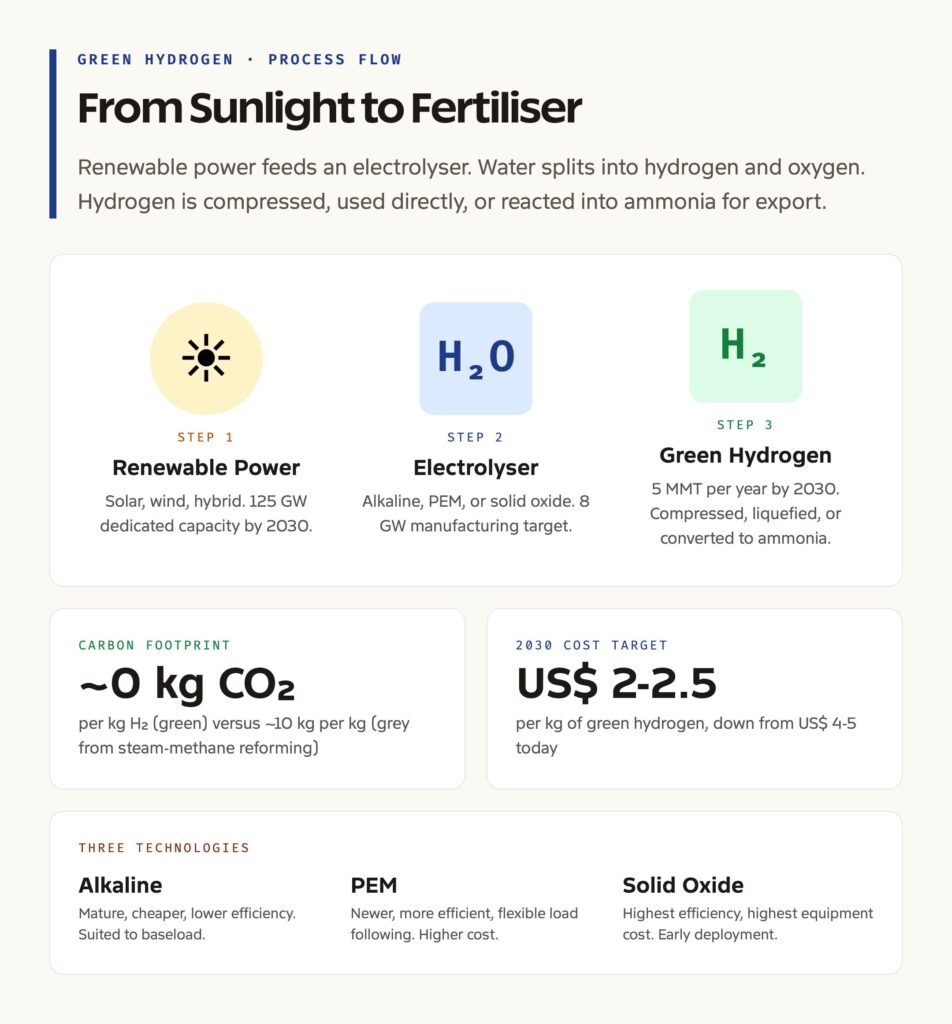
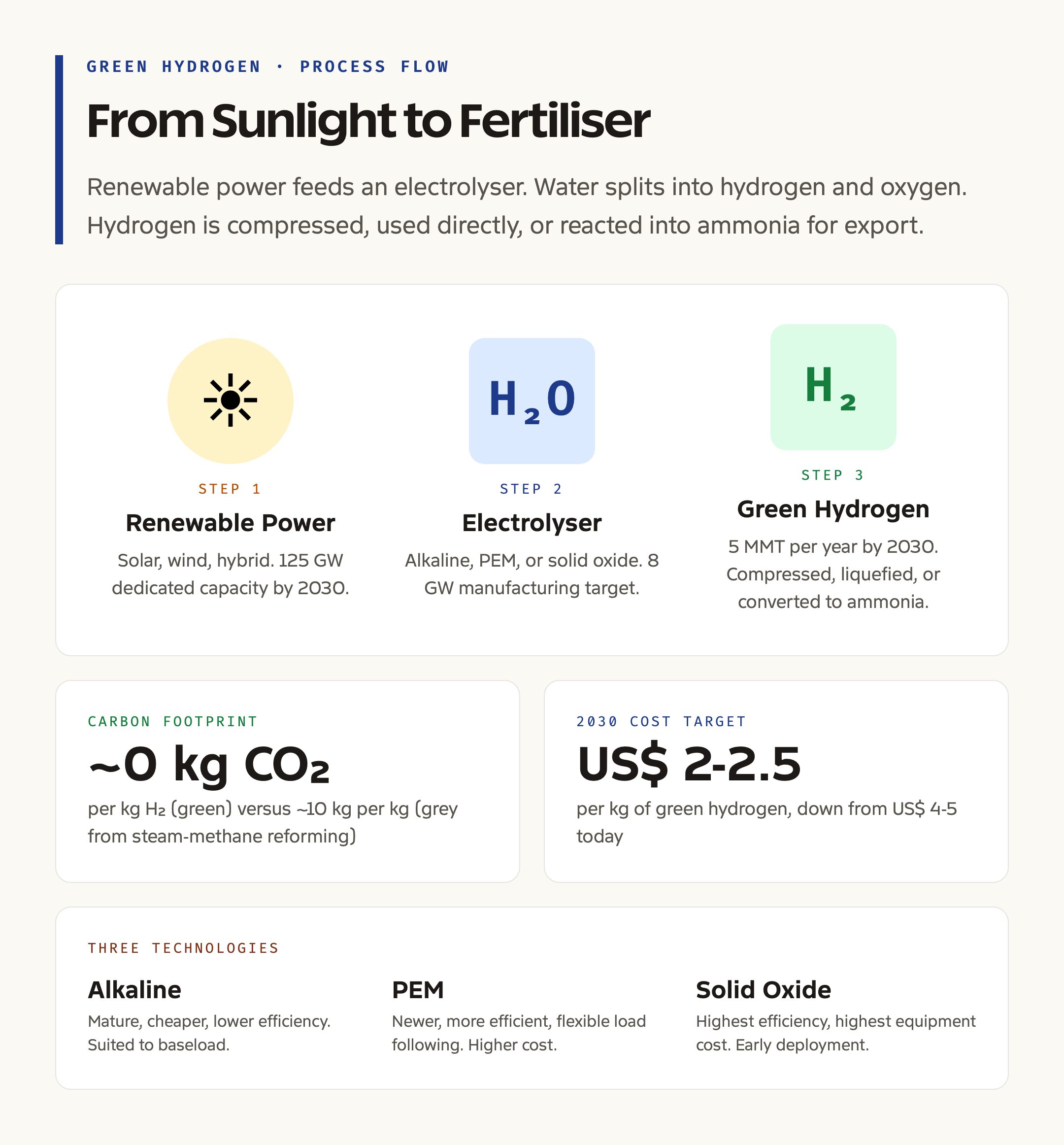
Green hydrogen is the same molecule, but produced differently. Renewable electricity from solar or wind is fed into an electrolyser, which splits water into hydrogen and oxygen. The hydrogen is captured, compressed, and used. The carbon footprint of the production step falls to near zero. The cost is currently higher than grey hydrogen because electrolysers and renewable power together cost more than steam reforming of cheap natural gas. The wager of the mission is that costs will fall fast enough through scale, learning curves, and cheaper renewables that green hydrogen becomes price-competitive by 2030.
The timing matters because the world’s heavy industries, fertilisers, steel, refining, shipping, are all looking for ways to decarbonise. Countries that produce green hydrogen cheaply will export to countries that cannot. India has the renewable resource base, the manufacturing scale, and the policy bandwidth to compete in that export market. The mission is the policy framework that captures the opportunity.
Mission Architecture and Outlay
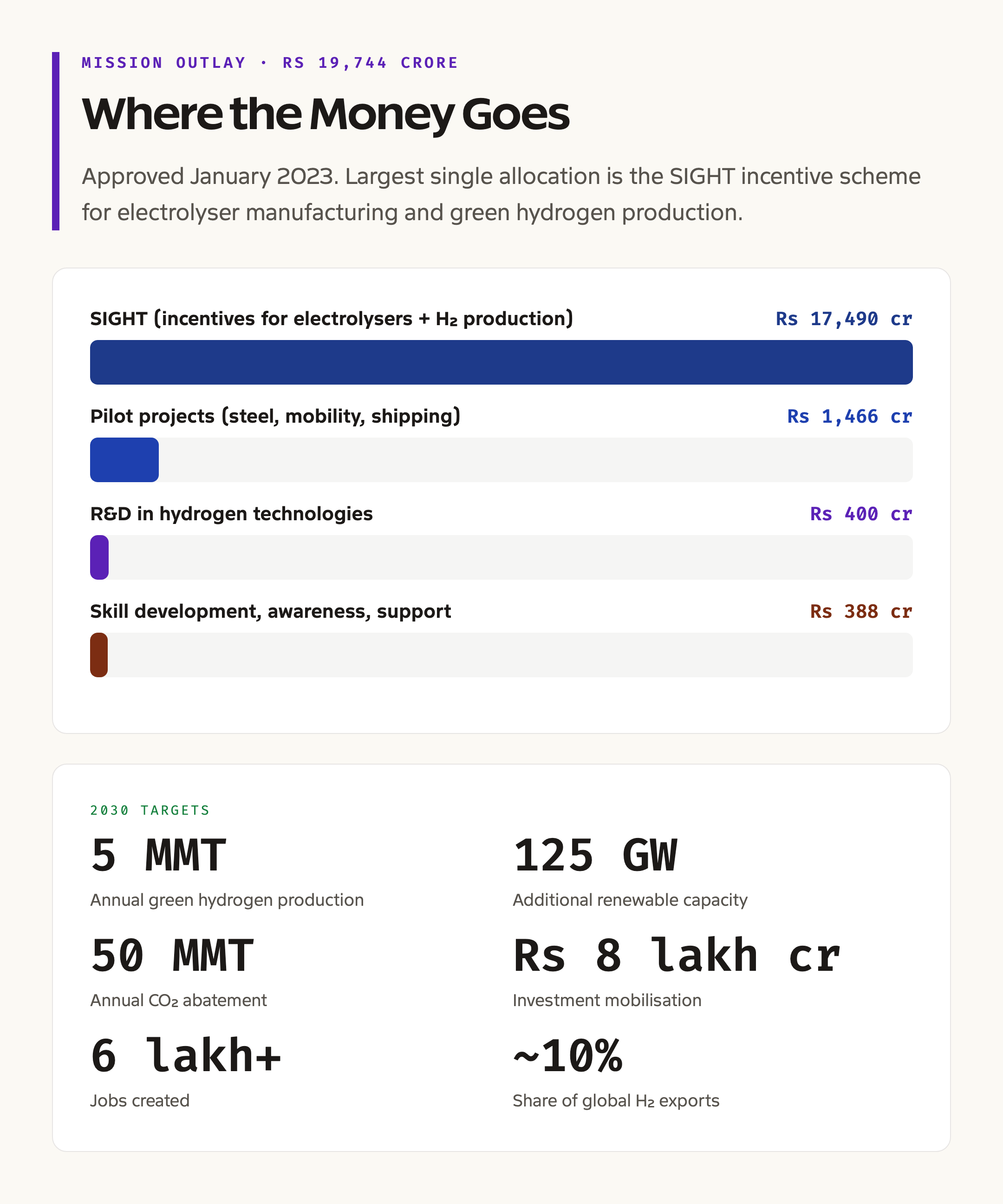
The National Green Hydrogen Mission was approved by the Union Cabinet in January 2023 with a total outlay of Rs 19,744 crore over the period to 2029-30. The Ministry of New and Renewable Energy is the nodal ministry. The outlay is split across four major heads.
The Strategic Interventions for Green Hydrogen Transition, or SIGHT programme, is the largest line item at Rs 17,490 crore. It funds two production-linked incentive schemes, one for electrolyser manufacturing and one for green hydrogen production. The pilot projects bucket has Rs 1,466 crore, funding deployment in steel, mobility, shipping, and other end-use sectors. R&D has Rs 400 crore for technology development. Skill development, awareness, and other support functions take the remainder.
The headline targets for 2030 are five million metric tonnes of green hydrogen production per year, 125 gigawatts of additional renewable energy capacity to power the electrolysers, an investment mobilisation of about Rs 8 lakh crore including private capital, the creation of over six lakh jobs, and the avoidance of about 50 million tonnes of carbon dioxide emissions per year.
How Green Hydrogen Is Made
The production chain has three pieces. The first is renewable power. A green hydrogen plant needs a stable, low-cost source of electricity that is renewable in origin. Solar parks and wind farms with dedicated lines to electrolysers are the standard configuration. Hybrid solar-wind plants with battery storage are increasingly the design choice because they smooth out the intermittency that lowers electrolyser utilisation.
The second piece is the electrolyser. Two technologies dominate. Alkaline electrolysers are the older, cheaper technology with lower efficiency and slower ramp rates, suited to baseload operation. Proton Exchange Membrane, or PEM, electrolysers are newer, more efficient, more flexible in load following, and currently more expensive. A third technology, solid oxide electrolysis, is in early commercial deployment and has the highest efficiency but the highest equipment cost. The mission incentivises domestic manufacturing of all three under the SIGHT electrolyser scheme.
The third piece is downstream processing. Hydrogen is a low-density gas that is hard to store and transport. Most hydrogen is either compressed to high pressure for pipeline delivery, liquefied at minus 253 degrees Celsius for shipping, or converted to green ammonia by reaction with nitrogen for easier global trade. Green ammonia is the export-ready form that India is most likely to ship to Europe, Japan, and Korea. For more on the molecule, see green ammonia and hydrogen energy.
The SIGHT Scheme
SIGHT is the engine of the mission. It is structured as two production-linked incentive schemes that pay manufacturers and producers per unit of output, declining over time as the technology matures. The electrolyser component allocates incentives across multiple tranches. The first tranche awarded contracts for about 1.5 gigawatts of electrolyser manufacturing capacity to Indian companies under tariff-based competitive bidding. Subsequent tranches will scale this to about 8 gigawatts of cumulative capacity by 2030.
The hydrogen component pays producers a per-kilogram incentive on green hydrogen output, with the tariff falling each year over a five-year window. The first tranche covered about 4.5 lakh tonnes of annual production capacity awarded to bidders under competitive bidding. The intent is to bring landed costs of green hydrogen in India down to about US$ 2 to US$ 2.5 per kilogram by 2030, from the current range of US$ 4 to US$ 5 per kilogram, which is the price point at which it competes with grey hydrogen and with fossil-fuel-derived alternatives in heavy industry.
The two-pronged design is deliberate. The electrolyser scheme builds domestic manufacturing capacity that captures the equipment value chain. The production scheme builds end-use demand that anchors the manufacturing capacity. Without both, India would either import all its electrolysers or build a manufacturing base with no buyers.
Focus Sectors: Where the Hydrogen Goes
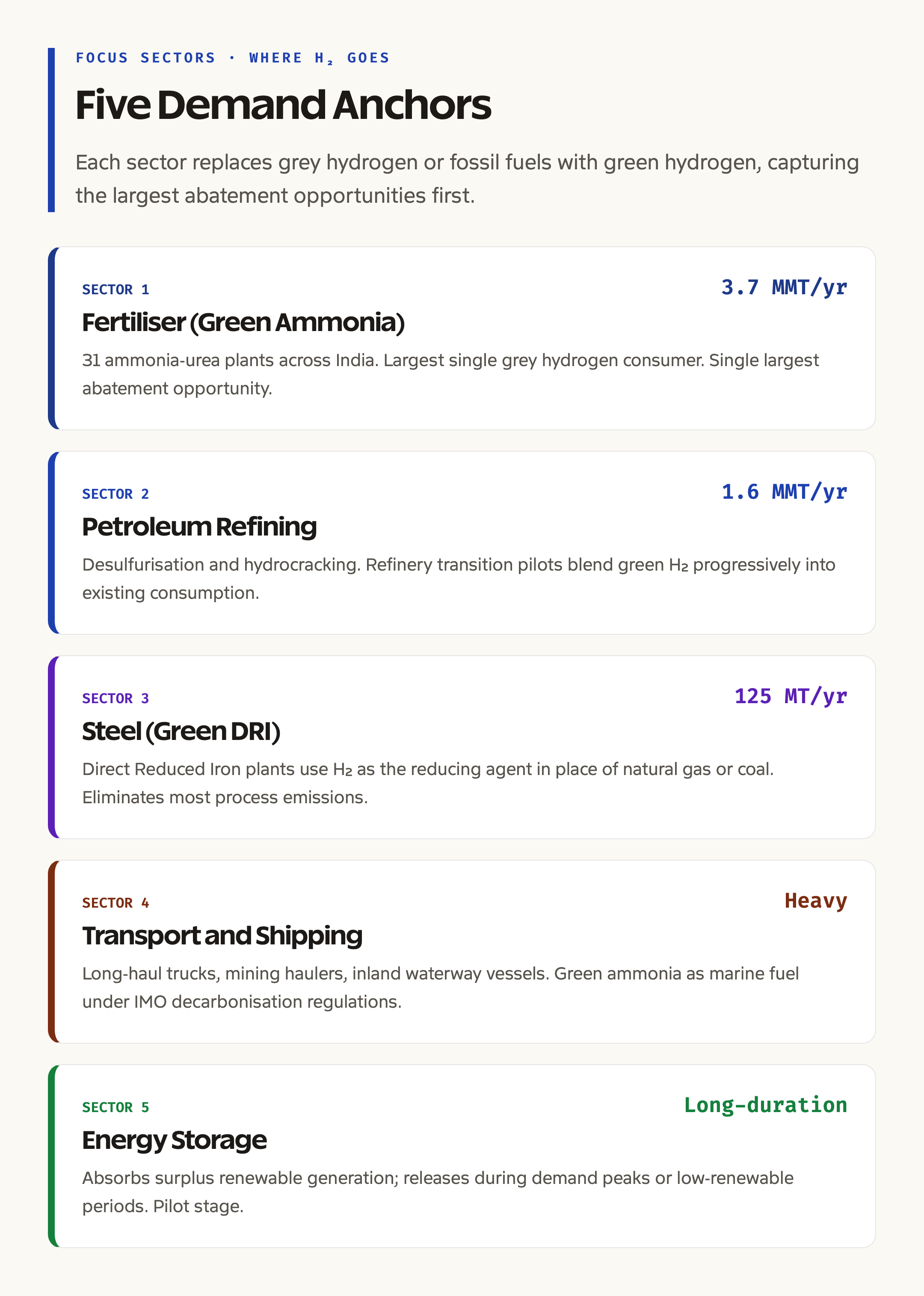
Five end-use sectors absorb most of the targeted production. Fertiliser is the largest single consumer of hydrogen in India today. The country runs 31 ammonia-urea plants that consume about 3.7 million tonnes of grey hydrogen a year. Replacing this with green hydrogen, channelled through green ammonia plants, is the single largest abatement opportunity in Indian industry. The mission explicitly designates fertilisers as a priority sector and supports green ammonia projects through pilot funding.
Petroleum refining is the second large user. Refineries use hydrogen for desulfurisation and hydrocracking. Indian refineries consume about 1.6 million tonnes of grey hydrogen a year. The mission supports refinery transition pilots that progressively blend green hydrogen into refinery hydrogen consumption.
Steel is the third sector. The steel industry produces around 125 million tonnes of crude steel annually in India and is one of the largest emitters of carbon dioxide. Direct Reduced Iron, or DRI, plants can use green hydrogen as the reducing agent in place of natural gas or coal, eliminating most of the process emissions. The mission supports green steel pilots that demonstrate the technology at scale.
Heavy transport and shipping is the fourth sector. Long-haul trucks, mining haulers, and inland waterway vessels are candidates for hydrogen fuel cells where battery-electric solutions are limited by weight and refuelling time. International shipping is regulated by the International Maritime Organisation toward zero-emission fuels by mid-century, and green ammonia is one of the leading candidate marine fuels.
Energy storage is the fifth sector. Hydrogen is a long-duration storage medium that can absorb surplus renewable generation and release it during demand peaks or low-renewable periods. The economics here are still developing, but the mission funds pilot projects that test hydrogen storage in distributed energy systems.
The Renewable Capacity Addition
A five million tonne hydrogen target requires roughly 250 to 300 terawatt-hours of renewable electricity per year, depending on electrolyser efficiency. That translates to about 125 gigawatts of dedicated renewable capacity, on top of the 500 gigawatts of total renewable capacity India targets by 2030. The 125 gigawatts is the largest single industrial demand pull on the renewable sector ever announced in India.
The capacity will come from a mix of solar parks, wind plants, and hybrid solar-wind configurations. Several states, Gujarat, Rajasthan, Tamil Nadu, and Andhra Pradesh, have allocated dedicated land banks for green hydrogen plants. The Ministry of Power has issued waivers on inter-state transmission charges for renewable power dedicated to green hydrogen production until 2030, removing one of the main cost frictions. The renewable energy purchase obligation framework has been adjusted to count green hydrogen feedstock toward state RPO targets.
Export Economics and Geopolitics
Green hydrogen is one of the few commodities for which the global market is being built from scratch. Major importers are emerging in Europe, Japan, Korea, and the Gulf. Germany has signed long-term offtake agreements totalling several million tonnes per year. Japan is targeting three million tonnes of clean hydrogen imports by 2030. Korea has comparable commitments. The Gulf states, despite having their own gas reserves, are positioning as transit hubs for green hydrogen trade.
India’s competitive position rests on three factors. Renewable resource quality, where Indian solar and wind sites are among the cheapest in the world. Manufacturing scale, where domestic electrolyser production drives down equipment cost. Political stability and contract enforcement, where India offers a more predictable investment environment than several other potential exporters. The export ambition is to capture a meaningful share of the global green hydrogen and ammonia trade, with the mission targeting around 10 percent of global hydrogen exports by 2030.
Structural Risks
The mission faces three structural risks that could keep it from hitting its 2030 numbers. The first is cost. Green hydrogen at US$ 2 to US$ 2.5 per kilogram by 2030 is a stretch target that depends on continued declines in renewable energy prices, electrolyser capital costs, and balance-of-plant expenses. If any of those declines stall, green hydrogen stays expensive enough that demand-side adoption slows.
The second is infrastructure. Hydrogen is hard to store and transport. The country lacks dedicated hydrogen pipelines, large-scale storage facilities, and export terminals that can handle hydrogen or ammonia at scale. The mission supports infrastructure development, but the pace has to match the pace of production capacity addition. If infrastructure lags, hydrogen sits at the production site without buyers.
The third is competition. Other countries are running their own green hydrogen programmes with their own subsidies. The European Union’s Hydrogen Bank, the United States Inflation Reduction Act tax credits, the Australian green hydrogen export programme, and several Gulf state initiatives all compete for the same global market. The Indian programme has to keep pace on both cost and contracting.
Frequently Asked Questions
What is the National Green Hydrogen Mission?
The National Green Hydrogen Mission is India’s flagship programme to make the country a global hub for production, use, and export of green hydrogen and its derivatives. It was approved in 2023 with an outlay of Rs 19,744 crore and a target year of 2030.
What are the key targets of the mission?
The headline targets are five million metric tonnes of green hydrogen production per year, 125 gigawatts of additional renewable capacity, around 50 million tonnes of annual carbon dioxide abatement, mobilisation of Rs 8 lakh crore in investment, and creation of over six lakh jobs by 2030.
What is the SIGHT scheme?
SIGHT, or Strategic Interventions for Green Hydrogen Transition, is the largest component of the mission with an outlay of Rs 17,490 crore. It runs two production-linked incentive schemes, one for electrolyser manufacturing and one for green hydrogen production.
Which sectors will use green hydrogen first?
The five priority sectors are fertilisers, petroleum refining, steel, heavy transport and shipping, and energy storage. Fertilisers and refining are the largest existing consumers of grey hydrogen and are the first targets for substitution.
How is green hydrogen different from grey hydrogen?
Green hydrogen is produced by electrolysing water using renewable electricity, with near-zero carbon emissions. Grey hydrogen is made from natural gas or naphtha through steam-methane reforming, which emits about ten kilograms of carbon dioxide per kilogram of hydrogen. The molecule is the same, the production pathway differs.
Which ministry runs the mission?
The Ministry of New and Renewable Energy is the nodal ministry. Implementation involves SECI, the Solar Energy Corporation of India, as the bid manager for SIGHT, along with sectoral ministries such as Steel, Petroleum and Natural Gas, Chemicals and Fertilisers, and Shipping for end-use deployment.
What is the export ambition for green hydrogen?
India aims to be among the top global exporters of green hydrogen and green ammonia. The target is around 10 percent of global hydrogen exports by 2030, with major importers expected to be Germany, Japan, Korea, and the Gulf transit hubs.
Tell Google you want more of this.
Add Anantam IAS as a preferred sourceOne tap, and this site shows up more often in your own Top Stories, AI Overviews and AI Mode. Remove it any time.