The phrase Annadata Se Urjadata, or from food provider to energy provider, captures the political and economic ambition behind India’s ethanol push. The country imports more than 85 percent of its crude oil and the cost of that import sits like a weight on the current account every time global prices spike. Ethanol, blended into petrol, is one of the few near-term levers that reduces import dependence, lifts farm incomes, and cuts vehicular carbon emissions all at once. The Ethanol Blended Petrol Programme, launched in 2003 and steadily ratcheted up since, has now achieved 20 percent blending in selected states ahead of the 2025 to 2026 target year, making India one of the most aggressive ethanol blenders among large economies after Brazil and the United States.
For UPSC the topic spans GS-III economy, environment, and science and technology. Aspirants need to understand the chemistry of ethanol, the four generations of feedstock, the institutional architecture of the EBP programme, the National Policy on Biofuels 2018 as amended in 2022, the role of the Pradhan Mantri JI-VAN Yojana, the Global Biofuels Alliance launched at the New Delhi G20 summit, the RUCO initiative for used cooking oil, and the wider environmental and water debates that surround sugarcane and maize-based ethanol.
This guide walks through the science, policy, and politics of ethanol in India and equips you to write a precise mains answer or pick the right prelims option whenever the topic appears.
Quick Facts at a Glance
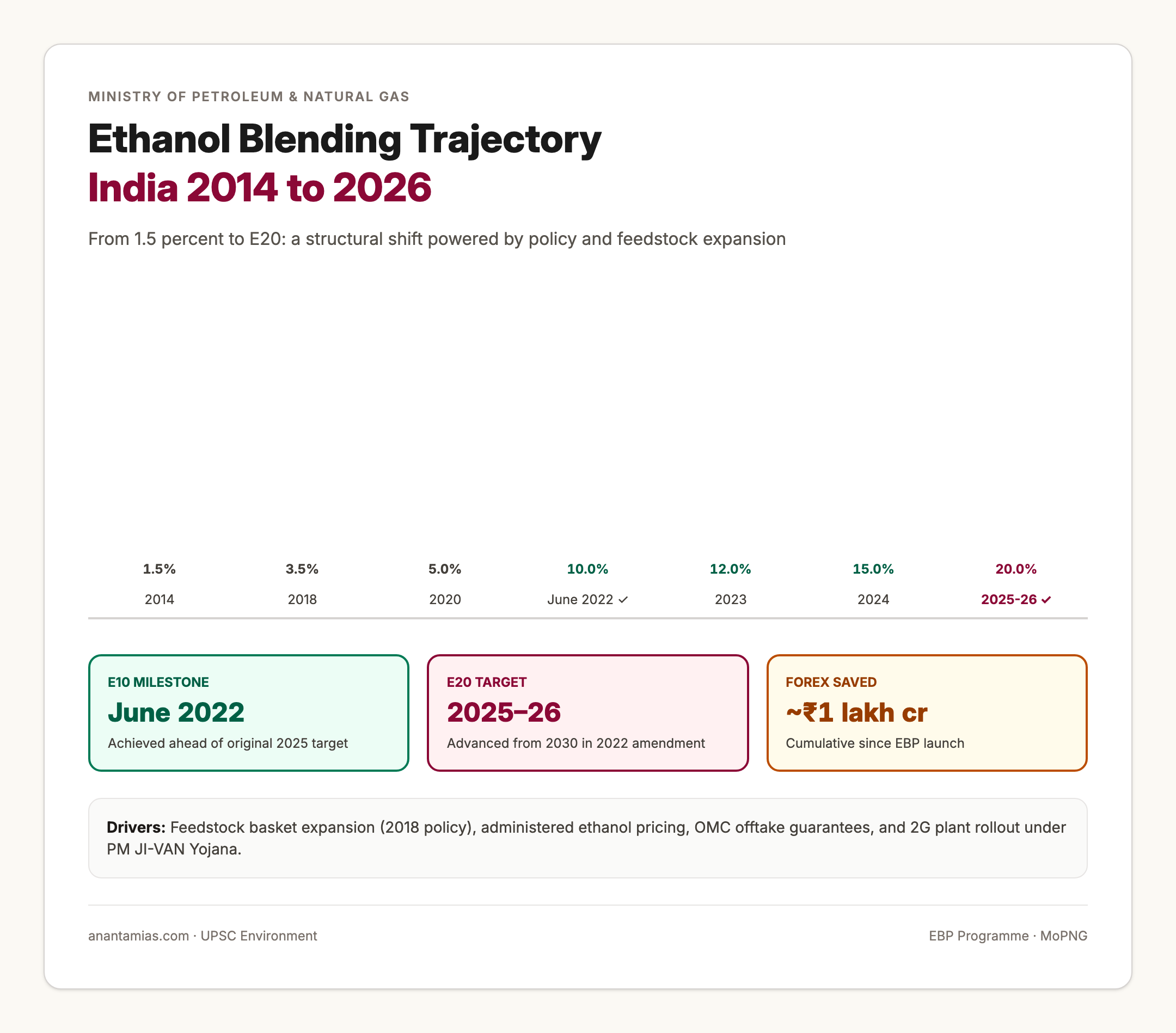
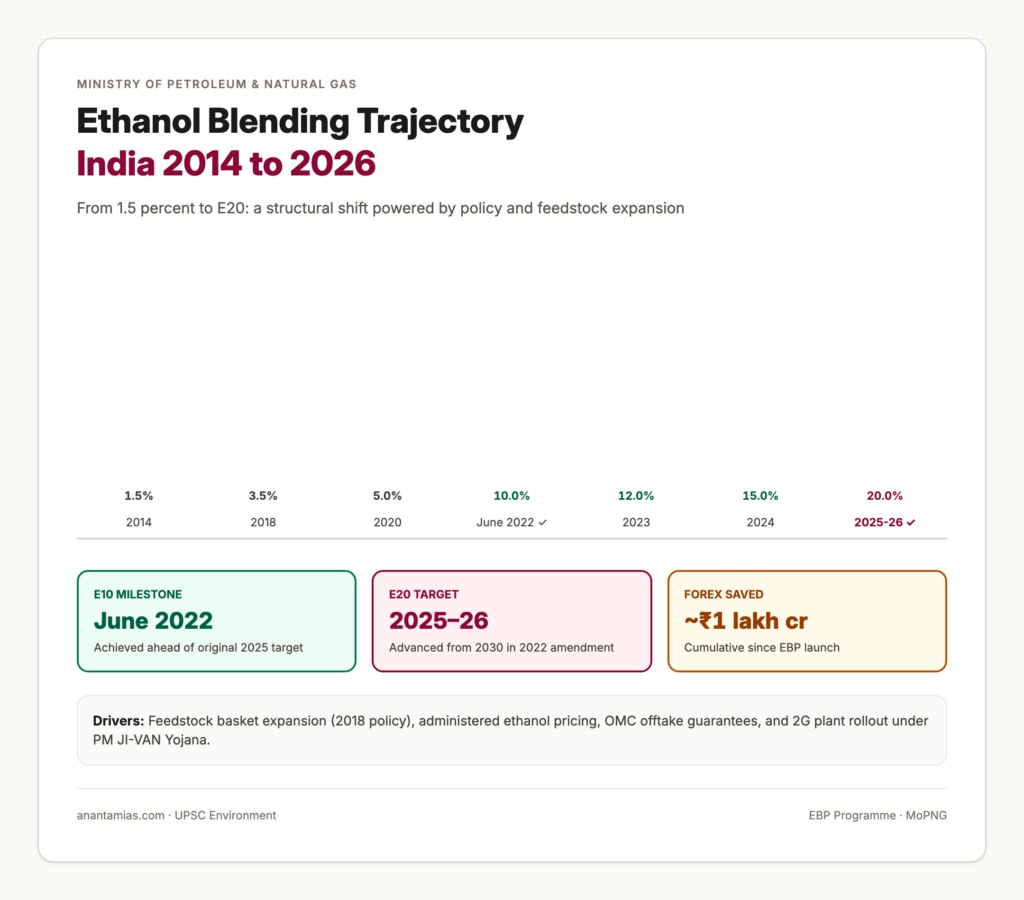
Ethanol has the chemical formula C2H5OH. It is a renewable biofuel produced primarily by the fermentation of sugars by yeast such as Saccharomyces cerevisiae under anaerobic conditions, releasing carbon dioxide as a co-product. The Ethanol Blended Petrol Programme aims to mix ethanol with petrol to reduce dependence on imported crude oil and cut emissions. India achieved 10 percent blending in June 2022 and the original 2030 target for 20 percent was advanced first to 2025 to 2026 and has since been hit ahead of schedule in multiple states. The National Policy on Biofuels 2018, amended in 2022, expanded the feedstock basket beyond sugarcane molasses to include sugarcane juice and syrup, B-heavy molasses, wheat, broken rice, and surplus rice and maize from FCI stocks. The Pradhan Mantri JI-VAN Yojana, launched in 2019, supports the construction of second-generation ethanol plants. The Global Biofuels Alliance was launched at the G20 New Delhi summit with India, Brazil, and the United States as founding members. The RUCO initiative, run by FSSAI, repurposes used cooking oil into biodiesel. Sustainable Aviation Fuel, an emerging frontier, is also drawing on ethanol-pathway technologies.
What Ethanol Is
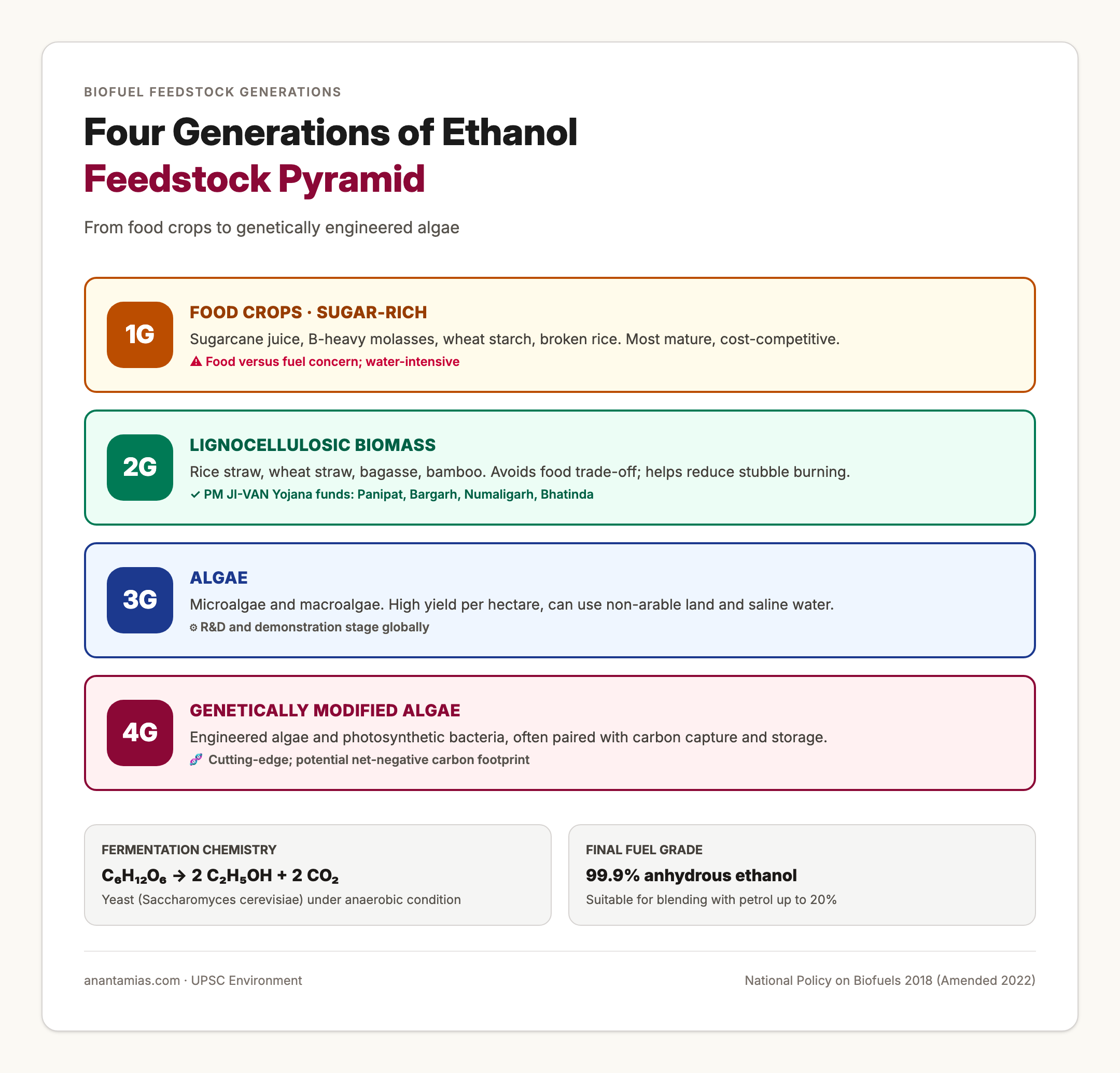
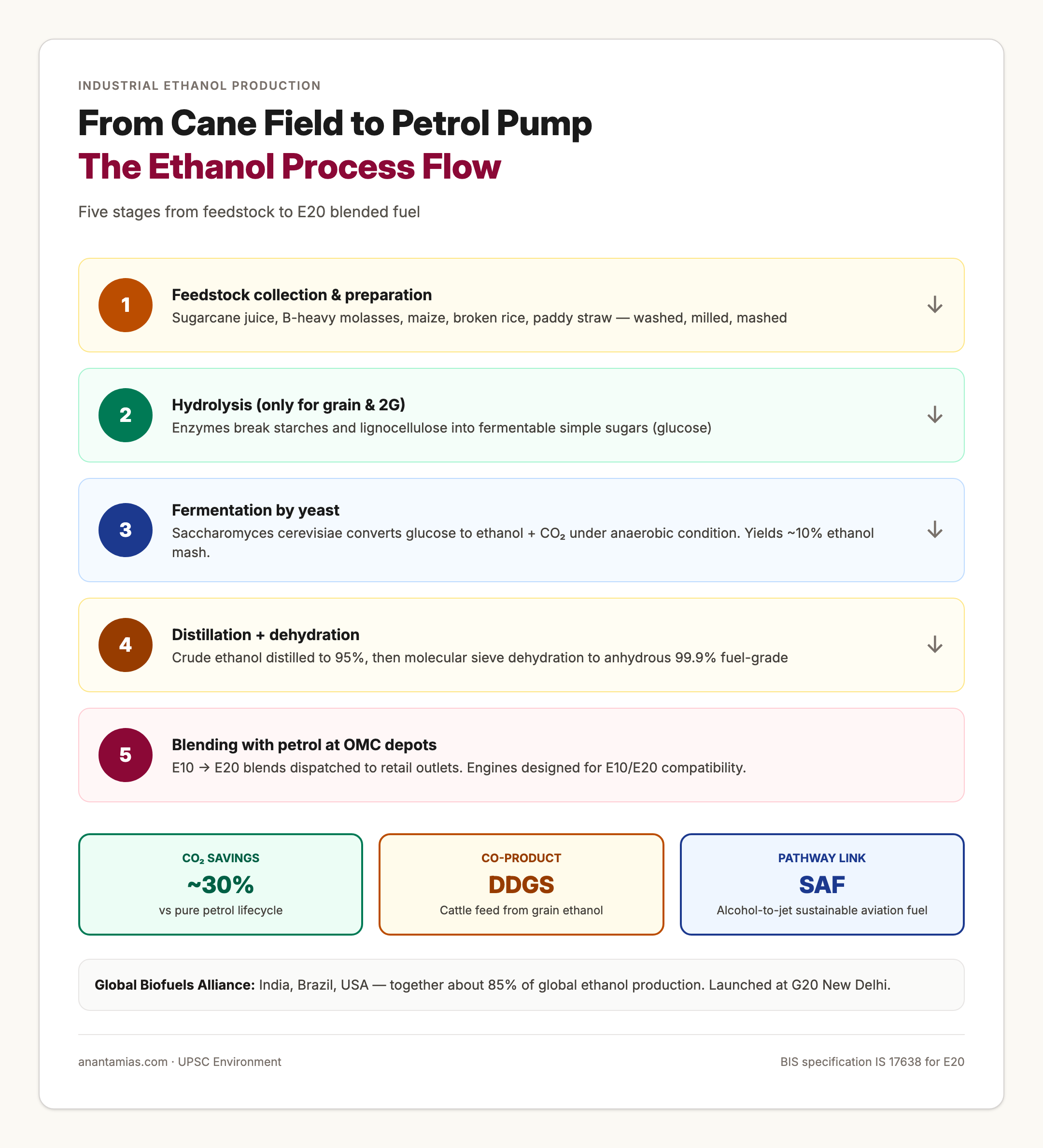
Ethanol, written as C2H5OH or sometimes ethyl alcohol, is a clear, colourless liquid with a characteristic odour. It is a renewable biofuel produced by the fermentation of sugars under anaerobic conditions by yeasts or bacteria, mainly Saccharomyces cerevisiae. The fermentation reaction converts each glucose molecule into two ethanol molecules and two carbon dioxide molecules, with energy released to the microbe. Industrial ethanol production then dehydrates the fermented mash to produce anhydrous ethanol of around 99.9 percent purity, suitable for blending with petrol.
Feedstock is the raw material from which ethanol is fermented. The basket includes sugarcane juice and molasses, grains such as maize and broken rice, and lignocellulosic agricultural waste such as paddy stubble and bamboo. Molasses is a by-product of sugar manufacture and has historically been the workhorse of ethanol supply in India, but the policy shift to allow direct use of sugarcane juice and syrup has unlocked far more volume. Maize and broken rice from FCI surplus stocks are now an important grain-based pathway.
Background and Historical Context
India’s ethanol journey began in earnest in the early 2000s. The Ethanol Blended Petrol Programme was launched in 2003 with an initial pilot of 5 percent blending in selected states. The programme stalled repeatedly through the 2000s due to feedstock shortages, sugar industry cycles, and the unwillingness of oil marketing companies to pay administered prices that reflected actual production cost. The structural change came in two waves. The first wave, in 2014 and 2015, fixed administered ethanol prices that allowed mills to plan ahead. The second wave, from 2018 onwards, expanded the feedstock basket beyond molasses through the National Policy on Biofuels 2018 and accelerated the blending target.
Once the policy moved beyond pure molasses, the supply curve shifted decisively. Mills could divert sugarcane juice and B-heavy molasses to ethanol when sugar prices were depressed, and oil marketing companies began signing long-term offtake contracts. The 10 percent blending milestone was crossed in June 2022, ahead of the original 2025 target. The amended policy of 2022 brought forward the 20 percent target, originally set for 2030, to 2025 to 2026, and recent oil ministry data shows that the programme is meeting that ambition in many states.
Generations of Ethanol
| Generation | Feedstock |
|---|---|
| 1G Ethanol | Food crops rich in sugar – sugarcane juice, molasses, wheat |
| 2G Ethanol | Lignocellulosic biomass: agricultural residues such as rice and wheat straw, bamboo |
| 3G Ethanol | Algae |
| 4G Ethanol | Genetically modified algae, often integrated with carbon capture |
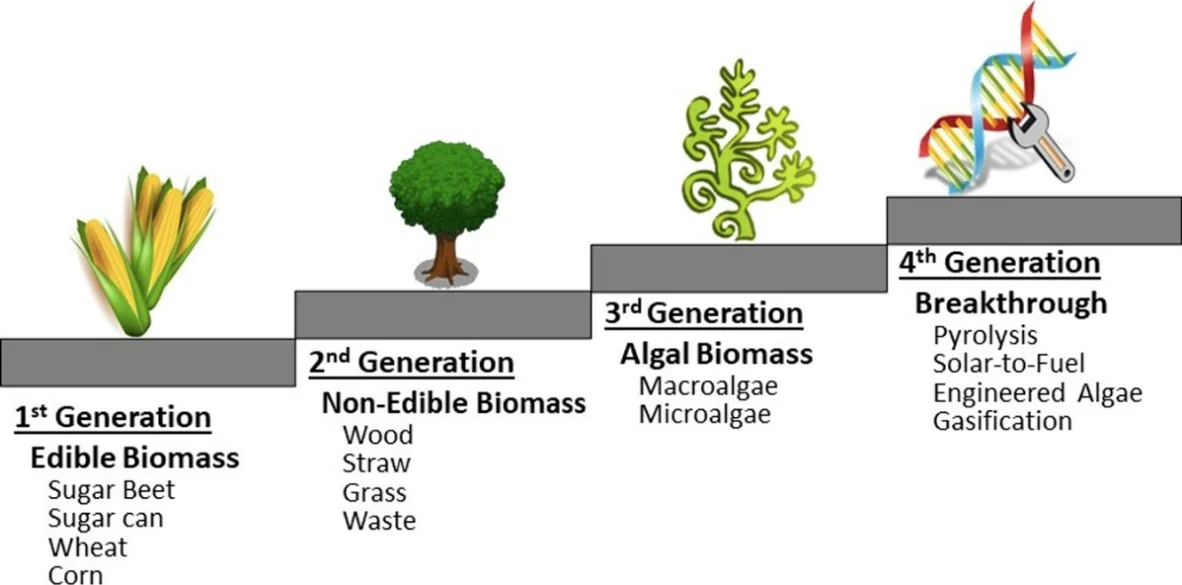
First-generation ethanol is the most mature and cost-competitive but raises food versus fuel concerns when grains are diverted from human consumption. Second-generation ethanol, made from agricultural residues, side-steps the food versus fuel conflict but is more expensive because lignocellulose is hard to break down without specialised enzymes. Third-generation ethanol, from algae, offers high yields per hectare and the possibility of using non-arable land, but commercial scale-up is in its infancy. Fourth-generation ethanol uses genetically engineered algae or photosynthetic bacteria, potentially with integrated carbon capture, and is still largely at the research and demonstration stage.
Government Initiatives Around Ethanol
The Ethanol Blended Petrol Programme is the operational backbone of the ethanol push. Oil Marketing Companies sell petrol blended with ethanol up to 20 percent in many states under the programme. The National Policy on Biofuels 2018, amended in 2022, expanded the permissible feedstock basket and laid down indicative roadmaps for first and second-generation ethanol, biodiesel, and bio-CNG.
The Pradhan Mantri JI-VAN Yojana, full name Pradhan Mantri Jaivik Indhan-Vaahan, was launched in 2019 by the Ministry of Petroleum and Natural Gas as part of the National Biofuel Policy. It is a central scheme that funds 2G ethanol plants designed to use agricultural waste. Major 2G ethanol projects supported under the scheme include plants at Panipat in Haryana, Bargarh in Odisha, Numaligarh in Assam, and Bhatinda in Punjab.
The Global Biofuels Alliance was launched at the G20 New Delhi summit. Founding members are India, Brazil, and the United States, which together account for about 85 percent of global ethanol production. The alliance is an umbrella of governments, international organisations, and industries. Its objectives include creating a virtual marketplace to connect technology providers with users and developing internationally recognised standards, codes, and certification frameworks for biofuels.
The RUCO Initiative, full name Repurpose Used Cooking Oil, is led by the Food Safety and Standards Authority of India. It enforces the rule that cooking oil used past a Total Polar Compounds level of 25 percent becomes carcinogenic and must not be reused. Instead of letting Food Business Operators dump such oil into drains, RUCO routes it to authorised biodiesel aggregators who convert it into transport fuel.
Why It Matters
The ethanol programme matters because it sits at the crossroads of energy security, climate policy, and farm incomes. India’s net oil import bill regularly tops 100 billion dollars, and even a small percentage shaved off through ethanol blending translates into significant foreign exchange savings. Each percentage point of blending saves roughly 30 to 35 thousand crore rupees a year by some estimates and reduces tailpipe carbon dioxide emissions because ethanol blended fuel burns more cleanly.
Ethanol also provides a price floor for sugarcane growers and an alternative to surplus FCI grain stocks. When sugar prices fall, mills divert juice to ethanol; when grain stocks bulge, FCI can release maize or broken rice to ethanol producers. This dual role gives the central government a useful instrument for managing both farm and food storage cycles. Article on coal power in India shows the parallel transition pressures on conventional energy.
Detailed Analysis
The ethanol push has not been without trade-offs. Sugarcane is a deeply water-intensive crop, and concentrating ethanol production in sugar belts pushes water use exactly where aquifers are most stressed. Maharashtra and Karnataka, the two largest sugar producers, are also two of the most groundwater-stressed states. The diversion of FCI grain to ethanol raises food security questions in years when monsoons fail. Land use shifts toward sugarcane over more diversified cropping reduce dietary diversity and resilience.
Air quality outcomes are mixed. Ethanol burns more cleanly than petrol on the carbon dioxide axis, but ethanol-blended fuels can increase aldehyde emissions in older engines, and stubble burning to clear fields for the next crop continues even where 2G plants exist because logistics for residue collection are weak. The environmental case for ethanol is therefore strongest when the ethanol comes from genuine waste streams and weakest when it comes from food crops grown in irrigated belts.
Comparative Note: India, Brazil, and the United States
Brazil began its ethanol journey in the 1970s with the Proalcool programme, born of the oil shocks. Brazil now runs a flexible-fuel vehicle fleet that can run on anywhere from E22 to E100, supported by sugarcane juice ethanol that is competitive without subsidy. The United States runs the world’s largest corn-based ethanol industry under the federal Renewable Fuel Standard. India falls between the two: feedstock is more diverse, the vehicle fleet is moving from E10 to E20 capability, and the policy mix relies more on administered prices and offtake guarantees.
Challenges and Implementation Gaps
Vehicle compatibility is the first challenge. India’s older two-wheelers and small cars were designed for E5 to E10 fuel and may need engine and material upgrades to run E20 reliably. The Bureau of Indian Standards has issued E20 specifications but real-world rollout requires the auto industry to retune engines and certify materials. The second challenge is feedstock predictability. Sugar cycles and monsoon variability cause sharp swings in molasses and grain availability. The third challenge is logistics for 2G ethanol; collecting paddy and wheat straw from millions of small farmers and transporting it to a 2G plant is expensive without pelletising infrastructure. The fourth challenge is water and land sustainability of cane and grain ethanol, already discussed above.
Prelims Pointers
Ethanol formula is C2H5OH. Yeast fermenting sugars produces ethanol and carbon dioxide under anaerobic conditions. The Ethanol Blended Petrol Programme was launched in 2003. Ten percent blending was achieved in June 2022. The 20 percent blending target year was advanced from 2030 to 2025 to 2026. The National Policy on Biofuels was notified in 2018 and amended in 2022. The Pradhan Mantri JI-VAN Yojana was launched in 2019 by the Ministry of Petroleum and Natural Gas. The Global Biofuels Alliance was launched at the G20 New Delhi summit and counts India, Brazil, and the United States as founding members, accounting for about 85 percent of global ethanol production. RUCO is run by FSSAI and the threshold for cooking oil disposal is 25 percent Total Polar Compounds. Burning of biomass and crop residue releases carbon monoxide, methane, ozone, and sulphur dioxide. Sustainable Aviation Fuel feedstocks include agricultural residues, corn grains, wastewater treatment sludge, and wood mill waste.
Mains Practice Questions
GS-III: Discuss India’s ethanol blending programme as a strategy for energy security and climate mitigation. What are its trade-offs in terms of water and food security? (250 words)
GS-III: Evaluate the role of the National Policy on Biofuels 2018 and its 2022 amendment in transforming India’s biofuel landscape. (250 words)
GS-II: Analyse the institutional and diplomatic significance of the Global Biofuels Alliance for India’s energy diplomacy. (250 words)
GS-III: Critically examine the second-generation ethanol pathway in India with reference to the Pradhan Mantri JI-VAN Yojana and its impact on stubble burning. (250 words)
Way Forward
A robust ethanol programme requires diversification of feedstock so that no single crop bears the full burden, expansion of 2G ethanol capacity backed by reliable agri-waste collection systems, accelerated retuning of vehicles and storage infrastructure for E20 fuel, careful water accounting in cane belts, and clearer guardrails on grain diversion in years of poor monsoon. India should leverage the Global Biofuels Alliance to attract finance, technology transfer, and trading frameworks that can move surplus ethanol across borders during demand-supply mismatches. The deeper goal is to convert ethanol from a transitional fuel into a structural pillar of energy security and farm income, supported by scientific cropping choices and rigorous lifecycle accounting. This dovetails with the methane and global methane pledge effort and India’s wider climate commitments at the UNFCCC.
Frequently Asked Questions
What does Annadata Se Urjadata mean?
Annadata Se Urjadata is a Hindi phrase meaning from food provider to energy provider. It is used by the Government of India to describe the transformation of farmers from suppliers of food to suppliers of energy through ethanol and biofuel programmes.
What is the Ethanol Blended Petrol Programme?
The Ethanol Blended Petrol Programme is an initiative under which Oil Marketing Companies sell petrol blended with ethanol. It was launched in 2003. The current target is 20 percent ethanol blending, known as E20, by 2025 to 2026.
When did India achieve 10 percent ethanol blending?
India achieved 10 percent ethanol blending in June 2022, ahead of the original target year. The 20 percent target was then advanced from 2030 to 2025 to 2026 in the amended National Policy on Biofuels 2022.
What are the four generations of ethanol?
First-generation ethanol uses food crops such as sugarcane and grains. Second-generation ethanol uses lignocellulosic biomass such as straw and bamboo. Third-generation ethanol uses algae. Fourth-generation ethanol uses genetically modified algae and is often paired with carbon capture.
What is the Pradhan Mantri JI-VAN Yojana?
The Pradhan Mantri JI-VAN Yojana, launched in 2019 by the Ministry of Petroleum and Natural Gas, is a central scheme to fund the construction of second-generation ethanol plants that use agricultural waste as feedstock. Major projects include Panipat, Bargarh, Numaligarh, and Bhatinda.
What is the Global Biofuels Alliance?
The Global Biofuels Alliance is an India-led initiative launched at the G20 New Delhi summit. Its founding members are India, Brazil, and the United States, which together account for about 85 percent of global ethanol production. The alliance aims to accelerate the global uptake of biofuels.
What is the RUCO initiative?
RUCO, or Repurpose Used Cooking Oil, is a programme run by the Food Safety and Standards Authority of India. It diverts used cooking oil that has crossed the 25 percent Total Polar Compounds threshold from drains to authorised biodiesel aggregators who convert it into transport fuel.
Why is sugarcane controversial as ethanol feedstock?
Sugarcane is highly water-intensive, and the largest sugar-producing states such as Maharashtra and Karnataka are also among the most groundwater-stressed. Diverting more cane to ethanol can deepen water stress unless compensated by drip irrigation, varietal change, and policy controls.
Is ethanol better for the environment than petrol?
Ethanol blended into petrol reduces tailpipe carbon dioxide emissions because ethanol burns more cleanly than petrol. However, lifecycle emissions depend on how the feedstock is grown, water use, fertiliser application, and transport logistics. Second-generation ethanol from genuine waste streams has the strongest environmental case.
What is Sustainable Aviation Fuel and how does it relate to ethanol?
Sustainable Aviation Fuel, or SAF, is a low-carbon jet fuel made from feedstocks such as agricultural residues, corn grains, wastewater treatment sludge, and wood mill waste. Many SAF pathways pass through ethanol as an intermediate, especially the alcohol-to-jet process, linking SAF directly to the ethanol economy.
Tell Google you want more of this.
Add Anantam IAS as a preferred sourceOne tap, and this site shows up more often in your own Top Stories, AI Overviews and AI Mode. Remove it any time.