Europe’s Worst Heatwave: How Attribution Science Links It to Climate Change
Why in News?
Western Europe baked through its most severe recorded heatwave in the days around the June 2026 solstice, with a stagnant heat dome drawing hot Saharan air over the Iberian Peninsula and France. The Indian Express Explained desk, drawing on a rapid World Weather Attribution (WWA) analysis, flagged how quickly scientists were able to tie the event to human-caused warming.
The WWA finding — that a heatwave of this kind would have been virtually impossible in the climate of the 1970s — is a clean teaching case on attribution science, on treating heat as a notified disaster, and on why India’s Heat Action Plans matter for an even more exposed population.
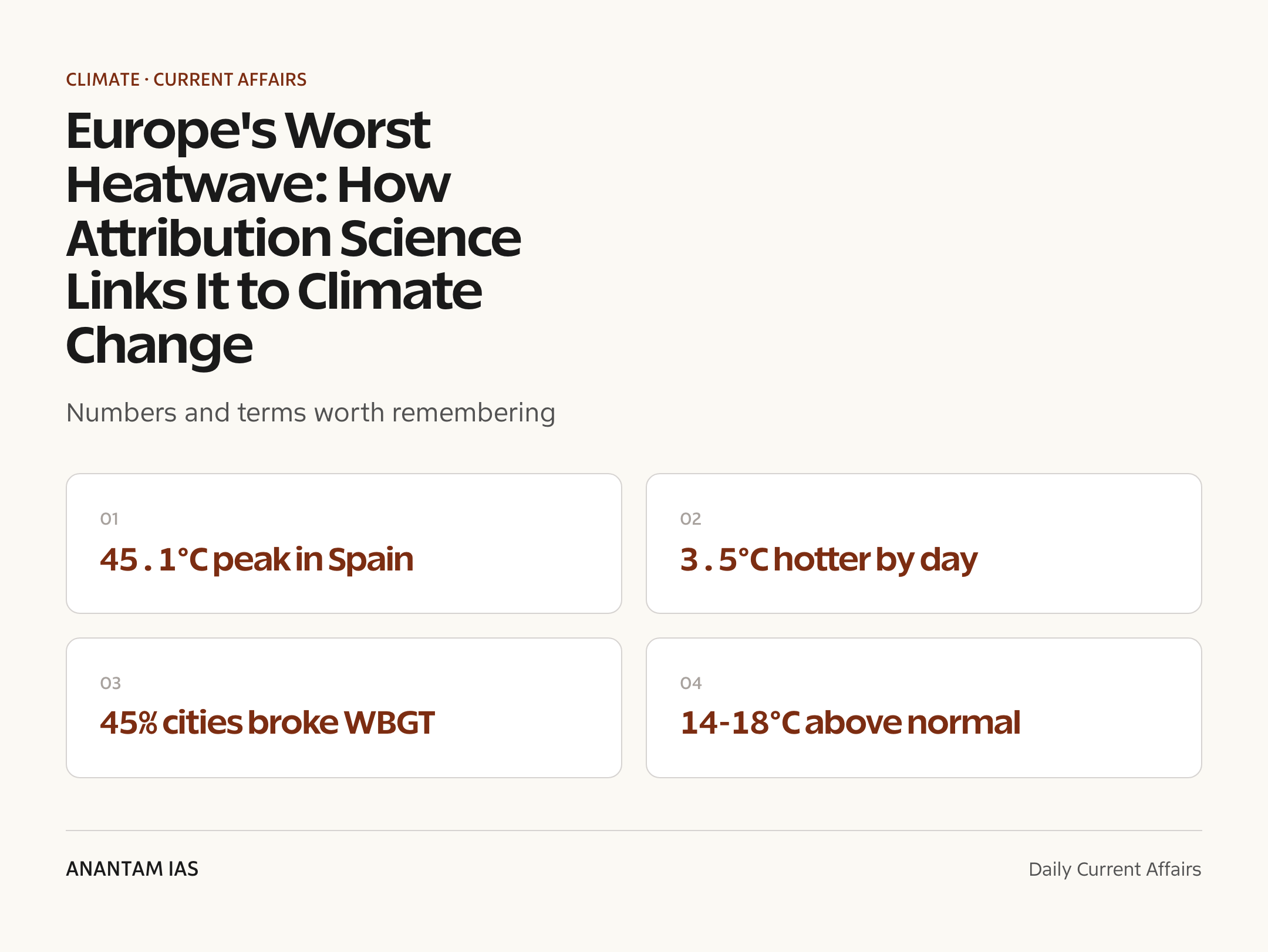
- Peak readings near 45.1°C at Andujar (southern Spain) on 22 June; Spain and Portugal pushed toward 44°C.
- Temperatures ran 14–18°C above normal for late June across the worst-hit belt.
- WWA rapid study: the event was around 3.5°C hotter by day than a comparable event in the 1976 climate.
- 45% of analysed European cities broke heat-stress (Wet Bulb Globe Temperature) thresholds during 18–29 June.
- Past European heat seasons carried huge mortality — over 60,000 excess deaths in 2022, by WWA’s cited figures.
The development matters in the context of:
- Europe is the fastest-warming continent, heating at roughly twice the global average rate, per the WMO and WWA.
- June daytime maxima in Western Europe are warming at close to triple the global mean rate in WWA’s analysis.
- Rapid-attribution studies now appear within days of an event, shifting climate debate from ‘someday’ to ‘this one, now’.
- Night-time minima are rising fast too, so bodies get no overnight recovery — a key driver of heat mortality among the elderly.
- The event sits inside a multi-year run of European heat seasons that carried tens of thousands of excess deaths each year.
UPSC Relevance
Prelims Relevance
- Attribution science: a method that estimates how much human-caused warming changed the likelihood or intensity of a specific extreme event, by comparing today’s climate with a counterfactual cooler one.
- World Weather Attribution (WWA): an international research collaboration that runs rapid, peer-reviewed-method analyses of extreme events; not a government body.
- Heat dome: a persistent high-pressure system that traps and compresses descending air, suppressing cloud and rain and locking in extreme heat.
- Wet Bulb Globe Temperature (WBGT): a heat-stress index combining temperature, humidity, wind and radiant heat — more health-relevant than air temperature alone.
- Return period: the average gap between events of a given severity; warming shortens it (a once-in-50-years heat can become once-in-5-years).
- IPCC AR6 (2021–23) concluded it is virtually certain that hot extremes have become more frequent and intense since the 1950s, with human influence the main driver.
- India’s IMD heatwave criterion: declared when plains touch 40°C, hills 30°C, coastal areas 37°C, with a departure of 4.5–6.4°C above normal (severe heatwave at higher departures).
- NDMA issues national guidelines for heatwave management; over 20 states and 100+ cities/districts run Heat Action Plans (HAPs).
- Heatwave is not currently a notified disaster under the Disaster Management Act, 2005 — a recurring policy debate.
Mains Relevance
GS Paper 3
- Attribution science as evidence: how rapid studies strengthen the case for mitigation, adaptation funding and even climate litigation.
- Heat as a slow-onset disaster: gaps in India’s disaster framework, the case for and against notifying heatwave under the DM Act, and financing of Heat Action Plans.
Essay
- The science we ignore at our peril: extreme weather and the cost of inaction.
- Development versus a warming planet — adaptation as a survival strategy.
Background and Context
What happened across Europe
An early, intense and unusually humid heatwave clustered around the 2026 solstice.
- A stagnant heat dome drew hot Saharan air over Iberia and France, with the worst heat between 20 and 23 June.
- Southern Spain saw readings near 45.1°C at Andujar; Spain and Portugal pushed toward 44°C, with parts of France placed under top-level heat warnings.
- Temperatures ran 14–18°C above normal for late June, and night-time minima stayed dangerously high, denying the body relief.
- WWA called it the most severe heatwave recorded over the region it studied, covering France, Germany, Italy, Spain and southern England.
What attribution science is and how it works
A way to answer ‘did climate change cause this?’ with numbers, not vibes.
- Scientists define the event (say, the three hottest days over a region), then build two model worlds: today’s climate and a counterfactual cooler world without ~1.3°C of human warming.
- They run large ensembles of climate models plus observational datasets such as ERA5, checking the models can reproduce the event’s statistics.
- Comparing the two worlds yields how much hotter and how many times more likely the event became — the core attribution result.
- For Europe 2026, WWA found daytime heat about 3.5°C hotter than a 1976-climate analogue, and the event virtually impossible in that older climate.
- The method does not claim warming ’caused’ the weather pattern; it quantifies how warming loaded the dice toward more extreme outcomes.
- Results carry uncertainty ranges, and scientists report them only when the models pass validation against observations — which is why the conclusions are credible.
- The same framework is applied to floods, droughts and cyclones, building a body of evidence that single events increasingly bear a human fingerprint.
Why heatwaves are intensifying
A hotter baseline plus stickier weather patterns push extremes higher.
- Every fraction of a degree of baseline warming shifts the whole temperature distribution, making record highs far more probable.
- A warmer atmosphere holds more moisture, so heat arrives with higher humidity — lifting WBGT and human heat stress even when air temperature looks moderate.
- Heat domes and stalled jet-stream patterns can park high pressure in place for days, extending exposure.
- Urban heat islands — concrete, asphalt and waste heat — add several degrees in cities and blunt night-time cooling.
- Europe warms at roughly twice the global rate, and Western Europe’s June maxima faster still, in WWA’s analysis.
Heat as a disaster and India's exposure
India is hotter, more humid in parts, and far more exposed by livelihood.
- Hundreds of millions of Indians work outdoors — farm labour, construction, street vending — with limited cooling, raising real-world heat risk.
- IMD declares a heatwave when plains hit 40°C (37°C coastal, 30°C hills) with a 4.5–6.4°C departure above normal; higher departures mark a severe heatwave.
- Heatwave is not a notified disaster under the Disaster Management Act, 2005, so it falls outside the SDRF/NDRF compensation default — a live debate.
- NDMA guidelines and state-city Heat Action Plans push early-warning, cool shelters, work-hour shifts and hospital readiness.
- Studies have flagged that many Indian HAPs are under-funded, weak on local data, and thin on long-term adaptation. See our explainer on heat waves in India.
- Rising wet-bulb temperatures in the humid Indo-Gangetic plains threaten to approach limits beyond which the body cannot cool by sweating, even in shade.
- Heat also strains the power grid, farm yields and water supply, turning a health emergency into a wider economic and food-security shock.
Policy and adaptation levers
Cutting emissions limits future heat; smart adaptation cuts deaths now.
- Mitigation: deep cuts in fossil-fuel emissions cap how much hotter future heatwaves get — the only durable fix.
- Early-warning to action: linking IMD forecasts to automatic local triggers (water points, cooling centres, ASHA outreach).
- Cool cities: cool/green roofs, urban trees, shaded transit and building codes that beat the urban heat island.
- Worker protection: rescheduled hours, rest-shade-water rules and wage protection for the informal workforce.
- Read our wider note on climate change and on disaster management in India.
Way Forward
Treat heat as a managed disaster
- Debate and decide whether to notify heatwave under the DM Act, with clear triggers and funding lines.
- Make Heat Action Plans data-driven, funded and audited, not just paper protocols.
Build the science-policy bridge
- Use rapid attribution to size adaptation budgets and inform climate-resilient infrastructure norms.
- Strengthen India’s own attribution and heat-mortality surveillance to count the true toll.
Protect the most exposed
- Shift outdoor work hours, mandate rest-shade-water, and expand cool public spaces.
- Target the elderly, infants, outdoor workers and slum residents with localised warnings.
- Map high-risk wards and run drills so that cooling shelters, water points and hospitals are ready before the first heat spike arrives.
Conclusion
Europe’s June 2026 heatwave is a warning the attribution numbers make hard to dismiss: a near-impossible event in a 1970s climate, now lived through in a single week. The science has matured to the point where the link between a specific killer heatwave and human emissions can be stated with confidence and speed.
For India — hotter, more humid and far more exposed by livelihood — the lesson is to treat heat as a recurring disaster, fund Heat Action Plans seriously, and protect outdoor workers, while pressing on the emissions cuts that decide how brutal future summers become.
UPSC Practice Questions
Prelims MCQ 1
With reference to extreme-event attribution science, consider the following statements:
- It estimates how human-caused warming has changed the likelihood or intensity of a specific extreme event.
- It works by comparing today’s climate with a modelled counterfactual climate without human warming.
- World Weather Attribution, which conducts such studies, is a specialised agency of the United Nations.
How many of the above statements are correct?
(a) Only one (b) Only two (c) All three (d) None
Answer: (b) Only two
Explanation:
Statements 1 and 2 describe the method correctly. Statement 3 is wrong: WWA is an independent international research collaboration, not a UN agency.
Prelims MCQ 2
As per the India Meteorological Department, a heatwave over the plains is normally declared when the maximum temperature reaches at least:
(a) 35°C (b) 37°C (c) 40°C (d) 45°C
Answer: (c) 40°C
Explanation:
IMD declares a heatwave over the plains at 40°C (37°C for coastal areas, 30°C for hills) with a departure of 4.5–6.4°C above normal; larger departures mark a severe heatwave.
UPSC Mains Questions
- Rapid attribution science has changed how we link extreme weather to climate change. Examine its method and its policy significance for a heat-exposed country like India. (250 words)
- Heatwaves are increasingly deadly yet remain outside India’s notified-disaster framework. Critically evaluate the case for treating heat as a disaster and the adequacy of Heat Action Plans. (250 words)
Sources: Indian Express and World Weather Attribution.
Frequently Asked Questions
What is attribution science?
It is a scientific method that estimates how much human-caused warming changed the probability or intensity of a specific extreme event, by comparing today’s climate with a modelled counterfactual climate that lacks recent warming.
What did World Weather Attribution find about Europe’s June 2026 heatwave?
A rapid WWA analysis found the heatwave was around 3.5°C hotter by day than a comparable event in the 1976 climate, and would have been virtually impossible in that older climate — pointing to human-caused warming as the driver.
What is a heat dome?
A heat dome is a strong, persistent high-pressure system that traps and compresses descending air, suppressing clouds and rain and locking extreme heat over a region for days.
Why is humidity important in measuring heat danger?
High humidity slows the body’s cooling by sweat. Indices like the Wet Bulb Globe Temperature combine humidity, radiant heat and wind with air temperature to better capture real heat stress on the human body.
Is a heatwave a notified disaster in India?
No. Heatwave is not currently notified under the Disaster Management Act, 2005, though several experts and states have urged its inclusion. The NDMA issues guidelines and many states run Heat Action Plans.
When does the IMD declare a heatwave?
Over the plains, when the maximum temperature is 40°C or more (37°C coastal, 30°C hills) with a departure of 4.5–6.4°C above normal; a higher departure marks a severe heatwave.