Disaster management sits squarely in GS-III and, after the Wayanad landslides (July 2024), the Sikkim GLOF (October 2023), and recurring cyclones, has become one of the most examined strands of the UPSC syllabus. This guide consolidates the Disaster Management Act, 2005, India's institutional machinery, the Sendai Framework, the Coalition for Disaster Resilient Infrastructure (CDRI), the Second ARC and PM's 10-point agenda, and the latest 2024 amendment — in one UPSC-ready note.
What is a disaster?
Per the DM Act, 2005:
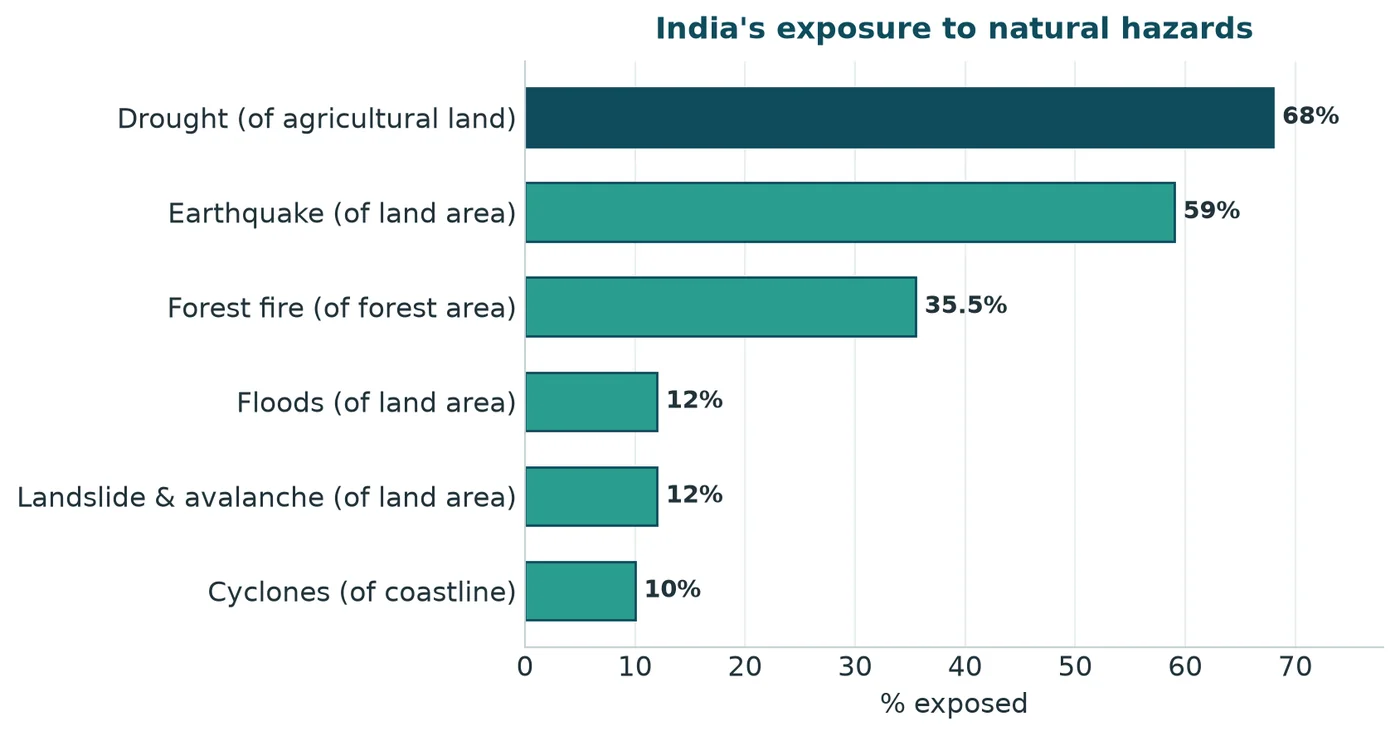
A catastrophe, mishap, calamity or grave occurrence in any area, arising from natural or manmade causes, or by accident or negligence, which results in substantial loss of life, human suffering, damage to/destruction of property, or damage to/degradation of environment — and is of such a nature or magnitude as to be beyond the coping capacity of the community of the affected area.
Disaster = Hazard × Vulnerability / Capacity.
The Disaster Management Act, 2005
Enacted after the 2004 Indian Ocean Tsunami exposed India’s lack of coordinated disaster machinery.
Core features
- Establishes a three-tier structure: NDMA (national), SDMA (state), DDMA (district).
- National Executive Committee (NEC) at Centre; State Executive Committee (SEC) at states.
- Creates National Institute of Disaster Management (NIDM) — capacity building.
- Creates National Disaster Response Force (NDRF) under Section 44.
- Requires disaster management plans at every tier.
- Establishes financial mechanisms: NDRF (Fund), SDRF, NDMF (Mitigation Fund).
- Mandates role for local bodies — consistent with 73rd/74th CAA.
Institutional architecture
| Tier | Body | Chair |
|---|---|---|
| National | NDMA | Prime Minister |
| National crisis coordination | NCMC | Cabinet Secretary |
| National implementation | NEC | Home Secretary |
| State | SDMA | Chief Minister |
| State implementation | SEC | Chief Secretary |
| District | DDMA | District Magistrate |
| Operational force | NDRF | DG NDRF |
| Capacity | NIDM | autonomous |
NDRF — operational muscle
- Established 2006 under DM Act.
- Personnel drawn from BSF, CRPF, CISF, ITBP, SSB, Assam Rifles.
- 16 battalions (post 2024 expansion) positioned strategically across India.
- Specialised teams for CBRN (Chemical-Biological-Radiological-Nuclear).
- International deployments: Nepal earthquake (2015), Turkey earthquake (2023), Myanmar floods.
From response to risk reduction — the paradigm shift
Two decades ago, Indian disaster management was largely reactive — relief and rehabilitation dominated. The Sendai paradigm demands pre-disaster investment in prevention, mitigation, and preparedness.
Disaster management cycle
Prevention → Mitigation → Preparedness → Response → Recovery → Reconstruction (Build Back Better).
Sendai Framework for DRR 2015–2030
Adopted at the Third UN World Conference on DRR, Sendai, Japan (2015); successor to Hyogo Framework (2005–2015).
Four priorities
- Understanding disaster risk.
- Strengthening disaster risk governance.
- Investing in DRR for resilience.
- Enhancing preparedness for effective response and "Build Back Better".
Seven global targets (2030)
- Reduce global disaster mortality.
- Reduce number of affected people.
- Reduce direct economic loss to GDP.
- Reduce damage to critical infrastructure.
- Increase countries with national strategies (2020).
- Enhance international cooperation to developing countries.
- Increase availability of early warning systems.
CDRI — India's signature global initiative
Coalition for Disaster Resilient Infrastructure:
- Launched by PM Modi at UN Climate Action Summit, 23 September 2019.
- Secretariat in New Delhi.
- Multi-stakeholder partnership: 40+ countries, UN agencies, MDBs, knowledge institutions.
- Flagship programmes: IRIS (Infrastructure for Resilient Island States) and CDRI Finance Hub.
- Complements the International Solar Alliance (ISA) as an India-led international body.
Why infrastructure resilience matters
- Global annual infrastructure investment need: USD 3.7 trillion (2016–2040).
- Sendai highlights resilient infrastructure as a cornerstone.
- Protects investments and aligns with SDGs.
Second ARC recommendations
The 2nd Administrative Reforms Commission (2006) on "Crisis Management" still drives reform thinking:
- States remain primary — the Centre plays a supportive role.
- Categorisation of disasters — local, district, state, national — for response scale clarity.
- Prominent role for local government — in cities >2.5 million, the Mayor + Municipal Commissioner + Police Commissioner to lead crisis management.
- Stringent penalties for misutilisation of disaster funds.
- NIDM to remain autonomous and act as apex research institution.
PM's 10-Point Agenda on DRR
Announced at the Asian Ministerial Conference on DRR (2016):
- All development sectors must embed DRR.
- Risk coverage for all — poor households to MNCs to states.
- Women's leadership central to DRR.
- Invest in risk mapping.
- Leverage technology for efficiency.
- Network of universities on disaster issues.
- Use social media and mobile technology.
- Build on local capacity.
- Learn from disasters via post-disaster studies.
- Bring cohesion to international response.
Major disasters that shaped Indian DM
| Event | Year | Policy impact |
|---|---|---|
| Bhuj earthquake | 2001 | GSDMA, seismic design codes |
| Indian Ocean tsunami | 2004 | DM Act 2005, NDMA |
| Uttarakhand flash floods | 2013 | NDRF expansion, Char Dham preparedness |
| J&K floods | 2014 | State DM overhaul |
| Nepal earthquake | 2015 | NDRF international deployment capability |
| Cyclone Fani | 2019 | Odisha gold-standard evacuation |
| COVID-19 | 2020–22 | Biological disaster under DM Act |
| Chamoli GLOF | 2021 | GLOF guidelines |
| Sikkim GLOF | 2023 | Hydropower risk review |
| Wayanad landslides | 2024 | WG ESA debate revived |
Key challenges
- Unsafe urban construction in seismic zones.
- Climate-induced disasters rising in frequency and intensity.
- Weak focus on vulnerable groups — elderly, children, disabled, SC/ST, women.
- Inter-agency coordination gaps.
- Funding shortages for mitigation.
- Low public awareness and community participation.
- Data gaps — recent 2024 Bill proposes national disaster database.
Latest developments (2024-26)
Updated context: verify particular figures with NDMA and MHA annual reports.
- Disaster Management (Amendment) Bill, 2024 — introduces UDMA for state capitals and large cities, statutory SDRF, Sendai-aligned definitions.
- Wayanad landslides (2024) — revived Western Ghats ESA debate.
- Sikkim GLOF (2023) — changed Himalayan hydropower risk thinking.
- Heat Action Plans across 23+ states; NDMA guidelines updated.
- 15th Finance Commission allocations to SDRF/NDRF in effect till 2025-26; 16th Finance Commission review under way.
- CDRI expansion — 40+ countries; IRIS aids Pacific Island states.
- COP29 Baku — reinforced the DRR-climate nexus.
UPSC relevance
GS-III mapping
- Directly maps to Disaster and disaster management.
Prelims bullets
- DM Act enacted — 2005.
- NDMA — Prime Minister is the ex-officio chairperson.
- NDRF battalions — now 16.
- CDRI launched — September 2019 at UN Climate Action Summit.
- Sendai Framework — 4 priorities, 7 global targets.
- NIDM headquartered in New Delhi.
Mains angles
- "India has shifted from disaster response to risk reduction. Examine the institutional and legal steps that have driven this shift."
- "Critically evaluate the role of local bodies in disaster management in India."
- "Discuss the significance of CDRI in advancing India's climate leadership."
Essay hooks
- Build back better — rebuilding as a developmental opportunity.
- Women's leadership in DRR — Kutch and Odisha experiences.
- Climate-resilient cities — the urban DM challenge.
Quick revision
| Framework / law | Year | Focus |
|---|---|---|
| Yokohama Strategy | 1994 | Early DRR agenda |
| Hyogo Framework | 2005 | Resilience building |
| DM Act (India) | 2005 | Institutional architecture |
| Sendai Framework | 2015 | DRR 2015-2030 |
| CDRI | 2019 | Resilient infrastructure |
| DM Amendment Bill | 2024 | UDMA, Sendai terms |
The bottom line for UPSC: Indian disaster management has institutional depth; the frontier now is urban, climate-induced, and local-government-led. The 2024 amendment, CDRI, and Sendai alignment all point in the same direction — from reactive relief to proactive resilience.
Tell Google you want more of this.
Add Anantam IAS as a preferred sourceOne tap, and this site shows up more often in your own Top Stories, AI Overviews and AI Mode. Remove it any time.