Federal Reserve Rate Hike: Spillovers and RBI Autonomy
Why in News?
On 16 September 2026, the US Federal Reserve announced a rate hike as elevated inflation persisted, renewing attention to monetary-policy spillovers for India.
- The Federal Open Market Committee raised its federal funds target range by 25 basis points to 3.75–4%.
- The statement describes economic activity as expanding and inflation as elevated; the increase responds to US conditions.
- The Fed also maintained its policy of ample banking-system reserves, showing that a rate change and reserve conditions are distinct.
- A change in US financial returns can affect cross-border investment choices, exchange rates and financing conditions elsewhere.
- India faces these external spillovers, but the Fed’s decision does not determine the Reserve Bank of India’s next policy move.
UPSC Relevance
Prelims Relevance
- FOMC: the Federal Reserve’s monetary-policy decision-making committee.
- Basis point: one-hundredth of a percentage point.
- Interest differential: the gap between interest rates on compared assets or markets.
- Exchange-rate depreciation: a currency losing value against another currency.
- Imported inflation: domestic price pressure transmitted through imported goods and inputs.
Mains Relevance
GS Paper 3
- Macroeconomics: external shocks, capital flows and monetary-policy transmission.
- Policy judgment: inflation risks, financing conditions and domestic growth.
GS Paper 2
- International relations: economic interdependence and national policy space.
Essay
- Interdependence changes the constraints on national policy without removing the need for independent judgment.
Background and Context
Why higher US rates can affect Indian markets
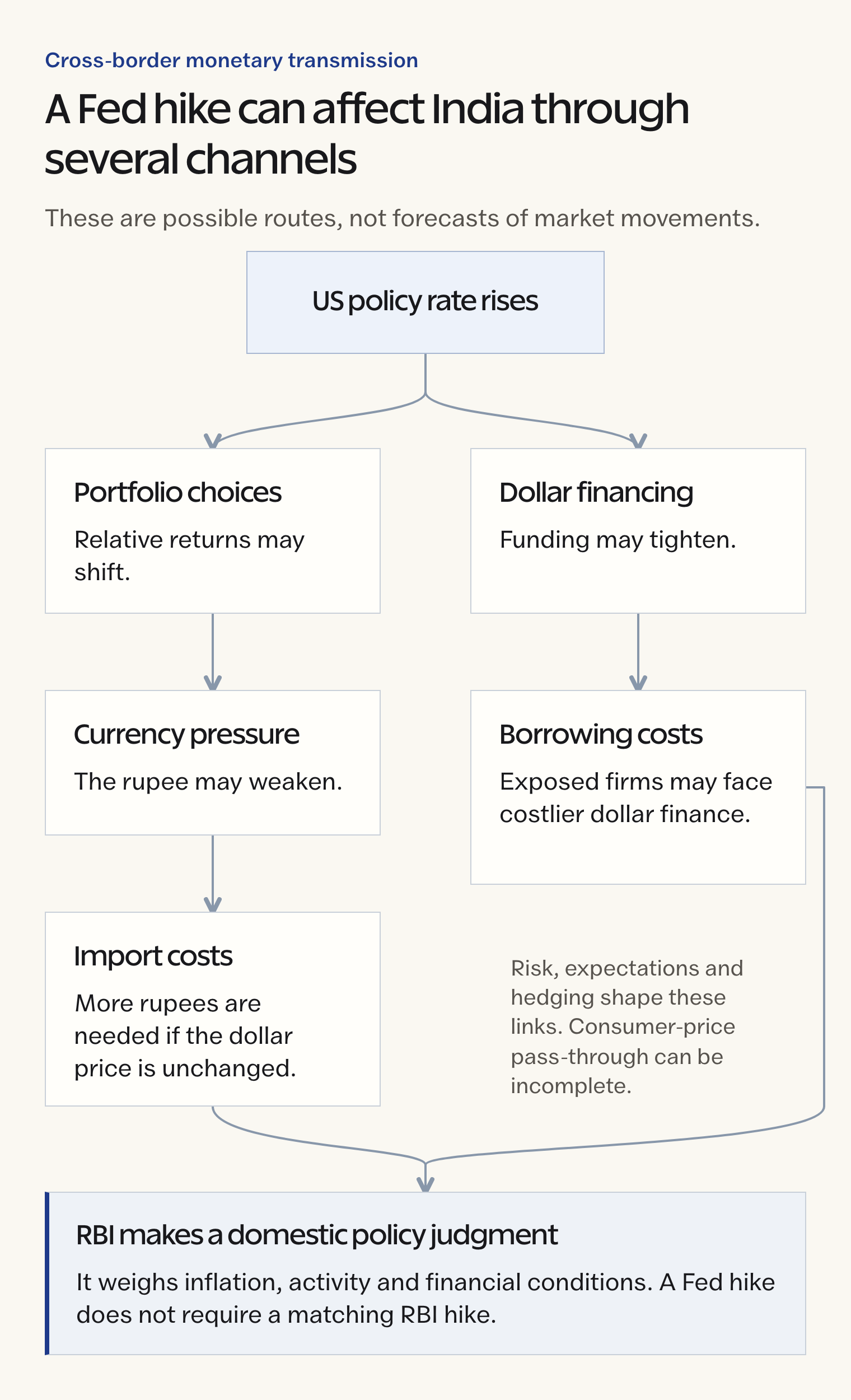
The first transmission channel runs through investors’ comparisons of returns and risk across currencies and financial markets.
- Interest differentials can narrow when US rates rise while Indian rates remain unchanged. That may reduce the relative attraction of some Indian debt investments, but investors also consider currency risk and hedging costs.
- Portfolio decisions compare risk-adjusted returns, not policy rates alone. Growth prospects, market liquidity and expected exchange-rate movements can alter the comparison, which is why a Fed increase does not guarantee capital flight from India.
- Market expectations matter before an announcement arrives. If investors already anticipated the decision, prices may have adjusted earlier; a surprise about the future rate path can matter more than the announced increase itself.
- Dollar funding is another channel: tighter global financing conditions can raise borrowing costs for exposed firms. The effect depends on refinancing needs and contract terms, rather than applying equally to every Indian borrower.
- Domestic market rates need not move exactly with the RBI’s policy rate. Global risk premiums can change financial conditions independently, a distinction that complements domestic liquidity and monetary transmission within India’s banking system.
How currency pressure can reach import costs
The second channel links foreign-exchange demand to domestic costs, with several conditions between a financial shock and consumer inflation.
- If investors shift funds toward dollar assets, increased dollar demand can put pressure on the rupee. This is a possible transmission route, not evidence that depreciation has already followed this particular Federal Reserve announcement.
- A weaker rupee raises the rupee cost of a dollar-priced import if its dollar price stays unchanged. The exchange rate and the international commodity price are separate influences that can reinforce or offset each other.
- Imported inputs can transmit currency pressure into production and distribution costs. Consumer prices do not necessarily rise immediately or equally: firms’ margins, existing contracts and demand conditions influence how much cost is passed through.
- Dollar liabilities can also become more expensive in rupee terms when the currency weakens. A borrower with dollar earnings or effective hedging faces a different exposure from an otherwise similar borrower without those protections.
- Inflation analysis must separate exchange-rate effects from domestic supply changes. Read the household price basket and food-inflation discussion alongside this channel; a rise in consumer prices cannot automatically be attributed to a foreign rate decision.
Why the RBI does not mechanically follow the Fed
External conditions enter India’s policy assessment through their domestic effects; they do not replace that assessment with a matching rule.
- Domestic judgment begins with the inflation outlook, economic activity and financial conditions in India. A foreign rate increase is relevant when it changes those conditions; copying its size is not a substitute for analysis.
- Policy trade-offs depend on the shock: persistent inflation pressure may call for a different response from temporary currency volatility. A rate increase can restrain demand, making the domestic growth implications part of the decision.
- Resilience varies across emerging markets because economic fundamentals, financing structures and policy credibility differ. The IMF’s assessment of earlier tightening shows why blanket predictions of outflows or crisis are unreliable guides to a new episode.
- Policy instruments address different problems. Interest-rate decisions, banking liquidity management and measures addressing disorderly currency markets should be judged against their purposes, rather than treated as identical ways of responding to the Federal Reserve.
- Forecasts and decisions belong in separate categories. Market expectations about an upcoming RBI meeting do not establish its outcome; an exam answer should distinguish the confirmed US action from any possible Indian policy response.
Way Forward
Judge the transmission before choosing the response
- Monitor capital flows, funding costs and currency exposure together to identify where the external shock is actually being transmitted.
- Assess inflation persistence and domestic demand before drawing conclusions about the appropriate interest-rate response.
- Explain the domestic basis of policy decisions clearly so a foreign announcement does not become a misleading guide to India’s next move.
Conclusion
- The Federal Reserve rate hike can influence India through returns, financing conditions and exchange rates. Each channel depends on expectations, exposures and domestic conditions; none establishes an automatic market outcome.
- A strong answer separates external pressure from policy choice. The RBI must assess how the shock affects India’s economy rather than reproduce the Federal Reserve’s decision mechanically.
UPSC Practice Questions
Prelims MCQ 1
Consider the following statements about monetary-policy spillovers:
- A Fed rate hike guarantees depreciation of the Indian rupee.
- Expected exchange-rate movements can influence investors’ comparisons of asset returns.
- Domestic borrowing conditions can change even without a change in the RBI policy rate.
How many of the above statements are correct?
(a) Only one (b) Only two (c) All three (d) None
Answer: (b) Only two
Explanation:
Statements 2 and 3 are correct. Currency risk and global financing conditions affect transmission. A rate increase does not guarantee a particular exchange-rate outcome.
Prelims MCQ 2
With a dollar-priced import’s dollar price unchanged, what is the direct effect of rupee depreciation?
(a) Its rupee cost falls (b) Its rupee cost is necessarily unchanged (c) Its rupee cost rises (d) Its dollar price must rise
Answer: (c) Its rupee cost rises
Explanation:
More rupees are required to purchase the same dollars. The effect on final consumer prices can differ because pass-through is not necessarily immediate or complete.
UPSC Mains Questions
- Explain how US monetary tightening can affect capital flows, exchange rates and imported inflation in India. Why are these effects conditional?
- Does a Federal Reserve rate hike require the RBI to raise its policy rate? Discuss with reference to domestic economic conditions and monetary-policy transmission.
Sources: Federal Reserve, FOMC statement and IMF, monetary policy transmission in emerging markets.
Frequently Asked Questions
What did the Federal Reserve decide?
On 16 September 2026, the FOMC raised the federal funds target range by 25 basis points to 3.75–4%. Its statement cited elevated inflation alongside expanding economic activity.
Does a Fed hike guarantee a weaker rupee?
No. Higher US returns can influence dollar demand, but currency outcomes also depend on expectations, capital flows, economic prospects and risk perceptions. A transmission channel is not a guaranteed forecast.
How can a weaker rupee affect inflation?
It can raise the rupee cost of dollar-priced imports when their dollar price is unchanged. Pass-through to consumer prices depends on contracts, margins, demand and other domestic conditions.
Must the RBI match the Fed’s rate increase?
No. The RBI must judge the consequences for Indian inflation, activity and financial conditions. A US policy decision can influence that assessment without determining the size or direction of India’s response.
Is an expected RBI move a confirmed decision?
No. Analysts’ forecasts and market expectations describe possible outcomes. Only the actual policy announcement confirms the decision; the US rate hike alone cannot establish what an upcoming RBI meeting will do.