Why in News?
Indian Express reported banking-system liquidity at a four-year high, while the Reserve Bank of India announced a 30-day VRRR auction for September 7 to absorb surplus funds temporarily.
- Banking-system liquidity reached about ₹9.7 lakh crore on September 2, its highest level since May 2022, according to Indian Express.
- The daily average surplus in August was reported at more than three times its July level, showing that the excess was persistent rather than a one-day fluctuation.
- RBI officially notified a 30-day VRRR auction with a ₹7 lakh crore amount and an October 7 reversal date.
- Foreign-currency inflows were one source of rupee creation, but the policy problem is domestic: abundant bank reserves can pull overnight rates away from the repo rate.
- Liquidity management implements the monetary-policy stance by keeping the overnight operating rate aligned with the policy rate; it is not a substitute for the Monetary Policy Committee’s rate decision.
- A surplus is not automatically beneficial: its effect depends on whether banks can deploy funds productively without weakening rate signals, asset-market stability or inflation control.
UPSC Relevance
Prelims Relevance
- The policy repo rate is the centre of RBI’s liquidity corridor and signals the monetary-policy stance.
- The Standing Deposit Facility absorbs overnight funds without collateral and forms the corridor’s lower bound.
- The Marginal Standing Facility supplies overnight funds against eligible securities and forms the upper bound.
- A Variable Rate Reverse Repo absorbs liquidity for a specified tenor through competitive bidding at a market-determined rate.
- OMO sales absorb durable liquidity by selling government securities, while CRR changes immobilise a share of bank deposits with RBI.
Mains Relevance
GS Paper 3
- Explain how surplus reserves can weaken the transmission of the policy repo rate to money-market, deposit and lending rates.
- Compare temporary VRRR absorption with durable tools such as CRR changes and OMO sales.
Essay
- Effective economic governance depends not only on choosing a policy signal but also on maintaining the operating conditions through which that signal reaches markets.
Background and Context
From Surplus Reserves to Overnight Rates
System liquidity describes the net short-term funds banks hold relative to their immediate reserve and payment needs.
- In a liquidity surplus, banks collectively seek safe places for excess reserves; in a deficit, they seek short-term funds from RBI or the money market.
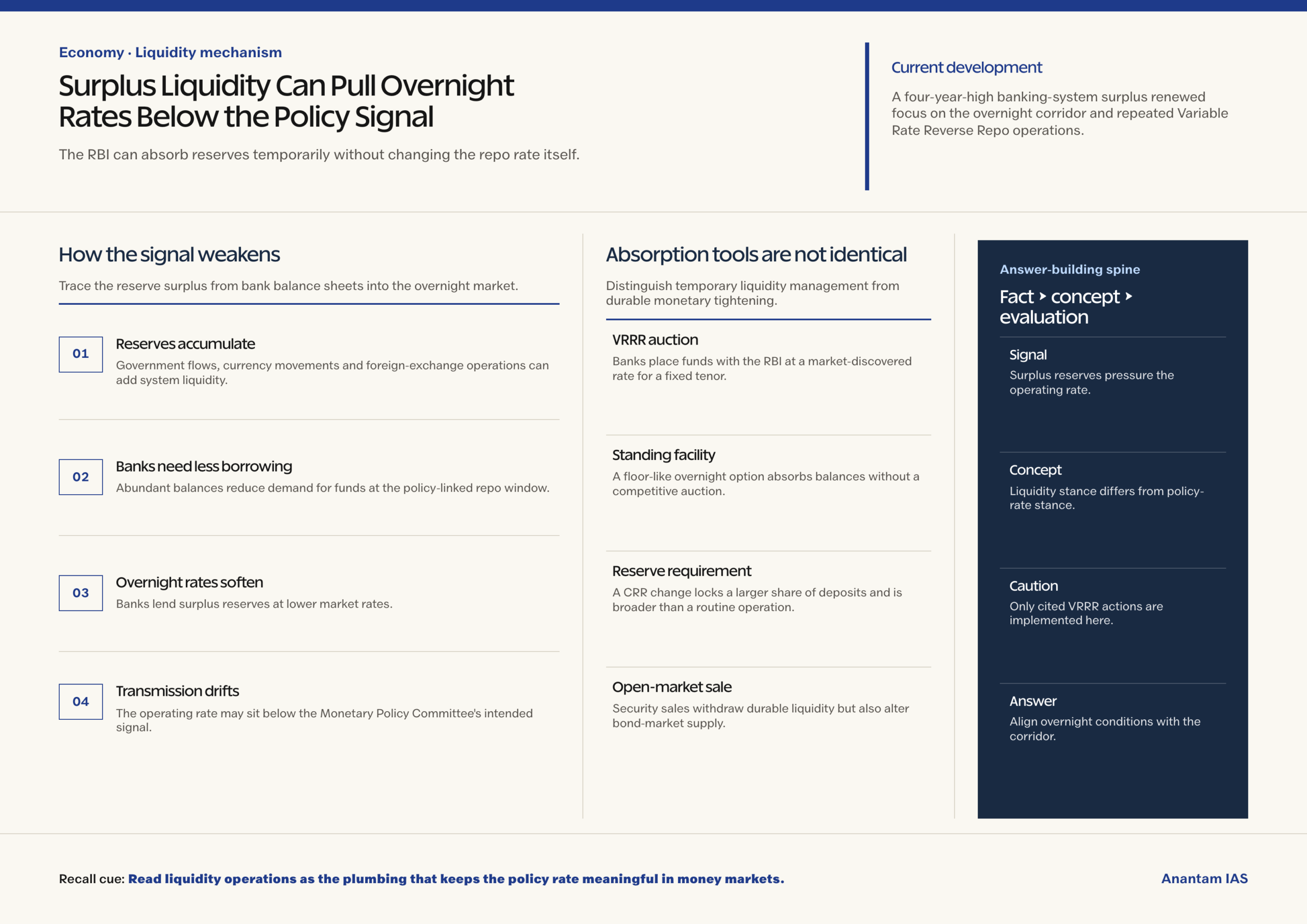
- Competition to lend abundant funds pushes the weighted average call rate and other overnight rates downward, even when the policy repo rate itself is unchanged.
- The repo rate is the policy signal, while the overnight call rate is the main operating target through which RBI observes whether that signal is taking hold.
- The SDF floor gives eligible banks an overnight absorption option, while the MSF ceiling limits the cost of emergency overnight borrowing against eligible securities.
- Market rates can still stray because participants, collateral and timing differ, so RBI evaluates persistent misalignment rather than treating every isolated print as policy failure.
How VRRR Absorbs Liquidity
A VRRR auction removes surplus reserves for a chosen period without changing the Monetary Policy Committee’s repo-rate decision.
- Banks submit the rates at which they will place funds with RBI, and accepted bids determine a variable auction rate rather than a universal fixed return.
- Settlement transfers accepted funds from banks to RBI for the auction tenor, reducing reserves available for immediate overnight deployment and easing downward pressure on money-market rates.
- At maturity, RBI returns principal with accrued interest, so the absorption normally reverses unless another operation replaces it or underlying liquidity conditions change.
- Tenor choice matters: an overnight auction manages a brief surplus, while a 30-day operation can lock away funds across several reserve-maintenance and payment cycles.
- The September 4 release announced the operation and allowed premature reversal under stated conditions; it did not announce a CRR increase, incremental CRR or OMO sale.
Why Monetary Transmission Weakens
Transmission begins when the policy rate influences overnight funding costs and then spreads through the financial system.
- The intended chain runs from the repo signal to overnight rates, treasury and bond yields, bank funding costs, deposit rates, lending rates, spending and inflation.
- When overnight rates remain below the repo rate, effective short-term financing conditions become easier than the announced stance, weakening the first link in that transmission chain.
- Banks with ample low-cost funds may feel less pressure to raise deposit or lending rates after a policy-rate increase, delaying or diluting transmission to borrowers and savers.
- Excess liquidity does not mechanically cause inflation; the outcome also depends on credit demand, bank risk assessment, fiscal flows, currency demand and the economy’s unused capacity.
- Foreign inflows can create rupee liquidity when RBI buys foreign currency, but government balances, currency withdrawals and RBI’s domestic operations can add or remove liquidity independently.
Way Forward
Match the Tool to Persistence
RBI should separate temporary liquidity management from any change in the monetary-policy stance.
- Use calibrated VRRR tenors and amounts when the surplus is temporary, publishing auction results and monitoring whether the overnight operating rate returns near the repo signal.
- Consider OMO sales only when durable absorption is needed, because selling government securities can also influence bond yields, portfolio values and government borrowing conditions.
- Reserve CRR or incremental CRR changes for persistent, system-wide excess because they absorb funds forcefully but can raise intermediation costs and affect banks unevenly.
- Communicate the distinction clearly: liquidity absorption supports transmission, while any repo-rate change remains a separate decision based on inflation and growth.
Conclusion
- Surplus liquidity becomes a monetary-policy problem when it persistently pulls the overnight operating rate below the repo signal and loosens financing conditions beyond the intended stance.
- A strong answer should trace the transmission chain, identify VRRR as temporary absorption, and present CRR, incremental CRR and OMO sales only as trade-off-heavy options, not implemented measures.
UPSC Practice Questions
Prelims MCQ 1
With reference to RBI’s liquidity corridor, consider the following statements:
- The Standing Deposit Facility forms the lower bound of the corridor.
- The Marginal Standing Facility supplies overnight funds against eligible securities.
- A VRRR auction necessarily changes the policy repo rate.
How many of the above statements are correct?
(a) Only one (b) Only two (c) All three (d) None
Answer: (b) Only two
Explanation:
Statements 1 and 2 are correct. A VRRR auction absorbs liquidity at a variable auction rate but does not itself change the policy repo rate.
Prelims MCQ 2
Which option best describes the immediate effect of a successful VRRR auction?
(a) RBI permanently cancels bank reserves (b) Banks place funds with RBI for the auction tenor (c) The Monetary Policy Committee automatically raises the repo rate (d) RBI purchases government securities from banks
Answer: (b) Banks place funds with RBI for the auction tenor
Explanation:
Accepted VRRR bids temporarily transfer surplus funds to RBI. Principal and interest return at maturity unless liquidity is absorbed again through another operation.
UPSC Mains Questions
- Explain how persistent surplus banking-system liquidity can weaken monetary transmission even when the policy repo rate remains unchanged.
- Compare VRRR auctions, CRR changes and OMO sales as liquidity-absorption tools. Why must their use remain distinct from a change in the monetary-policy stance?
Sources: Reserve Bank of India and Indian Express Explained.
Frequently Asked Questions
What is surplus banking-system liquidity?
It means banks collectively hold short-term funds beyond immediate reserve and payment needs. They then compete to place those funds, usually pushing overnight market rates downward.
Why can overnight rates fall below the repo rate?
When lendable funds are abundant relative to borrowing demand, banks accept lower overnight returns. Persistent softness indicates that short-term financing conditions are easier than RBI’s central policy signal.
How does a VRRR auction absorb liquidity?
Banks bid to place surplus funds with RBI for a specified tenor at a variable rate. The funds return with interest at maturity, making the absorption temporary.
Did RBI announce a CRR increase or OMO sale?
No. The cited official release announced a 30-day VRRR auction. CRR, incremental CRR and OMO sales were discussed as possible tools, not confirmed measures.
Does excess liquidity automatically create inflation?
No. It may weaken rate transmission and enable easier credit, but inflation also depends on credit demand, spending, supply conditions, expectations and the economy’s available capacity.
Tell Google you want more of this.
Add Anantam IAS as a preferred sourceOne tap, and this site shows up more often in your own Top Stories, AI Overviews and AI Mode. Remove it any time.