Why in News?
The Ministry of Statistics and Programme Implementation released August 2026 Consumer Price Index estimates on September 14, showing faster annual retail inflation.
- Combined CPI inflation was 4.82% provisionally in August, compared with July’s final 4.45% reading.
- Annual food inflation, measured through the Consumer Food Price Index, was 5.95% provisionally.
- The release uses the already operative 2024=100 base; it does not announce a new base-year change.
- A national average describes a representative consumption basket; it cannot reproduce every household’s shopping bill.
- Reading weights and comparison periods prevents confusing a dramatic vegetable-price movement with the largest contribution to overall inflation.
UPSC Relevance
Prelims Relevance
- CPI: a consumer price index covering goods and services.
- CFPI: the Consumer Food Price Index.
- Year-on-year: comparison with the corresponding month a year earlier.
- Expenditure weights: the relative importance of items in the basket.
- Disinflation: a declining inflation rate, distinct from deflation.
Mains Relevance
GS Paper 3
- Inflation measurement: aggregate indices and unequal household exposure.
- Food-price management: separating supply pressures from broad price trends.
Essay
- An average can measure society without describing every household.
Background and Context
What the consumer basket measures
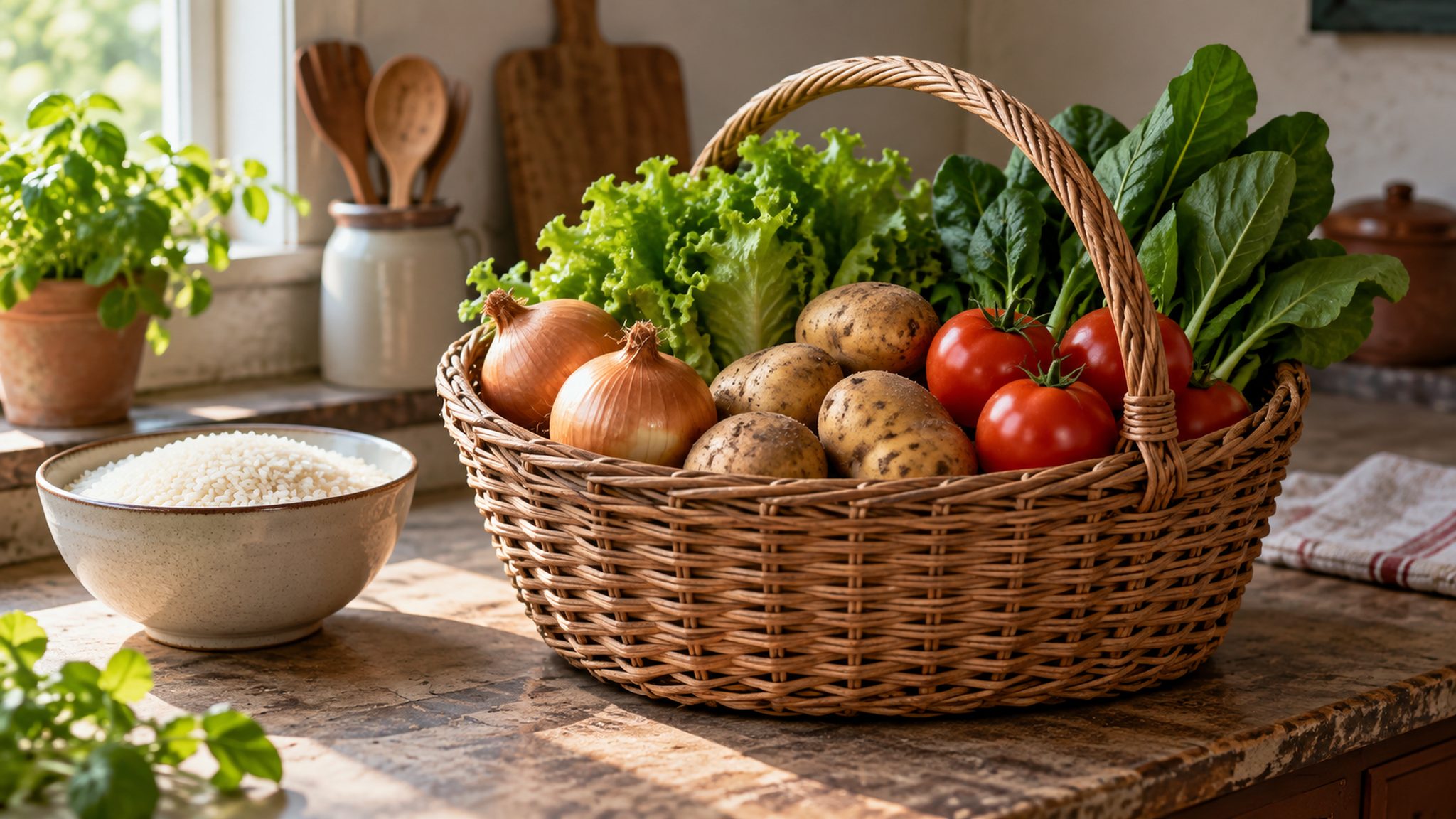
CPI compresses many consumer prices into a single comparable measure, while retaining differences in how much households spend on different items. Its construction matters before interpreting the headline.
- A price index tracks the cost of a representative basket relative to a reference period. It is neither a rupee bill nor the price of an individual product.
- The basket includes goods and services, such as food, clothing, transport and health care. A vegetable-market visit illustrates only part of what the headline index is designed to measure.
- An expenditure weight expresses an item’s importance within the basket. Frequently discussed prices do not receive extra statistical importance merely because they attract more public attention or appear in headlines.
- Rural and urban indices reflect different consumption patterns and observed prices. Their combined measure is not obtained by casually averaging the two published inflation rates without the relevant aggregation weights.
- A household spending unusually heavily on food or rent can experience a different cost increase from the national basket. Such differences do not, by themselves, make the aggregate index incorrect.
Index level, inflation rate and comparison period
The index tells us where the basket’s price level stands; inflation tells us how quickly that index changed over a specified interval. Always name that interval.
- Year-on-year inflation compares August’s index with the previous August’s index. It is the percentage change between those two observations, rather than the change since the immediately preceding month.
- Month-on-month change compares August with July. It answers a different question about recent movement, so it cannot replace the annual figure without explicitly changing the comparison period being discussed.
- Disinflation means inflation slows. If the rate remains positive, the measured basket still becomes more expensive over the comparison period; prices need not return to their earlier level.
- Deflation means the relevant aggregate price index declines over the stated interval. A cheaper tomato or potato alone does not establish deflation across the entire consumer basket of goods and services.
- The base effect comes from the earlier comparison value. Annual inflation can change partly because last year’s prices were unusually high or low, even when current monthly movement is modest.
Why food inflation is not the headline rate
CFPI isolates food-price movements; headline CPI combines food with other household purchases, whose movements may reinforce or offset each other. The distinction matters when identifying the underlying pressure.
- CFPI is narrower than headline CPI. It also differs from the broader food-and-beverages division shown in the release, so these labels should not be used interchangeably in an answer.
- A large item inflation rate does not automatically imply the largest headline contribution. Contribution depends on the item’s importance and index movement within the relevant aggregation, not its percentage alone.
- The release lists both rising and falling item prices. Their coexistence explains why one shopping experience can differ from the aggregate and why selecting only spectacular increases gives an incomplete picture.
- Food-price shocks can arise through harvest conditions, storage or transport disruptions. These are possible mechanisms to investigate, not verified explanations for this particular month’s movement merely because food inflation rose.
- A useful answer separates measurement from response: identify the basket, interval and weighted pressures first. Read the broader inflation-targeting debate separately; this release alone establishes no policy decision.
Way Forward
Diagnose pressures before choosing a response
- Use disaggregated evidence to distinguish concentrated food pressures from widespread increases before recommending supply interventions.
- Compare household exposure alongside national averages; targeted support should address the groups facing the greatest essential-spending pressure.
- Track revision status and subsequent releases. A provisional reading is usable evidence, but its label must survive quotation and comparison.
- Study LPG pricing as a separate sector-specific mechanism, without assuming it explains the August CPI result.
Conclusion
- Read CPI as a weighted measure with a defined comparison period. The headline rate, the price level and a household’s actual bill answer related but different questions.
- In an exam answer, explain weights and price transmission before recommending action. A striking item percentage is a clue for investigation, not proof of the largest inflation contribution.
UPSC Practice Questions
Prelims MCQ 1
With reference to consumer-price inflation, consider the following statements:
- Year-on-year inflation compares an index with its value in the corresponding month of the previous year.
- A decline in a positive inflation rate necessarily means the aggregate price level has fallen.
- An item’s expenditure weight matters when assessing its effect on the aggregate index.
How many of the above statements are correct?
(a) Only one (b) Only two (c) All three (d) None
Answer: (b) Only two
Explanation:
Statements one and three are correct. A slower positive inflation rate means prices rise more slowly over the comparison period; it does not establish a decline in the price level.
Prelims MCQ 2
Which is the best explanation for food inflation differing from headline CPI inflation?
(a) Headline CPI excludes all food items (b) CFPI measures only wholesale prices (c) The indices cover different baskets, while headline CPI also includes non-food purchases (d) Food inflation must always equal the rural CPI rate
Answer: (c) The indices cover different baskets, while headline CPI also includes non-food purchases
Explanation:
CFPI measures consumer food-price movements. Headline CPI also reflects other goods and services, whose prices and weights affect its overall movement.
UPSC Mains Questions
- Why can a national consumer price index differ from the inflation experienced by an individual household? Explain the roles of expenditure weights and consumption patterns.
- Distinguish disinflation from deflation. How should the interpretation of food-price movements guide, without predetermining, an inflation-management response?
Source: PIB, Ministry of Statistics and Programme Implementation.
Frequently Asked Questions
What does August’s CPI release show?
The provisional annual headline rate was 4.82%, above July’s final 4.45% reading. These figures compare each month’s index with the corresponding month a year earlier, rather than directly measuring August’s monthly increase.
Does lower inflation mean prices have fallen?
Not necessarily. A declining but positive inflation rate means prices are rising more slowly over the comparison period. A fall in the aggregate price index is deflation over that interval.
Why does an item’s weight matter?
The weight reflects its importance in the consumption basket. A dramatic increase in a lightly weighted item need not dominate the overall index; price movement and basket importance must be considered together.
Is CFPI the same as headline CPI?
No. CFPI measures consumer food-price movements. Headline CPI covers a wider basket of goods and services. CFPI should also be distinguished from the broader food-and-beverages division in the published tables.
Was a new CPI base introduced in this release?
No. The August release uses the already operative 2024=100 base. Its new information concerns August’s provisional price indices and inflation, alongside the final figures shown for the preceding month.
Tell Google you want more of this.
Add Anantam IAS as a preferred sourceOne tap, and this site shows up more often in your own Top Stories, AI Overviews and AI Mode. Remove it any time.