H-1B Visas: U.S. Bill Seeks a Three-Year Pause on New Issuance
Why in News?
U.S. Senator Tim Sheehy, a Republican from Montana, introduced the End H-1B Abuse Act of 2026, numbered S.5097, in the United States Senate. The Hindu reported the proposal’s three-year pause on new H-1B visa issuance; Sheehy’s office says the programme would later restart under narrower rules.
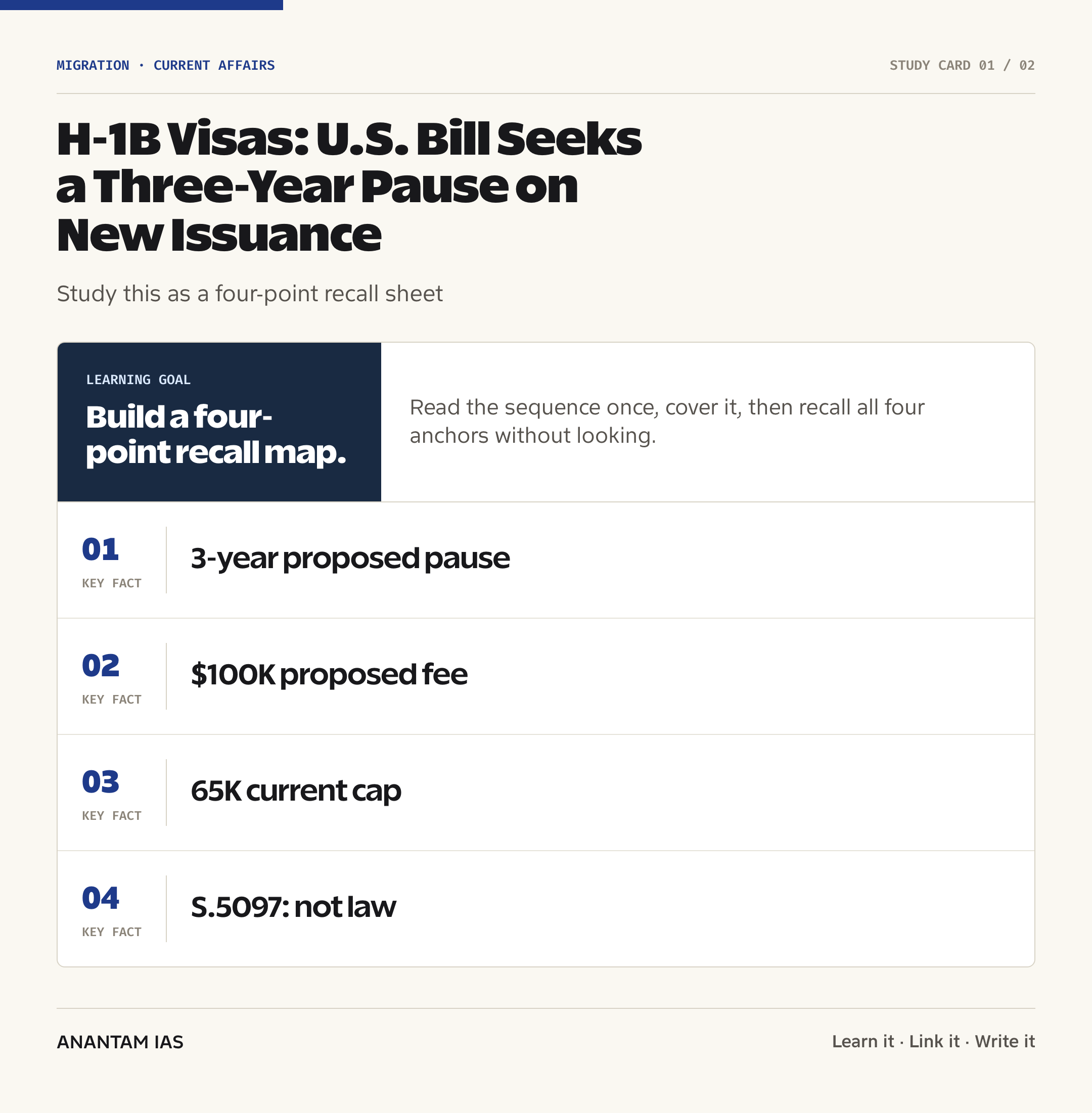
The proposal is not enacted law. The official congressional record shows that it was read twice and referred to the Senate Committee on the Judiciary on 24 July 2026; current H-1B rules remain in force unless both chambers pass legislation and the President signs it.
- The bill would pause issuance of new H-1B visas for three years; it does not itself cancel the programme on the date of introduction.
- It seeks to codify a $100,000 charge per H-1B petition, giving the charge a statutory basis rather than relying only on presidential entry-restriction powers.
- It proposes a wage-based selection system in place of random selection and would restrict concurrent employment and third-party staffing models.
- It would end dual intent, restrict dependants of H-class visa holders and eliminate work authorization routes for foreign students and some exchange visitors.
- The bill is especially relevant to India because skilled mobility, technology services, students and diaspora ties form an important people-to-people pillar of India-U.S. relations.
The development matters in the context of:
- The proposal comes amid a wider U.S. labour-market debate over whether the H-1B programme fills genuine skill gaps or enables labour-cost substitution.
- A separate September 2025 presidential proclamation imposed a $100,000 payment condition for specified new petitions involving workers abroad; that executive charge was later invalidated by a federal district court.
- The First Circuit Court of Appeals declined on 24 July 2026 to stay the district court order while the appeal continues, leaving the lower-court relief operative at that stage.
- The development tests how India can protect legitimate talent mobility without treating another country’s domestic immigration legislation as a bilateral entitlement.
UPSC Relevance
Prelims Relevance
- H-1B is a temporary, employer-sponsored nonimmigrant classification for a specialty occupation requiring highly specialized knowledge and ordinarily a relevant bachelor’s or higher degree.
- The statutory annual regular cap is 65,000, with a separate exemption of up to 20,000 for eligible beneficiaries holding an advanced degree from a U.S. institution.
- Certain petitions for institutions of higher education, affiliated nonprofits, nonprofit research bodies and governmental research organizations are cap-exempt under existing law.
- A worker cannot ordinarily self-petition for H-1B status; a qualifying U.S. employer files the petition with U.S. Citizenship and Immigration Services.
- Dual intent means H-1B status can coexist with an intention to seek lawful permanent residence, unlike the strict temporary-intent approach applied to several other nonimmigrant categories.
- Optional Practical Training is employment authorization connected to F-1 student status; it is not the H-1B programme, though it often forms part of a graduate’s transition to skilled employment.
- A bill introduced and referred to committee has not become a statute; in the U.S. federal process it must pass the House and Senate in identical form and receive presidential approval or overcome a veto.
- The wage rule for current H-1B employment generally requires the employer to pay the higher of the actual wage paid to similarly qualified employees or the applicable prevailing wage.
Mains Relevance
GS Paper 2
- India-U.S. relations: skilled mobility links immigration policy with technology cooperation, services trade and people-to-people relations.
- Effect of developed-country policies: a domestic U.S. visa proposal can affect Indian professionals, students, families and firms even before it becomes a diplomatic dispute.
- Indian diaspora: consular support, reliable legal information and protection against fraud become central when immigration rules face rapid change.
GS Paper 3
- Services and digital economy: higher costs or fewer visas could alter onsite delivery, global capability centres, remote work and investment location decisions.
- Employment and skills: the episode underlines the need for high-quality domestic research jobs, globally portable qualifications and stronger university-industry pathways.
- Innovation policy: talent circulation benefits both origin and destination countries, while abrupt restrictions can redirect skills, capital and entrepreneurship to other markets.
Essay
- Talent mobility sits at the intersection of national sovereignty, labour protection and an increasingly borderless knowledge economy.
- A strategic partnership is tested not only by defence agreements and trade volumes but also by how it manages students, workers and families.
Background and Context
What the H-1B classification does
The durable concept is an employer-led temporary worker route, not a general immigration visa or a guaranteed pathway to permanent residence.
- The Immigration and Nationality Act covers H-1B workers within the H nonimmigrant framework for temporary employment in specialty occupations.
- A specialty occupation involves theoretical and practical application of highly specialized knowledge and ordinarily requires at least a bachelor’s degree in a specific specialty or its equivalent.
- The petitioning employer first seeks classification from USCIS; visa issuance abroad is a separate consular step, and admission at a port of entry remains a separate decision.
- Approval is usually granted for a limited period, commonly up to three years at a time, with a normal six-year aggregate framework subject to statutory exceptions.
- The numerical ceiling applies to cap-subject initial cases, not every H-1B filing. Extensions, many changes of employer for previously counted workers and qualifying cap-exempt employment follow different rules, so the headline cap cannot be read as the programme’s total active workforce.
- For a concise baseline on existing rules, aspirants can compare this development with Anantam IAS’s earlier H-1B visa explainer.
What S.5097 proposes
The Senate measure is a broad restructuring proposal rather than a narrow amendment to one filing fee.
- The official title of S.5097 describes a pause on H-1B issuance until tighter statutory limitations are implemented.
- Senator Sheehy’s office says the bill would impose a three-year pause on new H-1B visas and later restart issuance under stricter limits and standards.
- The proposal would put a $100,000 per-petition charge into legislation, which is legally distinct from attempting to create the same charge through an executive proclamation.
- It would permanently replace random selection in statute with a wage-based selection method and prohibit concurrent employment and third-party staffing-agency arrangements.
- It also proposes to end dual intent, restrict H-class dependants, bar federal agencies from sponsoring or employing nonimmigrant visa holders and remove certain student and exchange-visitor work authorization routes.
- The phrase new H-1B visas matters: the public summary describes a pause on new issuance, not an automatic cancellation of every approval already held. The exact treatment of extensions, status changes and cap-exempt cases would depend on enacted text and implementing guidance.
- Some reports also describe a post-pause cap of 25,000 and a $200,000 salary threshold; these are proposed restrictions, not the present statutory cap or current universal wage rule.
Bill, statute and executive action are different
UPSC answers should separate the stage of legislation from the operation of existing immigration law.
- An introduced Senate bill is a legislative proposal. Referral to the Judiciary Committee begins scrutiny; it does not create an immediate visa suspension.
- For the proposal to become federal law, identical text must clear the Senate and House of Representatives and then receive presidential assent, unless Congress overrides a veto.
- The President can exercise powers already delegated by Congress, including some entry restrictions, but an executive action cannot simply be treated as a statute passed by Congress.
- Federal courts can review whether an executive charge is a valid regulatory condition, an unauthorized tax or an action beyond delegated authority.
- Committee referral can lead to hearings, amendments, a report or no further action. Even if the Senate passed S.5097, the House version could differ, requiring the chambers to resolve their texts before any measure reaches the President.
- For this reason, students and workers should rely on current USCIS and Department of State notices, not assume that a press release announcing a bill has changed their legal status.
The $100,000 charge and the court dispute
The fee claim needs a precise timeline because the proposed statutory charge and the earlier proclamation-based condition are not the same legal instrument.
- President Donald Trump’s 19 September 2025 proclamation restricted entry of specified new H-1B workers unless the sponsoring employer made a $100,000 payment.
- The Congressional Research Service recorded USCIS’s clarification that the proclamation charge generally targeted new petitions for workers abroad, not existing visas, ordinary renewals or many in-country changes of status.
- On 8 June 2026, U.S. District Judge Leo Sorokin invalidated the charge, holding that the large exaction operated as a tax that had not been authorized by Congress.
- On 24 July 2026, the First Circuit declined the administration’s request to stay that judgment pending appeal. That procedural ruling kept the district-court relief in place at that point but did not end every possible appellate step.
- A stay decision concerns whether a judgment should be paused while litigation continues; it is not the same as a final appellate ruling on every legal claim. This distinction prevents an interim procedural order from being overstated in a current-affairs answer.
- S.5097’s attempt to codify the charge responds to the authorization problem by asking Congress itself to enact it. The bill would still need to complete the full legislative process.
Why Indian workers and firms are exposed
India’s stake comes from the scale of its skilled workforce and the integration of technology services across the two economies.
- Indian professionals form a major part of the H-1B talent pool, especially in information technology, engineering, research and health care.
- A pause in new issuance could disrupt recruitment, project staffing and career transitions, while restrictions on third-party placement could particularly affect the onsite services model.
- A $100,000 charge and a high salary threshold would favour employers and roles able to absorb high fixed costs, potentially squeezing smaller firms, startups, universities and public-interest employers.
- Ending dual intent would weaken the route from temporary skilled work to employment-based permanent residence, where Indian applicants already face long queues linked to numerical limits.
- The impact would not stop at individual migration decisions. Companies could shift work to offshore delivery centres, automation or other countries, changing services exports, investment patterns and demand for specific skills in India without necessarily recreating the same jobs in the United States.
- Restrictions on student work authorization would affect the education-to-employment pathway discussed in Anantam IAS’s note on the U.S. fixed-term visa rule.
Labour protection versus innovation
The policy debate cannot be reduced to a simple choice between open borders and protecting domestic workers.
- Supporters argue that higher wage floors, domestic recruitment duties and limits on outsourcing would reduce wage arbitrage and discourage displacement of U.S. workers.
- Critics argue that an across-the-board pause can ignore genuine shortages in medicine, universities, advanced manufacturing and frontier technology.
- A wage-based system may prioritize better-paid roles, but pay also reflects geography, employer size and career stage; salary alone is an imperfect measure of social value or skill.
- Effective regulation needs worksite enforcement, transparent recruitment and anti-retaliation protection so that both local and migrant workers can report abuse.
- The existing labour-condition framework already links H-1B employment to wage and working-condition attestations. The policy test is whether agencies have the data, inspection capacity and penalties to enforce those safeguards against violators without treating every employer or worker as abusive.
- The core governance question is whether targeted enforcement can address fraud more proportionately than a blanket pause that also blocks compliant employers.
The India-U.S. diplomatic dimension
Visa policy is formally a sovereign U.S. decision, but its external effects make mobility a legitimate subject for structured bilateral engagement.
- The relationship spans defence, critical technology, education and trade; skilled professionals often connect these pillars through research networks and corporate investment.
- India can raise implementation concerns, seek predictable transition rules and protect its citizens without claiming a right to another country’s visas.
- Mobility discussions should sit within a broader view of India-U.S. relations, rather than being treated as an isolated consular problem.
- The Indian diaspora also contributes knowledge networks and soft power, a role examined in Anantam IAS’s diaspora governance notes.
- India should also distinguish mobility diplomacy from lobbying for one corporate model. Its public interest covers workers’ rights, student transitions, research collaboration, remittances, return migration and fair access, not only the staffing needs of large technology-service exporters.
- A durable response combines diplomacy abroad with better opportunities at home, reducing vulnerability to a single destination’s electoral and regulatory cycles.
Way Forward
Maintain legal and consular clarity
- India’s missions should issue timely, source-based advisories distinguishing introduced bills, court orders and rules in force.
- Consular outreach should warn applicants against agents who market guaranteed visas or exploit uncertainty around the proposed pause.
Use quiet bilateral engagement
- India should explain the contribution of skilled mobility to U.S. innovation and bilateral technology cooperation while respecting the U.S. legislative process.
- Bilateral engagement should seek predictable transition periods and protection for current workers, students and families if any final law is enacted.
Diversify global mobility routes
- Government and industry should deepen lawful mobility partnerships with the European Union, United Kingdom, Japan, Australia and Gulf economies.
- Qualifications recognition and social-security coordination can make Indian skills more portable without recreating dependence on one destination.
Build high-value work in India
- India needs stronger research funding, doctoral ecosystems, product companies and global capability centres that can retain and attract advanced talent.
- Indian firms should move from labour-cost arbitrage toward intellectual property, design, consulting and globally delivered high-value services.
Protect workers on both sides
- Employers should support fair recruitment, wage transparency and genuine skill matching rather than opaque subcontracting chains.
- Policy design should punish fraud and exploitation directly while preserving legitimate hiring for hard-to-fill positions.
Conclusion
S.5097 is a serious signal about the direction of U.S. skilled-migration politics, but it remains a Senate proposal. Treating it as an immediate three-year ban would be legally wrong and practically harmful to applicants making career decisions.
For India, the balanced response is to defend predictable mobility through diplomacy, protect citizens with accurate information and build stronger high-skill opportunities at home. That approach recognizes both U.S. regulatory sovereignty and the mutual value of talent circulation.
UPSC Practice Questions
Prelims MCQ 1
With reference to the H-1B nonimmigrant classification in the United States, consider the following statements:
- It is ordinarily based on a petition filed by a qualifying U.S. employer.
- The regular statutory cap is 65,000, with a separate exemption of up to 20,000 for eligible holders of advanced degrees from U.S. institutions.
- The introduction of S.5097 immediately suspended all new H-1B issuance for three years.
How many of the above statements are correct?
(a) Only one (b) Only two (c) All three (d) None
Answer: (b) Only two
Explanation:
Statements 1 and 2 are correct. Statement 3 is incorrect because S.5097 is an introduced Senate bill referred to committee; it has not become law and did not itself trigger a visa suspension.
Prelims MCQ 2
Which of the following best describes the term “dual intent” in the H-1B context?
(a) A worker may hold two H-1B visas issued by different countries (b) An employer may count the same petition under both annual caps (c) Temporary H-1B status can coexist with an intention to seek lawful permanent residence (d) A visa petition automatically grants both work authorization and permanent residence
Answer: (c) Temporary H-1B status can coexist with an intention to seek lawful permanent residence
Explanation:
Dual intent allows an H-1B worker to maintain temporary nonimmigrant status while pursuing permanent residence through a lawful route. It does not itself grant a green card.
UPSC Mains Questions
- The proposed End H-1B Abuse Act of 2026 shows how a developed country’s domestic immigration policy can affect India’s interests. Examine the implications for skilled workers, technology services and India-U.S. relations, while distinguishing a legislative proposal from law in force. (GS2)
- A durable skilled-migration framework must balance labour protection with innovation and genuine skill shortages. Critically assess the merits and limits of blanket visa pauses, high petition charges and wage-based selection as tools for regulating temporary skilled work. (GS2)
- India’s dependence on a narrow set of overseas labour markets creates strategic vulnerability. Suggest a policy mix combining mobility diplomacy, worker protection, market diversification and the creation of high-value research and technology employment within India. (GS3)
Sources: Office of U.S. Senator Tim Sheehy and The Hindu.
Frequently Asked Questions
Has the three-year H-1B pause begun?
No. Senator Tim Sheehy introduced S.5097, and the Senate referred it to the Judiciary Committee. It remains a bill, not enacted law. Existing H-1B rules continue unless Congress passes the same legislation through both chambers and it receives presidential approval, subject to any later implementation provisions.
Who introduced S.5097?
Republican Senator Tim Sheehy of Montana introduced the End H-1B Abuse Act of 2026. The official legislative listing identifies it as S.5097 and records referral to the Senate Committee on the Judiciary on 24 July 2026.
What would the bill change?
The proposal would pause new H-1B issuance for three years, codify a $100,000 petition charge, use wage-based selection and restrict concurrent and third-party employment. It also seeks to end dual intent, limit dependants, bar federal-agency sponsorship and remove some student and exchange-visitor work authorization.
Is the $100,000 fee currently valid?
The earlier charge came from a September 2025 presidential proclamation and generally targeted specified new petitions involving workers abroad. A federal district court invalidated it on 8 June 2026, and the First Circuit declined to stay that judgment on 24 July while the appeal continued. S.5097 separately seeks congressional authorization.
What is the current H-1B cap?
Existing law provides a regular annual cap of 65,000, plus up to 20,000 for eligible beneficiaries with advanced degrees from U.S. institutions. Some employers and petitions are exempt. Any lower figure described in connection with S.5097 is a proposal, not the present statutory cap.
Why does this matter for India?
Indian professionals, students and technology firms are deeply connected to the U.S. skilled-work ecosystem. A pause or sharp cost increase could affect hiring, onsite services, families and the transition from study to work. It could also add friction to India-U.S. technology cooperation and people-to-people ties.