ICMR i-DRONE Study: Faster TB Diagnosis and Lower Patient Costs in Telangana
Why in News?
The ICMR i-DRONE study has supplied programme-level evidence on transporting tuberculosis sputum samples from remote health facilities to diagnostic laboratories. On 16 July 2026, PIB reported findings from Yadadri-Bhuvanagiri district in Telangana, where ICMR worked with AIIMS Bibinagar and the District TB Office under the National TB Elimination Programme.
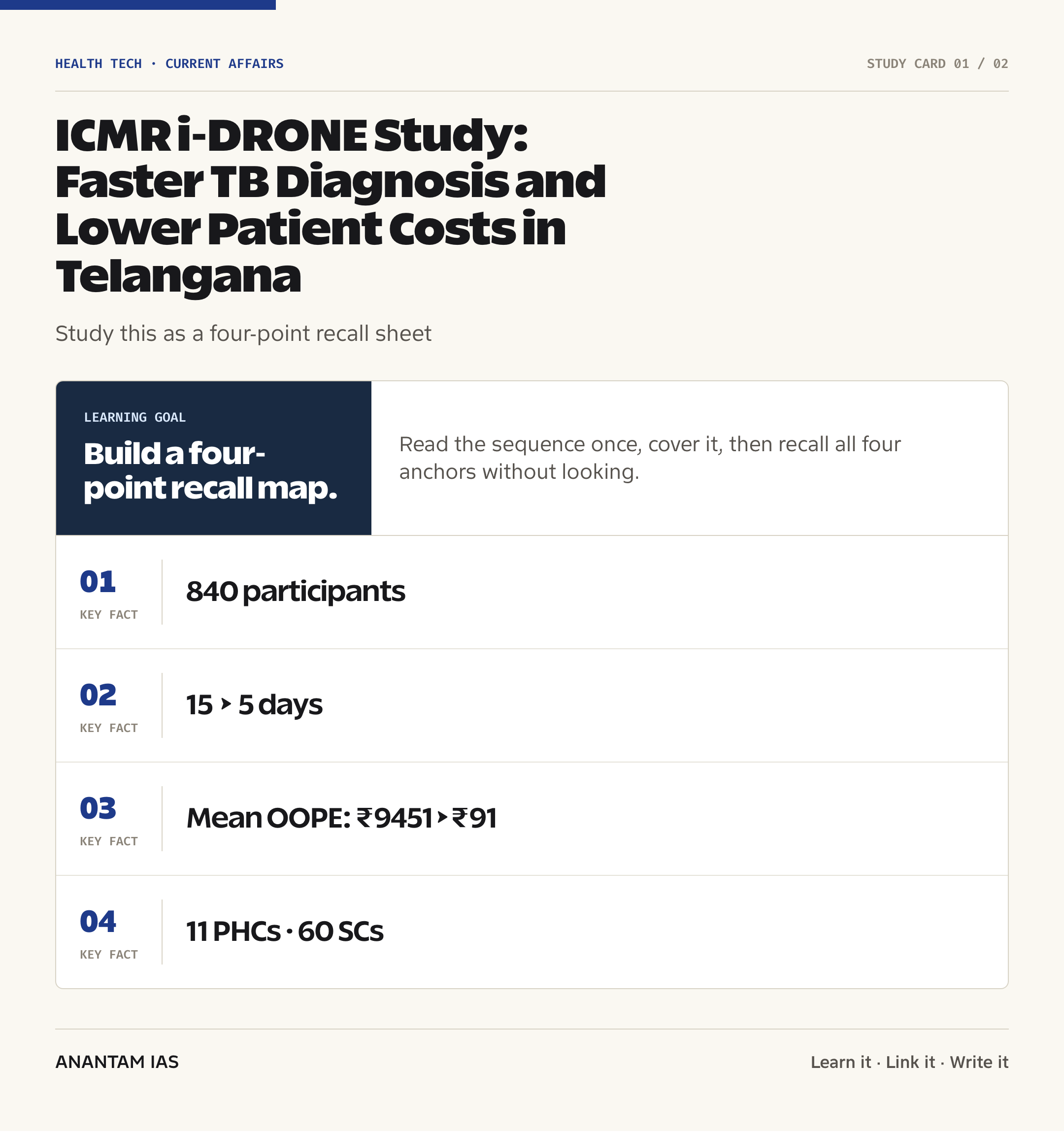
The underlying quasi-experimental study compared a 206-participant pre-drone phase with a 634-participant drone phase. The study-defined median diagnostic turnaround time fell from 15 days to 5 days, while mean patient out-of-pocket expenditure fell from about ₹9,451 to ₹90.9. These are results from one district and two non-equivalent study phases, not proof that the same effects will occur nationwide.
- Study population: The analysis covered 840 people, split between 206 participants in the conventional phase and 634 in the drone-enabled phase.
- Time comparison: Median turnaround time changed from 15 days, with an interquartile range of 10–20 days, to 5 days, with an interquartile range of 2–9 days.
- Patient-cost comparison: Mean out-of-pocket expenditure per participant changed from ₹9,451 to ₹90.9; the corresponding medians were ₹2,735 and zero.
- Delivery design: Four TB Units formed the diagnostic hubs, while 11 Primary Health Centres and 60 sub-centres acted as spokes.
- Evidence boundary: A pre-post operational study can show a strong association and practical feasibility, but it can’t by itself establish nationwide causal effectiveness.
The development matters in the context of:
- Last-mile barrier: Molecular tests help only when a viable sputum specimen reaches a capable laboratory and the result returns in time.
- Financial protection: Moving the sample instead of the patient can reduce travel, food and wage-loss costs borne by rural households.
- Health-system design: Drones are one transport layer within a hub-and-spoke laboratory network, not a substitute for PHCs, laboratories or trained workers.
- Technology governance: Wider use depends on biosafety, airspace permissions, weather resilience, cost-effectiveness and integration with NTEP reporting.
UPSC Relevance
Prelims Relevance
- i-DRONE expands to Drone Response and Outreach in North East; ICMR first launched the model for vaccine and medical-supply delivery in hard-to-reach areas.
- The Indian Council of Medical Research is an autonomous body under the Department of Health Research, Ministry of Health and Family Welfare.
- Tuberculosis is an infectious disease caused by Mycobacterium tuberculosis and most often affects the lungs.
- Presumptive pulmonary TB can require sputum collection followed by bacteriological testing; a drone transports the specimen but doesn’t perform the diagnosis.
- CBNAAT and Truenat are molecular testing platforms used within India’s TB diagnostic network.
- In a hub-and-spoke model, peripheral collection sites feed samples to a smaller number of laboratories with diagnostic capacity.
- Out-of-pocket expenditure in this study combined direct medical, direct non-medical and indirect costs such as wage loss.
- The study used triple-layer packaging for sputum specimens and obtained ethics, district-administration, police and aviation permissions.
- Civil drone operations in India are governed by the Drone Rules, 2021, with the Directorate General of Civil Aviation as the sector regulator.
- Median and interquartile range are useful for skewed time and expenditure data because extreme values can pull the mean.
Mains Relevance
GS Paper 2
- Public health: Access to early TB diagnosis, primary-care linkages and the operational capacity of the National TB Elimination Programme.
- Social justice: Geographic inequity, catastrophic health spending and wage loss among remote and low-income households.
- Governance: Centre-state-district coordination, public-health innovation, data systems and accountable scale-up.
GS Paper 3
- Science and technology: Civil-drone applications, hub-and-spoke logistics and technology adaptation for rural service delivery.
- Infrastructure: Connecting peripheral facilities to diagnostic laboratories across poor roads and difficult terrain.
- Regulation and safety: Airspace approval, biological-sample packaging, trained operators, weather limits and contingency planning.
Essay
- Move the service, not the vulnerable person: Public systems become more inclusive when delivery design absorbs distance and transaction costs.
- Innovation needs institutions: A drone has public value only when laboratories, frontline workers, protocols and accountability work around it.
Background and Context
What the Study Actually Compared
The strongest way to read the evidence is as a district-level pre-post comparison, not as a randomized national trial.
- Study design: Researchers used a quasi-experimental mixed-methods approach under ICMR’s i-DRONE initiative in rural Yadadri-Bhuvanagiri.
- Conventional phase: From February to December 2023, patients generally travelled 10–30 km by road to TB Units with CBNAAT or Truenat facilities.
- Drone phase: During the intervention period, presumptive TB patients submitted sputum at a nearby PHC or sub-centre and drones carried the packaged samples to a designated TB Unit.
- Different denominators: The conventional phase included 206 participants, while the drone phase included 634; every time or cost figure must be read against these unequal groups.
- Primary outcomes: The analysis examined turnaround time, patient and diagnostic delays, result-reporting time and patient out-of-pocket expenditure.
- Statistical method: Because the distributions weren’t normal, the study compared phases with the Mann-Whitney U test and reported means, medians and interquartile ranges.
- Supporting evidence: A separate qualitative study used 28 in-depth interviews and 12 focus-group discussions with 101 health-system stakeholders to examine feasibility and acceptability.
How the Hub-and-Spoke Network Worked
The intervention shortened the patient’s journey by connecting nearby collection points to centralized molecular-testing capacity.
- Spokes: Eleven PHCs and 60 sub-centres received sputum specimens from people living in or near remote villages.
- Hubs: Four TB Units with CBNAAT or Truenat facilities performed the diagnostic testing.
- Command centre: AIIMS Bibinagar coordinated routes, flight operations and links between the peripheral facilities and laboratories.
- Patient pathway: The person travelled only to the closest participating facility instead of making the longer trip to a diagnostic TB Unit.
- Sample pathway: Health workers collected, labelled and placed specimens in triple-layer packaging before scheduled transport.
- Flight planning: Pre-programmed routes accounted for terrain, population density and no-fly zones; a licensed pilot monitored operations.
- Technology role: The drone replaced a portion of surface transport. Collection quality, laboratory capacity, result communication and treatment linkage remained health-system tasks.
Reading the Turnaround-Time Results
The time result is substantial, but the definition, distribution and study setting matter as much as the headline.
- Median comparison: Study-defined turnaround time fell from 15 days in the conventional group to 5 days in the drone group.
- Spread of observations: The interquartile range narrowed from 10–20 days to 2–9 days, suggesting that the typical experience also became less delayed.
- Mean comparison: Mean turnaround time fell from 16.6 days to 6.96 days, with a reported P value below 0.001.
- Reporting pattern: Next-day results rose from 1.5% of 206 conventional-phase participants to 76.3% of 634 drone-phase participants.
- Long reporting delays: Results taking more than two days fell from 92.2% in the conventional phase to 16.3% in the drone phase.
- What changed directly: Samples reached laboratories through a planned logistics network without requiring the patient to make the full journey.
- What remains unproven: The study didn’t establish whether the model improves long-term treatment initiation, adherence, cure rates or transmission at population scale.
Reading the Cost Results Without Overclaiming
The reported rupee values measure patient out-of-pocket expenditure, not the government’s total drone-service cost.
- Mean OOPE: Average expenditure per participant fell from ₹9,451 in the conventional phase to ₹90.9 in the drone phase.
- Median OOPE: The median fell from ₹2,735 to zero, meaning at least half of the drone-phase participants reported no measured out-of-pocket cost.
- Cost basket: OOPE covered direct medical spending, direct non-medical costs such as travel and food, and indirect costs such as wage loss for the patient or attendant.
- Mechanism: Nearby collection reduced long-distance travel and time away from work, while the public network handled specimen transport.
- Mean versus median: The much higher mean in the conventional phase shows that some participants faced very large expenses; both statistics are needed to describe the distribution.
- Missing denominator: The study didn’t present the full public cost per flight, per sample, per positive diagnosis or per disability-adjusted life year averted.
- Policy implication: A patient-cost reduction supports equity, but procurement decisions still need a separate health-system cost-effectiveness and budget-impact assessment.
Why Sample Transport Matters for TB Elimination
A molecular-testing network is only as useful as its ability to move good-quality specimens and timely results across the last mile.
- Diagnostic cascade: A person with symptoms must reach care, provide an adequate specimen, receive a bacteriological result and enter appropriate treatment.
- Transport bottleneck: Long distance, weak roads, infrequent public transport and wage loss can interrupt the cascade before a laboratory sees the sample.
- Public-health cost: Delayed diagnosis prolongs illness and can extend the period during which infectious pulmonary TB spreads in the community.
- Equity gain: Sending the sample to the laboratory can be more inclusive than requiring a sick person and attendant to cross the district.
- NTEP fit: The model strengthens laboratory linkage inside the existing programme rather than creating a separate diagnostic system.
- Core revision: Review the TB-Free India strategy and the wider tuberculosis care cascade before using this case study in a Mains answer.
- Replicability test: Scale should be targeted where avoidable road delay, sufficient sample volume and reliable laboratory capacity make aerial logistics valuable.
Operational, Biosafety and Regulatory Safeguards
Routine deployment needs a safe chain of custody from sputum collection to the laboratory bench.
- Biosafety: Trained staff must use correct containers, triple-layer packaging, disinfection procedures, manifests and documented handover.
- Specimen integrity: Operations must protect samples from leakage, extreme conditions, delay and misidentification while meeting NTEP laboratory requirements.
- Aviation approval: Routes, altitude, airspace and operator requirements must comply with the Drone Rules, 2021 and applicable DGCA permissions.
- Weather resilience: Rain, high winds, signal loss or battery limits can ground a flight, so every route needs a road-based fallback.
- Payload limits: The qualitative study recorded concerns about limited capacity and the need for extra sorties when sample volume exceeded a flight’s practical load.
- Human interface: ASHAs, ANMs, laboratory staff and district authorities built trust, prepared specimens and aligned flight schedules with routine work.
- Privacy: Flight visibility or poorly designed collection practices can expose a stigmatized health condition; facility-based collection and discreet scheduling matter.
- Comparable institution-building: The ICMR high-altitude medicine centre at Keylong offers another example of adapting health research to difficult geography.
Limits, Scale-Up Tests and Answer-Building Guidance
A balanced answer should pair the promising operational association with the tests required before routine expansion.
- No concurrent control: The before-and-after phases occurred at different times, so other programme changes may have contributed to the observed differences.
- Unequal groups: The groups differed in size and participant characteristics; the researchers noted demographic imbalance and possible confounding.
- Selection issue: Sites were purposively chosen for TB burden, remoteness and weak diagnostic access, which improves relevance to hard areas but limits generalization.
- Recall bias: Patient spending was self-reported, making some measurement error possible, especially for indirect costs.
- One-district evidence: Telangana’s terrain, staffing, TB Units, routes and weather can’t stand in for every Indian district.
- Scale-up metrics: Compare road and drone options on cost per viable sample delivered, cancellation rate, time saved, laboratory throughput and treatment-linkage outcomes.
- Digital integration: Track the specimen and result without creating a parallel data silo; the Ayushman Bharat Digital Mission shows the wider need for interoperable health information systems.
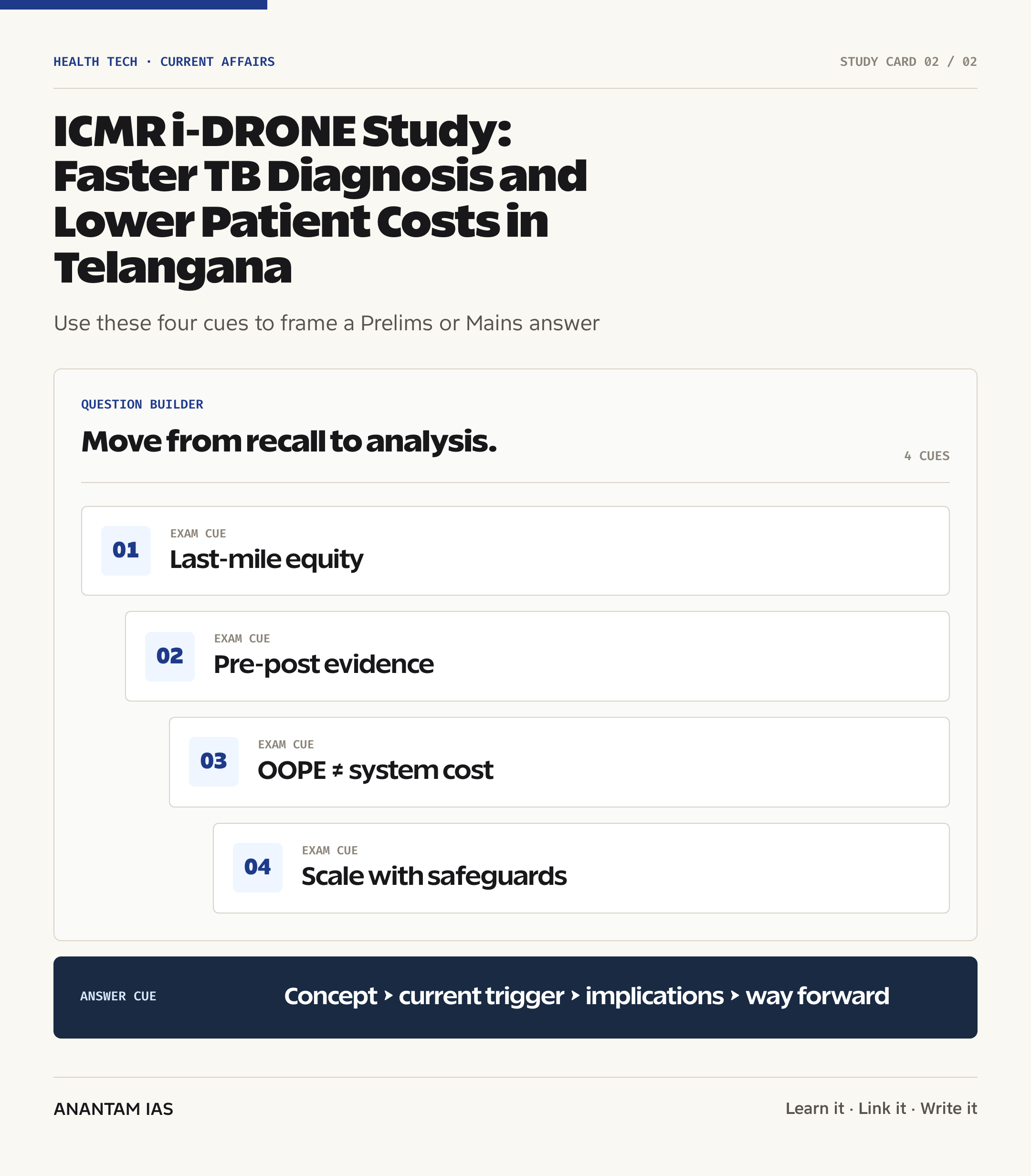
- Answer structure: Start with the access problem, explain the network, cite the 840-participant result, separate patient OOPE from system cost, discuss limitations, and close with targeted evidence-led scale-up.
Way Forward
Target the Right Routes
- Use distance, road time, weather, sample volume and laboratory readiness to identify corridors where drones offer a clear gain over scheduled surface transport.
- Retain reliable road-based contingency plans for rain, wind, maintenance, signal failure and restricted airspace.
Measure Full Costs and Outcomes
- Publish the public cost per sortie, per viable sample and per completed diagnosis, including staff, maintenance, batteries, training and regulatory compliance.
- Track treatment initiation, adherence and patient outcomes instead of stopping assessment at sample delivery or result reporting.
Standardize Safety and Quality
- Adopt audited SOPs for collection, triple-layer packaging, temperature and shock control, chain of custody, spill response and laboratory receipt.
- Use route-risk assessments, trained operators, maintenance records and incident reporting under the applicable aviation framework.
Integrate People and Data
- Train and compensate frontline workers and laboratory teams for the additional scheduling, packaging, documentation and community-communication work.
- Link specimen identifiers, flight manifests, laboratory results and patient follow-up within NTEP systems while applying privacy safeguards.
Build Stronger Evidence
- Test the model across tribal, hilly, flood-prone and island settings using concurrent comparison groups where feasible.
- Set transparent expansion thresholds and subject contracts to independent evaluation so a promising pilot doesn’t become technology-led procurement without proof.
Conclusion
The ICMR i-DRONE study shows how a logistics redesign can move the burden of distance away from a person with possible TB. In one Telangana district, the drone-enabled phase was associated with a shorter diagnostic pathway and far lower patient spending because nearby facilities collected sputum and the network moved it to the laboratory.
The result supports careful expansion, not automatic national replication. India should scale route by route, protect biosafety and privacy, measure public-system costs, maintain surface-transport backups and test whether faster specimen movement leads to faster treatment and better outcomes.
UPSC Practice Questions
Prelims MCQ 1
With reference to ICMR’s i-DRONE TB study, consider the following statements:
- i-DRONE originally expands to Drone Response and Outreach in North East.
- The TB study was a randomized concurrent-control trial conducted across all Indian states.
- Primary Health Centres and sub-centres acted as spokes linked to TB Units with molecular-testing capacity.
How many of the above statements are correct?
(a) Only one (b) Only two (c) All three (d) None
Answer: (b) Only two
Explanation:
Statements 1 and 3 are correct. The study was a quasi-experimental pre-post programme study in Yadadri-Bhuvanagiri district, Telangana, not a randomized nationwide trial.
Prelims MCQ 2
Which interpretation of the study’s ₹9,451-to-₹90.9 comparison is most accurate?
(a) It is the total government cost of all conventional and drone operations. (b) It compares mean patient out-of-pocket expenditure across the two study phases. (c) It proves the drone service costs ₹90.9 for every sample nationwide. (d) It compares the market prices of the two drone models used.
Answer: (b) It compares mean patient out-of-pocket expenditure across the two study phases.
Explanation:
The figures are mean OOPE per participant, covering direct medical, direct non-medical and indirect costs. They aren’t a measure of the health system’s drone operating cost.
UPSC Mains Questions
- Drone-enabled sputum transport can reduce a geographic barrier to tuberculosis diagnosis, but it can’t replace primary care, laboratories or programme capacity. Discuss the i-DRONE model as a case of technology embedded in a public-health system.
- Assess the evidentiary value and limitations of the Telangana i-DRONE study. In your answer, distinguish patient out-of-pocket expenditure from health-system cost and suggest metrics for an accountable scale-up.
- Last-mile health innovation must be judged by equity, safety and outcomes rather than technological novelty. Examine with reference to the use of civil drones for transporting biological specimens in remote India.
Sources: PIB, Ministry of Health and Family Welfare and The International Journal of Tuberculosis and Lung Disease Open.
Frequently Asked Questions
What is ICMR i-DRONE?
i-DRONE expands to Drone Response and Outreach in North East. ICMR began it as a drone-based model for moving vaccines and medical supplies to hard-to-reach areas. The programme has since explored applications such as blood products, medicines, diagnostic specimens and TB sputum transport.
Where was the TB study conducted?
The programme-based study took place in Yadadri-Bhuvanagiri district of Telangana. AIIMS Bibinagar coordinated a network involving the District TB Office, four TB Units, 11 Primary Health Centres and 60 sub-centres under the National TB Elimination Programme. These facilities served remote and underserved villages.
What did the turnaround result show?
Among 206 conventional-phase and 634 drone-phase participants, the study-defined median turnaround time fell from 15 days to 5 days. The interquartile range narrowed from 10–20 days to 2–9 days. This is a district-level pre-post association, not a nationwide causal estimate.
Did drones reduce the government’s costs?
The published comparison doesn’t answer that question. It found mean patient out-of-pocket expenditure falling from ₹9,451 to ₹90.9, with the median falling from ₹2,735 to zero. A government decision also needs operating, staffing, maintenance, regulatory and opportunity costs per sample and diagnosis.
Why can’t the findings be generalized nationally?
The research compared two unequal groups at different times in one purposively selected district and had no concurrent control group. Participant characteristics also differed, and spending was self-reported. Other regions may have different terrain, weather, laboratory capacity, sample volumes, road networks and aviation constraints.
What safeguards are needed for TB sample flights?
A safe service needs trained collection staff, correct containers, triple-layer packaging, an auditable chain of custody, specimen tracking, licensed operators, approved routes and privacy protection. It also needs weather thresholds, maintenance and incident protocols, plus a dependable surface-transport fallback when a drone can’t fly.