Why in News?
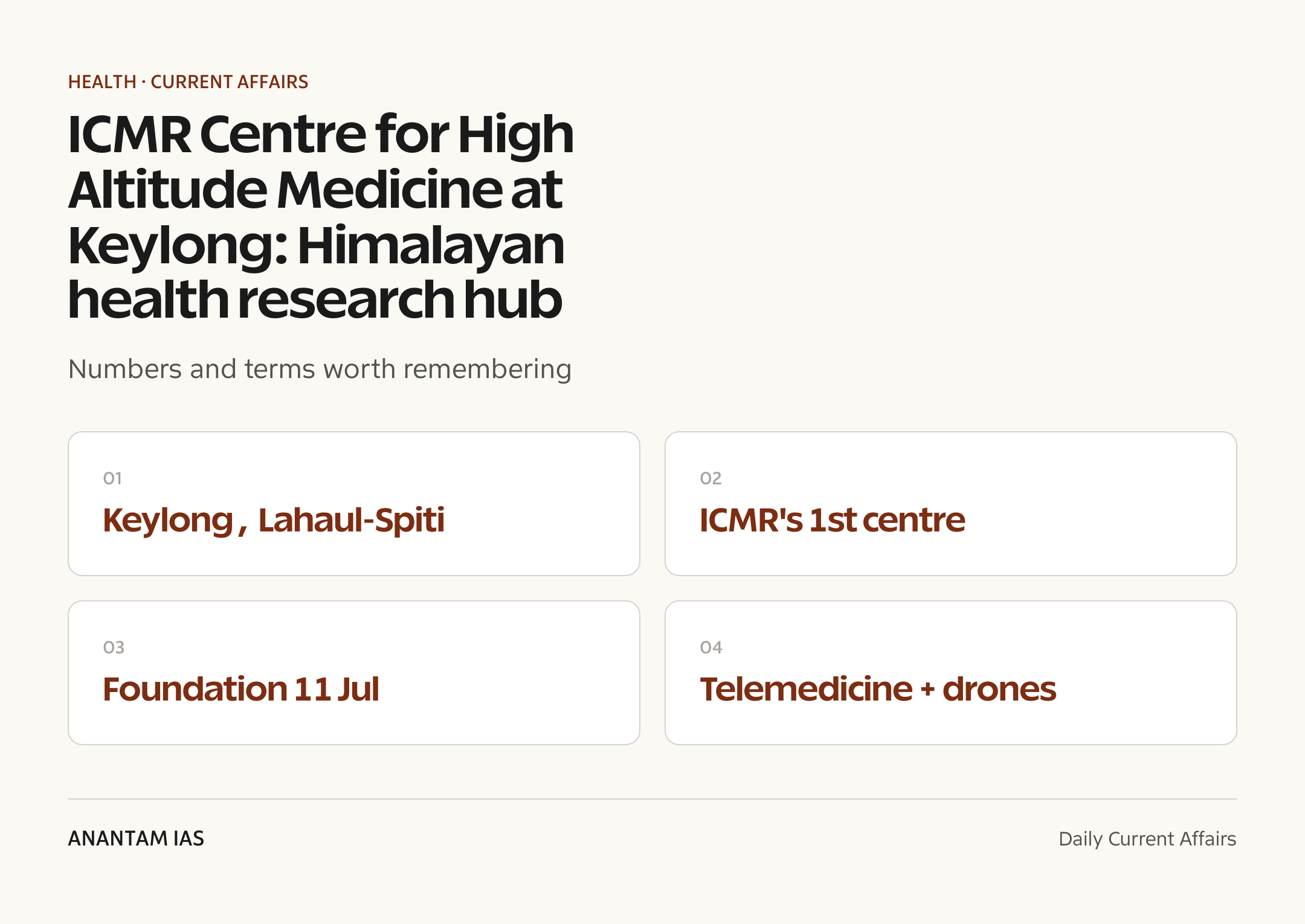
Union Health Minister J.P. Nadda will lay the foundation stone of the ICMR Centre for High Altitude Medicine and Public Health Research at Keylong in Lahaul & Spiti district, Himachal Pradesh, on 11 July 2026, PIB confirmed in a curtain-raiser issued by the Ministry of Health & Family Welfare.
It becomes ICMR’s first dedicated centre for high-altitude medicine, upgrading the council’s existing Keylong field station into a full-fledged multidisciplinary research hub for India’s Himalayan and climate-sensitive regions. ANI reported that the ceremony will draw the Defence Secretary and the Himachal Chief Secretary, underlining the centre’s civil-military spread.
The move matters because India has vast high-altitude populations — tribal residents, pilgrims, tourists and soldiers — yet has lacked a permanent, place-based biomedical institution studying the exact conditions they live and work in. The Keylong centre is meant to close that evidence gap and turn a remote border district into a hub of climate-resilient health science.
- Set up by the Indian Council of Medical Research (ICMR) under the Department of Health Research, Ministry of Health & Family Welfare.
- Sits in a strategically important border region with year-round access to high-altitude and tribal populations.
- Mandate spans high-altitude physiology, mountain medicine, climate-sensitive diseases, maternal-child health and disaster medicine.
- Will integrate telemedicine, drone-enabled healthcare logistics and real-time surveillance for hard-to-reach areas.
- Ceremony includes a Bhumi Pujan, saplings under the Green ICMR Campus Initiative, and a commemorative postal special cover.
The development matters in the context of:
- The Himalayan ecosystem presents distinct public-health stresses — thin air, extreme cold, difficult terrain and rising climate variability — that shape disease and emergency response.
- It advances the Government’s Atmanirbhar Bharat push in health research and its broader goal of climate-resilient, inclusive health systems.
UPSC Relevance
Prelims Relevance
- ICMR — apex biomedical research body, founded 1911 (as IRFA), under the Department of Health Research, Ministry of Health & Family Welfare.
- Keylong — administrative headquarters of Lahaul & Spiti district, Himachal Pradesh, connected to Manali via the Atal Tunnel (Rohtang).
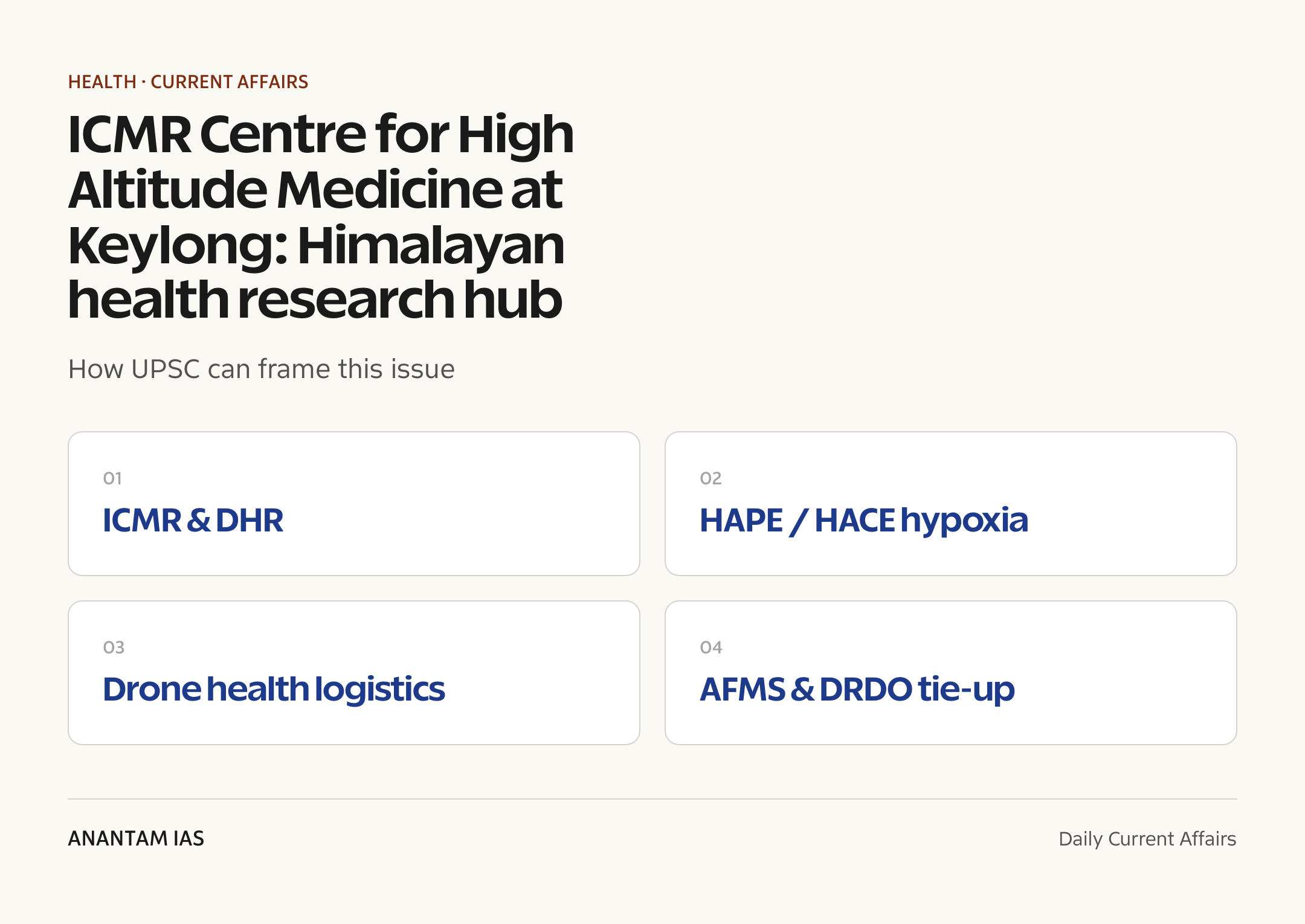
- High-altitude illness — Acute Mountain Sickness (AMS), HAPE (pulmonary edema) and HACE (cerebral edema), driven by hypoxia.
- Acclimatisation — physiological adaptation to low oxygen at high altitude.
- Partner bodies: AFMS (Armed Forces Medical Services) and DRDO.
- Non-communicable diseases (NCDs) vs communicable/infectious diseases in the research mandate.
- Department of Health Research — created 2007; ICMR is its attached body.
- Green ICMR Campus Initiative and native Himalayan saplings.
Mains Relevance
GS Paper 3
- Application of science and technology and indigenous innovation — telemedicine and drone logistics for remote healthcare.
- Disaster management in fragile mountain ecosystems and emergency medical response.
GS Paper 2
- Health-sector governance and equitable access for tribal and border populations.
Essay
- Science at the service of the last mile — health equity in India’s mountains.
Background and Context
ICMR and where this centre sits
The apex biomedical body is extending its footprint into India’s toughest terrain.
- The Indian Council of Medical Research (ICMR) is India’s apex body for formulation, coordination and promotion of biomedical research, tracing its origins to 1911 (as the Indian Research Fund Association).
- It functions under the Department of Health Research (DHR), carved out in 2007 within the Ministry of Health & Family Welfare.
- ICMR runs a national network of ~26 institutes plus regional centres — spanning virology (NIV Pune), nutrition (NIN Hyderabad), vector-borne disease, cancer and reproductive health.
- The Keylong upgrade adds a high-altitude, mountain-focused node the network has so far lacked, complementing existing coastal, urban and plains research bases.
- It is pitched as a multidisciplinary hub for research, innovation and capacity building, not merely a diagnostic outpost.
Why high-altitude medicine matters
Life above roughly 2,500 m stresses the body in ways low-altitude medicine cannot fully address.
- As altitude rises, atmospheric pressure falls and so does the oxygen available to tissues — the state of hypoxia that underlies most mountain illness.
- Acute Mountain Sickness (AMS) — headache, nausea, fatigue on rapid ascent — is the mild, common form.
- HAPE (High-Altitude Pulmonary Edema) floods the lungs with fluid; HACE (High-Altitude Cerebral Edema) swells the brain — both can kill within hours without descent or oxygen.
- The body’s defence is acclimatisation — slower ascent, more red cells and breathing changes over days; the centre will study how residents and visitors adapt.
- Keylong lies above 3,000 m and nearby passes climb far higher, making it an ideal natural laboratory.
- Extreme cold, thin air, difficult terrain and long winter isolation compound every clinical and logistical problem.
The broad research mandate
The scope is deliberately wide to match the region’s layered health burden.
- High-altitude physiology, acclimatisation and mountain medicine.
- Climate-sensitive and emerging diseases whose range and timing shift as the Himalayas warm.
- Both infectious diseases and the rising tide of non-communicable diseases (NCDs).
- Maternal and child health, nutrition and mental health — often neglected in scattered mountain settlements.
- Environmental and occupational health plus disaster medicine for a zone prone to landslides, avalanches and flash floods.
- Its stable resident base enables long-term cohort studies on the environmental determinants of health that transient sites cannot run.
Himalayan health-infrastructure challenge
Geography, not just poverty, is the barrier to care in Lahaul & Spiti.
- Sparse, scattered populations make it uneconomic to place specialists in every valley, leaving a chronic referral gap.
- Heavy snowfall can cut villages off for months; the road window for supplies and evacuation is narrow.
- Peer-reviewed work on Lahaul & Spiti has flagged high-altitude-specific burdens — hypertension, respiratory disease and reproductive-health gaps in tribal cohorts.
- Emergency response — the golden hour — is hardest to honour exactly where terrain is most punishing.
- This is why the centre pairs research with delivery innovation rather than treating them as separate problems.
Technology and last-mile delivery
The centre is built to test, not just study, remote-care solutions.
- Telemedicine and digital health platforms let a district clinic tap distant specialists in real time, bridging the manpower shortfall.
- Drone-enabled healthcare logistics can move blood, vaccines and essential drugs across snow-blocked terrain far faster than road convoys.
- Indian feasibility studies — including drone-delivery trials in extreme Himalayan conditions — have already shown medical payloads can cross ridgelines that stop ambulances.
- Real-time public-health surveillance aims to catch outbreaks and climate-linked disease shifts early.
- It dovetails with national digital-health scaffolding such as the Ayushman Bharat Digital Mission and the government’s broader drones-in-healthcare push.
Institutional collaborations
The centre is designed as an ecosystem, not a standalone lab.
- Armed Forces Medical Services (AFMS) — decades of hard-won field data on soldiers deployed at extreme altitude.
- DRDO — whose high-altitude labs (DIHAR at Leh, DIPAS) already research acclimatisation, nutrition and cold-injury prevention.
- The Himachal Pradesh Government for local delivery, cohort access and integration with state health systems.
- Academic and research institutions in India and abroad for translational research and policy support.
- The mix makes the centre a genuine civil-military-academic platform rather than a single-ministry silo.
Strategic and climate-resilience dimension
Health research here doubles as security-relevant and climate-adaptation capacity.
- Lahaul & Spiti is a border region along the northern frontier, so troop readiness and civilian health overlap directly.
- The Atal Tunnel (opened 2020, bypassing Rohtang Pass) gives Keylong year-round road access, making a permanent institution viable where winter once ruled it out.
- As the Himalayas warm faster than the plains, climate-resilient healthcare — anticipating shifting disease patterns and disaster risk — becomes central, not peripheral.
- The effort supports national priorities in tribal health, disaster preparedness and digital health innovation.
- Officials frame it within the Atmanirbhar Bharat vision of self-reliant biomedical research.
Way Forward
Build durable local capacity
- Train and retain local health workers and researchers so the centre runs year-round, not as a summer-only field camp.
- Establish resident cohort registries and biobanks for continuous, high-quality altitude data across seasons.
- Involve tribal communities as partners in study design so research answers questions they actually face.
Scale what works
- Convert successful telemedicine and drone pilots into a replicable model for Ladakh, Sikkim and the Northeast.
- Feed evidence into national protocols for AMS/HAPE/HACE management, troop deployment and mountain-tourism safety.
- Link surveillance data to disaster-management agencies so health early-warning is built into mountain emergency planning.
Protect the ecosystem it studies
- Guard the fragile Himalayan environment — the campus must model low-impact, climate-resilient construction rather than add stress to the terrain.
- The Green ICMR Campus Initiative and native-sapling plantation should set the template, not be a one-day gesture.
Conclusion
The Keylong centre fills a real gap. India has vast high-altitude populations and armed forces stationed on the world’s toughest frontiers, but little dedicated, place-based biomedical research on the hypoxia, cold and isolation they endure.
By pairing frontier science — high-altitude physiology, disaster medicine, climate-sensitive disease — with delivery tools like telemedicine and drone logistics, the centre treats research and last-mile care as one problem.
If those components deliver, the model can be exported across the entire Himalayan arc, turning a remote border district into a national hub of climate-resilient health science and a template for equity in India’s mountains.
UPSC Practice Questions
Prelims MCQ 1
With reference to the proposed ICMR Centre for High Altitude Medicine and Public Health Research, consider the following statements:
- It is being set up under the Department of Health Research, Ministry of Health & Family Welfare.
- It is located at Keylong in the Lahaul & Spiti district of Himachal Pradesh.
- Its mandate is limited strictly to infectious diseases at high altitude.
How many of the above statements are correct?
(a) Only one (b) Only two (c) All three (d) None
Answer: (b) Only two
Explanation:
Statements 1 and 2 are correct. Statement 3 is wrong — the mandate is broad (physiology, NCDs, maternal-child health, mental health, disaster medicine), not just infectious diseases.
Prelims MCQ 2
‘HAPE’ and ‘HACE’, often discussed in the context of high-altitude health, are best described as:
(a) Two vaccines for cold-region infections (b) Pulmonary and cerebral edema caused by high-altitude hypoxia (c) Names of ICMR field stations in the Himalayas (d) Drone models used for medical delivery
Answer: (b) Pulmonary and cerebral edema caused by high-altitude hypoxia
Explanation:
HAPE is High-Altitude Pulmonary Edema and HACE is High-Altitude Cerebral Edema — severe, potentially fatal conditions driven by hypoxia (low oxygen) at altitude.
UPSC Mains Questions
- Dedicated high-altitude medical research and last-mile technologies like telemedicine and drone logistics can transform healthcare in India’s mountain regions. Discuss with reference to the proposed ICMR centre at Keylong. (150 words)
- Health research in border and tribal regions serves both public-health equity and national security. Examine in the context of India’s Himalayan ecosystem. (150 words)
Sources: PIB, Ministry of Health & Family Welfare and ANI.
Frequently Asked Questions
What is the ICMR Keylong centre?
It is the ICMR Centre for High Altitude Medicine and Public Health Research, being set up at Keylong in Lahaul & Spiti, Himachal Pradesh. It upgrades ICMR’s existing field station into a full multidisciplinary hub for research on high-altitude and climate-sensitive health. The foundation stone is to be laid on 11 July 2026.
Who is establishing the centre and under which ministry?
The Indian Council of Medical Research (ICMR) is setting it up under the Department of Health Research, which sits within the Union Ministry of Health & Family Welfare. It is India’s first dedicated centre focused on high-altitude medicine and public-health research.
Why is Keylong chosen for this centre?
Keylong, in Lahaul & Spiti, offers year-round access to high-altitude and tribal populations in a strategically important border region. The Atal Tunnel provides all-weather road connectivity, making a permanent research institution feasible where winter isolation once ruled it out.
What is high-altitude illness?
It refers to disorders caused by low oxygen (hypoxia) at high altitude, ranging from Acute Mountain Sickness to the life-threatening HAPE (pulmonary edema) and HACE (cerebral edema). The centre will research acclimatisation and treatment to protect residents, soldiers and tourists.
How will the centre use technology?
It will integrate telemedicine, digital health platforms, drone-enabled healthcare logistics for supplies, and real-time public-health surveillance. These tools aim to deliver specialist care and essential medicines to remote, snow-bound Himalayan areas that are hard to reach by road.
Which agencies will collaborate with the centre?
It will build partnerships with the Armed Forces Medical Services (AFMS), the Defence Research and Development Organisation (DRDO), the Himachal Pradesh Government, and academic and research institutions in India and abroad, creating an ecosystem for translational research and policy support.
Tell Google you want more of this.
Add Anantam IAS as a preferred sourceOne tap, and this site shows up more often in your own Top Stories, AI Overviews and AI Mode. Remove it any time.