Why in News?
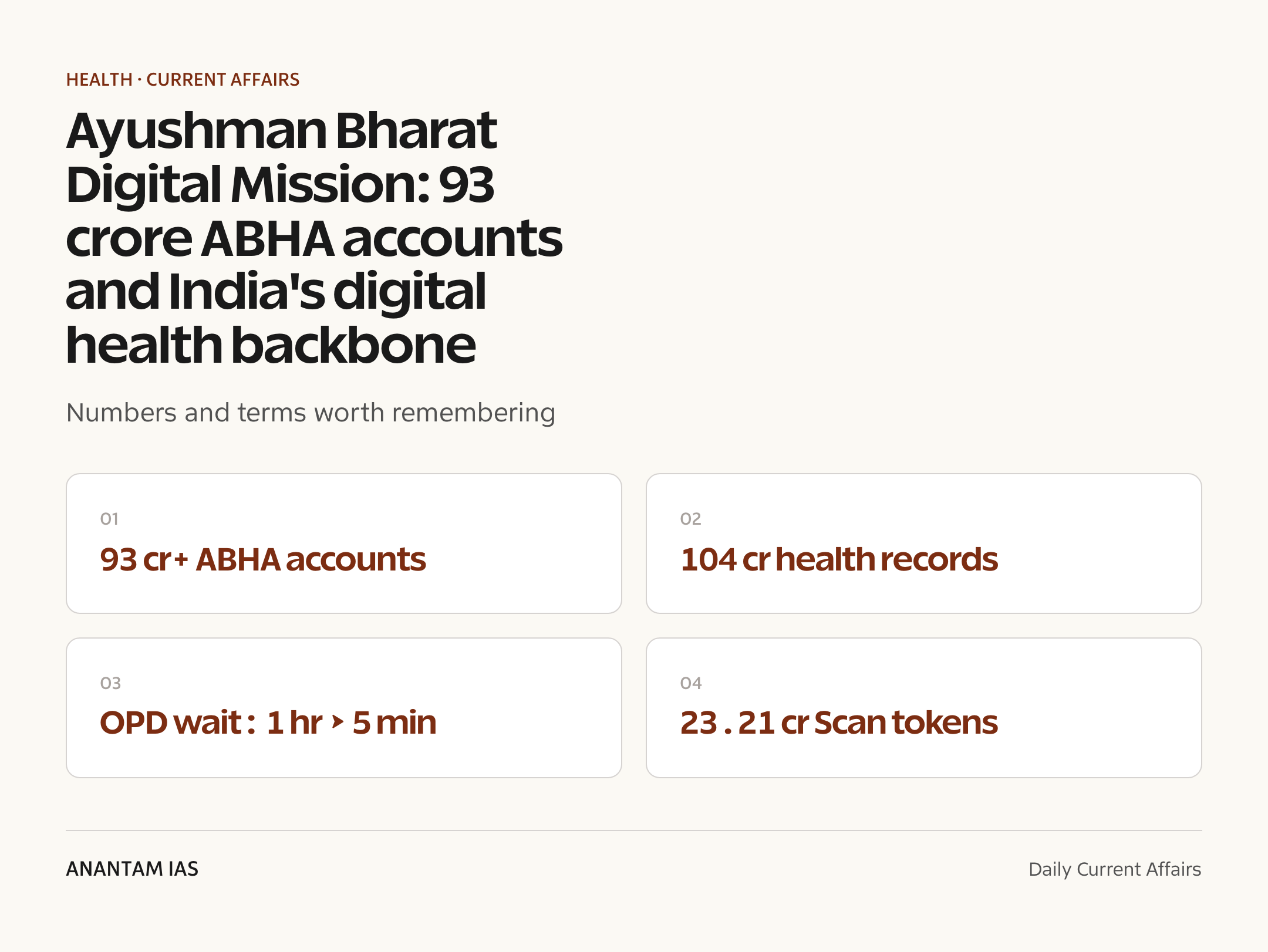
PIB released a backgrounder on the Ayushman Bharat Digital Mission (ABDM), describing it as one of the world’s largest digital health ecosystems. Over 104 crore health records now stand linked to more than 93 crore ABHA accounts, connecting patients, hospitals, doctors and insurers on a single interoperable network.
The backgrounder also details the revamped Aarogya Setu 2.0 app launched on June 29, 2026, the Scan and Share OPD service that cut hospital waiting times from about an hour to 2–5 minutes, and the National Health Claims Exchange (NHCX) for paperless insurance claims.
- Over 104 crore health records linked to 93 crore-plus ABHA accounts; the 100-crore-records / 90-crore-ABHA milestone was crossed in May 2026.
- Aarogya Setu 2.0 relaunched on June 29, 2026 by Union Health Minister J.P. Nadda as a citizen-facing gateway and Personal Health Record app under ABDM.
- Over 23.21 crore ABHA-linked tokens issued through the Scan and Share service (as on June 18, 2026); an IIHMR study found OPD waiting time fell from about one hour to 2–5 minutes.
- The Digital Health Incentive Scheme has paid hospitals over ₹107 crore, digital solution companies over ₹26 crore, and diagnostics/labs/pharmacies ₹2.95 crore for digitising records.
- eSushrut@Clinic, a plug-and-play hospital management system by C-DAC for small clinics, has onboarded over 2,200 facilities since its June launch.
The development matters in the context of:
- ABDM is the health layer of India’s digital public infrastructure (DPI) story — the same design logic as Aadhaar for identity and UPI for payments, now applied to health records and services.
- The mission is central to the National Health Policy 2017 goal of Universal Health Coverage: portable records, verified providers and faster claims lower both the cost and friction of care.
- Anonymised, consent-based health data at this scale can power disease surveillance, better public-health planning and India’s emerging AI-in-health ecosystem.
UPSC Relevance
Prelims Relevance
- ABDM — launched 27 September 2021; implemented by the National Health Authority (NHA) under the Ministry of Health and Family Welfare; nationwide rollout followed a pilot in six Union Territories.
- ABHA (Ayushman Bharat Health Account) — a 14-digit unique health identifier that links a person’s health records across hospitals, labs, insurers and national health programmes, with consent.
- Healthcare Professionals Registry (HPR) — national registry of verified doctors and practitioners, including AYUSH professionals.
- Health Facility Registry (HFR) — single national repository of public and private hospitals, clinics, labs and pharmacies.
- Unified Health Interface (UHI) — an open network for health services, often called ‘UPI for healthcare‘; its common gateway is operated by the NHA.
- NHCX (National Health Claims Exchange) — a digital highway for exchanging insurance-claims information among payers, providers, beneficiaries and regulators.
- Scan and Share — QR-code OPD registration service launched in 2022; over 23.21 crore ABHA-linked tokens issued.
- Aarogya Setu 2.0 — the former COVID-19 contact-tracing app relaunched on June 29, 2026 as ABDM’s unified citizen gateway and Personal Health Record.
- Record-sharing under ABDM needs the patient’s revocable, time-bound consent — a federated, consent-first architecture, not a central health database.
- Policy lineage: National Health Policy 2017 → National Digital Health Blueprint 2019 → National Digital Health Mission pilot (2020) → ABDM (2021).
Mains Relevance
GS Paper 2
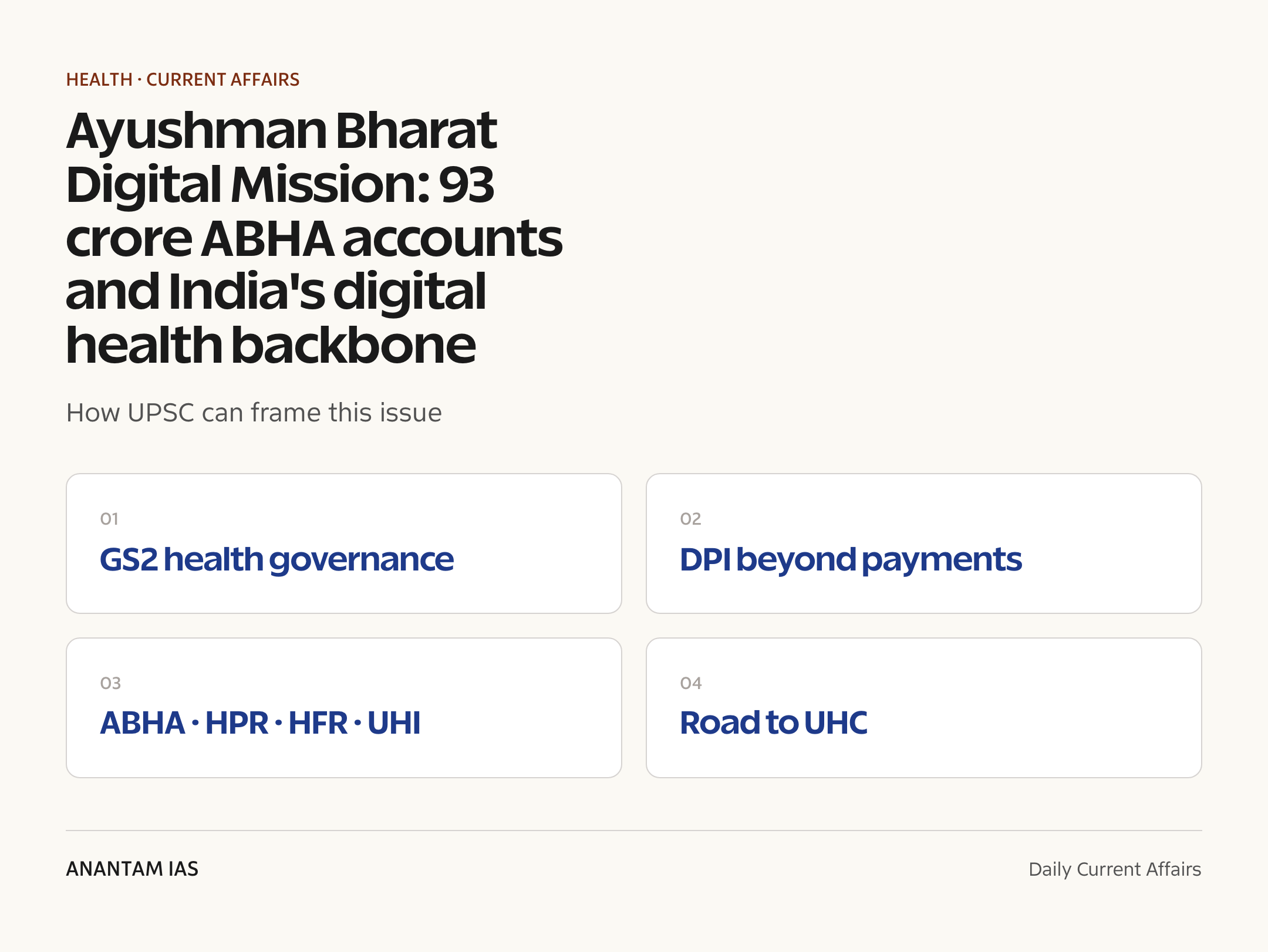
- Digital public infrastructure as a governance instrument: how ABDM’s ABHA–HPR–HFR–UHI stack replicates the Aadhaar–UPI playbook in the health sector.
- ABDM and Universal Health Coverage: portability of records, verified providers and faster NHCX claims as tools to cut out-of-pocket friction.
- E-governance design lessons: consent-based federated architecture, incentive schemes for private-sector adoption, and measurable service-delivery gains (2–5 minute OPD registration).
- Gaps to argue: digital divide, data-privacy safeguards in the absence of sector-specific health-data law, and uneven private-sector participation.
GS Paper 3
- Anonymised health data as a resource for AI-driven diagnostics, disease surveillance and health-tech innovation.
- Cybersecurity of health records: protecting a 104-crore-record ecosystem against breaches, and the interplay with the Digital Personal Data Protection Act, 2023.
Essay
- Technology as the great equaliser in public service delivery — from UPI to ABHA.
- Health for all in a digital republic: can code substitute for clinics?
Background and Context
What ABDM is and where it came from
ABDM is India’s attempt to give healthcare the same digital backbone that Aadhaar gave identity and UPI gave payments.
- The Ayushman Bharat Digital Mission was launched nationwide on 27 September 2021, after a pilot as the National Digital Health Mission in six Union Territories from August 2020.
- It’s implemented by the National Health Authority (NHA) — the same body that runs the AB-PMJAY insurance scheme — under the Ministry of Health and Family Welfare.
- The policy lineage runs from the National Health Policy 2017 (integrating health and IT) through the National Digital Health Blueprint 2019, which designed the building blocks ABDM now operates.
- The architecture is federated and consent-first: records stay with hospitals and labs, and can be accessed only through the patient’s revocable, time-bound consent — there’s no single central health database.
- PIB describes the outcome as one of the world’s largest digital health ecosystems: 104 crore-plus health records linked to 93 crore-plus ABHA accounts. For the full scheme explainer, see our note on the Ayushman Bharat Digital Mission.
The building blocks: ABHA, HPR, HFR, UHI
Four registries and rails make up the core stack — each is independently testable in Prelims.
- ABHA number: a 14-digit unique health identifier, Aadhaar-like in design, that links all of a person’s records across hospitals, labs, insurers and national health programmes — shared only with consent.
- Healthcare Professionals Registry (HPR): a national, verified registry of healthcare professionals — from allopathic doctors to AYUSH practitioners — digitally connected to the ecosystem.
- Health Facility Registry (HFR): one national list of health facilities — hospitals, clinics, labs, pharmacies — public and private; enrolled facilities become discoverable on the ABHA app.
- Unified Health Interface (UHI): an open network — ‘UPI for healthcare‘ — that lets a patient on any UHI-enabled app discover, book and consult any verified provider, whatever app the provider uses.
- UHI requests route through a common gateway run by the NHA, which authenticates patients via ABHA and verifies providers through the HPR and HFR; its design principles include interoperability and fair discoverability for providers of any size.
- Together these form health-sector digital public infrastructure — open, interoperable rails on which public and private apps can build.
Aarogya Setu 2.0: from contact tracing to health gateway
The pandemic-era app has been rebuilt as ABDM’s citizen-facing front door.
- Aarogya Setu 2.0 was launched on June 29, 2026 by Health Minister J.P. Nadda, transforming the COVID-19 contact-tracing app into a unified gateway and Personal Health Record (PHR) under ABDM.
- Core services: ABHA creation, health-record management, and Scan & Register for instant digital OPD registration.
- Smart Reports use Optical Character Recognition (OCR) to read and digitise uploaded medical documents.
- Users can view their AB-PMJAY wallet and private insurance details through NHCX, and check real-time blood-unit availability via e-RaktKosh.
- The app adds AI-driven health insights (biomarker and wellness trends from linked records), teleconsultation and in-person booking through UHI, plus wearable-device syncing for steps, heart rate and glucose.
Measured gains: Scan and Share, DHIS, eSushrut@Clinic
PIB’s backgrounder leans on hard service-delivery numbers rather than promises.
- Scan and Share (launched 2022): patients scan a QR code at a facility to get a digital queue token, with demographic details pulled securely from their ABHA.
- A study by the Indian Institute of Health Management Research (IIHMR) found the service cut OPD waiting times from roughly one hour to 2–5 minutes; over 23.21 crore ABHA-linked tokens have been issued (as on June 18, 2026).
- The Digital Health Incentive Scheme (DHIS) pays facilities and software firms for creating interoperable digital records: hospitals have received over ₹107 crore, digital solution companies over ₹26 crore, and diagnostics/labs/pharmacies ₹2.95 crore.
- eSushrut@Clinic, launched in June 2026, is a plug-and-play Hospital Management Information System built by C-DAC for small clinics; over 2,200 facilities have been onboarded, with access gated through HPR/HFR verification.
- The National Health Claims Exchange (NHCX) acts as a digital highway for claims data among insurers, hospitals, beneficiaries and regulators — speeding approvals, cutting discharge delays and letting patients track every claim in one place.
Why it matters: DPI and Universal Health Coverage
ABDM is the connective tissue between India’s insurance push and its service-delivery goals.
- India’s stated destination is Universal Health Coverage — quality care for all without financial hardship; a digital backbone makes that goal administratively feasible in a country of 140-crore people.
- Portability is the quiet revolution: a migrant worker’s records travel with their ABHA, accessible at any ABDM-enabled facility in the country.
- Consent-based access to full patient histories reduces duplicate diagnostics and improves clinical decisions — direct savings in out-of-pocket expenditure.
- Anonymised, aggregated data can drive disease surveillance, smarter public-health planning and India’s AI ecosystem in diagnostics and healthcare management.
- For insurers, structured NHCX data enables faster claim decisions and new products — relevant as health-insurance penetration widens under AB-PMJAY and private cover.
Concerns and criticisms to balance the answer
A Mains answer needs the friction points, not just the milestone numbers.
- Digital divide: smartphone-first services risk excluding the elderly, rural poor and low-literacy users unless assisted-access models (CSCs, ASHA workers) keep pace.
- Privacy and data protection: health data is the most sensitive personal data; India relies on the general Digital Personal Data Protection Act, 2023 rather than a dedicated health-data law, and consent quality at the point of care remains a live concern.
- Cybersecurity: a 104-crore-record ecosystem is a high-value target; breach-response capacity across thousands of small facilities is untested.
- Adoption asymmetry: many ABHA accounts exist because they were generated during vaccination and public-programme drives; active, repeated use by patients and full private-hospital participation are the harder metrics.
- Federal dimension: health is a State subject — sustained success needs states to integrate their own HMIS systems and programmes with ABDM rails.
Way Forward
Deepen adoption, not just registration
- Shift KPIs from ABHA counts to active usage — records fetched per patient visit, repeat Scan and Share use, and NHCX claim volumes.
- Expand assisted digital access through ASHAs, ANMs and Common Service Centres so the digital divide doesn’t become a care divide.
- Scale eSushrut@Clinic and DHIS incentives to bring small private clinics — where most Indians first seek care — onto the network.
Harden trust and governance
- Operationalise the DPDP Act, 2023 for health with sector-specific consent standards, audits and breach-notification drills.
- Publish transparent data-governance norms for anonymised-data use in research and AI, with independent oversight.
- Co-opt states through flexible integration support, since public health delivery ultimately runs through state systems.
Conclusion
With 104 crore health records linked to 93 crore ABHA accounts, ABDM has crossed the scale threshold where digital public infrastructure starts changing everyday experience — a queue token in minutes, records that follow the patient, claims that settle faster.
The next phase is less about numbers and more about trust: privacy safeguards, cybersecurity, and pulling small clinics and states fully onto the network. If that holds, ABDM becomes the administrative backbone on which Universal Health Coverage can actually be delivered.
UPSC Practice Questions
Prelims MCQ 1
With reference to the Ayushman Bharat Digital Mission (ABDM), consider the following statements:
- It was launched in 2021 and is implemented by the National Health Authority.
- The ABHA number is a 14-digit unique health identifier that links a person’s health records across facilities.
- Under ABDM, a health facility can access a patient’s past health records without the patient’s consent.
How many of the above statements are correct?
(a) Only one (b) Only two (c) All three (d) None
Answer: (b) Only two
Explanation:
Statements 1 and 2 are correct — ABDM was launched on 27 September 2021 and is implemented by the NHA; ABHA is a 14-digit identifier. Statement 3 is wrong: records can be exchanged only with the patient’s revocable, time-bound consent.
Prelims MCQ 2
The ‘Unified Health Interface (UHI)’, sometimes described as ‘UPI for healthcare’, refers to:
(a) A digital exchange for processing health-insurance claims between insurers and hospitals (b) An open network that lets a patient on any enabled app discover, book and consult any verified healthcare provider (c) A national registry of verified doctors and AYUSH practitioners (d) A revamped contact-tracing application for pandemic surveillance
Answer: (b) An open network that lets a patient on any enabled app discover, book and consult any verified healthcare provider
Explanation:
UHI is ABDM’s open, interoperable service network with a common NHA-run gateway. Option (a) describes the NHCX, (c) the Healthcare Professionals Registry, and (d) the original Aarogya Setu.
UPSC Mains Questions
- “The Ayushman Bharat Digital Mission extends India’s digital public infrastructure playbook from payments to health.” Examine the mission’s architecture and its potential to advance Universal Health Coverage, highlighting the risks that a records-first approach must address. (250 words)
- Digital health platforms can reduce the cost and friction of healthcare delivery, but only if trust keeps pace with technology. Discuss with reference to consent, data protection and the digital divide in the context of ABDM. (250 words)
Source: PIB, Ministry of Health and Family Welfare.
Frequently Asked Questions
What is the Ayushman Bharat Digital Mission?
ABDM is India’s national digital health ecosystem, launched on 27 September 2021 and implemented by the National Health Authority. It creates interoperable rails — ABHA IDs, professional and facility registries, and the Unified Health Interface — so patients, hospitals, doctors and insurers can exchange health records with consent on one network.
What is an ABHA number?
ABHA (Ayushman Bharat Health Account) is a 14-digit unique health identifier, similar in design to Aadhaar. It links a person’s health records across hospitals, labs, insurers and national health programmes, and lets them share those records digitally through revocable, time-bound consent. Over 93 crore ABHA accounts have been created.
How many health records are linked under ABDM?
As per the PIB backgrounder of July 2026, more than 104 crore health records are linked to over 93 crore ABHA accounts. The milestone of 100 crore records linked to 90 crore-plus accounts was crossed in May 2026, making ABDM one of the world’s largest digital health ecosystems.
What is Aarogya Setu 2.0?
Aarogya Setu 2.0, launched on June 29, 2026, is the COVID-era contact-tracing app rebuilt as ABDM’s citizen gateway and Personal Health Record. It offers ABHA creation, OCR-based smart reports, insurance visibility via NHCX, blood availability through e-RaktKosh, UHI-based appointment booking and wearable-device syncing.
What is the Scan and Share service?
Scan and Share, launched in 2022, lets patients scan a QR code at a hospital to generate a digital OPD token using their ABHA details. An IIHMR study found it cut waiting times from about one hour to 2–5 minutes; over 23.21 crore tokens have been issued nationwide.
What is the National Health Claims Exchange?
NHCX is a digital highway for exchanging health-insurance claims information among insurers, hospitals, beneficiaries and regulators. It speeds up claim decisions, reduces discharge delays and administrative costs, and lets patients track benefits, entitlements and every claim on a single platform — useful for chronic, non-communicable disease treatment.
Tell Google you want more of this.
Add Anantam IAS as a preferred sourceOne tap, and this site shows up more often in your own Top Stories, AI Overviews and AI Mode. Remove it any time.