India-ASEAN Summit

Why in the News?
The 22nd ASEAN-India Summit was held on 26 October 2025. Prime Minister Shri Narendra Modi participated virtually in the Summit. Prime Minister and ASEAN leaders jointly reviewed progress in ASEAN-India relations and discussed initiatives for strengthening the Comprehensive Strategic Partnership.
UPSC Relevance
GS2 Mains – Bilateral, Regional and Global Groupings and Agreements involving India and/or affecting India’s interests.
Regional Organisations are asked in Prelims also.
PYQ
2023 – The expansion and strengthening of NATO and a stronger US-Europe strategic partnership works well for India. What is your opinion about this statement? Give reasons and examples to support your answer.
2021- Critically examine the aims and objectives of SCO. What importance does it hold for India?
2018 Prelims
Consider the following countries:
- Australia
- Canada
- China
- India
- Japan
- USA
Which of the above are among the ‘free-trade partners’ of ASEAN?
(a) 1, 2, 4 and 5
(b) 3, 4, 5 and 6
(c) 1, 3, 4 and 5
(d) 2, 3, 4 and 6
The Association of Southeast Asian Nations (ASEAN)
Founding and Initial Members
- Establishment Date: ASEAN was established on 8 August 1967.
- Location: The founding took place in Bangkok, Thailand.
- Founding Document: The establishment was marked by the signing of the ASEAN Declaration (Bangkok Declaration).
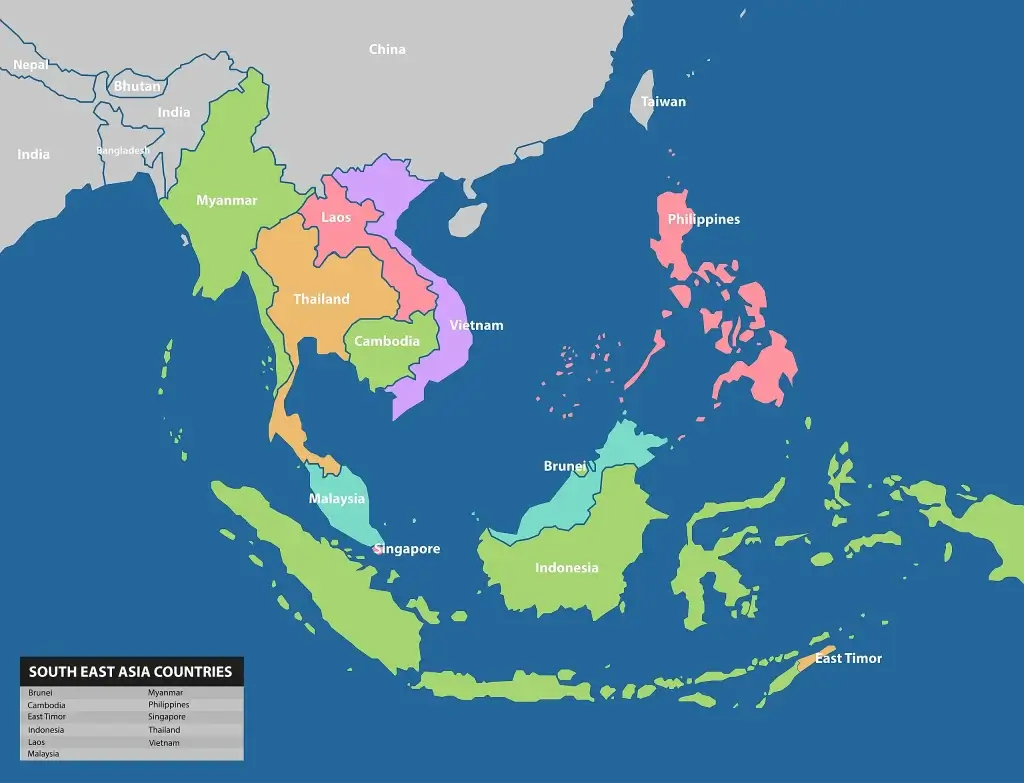
- Total Member States: ASEAN currently comprises Eleven Member States.
- 5 Founding Fathers:
- Indonesia
- Malaysia
- Philippines
- Singapore
- Thailand
- 6 Subsequent Entrants:
- Brunei Darussalam: Joined on 7 January 1984.
- Viet Nam: Joined on 28 July 1995.
- Lao PDR and Myanmar: Both joined on 23 July 1997.
- Cambodia: Joined on 30 April 1999.
- Timor Leste: Joined on 25 October 2025. (Latest)
Three Communities of ASEAN

ASEAN Flag

India-ASEAN Relations’ Timeline
Phase 1: Post-Independence/Cold War Disconnect (1947–Early 1990s)
- 1947–1950s: Initial goodwill and Pan-Asianism, championed by PM Jawaharlal Nehru, but lacking substantial policy follow-up. India was a key player at the 1955 Bandung Conference.
- 1960s–Early 1990s: A period of relative disconnect and strained ties. India’s close relationship with the Soviet Union and its non-aligned, socialist economic model led to anxiety among many pro-Western, capitalist ASEAN nations. Bilateral ties were maintained but not prioritized with the ASEAN grouping.
- ASEAN Formation: ASEAN itself was established in 1967.
Phase 2: The ‘Look East’ Policy (LEP) – Strategic Rapprochement (1991–2014)
- 1991: India launched the Look East Policy (LEP) under PM P.V. Narasimha Rao. This was triggered by the end of the Cold War and India’s economic liberalization, necessitating a shift toward new trading partners and a deeper engagement with the East.
- 1992: India became an ASEAN Sectoral Dialogue Partner (focused on trade, investment, tourism, science & technology).
- 1996: India became a Full Dialogue Partner of ASEAN and a member of the ASEAN Regional Forum (ARF), elevating the political and security dimension.
- 2002: The relationship was upgraded to a Summit-Level Partnership, with annual meetings held between the leaders.
- 2003: India acceded to the Treaty of Amity and Cooperation (TAC) in Southeast Asia, signaling commitment to regional peace.
- 2009/2010: The ASEAN-India Trade in Goods Agreement (AITIGA) was signed and came into effect, establishing a Free Trade Area.
- 2012: The relationship was upgraded to a Strategic Partnership.
Phase 3: The ‘Act East’ Policy (AEP) – Comprehensive Strategic Engagement (2014–Present)
- 2014: The ‘Look East’ Policy was officially upgraded to the Act East Policy (AEP) by PM Narendra Modi. This shift emphasized a more proactive, outcome-oriented approach, expanding engagement from primarily economic to include strategic, security, cultural, and connectivity dimensions.
- Focus Areas: Renewed focus on maritime security (Indo-Pacific), connectivity (e.g., Trilateral Highway, Kaladan Project), and developing India’s Northeast region as a gateway to ASEAN.
- 2015: ASEAN-India Trade in Services and Investment Agreements came into force, completing the ASEAN-India Free Trade Area (FTA).
- 2018: India hosted the ASEAN-India Commemorative Summit, with all ten ASEAN leaders attending India’s Republic Day Parade as Chief Guests.
- 2022: The relationship was elevated to a Comprehensive Strategic Partnership (CSP), marking a commitment to deeper and broader collaboration across all sectors, with ASEAN Centrality reaffirmed as a core pillar of India’s policy.
Areas of convergence between India and ASEAN
- Strategic Alignment: Southeast Asia has become a primary arena for strategic competition between the US and China. Amidst these tensions India strongly supports the ASEAN Outlook on the Indo-Pacific (AOIP), which aims for an inclusive and rules-based regional architecture. India’s own Indo-Pacific Oceans Initiative (IPOI) aligns with AOIP’s maritime objectives. Both India and ASEAN share concerns over regional stability, particularly regarding the South China Sea.
- Defense Cooperation: There is an increase in joint military exercises, intelligence sharing, and defense trade. India’s sale of the BrahMos supersonic cruise missile to the Philippines marks a significant step in defense exports to the region. Both sides also conduct naval exercises like the ASEAN-India Maritime Exercise (AIME).
- Economic Cooperation: Significant cooperation in trade via ASEAN-India Free Trade Area (AIFTA) which is being reviewed to boost gains for India in trade.
- ASEAN is India’s fourth largest trading partner and India is the ASEAN’s sixth largest trading partner.
- Cooperation is also focused on linking digital payment systems and sharing best practices on DPI. The linkage between India’s Unified Payments Interface (UPI) and Singapore’s PayNow is a key example of financial technology integration, promoting seamless, instant cross-border payments.
- Connectivity: Efforts are focused on connecting India’s Northeast with Southeast Asia. The development of the India-Myanmar-Thailand Trilateral Highway and the Kaladan Multimodal Transit Transport Project are vital infrastructure initiatives aimed at enhancing regional commerce and people-to-people links.
- Energy Security and Climate Action: There is growing collaboration on renewable energy and sustainable development. India’s International Solar Alliance (ISA) and the ASEAN-India Green Fund align with ASEAN’s clean energy goals, fostering joint investment in renewable technologies.
- Global Governance: India and ASEAN advocate for multilateralism and a rules-based global order, cooperating in forums like the East Asia Summit (EAS) and the G20.
- Shared Civilizational Heritage: The historical influence of Hinduism and Buddhism from India continues to resonate in ASEAN countries, providing a natural basis for cultural exchange. The enduring popularity and local adaptations of the Indian epics, the Ramayana and Mahabharata, are seen across Southeast Asia, such as the Ramakien in Thailand and the Kakawin Ramayana in Indonesia.
- Tourism Promotion: Both sides are actively promoting tourism by focusing on shared spiritual and historical routes, and enhancing connectivity. Promotion of the Buddhist Circuit in India (connecting sites like Bodh Gaya and Sarnath) targets tourists from predominantly Buddhist ASEAN nations. Initiatives like the ASEAN-India Tourism Work Plan (2023–2027) focus on boosting cruise tourism, promoting joint marketing, and developing sustainable tourism practices.
- Disaster Management: India consistently reaffirms its role as a “First Responder” in times of crisis in the neighborhood, including for ASEAN partners.India has historically provided timely aid and response to disasters in the region, such as its massive multinational Humanitarian Assistance and Disaster Relief (HADR) operation after the 2004 Indian Ocean Tsunami and recent operations like ‘Operation Karuna’ to deliver relief supplies following Cyclone Mocha in Myanmar.
The persistent challenges in India-ASEAN relations
Economic and Trade Challenges
- Widening Trade Deficit: India’s trade deficit with ASEAN has consistently widened, rising significantly over the years. This is largely due to imports from ASEAN growing faster than India’s exports to the region.
- Key concerns in India include the non-tariff barriers and complex technical standards in ASEAN member states that hinder Indian exports, especially in sectors like engineering goods and pharmaceuticals.
- India alleges circumvention of ‘Rules of Origin’, where products from a third country (primarily China) are routed through some ASEAN nations to gain easy, tariff-free access to the Indian market, thus deepening India’s deficit and affecting domestic industries.
Connectivity and Infrastructure Delays
- Delayed Trilateral Highway: The India-Myanmar-Thailand (IMT) Trilateral Highway project, intended to connect Moreh (India) to Mae Sot (Thailand) via Myanmar, has faced significant funding, security, and bureaucratic delays.
- Kaladan Multi-Modal Transit Transport Project (KMMT): This complex project, which aims to connect the eastern Indian seaport of Kolkata with the Sittwe seaport in Myanmar by sea, and then link it by river and road to Mizoram in India, has also been subject to prolonged delays, mainly due to instability in Myanmar.
Geopolitical and Strategic Challenges
- China’s Dominance: ASEAN countries’ deep economic dependence on China often limits the scope for deeper defense and strategic cooperation with India. ASEAN’s combined trade with China is substantially larger than its trade with India, making member states cautious about taking steps that could antagonize Beijing.
- Divergent Approaches to Regional Issues: Differences in diplomatic strategy, particularly regarding internal political crises in member states, can strain relations.
- Example: India and ASEAN have different approaches to the ongoing political crisis in Myanmar. India has maintained a pragmatic relationship with the ruling junta due to border and connectivity concerns, while ASEAN has pursued a diplomatic path via the ‘Five-Point Consensus’.
- South China Sea (SCS) Nuances: While India generally supports the peaceful resolution of SCS disputes based on international law (like UNCLOS), some ASEAN members with direct claims are hesitant for India to take a more proactive or visible role that might be perceived as countering China.
Way Ahead in the recent ASEAN-India Leaders’ Summit
Prime Minister Modi’s Statements and Vision
- Global Stability and Development: PM Modi stated that the India-ASEAN partnership, representing nearly a quarter of the world’s population, is “emerging as a robust foundation for global stability and development” in “this era of uncertainties,” despite ASEAN not picking sides between the US and China.
- A Shared Century: He expressed confidence that the “21st century is our century, the century of India and ASEAN,” with the ASEAN Community Vision 2045 and Viksit Bharat 2047 building a bright future.
- Maritime Cooperation: He declared 2026 as the ‘ASEAN-India Year of Maritime Cooperation,’ a move noted to be made with China’s assertions in regional waters in mind.
- Areas of Cooperation: He outlined expanding cooperation in:
- HADR (Humanitarian Assistance and Disaster Relief) and Maritime Security and the Blue Economy.
- Education, Tourism, Science and Technology, Health, Green Energy, and Cyber Security.
- Shared Values: He emphasized that India and ASEAN are “companions in the Global South,” bound by geography, deep historical ties, shared values, and are both commercial and cultural partners.
- Act East Policy: He reiterated that ASEAN is a “cornerstone of India’s Act East Policy” and affirmed India’s full support for ASEAN centrality and its outlook in the Indo-Pacific.
- Economic Potential: He urged an “early review of the ASEAN-India FTA (AITIGA)” to “unleash the full economic potential” of the relationship.
- Terrorism: He stressed the “importance of unity in the fight against terrorism,” calling it a “serious challenge to global peace and security.”
Key Announcements and Commitments by India
- Year of Maritime Cooperation: Designation of 2026 as the “ASEAN-India Year of Maritime Cooperation.”
- Security Initiatives: Proposed to organize the Second ASEAN-India Defence Ministers’ Meeting and the Second ASEAN-India Maritime Exercise.
- First Responder Role: India will continue its role as a First Responder in times of crisis and further strengthen cooperation in Disaster Preparedness and HADR.
- Skill Development: Training of 400 professionals in renewable energy to support the ASEAN Power Grid initiative.
- Tourism: Adoption of the Joint Leaders’ Statement on Sustainable Tourism to strengthen cooperation during the “ASEAN-India Year of Tourism.”
- New Institutions: Proposed establishment of a Centre for Southeast Asian Studies at Nalanda University.
- Infrastructure & Technology: Emphasized the need for increasing cooperation in infrastructure, semiconductor, emerging technologies, rare earths, and critical minerals.
- Timor-Leste: Extending Quick Impact Projects (QIPs) to Timor-Leste.
ASEAN Leaders’ Perspective
- Malaysian PM Anwar Ibrahim: Called ASEAN-India relations a “force for stability, for mutual prosperity.” He noted discussions on the ASEAN-India Plan of Action 2026-2030 and the goal to conclude the ASEAN-India trade and goods agreement this year.
- Philippines President Ferdinand R. Marcos Jr.: Stressed that as nations of the Global South, they share common challenges, making deeper cooperation essential. He highlighted India’s potential, as a committed dialogue partner, to offer solutions to common concerns.
- Rule of Law in Oceans: Marcos specifically highlighted the great importance of the rule of law in oceans and thanked PM Modi for India’s consistent support for international law and the peaceful settlement of disputes concerning the South China Sea.