The Association of Southeast Asian Nations (ASEAN) is one of the most significant regional organisations in the world, and a cornerstone of India's foreign policy in the Indo-Pacific. For UPSC aspirants, ASEAN is a high-frequency topic that appears across Prelims, Mains (GS Paper II), and essays on regional cooperation and multilateralism.
What Is ASEAN?
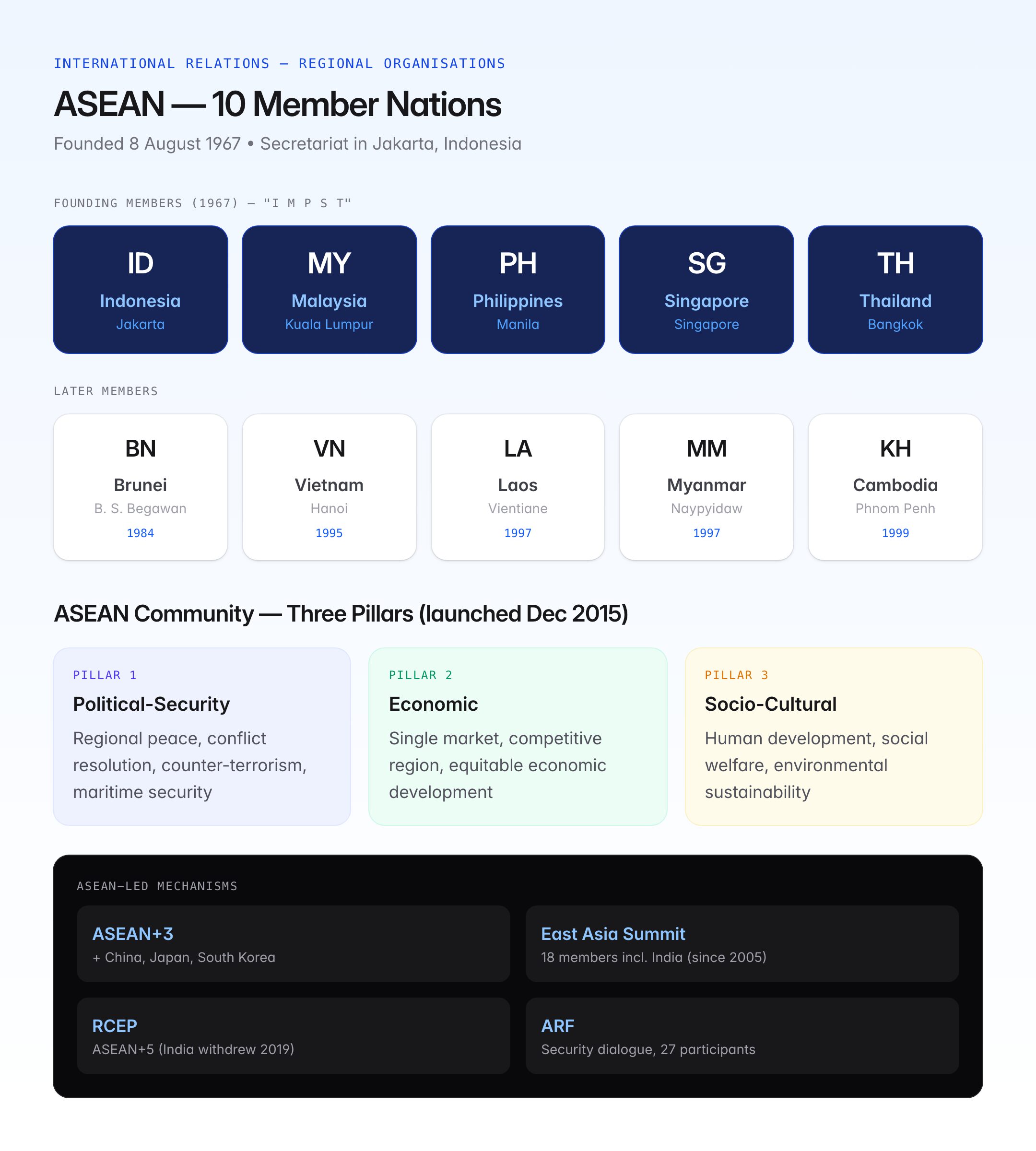
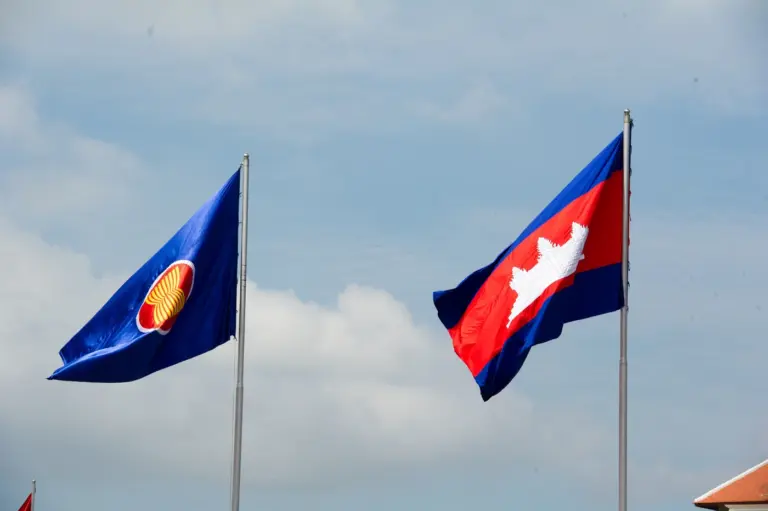
ASEAN is a regional intergovernmental organisation comprising ten Southeast Asian countries. It was established to promote political stability, economic growth, social progress, and cultural development in the region. ASEAN operates on the principles of non-interference in internal affairs, consensus-based decision-making, and peaceful settlement of disputes.
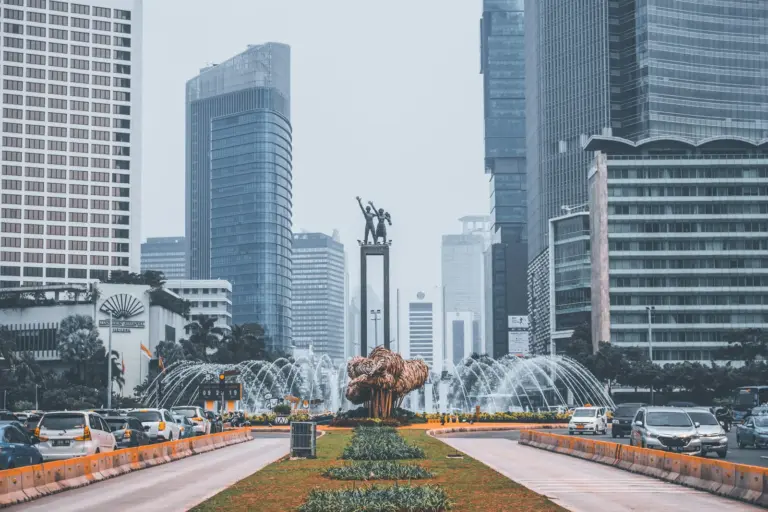
The ASEAN Secretariat is located in Jakarta, Indonesia. The current Secretary-General position rotates among member states in alphabetical order.
ASEAN Member Countries
| Country | Capital | Year of Joining | Notes |
|---|---|---|---|
| Indonesia | Jakarta | 1967 (founding) | Largest ASEAN economy; hosts Secretariat |
| Malaysia | Kuala Lumpur | 1967 (founding) | Major trading partner of India |
| Philippines | Manila | 1967 (founding) | Archipelagic state in the Pacific |
| Singapore | Singapore | 1967 (founding) | Highest per-capita income in ASEAN |
| Thailand | Bangkok | 1967 (founding) | Site of the Bangkok Declaration |
| Brunei | Bandar Seri Begawan | 1984 | Oil-rich sultanate on Borneo |
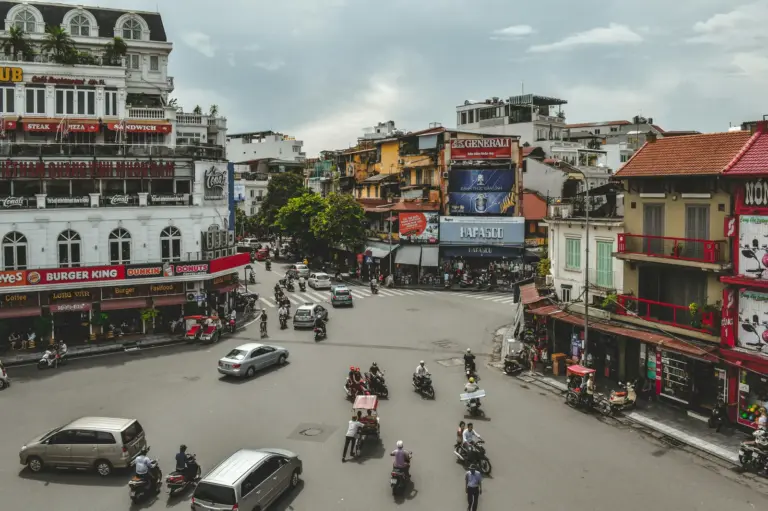
| Vietnam | Hanoi | 1995 | Joined after the end of the Cold War |
| Laos | Vientiane | 1997 | Landlocked; only landlocked ASEAN member along with… |
| Myanmar | Naypyidaw | 1997 | India shares a land border with Myanmar |
| Cambodia | Phnom Penh | 1999 | Last country to join ASEAN |
Mnemonic for founding members: "I M P S T" — Indonesia, Malaysia, Philippines, Singapore, Thailand.
Formation and the Bangkok Declaration (1967)
ASEAN was founded on 8 August 1967 with the signing of the ASEAN Declaration (Bangkok Declaration) by the foreign ministers of the five founding members. The context was the Cold War — Southeast Asia was deeply affected by the Vietnam War, communist insurgencies, and regional instability.
Key objectives of the Bangkok Declaration:
- Accelerate economic growth, social progress, and cultural development in the region.
- Promote regional peace and stability through respect for justice and the rule of law.
- Promote active collaboration and mutual assistance in economic, social, cultural, technical, scientific, and administrative fields.
- Maintain close and beneficial cooperation with existing international and regional organisations.
ASEAN Charter (2007)
The ASEAN Charter, signed in 2007 and effective from December 2008, gave ASEAN a legal personality and a formal institutional framework. Key provisions:
- Established ASEAN as a rules-based organisation with legal personality.
- Created the ASEAN Summit as the supreme policy-making body (meets twice a year).
- Established a Human Rights Body (ASEAN Intergovernmental Commission on Human Rights — AICHR).
- Codified the principles of non-interference, consensus, and the ASEAN Way.
ASEAN Community — Three Pillars
At the 2003 Bali Concord II, ASEAN committed to building an ASEAN Community by 2015, resting on three pillars:
| Pillar | Focus |
|---|---|
| ASEAN Political-Security Community (APSC) | Regional peace, conflict resolution, counter-terrorism, maritime security |
| ASEAN Economic Community (AEC) | Single market and production base, competitive economic region, equitable development |
| ASEAN Socio-Cultural Community (ASCC) | Human development, social welfare, environmental sustainability, cultural identity |
The ASEAN Community was formally launched on 31 December 2015.
ASEAN-Led Mechanisms
ASEAN has developed several extended frameworks that include dialogue partners:
- ASEAN+3: ASEAN + China, Japan, South Korea. Focuses on economic and financial cooperation, including the Chiang Mai Initiative (currency swap arrangement).
- ASEAN+6 / RCEP: The Regional Comprehensive Economic Partnership (RCEP), signed in 2020, includes ASEAN+3 plus Australia and New Zealand. India withdrew from RCEP negotiations in 2019.
- East Asia Summit (EAS): Includes 18 members (ASEAN+8, including India, US, Russia). India has been a member since the EAS inception in 2005.
- ASEAN Regional Forum (ARF): Security dialogue forum with 27 participants, including India.
- ASEAN Defence Ministers' Meeting Plus (ADMM-Plus): Includes 8 dialogue partners; India participates.
India-ASEAN Relations
India's engagement with ASEAN has evolved through distinct phases:
Look East Policy (1991)
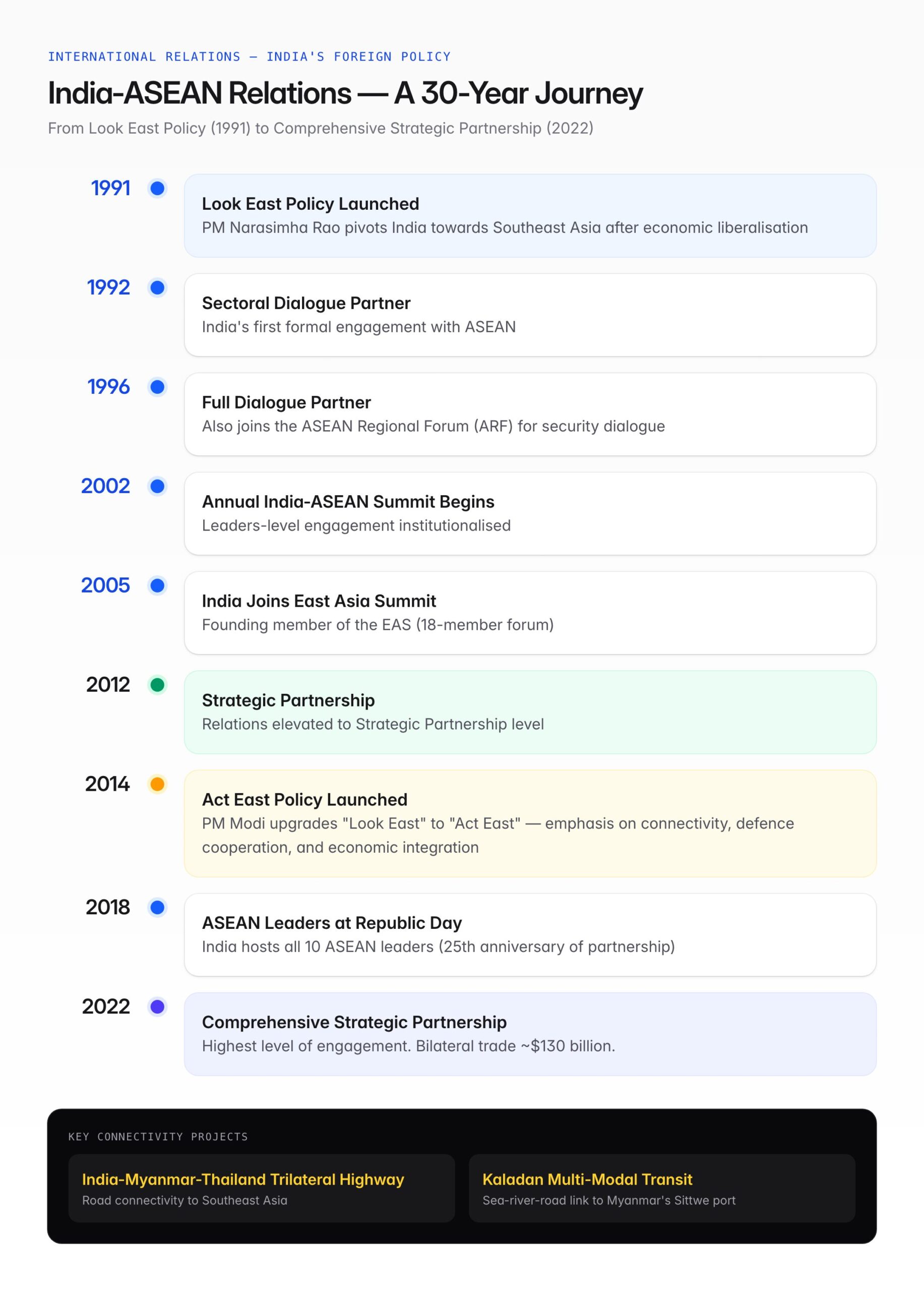
Launched by PM Narasimha Rao in 1991, the Look East Policy marked India's strategic pivot towards Southeast Asia after the end of the Cold War and economic liberalisation. India became an ASEAN Sectoral Dialogue Partner in 1992, a Full Dialogue Partner in 1996, and a member of the ASEAN Regional Forum in 1996.
Act East Policy (2014)
PM Narendra Modi upgraded the Look East Policy to the Act East Policy in 2014 at the East Asia Summit in Myanmar. The shift from "Look" to "Act" signalled a more action-oriented approach emphasising:
- Enhanced connectivity (India-Myanmar-Thailand Trilateral Highway, Kaladan Multi-Modal Transit Transport Project).
- Stronger defence and maritime cooperation in the Indo-Pacific.
- Deeper economic integration through trade and investment.
- People-to-people ties, including scholarships and cultural exchanges.
Key Milestones in India-ASEAN Ties
| Year | Event |
|---|---|
| 1992 | India becomes ASEAN Sectoral Dialogue Partner |
| 1996 | India becomes ASEAN Full Dialogue Partner |
| 2002 | Annual India-ASEAN Summit begins |
| 2005 | India joins the East Asia Summit |
| 2012 | India-ASEAN relations elevated to Strategic Partnership |
| 2014 | Act East Policy launched |
| 2018 | India hosts ASEAN leaders at the Republic Day celebrations (25th anniversary of partnership) |
| 2022 | India-ASEAN relations elevated to Comprehensive Strategic Partnership |
India-ASEAN Trade
India-ASEAN bilateral trade stands at approximately $130 billion (as of recent years), making ASEAN India’s fourth-largest trading partner. However, India runs a significant trade deficit with ASEAN, which was one reason for India’s withdrawal from RCEP.
ASEAN and the South China Sea
The South China Sea dispute is a major geopolitical issue involving ASEAN members (Vietnam, Philippines, Malaysia, Brunei) and China. ASEAN has sought to negotiate a Code of Conduct (COC) for the South China Sea, though progress has been slow. India supports freedom of navigation and a rules-based order in the South China Sea, aligning with the UNCLOS (United Nations Convention on the Law of the Sea).
UPSC Relevance
GS Paper Mapping:
- Prelims: ASEAN member countries, founding year, headquarters, ASEAN+3, EAS membership, India-ASEAN milestones.
- GS Paper II (Mains): India’s foreign policy — Act East Policy, India-ASEAN relations, regional groupings, effect on India’s interests.
- Essay: Multilateralism, regionalism, India's role in the Indo-Pacific.
Key Prelims Facts:
- ASEAN was founded on 8 August 1967 with the Bangkok Declaration by five founding members.
- The five founding members are Indonesia, Malaysia, Philippines, Singapore, and Thailand.
- ASEAN has 10 members; Cambodia (1999) was the last to join.
- The ASEAN Secretariat is in Jakarta, Indonesia.
- The ASEAN Charter (2007) gave the organisation legal personality.
- ASEAN+3 includes China, Japan, and South Korea alongside ASEAN.
- India is a Full Dialogue Partner (1996) and a member of the East Asia Summit (2005).
- The Look East Policy (1991) was upgraded to the Act East Policy (2014).
- India-ASEAN relations were elevated to Comprehensive Strategic Partnership in 2022.
- India withdrew from RCEP negotiations in 2019.
- The ASEAN Community (three pillars) was launched on 31 December 2015.
Tell Google you want more of this.
Add Anantam IAS as a preferred sourceOne tap, and this site shows up more often in your own Top Stories, AI Overviews and AI Mode. Remove it any time.