Ganga Water Treaty: A Broader Renewal Test
Why in News?
An Indian Express opinion column published on 28 July argued that India and Bangladesh should use the approaching end of the 1996 Ganga Water Treaty‘s 30-year term to look beyond dry-season allocation at Farakka. It proposed a wider agenda covering climate risk, flood forecasting, ecology, navigation, federal consultation and stronger institutions.
Those recommendations are the author’s analysis, not adopted policy or agreed treaty language. The official baseline remains the treaty signed on 12 December 1996, while a June 2024 India-Bangladesh announcement recorded a decision to begin technical-level discussions for renewal.
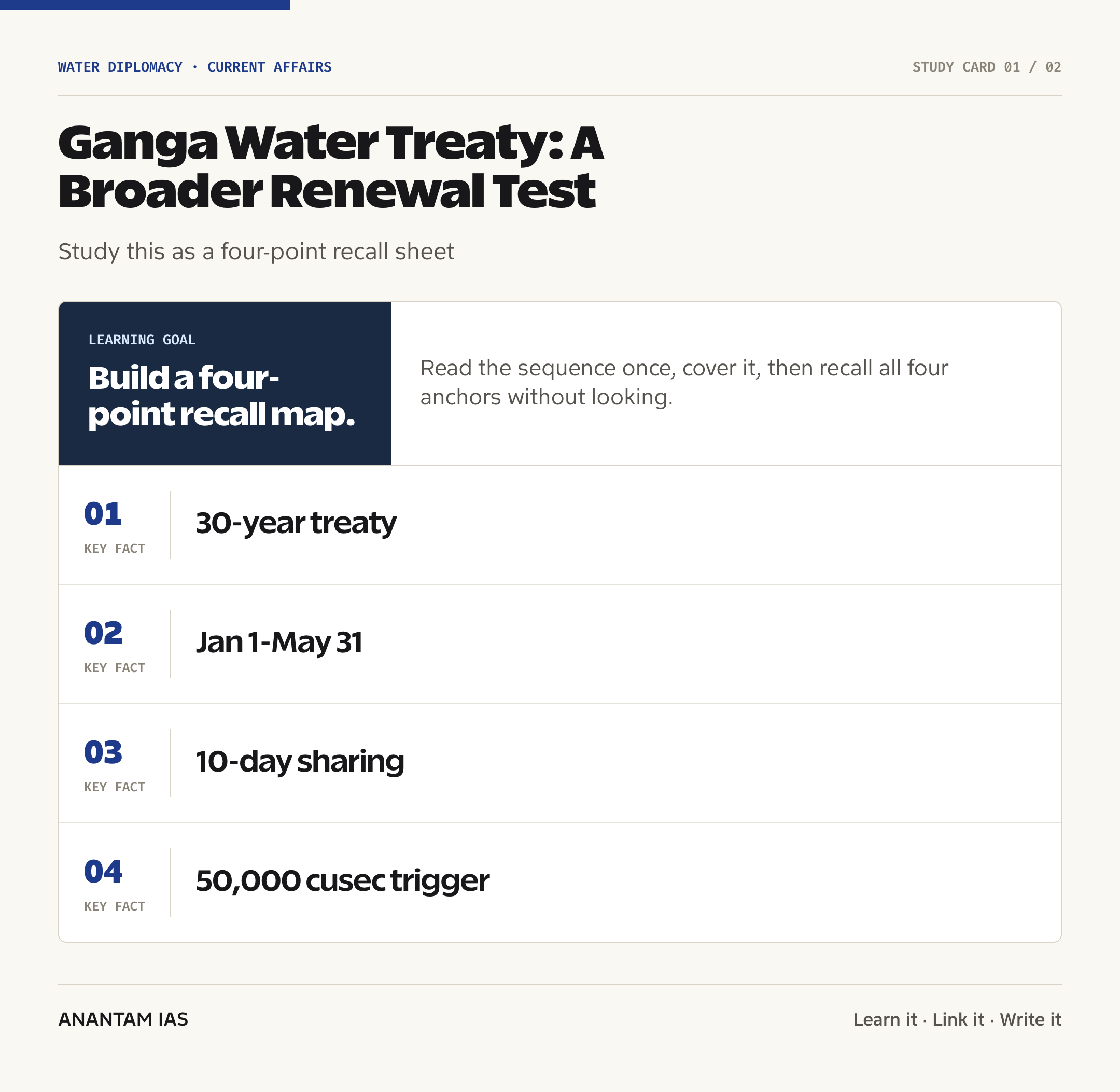
- Treaty period: the agreement remains in force for 30 years and is renewable by mutual consent.
- Sharing window: Ganga flows at Farakka are shared from 1 January to 31 May in 10-day periods.
- Monitoring: joint teams observe flows at Farakka and Hardinge Bridge under a bilateral Joint Committee.
- Official continuity: India’s 2024 statement announced technical-level renewal discussions; it did not endorse every expansion proposed in the opinion column.
- Renewal question: whether to preserve a focused allocation treaty or add risk-management functions requires negotiation by both governments.
The development matters in the context of:
- The issue matters in the context of India-Bangladesh relations, where shared rivers combine foreign policy with state-level politics and livelihood concerns.
- It tests whether a fixed sharing formula can remain credible when river flow varies across seasons and years.
- It also raises a design choice between a narrow allocation agreement and broader adaptive river governance based on data, consultation and joint risk reduction.
UPSC Relevance
Prelims Relevance
- The treaty concerns sharing of the Ganga/Ganges waters at Farakka, not all common rivers between India and Bangladesh.
- Its annual sharing period is 1 January to 31 May, divided into 10-day blocks.
- At flows of 70,000 cusecs or less, India and Bangladesh receive equal shares.
- Between 70,000 and 75,000 cusecs, Bangladesh receives 35,000 cusecs and India receives the balance.
- At 75,000 cusecs or more, India receives 40,000 cusecs and Bangladesh receives the balance.
- If flow falls below 50,000 cusecs in a 10-day period, the governments must enter immediate emergency consultations.
- A bilateral Joint Committee implements the treaty and collects data; unresolved issues move to the Indo-Bangladesh Joint Rivers Commission.
- The Joint Rivers Commission has functioned since 1972 and is broader than the treaty-specific Joint Committee.
- Hardinge Bridge is a treaty observation location in Bangladesh; Farakka is the release and primary sharing point in India.
- The treaty is renewable by mutual consent; renewal is not automatic.
Mains Relevance
GS Paper 2
- Transboundary-water diplomacy as a test of neighbourhood policy, trust and reciprocal restraint.
- The role of West Bengal, Bihar and other domestic stakeholders in international river negotiations.
- Institutional design, dispute management and data credibility in India-Bangladesh relations.
GS Paper 3
- Dry-season allocation, flood risk, sediment, river morphology, ecology and inland navigation.
- Climate adaptation through flexible rules, shared observations and pre-agreed drought or flood responses.
- River-basin management that connects water quantity with water quality, fisheries and ecosystem functions.
Essay
- A shared river turns sovereignty into interdependence.
- Durable treaties allocate not only water but also uncertainty and trust.
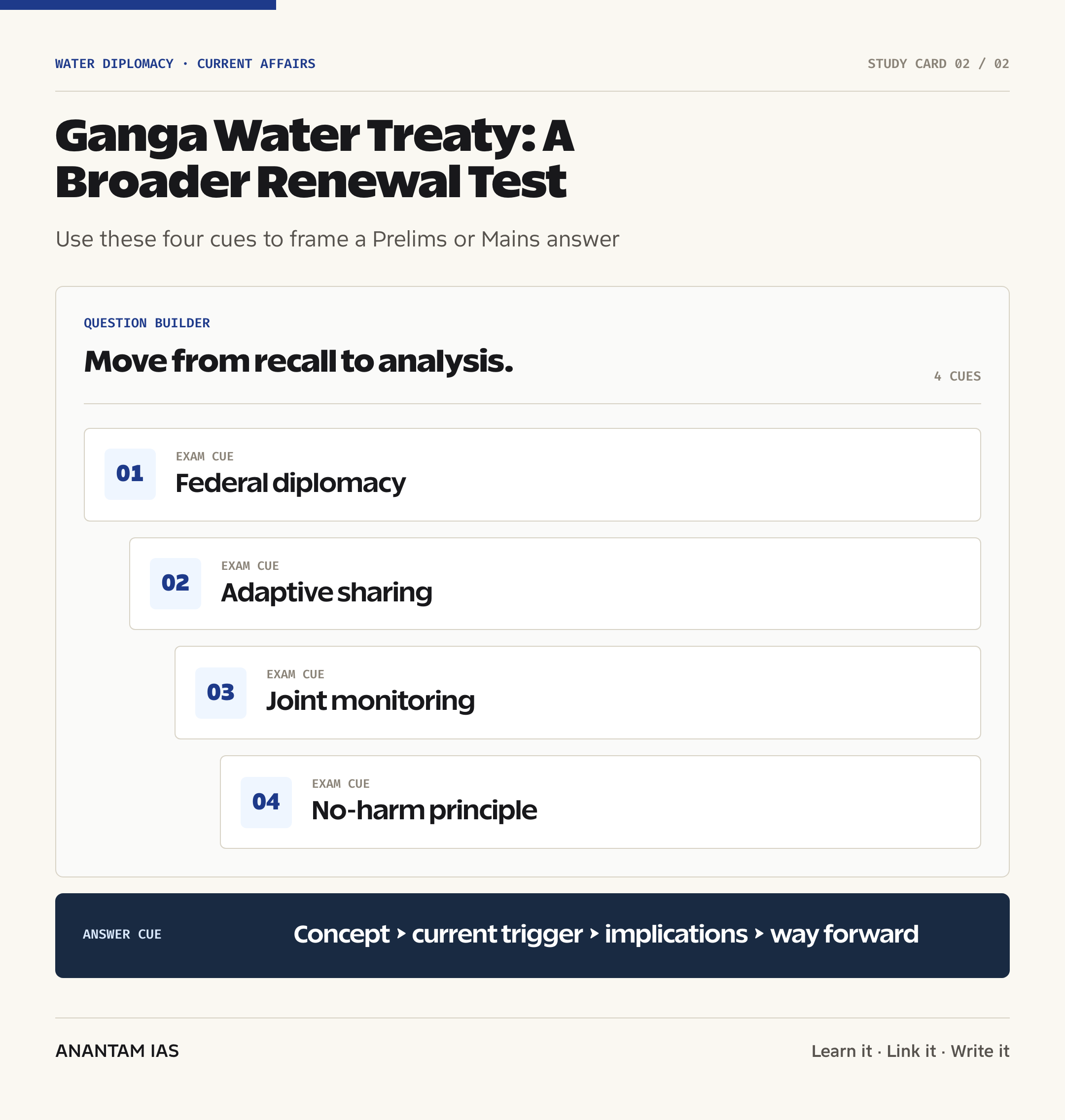
- Federal diplomacy strengthens external agreements when affected regions have a voice.
Background and Context
What the 1996 treaty actually covers
The agreement is a focused dry-season sharing arrangement at one control point, not a complete Ganga-basin treaty.
- Article I fixes Farakka as the point at which India releases the agreed quantum of water to Bangladesh.
- Article II applies the Annexure I formula in 10-day periods from 1 January to 31 May each year.
- The indicative schedule uses the 1949-1988 10-day average availability at Farakka as its historical reference.
- The upper riparian is to make every effort to protect flows at Farakka in line with that 40-year average availability.
- Article III limits Indian withdrawals below Farakka and before both banks lie in Bangladesh to reasonable uses not exceeding 200 cusecs.
- The agreement does not allocate monsoon flows, establish a whole-basin environmental-flow regime or settle sharing of the Teesta and other common rivers.
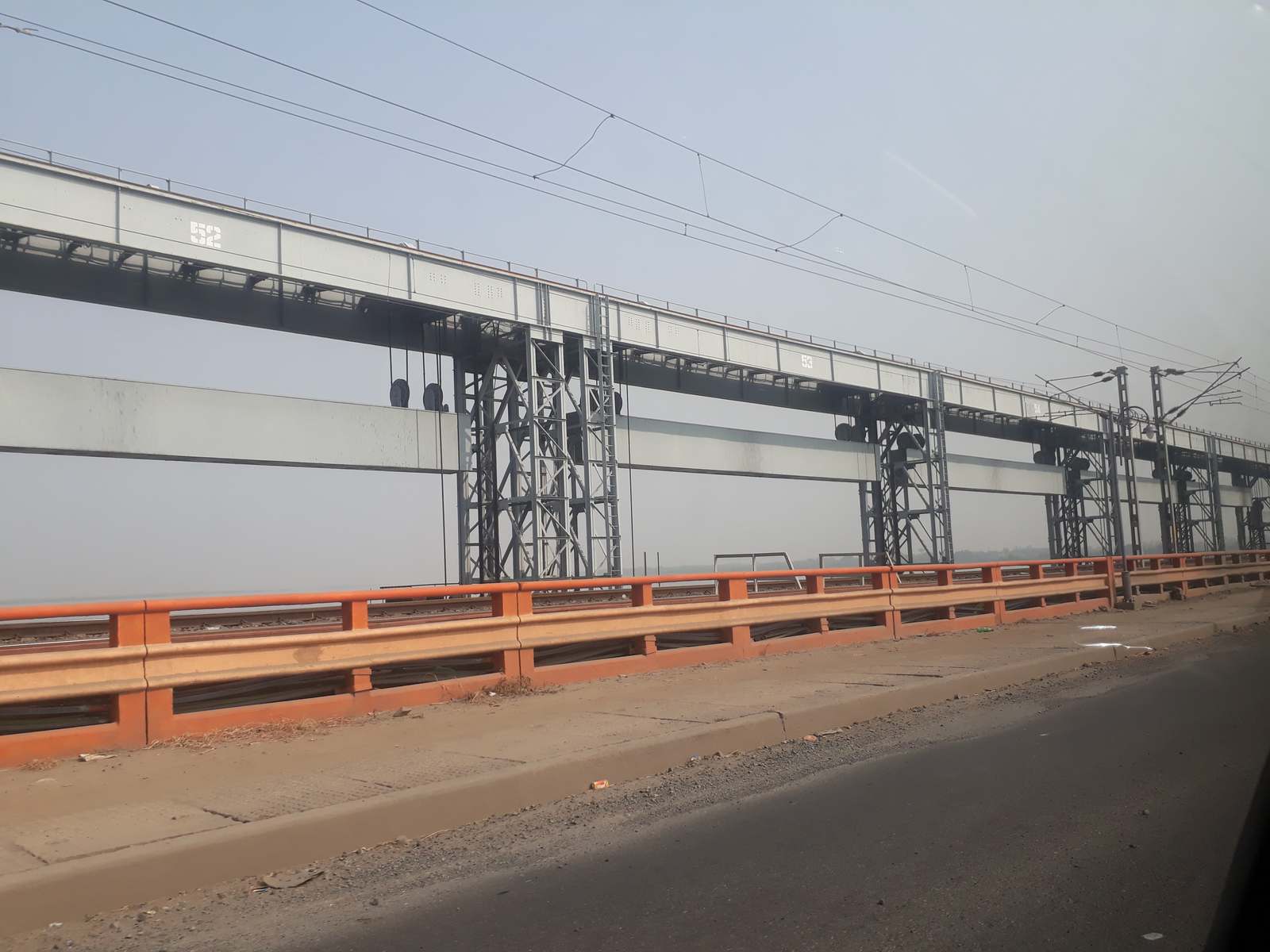
- Students can use the Farakka Barrage explainer for the structure’s role in the Bhagirathi-Hooghly system and Kolkata Port.
How the flow-sharing formula works
The formula changes with measured availability rather than promising both countries a fixed volume in every condition.
- When availability is 70,000 cusecs or less, the flow is divided equally between India and Bangladesh.
- When flow is between 70,000 and 75,000 cusecs, Bangladesh gets 35,000 cusecs and India receives the balance.
- When availability is 75,000 cusecs or more, India gets 40,000 cusecs and Bangladesh receives the balance.
- Each country is guaranteed 35,000 cusecs in alternate sets of three 10-day periods between 11 March and 10 May, subject to the Annexure condition.
- If availability falls below 50,000 cusecs in any 10-day period, both governments must consult immediately for an emergency adjustment based on equity, fair play and no harm.
- A cusec means one cubic foot per second. It measures discharge, not the total seasonal volume received by a country.
- The formula’s bands make measurement quality decisive: a dispute over discharge data can become a dispute over the share itself.
Institutions, measurement and disputes
The treaty creates a monitoring chain before a disagreement reaches the two governments.
- Article IV creates a Joint Committee with equal representation from India and Bangladesh.
- Its teams record daily flows below Farakka Barrage, in the Feeder Canal, at the Navigation Lock and at Hardinge Bridge.
- The Committee supplies collected data and a yearly report to both governments and examines implementation difficulties.
- An unresolved difference first goes to the Indo-Bangladesh Joint Rivers Commission; if it remains unresolved, the two governments meet urgently for mutual discussion.
- The Joint Rivers Commission was established in 1972 for wider cooperation on shared rivers, flood management and water-resource questions.
- India’s 2024-25 official reporting says the 86th Joint Committee meeting was held at Kolkata and Farakka on 4-6 March 2025 and noted joint measurements under the approved procedure.
- That official record supports continued implementation at that meeting; it does not settle every political, ecological or distributional criticism of the treaty.
Review, protection and renewal clauses
The treaty contains review mechanisms, but long-term continuation still depends on political consent.
- Article X allows review every five years or earlier when either party requests it, with adjustments guided by equity, fairness and no harm.
- Either party could seek the first review after two years to assess the working and impact of the arrangement.
- During the treaty period, if reviews produce no mutual agreement, Article XI protects a floor of 90% of Bangladesh’s formula share until agreed flows are decided.
- Article XII sets a 30-year term and says renewal is possible on the basis of mutual consent.
- The text does not prescribe automatic rollover, a compulsory arbitral tribunal or a ready-made replacement formula after the term.
- The official June 2024 announcement to start technical-level discussions is evidence of a renewal process, not proof that a final renewed text has been agreed.
- A renewal can retain the existing core, amend selected provisions or create linked instruments, but each route requires bilateral agreement.
Hydrology behind the diplomatic problem
Farakka discharge reflects a changing river system, so allocation cannot be understood from treaty percentages alone.
- Dry-season flow depends on antecedent monsoon rainfall, groundwater contribution, tributary inflows, upstream uses and channel conditions.
- Sediment transport and changing river morphology can alter conveyance, bank erosion, navigation and the performance of control structures.
- Climate change can shift the timing and intensity of rainfall and increase the probability of hydrological extremes, but it doesn’t produce one uniform flow trend in every season.
- Glacier and snow processes influence parts of the wider Ganga system, while monsoon rainfall remains a major driver; a renewal should use verified basin-specific evidence rather than a single climate slogan.
- Bangladesh’s downstream concerns include dry-season availability, salinity, agriculture, fisheries and ecosystem health; Indian concerns include Hooghly flows, navigation, local water needs and flood or sediment management.
- Claims that one structure alone caused a particular flood, siltation pattern or ecological change require site-specific hydrological analysis, not political assertion.
- A modern agreement could mandate transparent methods for updating reference flows, but that is a policy option and not part of the current treaty text.
Federal diplomacy inside India
An international agreement is negotiated by the Union, but its costs and benefits are experienced by states and river communities.
- Water is primarily in the State List, while Parliament can regulate and develop inter-State rivers in the public interest under Union List Entry 56.
- Foreign affairs and treaty-making lie with the Union, creating a need for structured consultation with affected states before an external commitment is finalised.
- West Bengal has direct interests in Farakka operation, the Bhagirathi-Hooghly system, navigation, water supply and local livelihoods.
- Bihar’s concerns about upstream sediment and flooding, cited in the opinion column, are stakeholder claims that should be tested through shared technical evidence.
- Federal consultation can identify minimum needs, acceptable flexibility and compensation or adaptation measures before positions harden publicly.
- State participation should inform the national negotiating mandate without turning a bilateral treaty into a veto contest among domestic actors.
- A standing Centre-state technical forum could review data and draft options, but today’s column presents this as a governance direction, not an announced mechanism.
What a broader renewal could add
The Indian Express column proposes moving from allocation alone toward shared-risk management, but none of these additions is yet agreed policy.
- A renewed framework could link allocation with flood forecasting, drought triggers, water-quality alerts and emergency communication.
- Joint ecological work could cover fisheries, wetlands, bank erosion and sediment, with indicators defined before compliance is assessed.
- Inland navigation and trade can create visible mutual gains, making cooperation valuable beyond a debate over who receives each cusec.
- Updated hydrological baselines could be reviewed at fixed intervals, while preserving predictability through transparent adjustment rules.
- A strengthened secretariat could support continuous data analysis, public summaries and technical mediation between formal Joint Rivers Commission meetings.
- Track 2 dialogue among researchers and former officials may widen options and build trust, but it cannot replace decisions by authorised governments.
- The Teesta River guide shows why other shared-river questions may influence political trust even though they remain legally outside the Ganga treaty.
Principles for transboundary river cooperation
A durable renewal needs predictable allocation and a method for dealing with conditions the original schedule did not anticipate.
- Equity is not the same as an equal split in every circumstance; it requires consideration of relevant needs, effects and basin conditions.
- The treaty itself invokes fairness and no harm, but does not create a general precedent beyond the rights and entitlements it expressly covers.
- Data sharing works only when both sides agree on observation sites, instruments, calibration, timing and treatment of missing measurements.
- Adaptive rules should be bounded: too little flexibility makes a treaty brittle, while unchecked discretion weakens predictability and trust.
- Dispute prevention through joint facts is usually cheaper than dispute settlement after national narratives have diverged.
- Public communication should distinguish measured flow, allocated share, delivered share and ecological outcome; these are related but not identical.
- For the wider relationship, see the India-Bangladesh relations overview covering connectivity, security and neighbourhood diplomacy.
Way Forward
Protect continuity first
- Both sides should prevent a legal vacuum through timely technical and political decisions based on mutual consent.
- Existing measurement and data-sharing work should continue while renewal terms are negotiated.
- Any interim arrangement should state its duration, formula and dispute path clearly.
Update the evidence base
- Jointly audit discharge series, instruments, reference periods and climate-risk assumptions.
- Publish agreed summaries that separate observed flow from allocation and delivery.
- Commission shared studies on sediment, ecology and extreme events rather than relying on competing national claims.
Create bounded adaptability
- Retain clear allocation bands while adding pre-agreed drought and flood triggers.
- Schedule periodic scientific reviews without making every seasonal variation a reopening of the treaty.
- Define how revised data can change future rules and how existing entitlements are protected during review.
Deepen institutional capacity
- Give the Joint Committee stronger technical support for modelling, ecological indicators and public reporting.
- Use the Joint Rivers Commission for cross-river coordination while keeping treaty-specific accountability visible.
- Add mediation or expert review stages if both governments agree they would resolve technical disputes faster.
Practise federal and public diplomacy
- Consult West Bengal, Bihar and affected communities through a structured evidence-led process.
- Engage Bangladeshi stakeholders without treating domestic criticism as hostility to bilateral cooperation.
- Label proposals, negotiating positions and adopted commitments accurately to protect public trust.
Conclusion
The 1996 Ganga Water Treaty has value because it converted a long dispute into a measurable sharing arrangement with joint monitoring. Its renewal should preserve that predictability rather than discard it for an undefined vision of basin cooperation.
But continuity need not mean institutional stasis. India and Bangladesh can pair a clear Farakka formula with updated data, bounded adaptation, federal consultation and joint management of floods, droughts and ecological risks. The opinion column opens that debate; only bilateral negotiation can turn any proposal into policy.
UPSC Practice Questions
Prelims MCQ 1
With reference to the 1996 Ganga Water Treaty, consider the following statements:
- It applies to 10-day sharing periods from 1 January to 31 May.
- It provides equal sharing whenever availability at Farakka is 70,000 cusecs or less.
- It renews automatically for another 30 years unless either party objects.
How many of the above statements are correct?
(a) Only one (b) Only two (c) All three (d) None
Answer: (b) Only two
Explanation:
Statements 1 and 2 are correct under Article II and Annexure I. Statement 3 is incorrect because Article XII makes renewal dependent on mutual consent.
Prelims MCQ 2
Which institution first examines an implementation difficulty under the Ganga Water Treaty?
(a) SAARC Secretariat (b) International Court of Justice (c) Treaty Joint Committee (d) Central Water Commission alone
Answer: (c) Treaty Joint Committee
Explanation:
The bilateral Joint Committee implements the arrangement and examines difficulties. An unresolved issue moves to the Indo-Bangladesh Joint Rivers Commission and later to the two governments for urgent mutual discussion.
UPSC Mains Questions
- The approaching renewal of the Ganga Water Treaty is both a foreign-policy negotiation and an exercise in federal diplomacy. Examine how India can reconcile a predictable Farakka allocation with state interests, updated hydrology and the principles of equity and no harm.
- Transboundary river treaties must manage uncertainty as well as divide water. Using the Ganga treaty as a case, discuss institutional reforms for joint data, flood forecasting, drought response, ecological monitoring and dispute prevention without weakening clear legal entitlements.
Sources: 1996 Ganga Water Treaty, Bangladesh Ministry of Water Resources and The Indian Express.
Frequently Asked Questions
When was the Ganga treaty signed?
India and Bangladesh signed the treaty in New Delhi on 12 December 1996. It entered into force on signature, remains in force for 30 years and can be renewed by mutual consent. The agreement focuses on sharing Ganga flows at Farakka during the annual dry-season window.
How is water shared at Farakka?
The treaty uses three flow bands. At or below 70,000 cusecs, flow is shared equally. Between 70,000 and 75,000, Bangladesh gets 35,000 and India the balance. At or above 75,000, India gets 40,000 and Bangladesh the balance, subject to the alternating guarantee condition.
What happens below 50,000 cusecs?
If flow falls below 50,000 cusecs in any 10-day period, the two governments must consult immediately and make emergency adjustments according to equity, fair play and no harm to either party. The treaty doesn’t provide a separate automatic low-flow percentage for that situation.
Are the renewal proposals official policy?
No. The broader ideas on climate risk, navigation, ecology, federal diplomacy and redesigned institutions come from an Indian Express opinion column. Officially, India and Bangladesh announced technical-level renewal discussions in 2024. A proposal becomes policy only if authorised governments agree and adopt it.
What does the Joint Committee do?
The treaty-specific Joint Committee has equal representation, observes flows at Farakka and Hardinge Bridge, supplies data and annual reports, implements the sharing arrangement and examines difficulties. It is distinct from the wider Indo-Bangladesh Joint Rivers Commission, to which unresolved treaty issues may be referred.
Is Teesta covered by this treaty?
No. The Teesta is a separate shared-river question. The 1996 agreement covers Ganga/Ganges waters at Farakka. Teesta politics may affect bilateral trust and the negotiating climate, but renewal of the Ganga treaty does not by itself create a Teesta allocation.