India China Ties Reset


Why in news:
Chinese Foreign Minister Wang Yi’s visit to India was the first ministerial visit from China since the two countries decided to disengage at the border last October. At his meeting with Prime Minister Narendra Modi on Tuesday, Wang said bilateral relations had experienced “ups and downs, and the lessons learned are worth remembering”. according to China’s Foreign Ministry readout.
UPSC Relevance:
GS2, India and its Neighborhood- Relations.
UPSC Mains PYQ 2017:
Q: ‘China is using its economic relations and positive trade surplus as tools to develop potential military power status in Asia’, In the light of this statement, discuss its impact on India as her neighbor.
UPSC Mains PYQ 2024:
Q: ‘The West is fostering India as an alternative to reduce dependence on China’s supply chain and as a strategy to counter China’s political and economic dominance.” Explain this statement with examples.
Evolution of India China Ties:
| Phase | Years | Key Features/Details |
| 1st phase | 1947 – 1959 | Nehru’s initial idealism towards cooperation with China Initial bonhomieHindi China bhai bhaiPanchsheel Agreement in 1954Until the Dalai Lama’s exile in India. |
| 2nd phase | 1959 – 1962 | Tibet issue – 1959Tensions mounted on Asylum to Dalai Lama by India and border disputeIndo – China War -1962Nehru’s disillusionment with ChinaPressure and Criticism from parliament on China Policy |
| 3rd phase | 1962 – 1988 | Balance of power consideration– China-Pak-USA nexus- India-Soviet Friendship Treaty 1971 |
| 4th phase | 1988 – present | Combination of systemic and domestic factors- – Normalisation of ties – Rajeev Gandhi’s visit in 1988-Deng Xiaoping talked of Asian Century- Confidence building measure on boundary issues- Trade and connectivity- PM Manmohan – India and China can reshape the world together.- China surpassed India economically and became a threat to USA’s hegemony.- increasing regional assertion by China in Asia. Recent times – More Pragmatic Approach– China–Pakistan’s ‘all weather friendship’- China’s proximity to Russia- China’s expanding presence in the Global South via economic engagement, BRI, loans, infrastructure, which India failed to do.- India trying to hedge against uncertainties associated with the rise of China via:rapid economic growth (internal balance) tilting towards USA (external balance) |
Recent years:
- There was a sense of euphoria around India-China ties due to the 2019 meeting of PM Modi and President Xi . Just eight months later, Indian and Chinese troops clashed violently in Galwan in eastern Ladakh causing anger and anxiety in India.
- Over the years there were reports of confrontations and pictures and reports of infrastructure building on both sides.
- On the economic front, multiple Apps were banned and India pushed for Aatmanirbharta and supply chain resilience even as trade remained robust between both.
- QUAD strengthened and there was growing strategic partnership between India and USA, even as India continued to engage in SCO and BRICS.
- After several rounds of negotiations between diplomats and military leaders, there were troop withdrawals at some places.
- On October 21, the two sides agreed to complete the disengagement process in the last two remaining locations in Depsang and Demchok. President Xi and PM Modi met in Kazan on October 23 and decided to mend ties, followed by high level visits.
The Trump Effect on Relations:
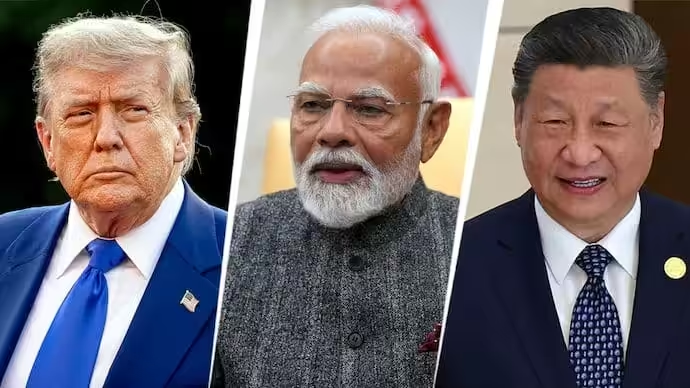
- After Trump entered the White House and targeted China – and now India with his tariffs, the thaw between New Delhi and Beijing has progressed.
- The Kailash Mansarovar Yatra has restarted, and India has begun to issue visas to Chinese nationals again.
- Wang’s visit came ahead of PM Modi’s visit to Tianjin for the Shanghai Cooperation Organisation (SCO) leaders’ summit at the end of next month-his first such visit since 2018, when he attended the SCO summit in Qingdao.
Twin-track movement – 10 point understanding to normalise ties:
- The two sides have agreed to move forward on two fronts in a dual track strategy, without allowing one to impact the other.
- border issues
- bilateral ties
- The parallel engagement was agreed upon after the 1988 visit of then PM Rajiv Gandhi to China, and had been followed until 2020
Border Issues:
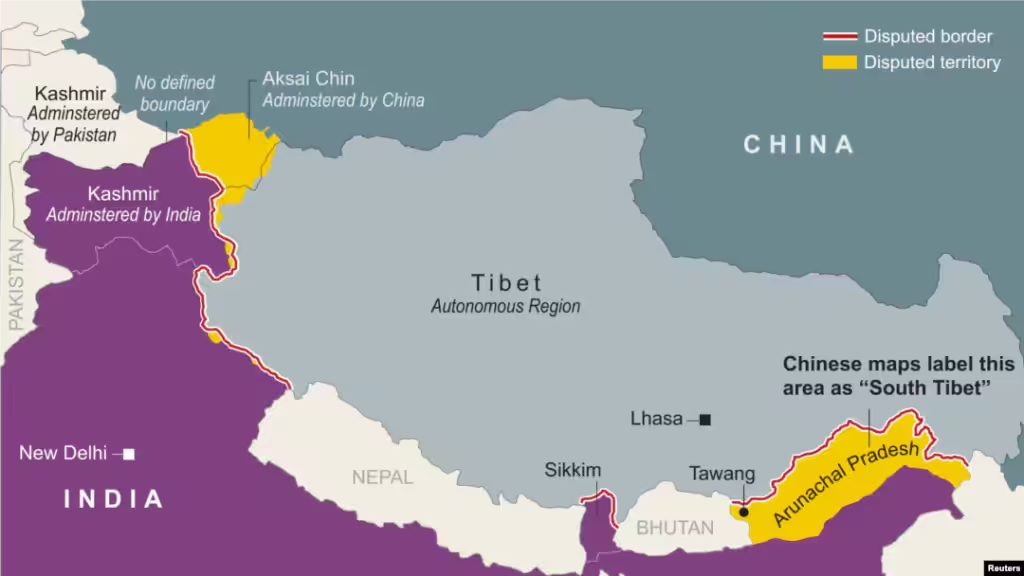
- India and China have agreed to form at least three new border-related mechanisms.
- An Expert Group under the Working Mechanism for Consultation and Coordination on India-China Border Affairs (WMCC) to “explore Early Harvest in boundary delimitation”
- A Working Group under the WMCC to “advance effective border management” in order to maintain peace and tranquillity in the border areas
- “General Level Mechanisms in Eastern, and Middle Sectors, in addition to the existing General Level Mechanism in Western Sector, and holding an early meeting of the General Level Mechanism in the Western Sector.”
- Agreed to use the border management mechanisms at the diplomatic and military levels to carry forward the process of “border management, and discuss de-escalation“, beginning with the principles and modalities.
- There is agreement on the need to take a “political perspective” of the overall bilateral relationship while seeking a fair, reasonable and mutually acceptable framework for settlement of the boundary question.
Connectivity
- Resume direct flight connectivity at the earliest, facilitate visas to tourists, businesses, media and other visitors
Trade
- Re-open border trade through the designated trading points at Lipulekh Pass, Shipki La Pass, and Nathu La Pass
- facilitate trade and investment flows through concrete measures.
Cross Border River
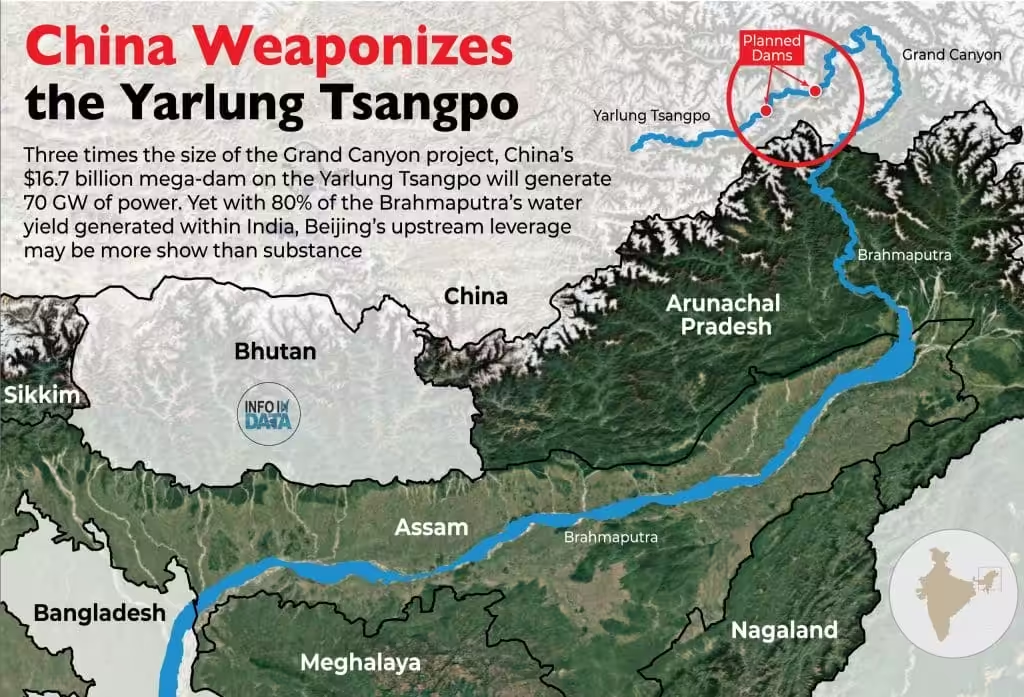
- On transborder rivers cooperation, the Chinese side agreed to “share hydrological information during emergency situations based on humanitarian considerations“.
Other Issues of Convergence between India and China
- Multilateralism – Both countries are active participants in regional and global organizations such as the Shanghai Cooperation Organisation (SCO), BRICS, the Asian Infrastructure Investment Bank (AIIB), and the New Development Bank (NDB). These bodies provide a platform for dialogue, cooperation, and mutual development projects.
- Climate Change – India and China are part of the BASIC group, working together to advocate for the concerns of developing countries in global climate negotiations. They cooperate on renewable energy development and pollution control initiatives. Call for responsibility on historical emissions and climate finance.
- Global South – India and China often collaborate to represent the interests of developing and underdeveloped countries particularly within the United Nations and climate forums (such as the BASIC group at UN climate summits) championing equity, development rights for poorer nations.
Addressing trust deficit – Issues of Confrontation remain
- The Conflicting Worldviews – China has a vision of sino centric world order, considering China as the middle kingdom as visible in its conflicts across all borders and in South China Sea while India believes in a truly multilateral world based on rules and cooperation shaped by Vadudhaiva Kutumbakam. These world views are inherently conflictual.
- Border disputes– The repeated Chinese incursions on the border-Depsang in 2013, Chumar in 2014, Doklam in 2017, and the ongoing border standoff have impacted trust. At least 50,000 troops are still stationed in eastern Ladakh, and de-escalation and de-induction must happen along a time-bound roadmap.
- Territorial Claims – China claims Arunachal Pradesh as part of “South Tibet.” In contrast, India considers Aksai Chin to be illegally occupied by China. These conflicting claims lead to ongoing diplomatic and military tensions.
- China-Pakistan Relations – China’s military cooperation with Pakistan was on display during Operation Sindoor, when the Chinese supplied weapons and live intelligence to the Pakistanis. The China-Pakistan Economic Corridor (CPEC), which runs through Pakistan-occupied Kashmir (POK), adds to India’s security worries.
- Transboundary River issue – India has concerns with regard to the mega dam that is being built on the Yarlung Tsangpo (Brahmaputra), which will have implications for lower riparian states.
- Geopolitical Rivalry – Strategic competition in the Indo-Pacific and China’s growing influence in South Asia contribute to India’s challenges. China’s efforts to weaken India’s influence in neighboring countries like Nepal, Sri Lanka, and the Maldives have led to confrontations on several fronts.
- Terrorism – India strongly raised the issue of terrorism in all its forms and manifestations, including cross-border terrorism, and recalled that one of the original objectives of the SCO was to counter the evil of terrorism. China has not been that vocal about terrorism and vetoed listing of various Pakistani Terrorists in UNSC.
- Economic Imbalances – India faces a significant trade deficit with China. The country is concerned about unfair trade practices, export controls, and restrictions that China imposes on key Indian imports like chemicals and electronics.
- Supply Chain dependence for critical minerals – India is concerned at China’s export restrictions on rare earths, tunnel boring machines, and fertilisers, which are key to India’s development, digital ambitions, renewable energy and food security.
- Non Acceptance of India’s strategic interests – China also keeps blocking India’s membership in the Nuclear Suppliers Group and permanent membership in UNSC.
Way Forward:
If the new dual track strategy is to be durable, the onus is on Beijing to address New Delhi’s concerns. As PM Modi told Wang Yi, India seeks stable, predictable and constructive relations with China for global peace and prosperity. India must ensure its strategic autonomy and not getting squeezed in great power game of US- China or US- Russia. Congagement remains a reliable and pragmatic strategy going ahead. India must engage China wherever possible (economically, climate change, multilateral institutions, voice of global south) and contain wherever necessary (maintaining its strategic depth in South Asia). India must walk softly but carry a stick big enough to keep the dragon at bay.