India’s Clean-Energy Transition: From Capacity Milestone to Grid Readiness
Why in News?
During a press conference in New Delhi on 21 July 2026, UN Climate Change Executive Secretary Simon Stiell described clean energy as a source of economic competitiveness, energy security and strategic autonomy for India. He called for faster investment in electricity grids and storage, wider electrification and sustained engagement with the UN climate process.
The Hindu reported the clean-energy emphasis during Stiell’s India visit. The official UN Climate Change remarks linked India’s early non-fossil installed-capacity milestone to the harder implementation phase: converting new capacity into dependable electricity, manufacturing strength, cleaner air, resilience and development gains.
- Stiell noted that non-fossil sources had crossed half of India’s installed electricity capacity five years before the 2030 deadline in its updated climate commitment.
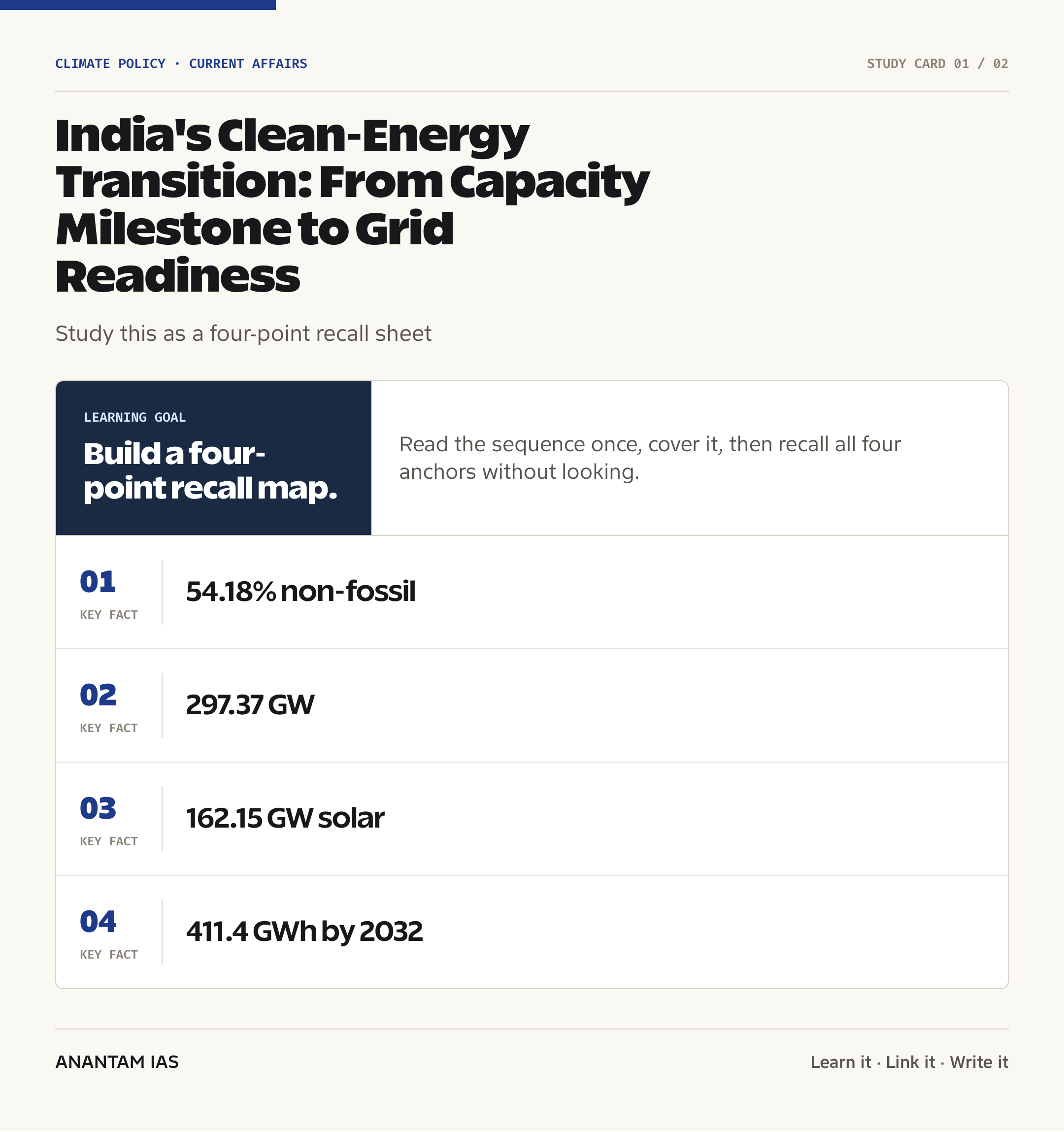
- The Central Electricity Authority (CEA) recorded 297,369 MW of non-fossil capacity out of 548,858 MW on 30 June 2026, a share of 54.18%.
- He identified grids, storage and electrification as the next investment priorities rather than treating capacity addition as the finish line.
- The Turkish COP31 Presidency has announced an Action Agenda objective of raising electricity’s share of final energy demand to 35% by 2035; this is a COP action objective, not an Indian national target.
- Stiell also stressed delivery of international climate finance, including adaptation finance and the wider pathway towards $1.3 trillion a year for developing countries.
The development matters in the context of:
- India’s transition has moved from proving that renewable capacity can scale to ensuring that variable generation can be transmitted, balanced and delivered when demand rises.
- A higher clean-capacity share doesn’t automatically produce the same generation share; output depends on availability, resource conditions, plant load factors, transmission and dispatch.
- Grid investment connects energy security with climate implementation.
UPSC Relevance
Prelims Relevance
- India’s updated NDC commits to about 50% cumulative electric power installed capacity from non-fossil sources by 2030; this refers to capacity, not electricity generation.
- The government’s separate 500 GW non-fossil capacity objective for 2030 was announced as part of the Panchamrit commitments; it shouldn’t be confused with the percentage formulation in the NDC.
- Non-fossil capacity includes renewable energy, large hydro and nuclear power; it isn’t identical to solar and wind capacity alone.
- Installed capacity is measured in MW or GW, while electricity generated over time is measured in MWh, GWh or billion units.
- Storage power is measured in MW or GW, while its energy-holding capability is measured in MWh or GWh; their ratio indicates discharge duration.
- Major storage routes include battery energy storage systems (BESS) and pumped-storage hydropower, or PSP.
Mains Relevance
GS Paper 3
- Energy infrastructure: transmission, distribution, storage, forecasting and flexible resources required for reliable renewable integration.
- Environmental policy: the difference between installed-capacity achievement and actual decarbonisation of electricity generation and final energy use.
- Indian economy: clean manufacturing, import vulnerability, investment costs, jobs and the financial health of distribution companies.
- Disaster resilience: adaptation finance and climate-resilient grids as protection against heat, floods, cyclones and demand shocks.
GS Paper 2
- International relations: climate multilateralism, equity and India’s negotiating interest in predictable finance and technology access.
- Global governance: the shift from headline COP pledges to implementation through national policy, public finance and non-state actors.
Essay
- The energy transition is an infrastructure transformation, not simply a substitution of one fuel with another.
Background and Context
What the Capacity Milestone Means
India has met the percentage component of its 2030 non-fossil capacity commitment early, but the milestone describes the power system’s asset base rather than its delivered electricity.
- India crossed the 50% non-fossil installed-capacity threshold in June 2025, according to the Ministry of New and Renewable Energy; Stiell called this achievement five years early.
- The CEA’s official June 2026 report placed total installed capacity at 548.858 GW and non-fossil capacity at 297.369 GW.
- The non-fossil category also contains biomass, waste-to-energy and small hydro. It is broader than the common shorthand of solar plus wind.
- India’s solar-energy expansion is the largest component of the new non-fossil base, but a diversified portfolio can reduce exposure to any single resource profile.
- The government’s 500 GW by 2030 ambition is an absolute-capacity objective. It remains a distinct policy benchmark even though the NDC’s 50% capacity share has already been crossed.
Capacity Is Not Generation
The distinction between rated power and electricity produced is central to reading India’s energy-transition statistics correctly.
- Generation is the electricity produced over a period and is expressed in MWh, GWh or billion units; one billion unit equals one terawatt-hour.
- A 1 GW solar fleet doesn’t generate 1 GW continuously because sunlight varies by hour, season, cloud cover and location. Coal, nuclear and hydro plants also face maintenance, fuel, water and dispatch constraints.
- A technology’s capacity factor compares actual output with the maximum possible output over the same period. Different capacity factors mean capacity shares and generation shares diverge.
- So the 54.18% figure must not be rewritten as ‘54.18% of India’s electricity is generated from non-fossil sources.’ The official figure is explicitly an installed-capacity share.
- Decarbonisation depends on actual clean generation, reduced fossil dispatch, efficient demand and electrification of transport, industry and buildings, not capacity addition alone.
Why Grids Become the Binding Constraint
As variable renewable capacity grows, the grid must move electricity across regions and balance supply and demand continuously.
- Solar output is concentrated in daylight hours, while evening demand can remain high. This creates steep ramping needs when solar output falls.
- Renewable-rich regions may produce more power than local networks can evacuate. New interstate and intrastate transmission must arrive in step with generation to avoid congestion and curtailment.
- The distribution network is the last-mile constraint. Rooftop solar, electric vehicles and batteries can reverse or reshape power flows that older feeders weren’t designed to manage.
- Distributed energy resources can support the grid when smart inverters, time-based tariffs, aggregation and consumer protection are designed together.
- Grid resilience also has a climate dimension: substations, lines and control systems must withstand extreme heat, floods, cyclones and wildfire risk.
Storage Adds Time to the Power System
Storage shifts electricity across time, supplies flexibility and reduces the need to match every unit of generation with immediate consumption.
- BESS can respond rapidly for frequency control, peak shifting, renewable firming, congestion relief and backup, but economics depend on duration, cycling and revenue stacking.
- Pumped-storage projects move water to a higher reservoir when electricity is available and release it through turbines later; they can offer long-duration storage but need suitable sites and careful environmental appraisal.
- The MNRE storage overview, citing CEA’s National Electricity Plan 2023, projects a requirement of 82.37 GWh in 2026-27 and 411.4 GWh in 2031-32.
- Those figures are planning requirements, not statements of storage already installed. The 2031-32 projection comprises 175.18 GWh from PSP and 236.22 GWh from BESS.
- The Ministry of Power’s 2025-26 annual report says the Union government is supporting 43.85 GWh of BESS through two viability-gap-funding arrangements; supported or awarded capacity isn’t the same as commissioned capacity.
- Storage procurement should specify both power and energy, because MW defines discharge rate while MWh determines how long that output can be sustained.
Electrification Links Supply with Final Demand
Clean power produces wider climate and security gains only when electricity displaces fossil fuels in transport, industry, buildings and other end uses.
- The COP31 Action Agenda objective cited by Stiell seeks to raise electricity’s share of global final energy demand to 35% by 2035.
- This shouldn’t be presented as a new Indian NDC commitment. It is an international action-agenda objective announced by the Turkish COP31 Presidency.
- Electric vehicles can reduce oil exposure when their charging is coordinated with clean generation and grid capacity; unmanaged charging can add stress to local peaks.
- The climate value of electrification depends on the marginal electricity source. Faster clean generation, transmission and storage must accompany demand-side conversion.
- For India, the co-benefits include cleaner urban air, lower exposure to volatile imported fuels and new domestic markets for electrical equipment and clean technology.
Climate Finance and the COP31 Implementation Test
The central multilateral question is whether developing countries can obtain affordable capital for both low-carbon infrastructure and protection from worsening climate impacts.
- Stiell said developed countries must triple adaptation finance and deliver $300 billion a year by 2035 as part of a clear pathway towards $1.3 trillion annually.
- The figures should be read in their UN climate-finance context: the $300 billion goal is the core developed-country-led mobilisation level, while $1.3 trillion is the wider developing-country finance pathway involving all sources.
- India needs mitigation capital for grids, storage, clean industry and transport, but also adaptation finance for heat action, water security, climate-resilient agriculture, coasts and disaster preparedness.
- The quality of finance matters. High-cost foreign-currency debt can worsen fiscal and exchange-rate risk, while grants and concessional finance are especially important for adaptation, where revenue streams are weak.
- The climate-finance framework rests on equity and capability, while the Paris Agreement combines nationally determined action with support, transparency and periodic ambition cycles.
Economic Opportunity and Transition Risks
Clean energy can strengthen competitiveness, but the gains depend on supply-chain depth, affordable power and a transition that protects workers and consumers.
- Stiell highlighted India’s technology workforce and manufacturing potential, including opportunities in electrical equipment, green steel and other clean technologies.
- Coal-dependent districts need advance planning for worker reskilling, municipal revenue, land restoration, pension security and new productive investment. A just transition is place-based, not only sector-wide.
- Distribution companies must remain financially capable of buying power, maintaining networks and investing in digital systems. Weak utility finances can delay both renewable integration and reliable service.
- Land acquisition, biodiversity, recycling, mineral supply and community consent remain material constraints. Clean technology has a smaller climate burden than fossil systems, but it isn’t impact-free.
- The policy standard should be reliable, affordable and progressively cleaner electricity, supported by transparent data on generation, emissions, outages, curtailment and costs.
Way Forward
Plan Generation, Networks and Storage Together
- Synchronise renewable auctions with transmission readiness, land access, storage procurement and realistic commissioning schedules.
- Use CEA resource-adequacy planning and state-level demand forecasts to procure the right mix of energy, peak capacity, reserves and duration.
Create Markets for Flexibility
- Deepen ancillary-service, time-of-day and demand-response mechanisms so flexible resources are paid for the system value they provide.
- Allow batteries, pumped storage, electric vehicles and aggregated consumer resources to compete under technology-neutral performance rules.
Repair the Distribution Layer
- Improve feeder data, metering, loss reduction, subsidy payment and cost recovery while protecting basic energy access for vulnerable households.
- Tie reform support to service-quality outcomes such as fewer outages, faster connections and transparent renewable curtailment.
Seek Better Climate Finance
- Build bankable public pipelines for adaptation and grid resilience, where social returns are high but commercial cash flows may be limited.
- Press for predictable grants, concessional funds, guarantees, technology access and fair multilateral-development-bank reform while improving domestic project governance.
Conclusion
India’s early non-fossil capacity milestone is substantial, but it marks the start of the systems phase of the transition. Generation, transmission, distribution, storage and new electrical demand now have to expand as one coordinated architecture.
COP31 can sharpen that implementation agenda, yet international objectives aren’t substitutes for national planning. India should pair competitive clean manufacturing with a resilient grid, financially viable utilities, honest capacity-versus-generation accounting and a fair transition for affected regions.
The decisive question is no longer whether clean capacity can grow. It is whether that capacity can deliver reliable, affordable and low-carbon energy while climate finance also reaches adaptation needs that markets routinely undersupply.
UPSC Practice Questions
Prelims MCQ 1
With reference to India’s non-fossil electricity capacity, consider the following statements:
- The category includes renewable energy, large hydro and nuclear power.
- A 54% non-fossil installed-capacity share necessarily means 54% of electricity generation is non-fossil.
- India’s updated NDC expresses its 2030 non-fossil electricity commitment as a share of cumulative installed capacity.
How many of the above statements are correct?
(a) Only one (b) Only two (c) All three (d) None
Answer: (b) Only two
Explanation:
Statements 1 and 3 are correct. Statement 2 confuses installed capacity, measured in MW or GW, with electricity generated over time. Resource availability, capacity factors, transmission and dispatch cause the shares to differ.
Prelims MCQ 2
Which one of the following correctly distinguishes the ratings of a battery energy storage system?
(a) MW measures stored energy, while MWh measures discharge power (b) MW measures discharge power, while MWh measures energy-holding capability (c) MW and MWh are interchangeable ratings (d) MWh measures only the battery’s charging losses
Answer: (b) MW measures discharge power, while MWh measures energy-holding capability
Explanation:
MW is the instantaneous power rating, while MWh is the quantity of energy available over time. Dividing MWh by MW gives the approximate discharge duration at rated power.
UPSC Mains Questions
- India’s early achievement of a majority non-fossil installed-capacity share is necessary but insufficient for power-sector decarbonisation. Examine the difference between capacity and generation, and analyse why grids, storage and distribution reform are now the central transition challenges. (250 words)
- Climate finance must support both clean-energy infrastructure and adaptation while avoiding unsustainable debt for developing countries. Discuss India’s priorities in the COP31 implementation agenda and suggest principles for effective international and domestic financing. (250 words)
Sources: UN Climate Change and The Hindu.
Frequently Asked Questions
What did India achieve ahead of 2030?
India crossed the point where non-fossil sources account for at least half of cumulative installed electric-power capacity. The milestone was reached in June 2025, five years before the 2030 date in India’s updated NDC. It refers to installed capacity, not to half of actual electricity generation.
What was India’s non-fossil capacity in June 2026?
CEA’s report for 30 June 2026 recorded 297,369 MW of non-fossil capacity out of 548,858 MW total installed capacity. That equals 54.18%. The non-fossil total includes renewable sources, large hydro and nuclear power, so it is broader than solar and wind alone.
Why doesn’t capacity equal generation?
Capacity is the rated power of installed assets, measured in MW or GW. Generation is electricity produced across time, measured in MWh, GWh or billion units. Solar and wind output varies with resources, while every technology also faces availability and dispatch constraints, so the two percentage shares differ.
Why does a renewable grid need storage?
Storage moves electricity from periods of surplus to periods of higher demand and can supply fast balancing, reserves and congestion relief. Batteries respond quickly, while pumped storage can provide longer duration. Storage complements transmission, forecasting and flexible demand; it doesn’t remove the need for those grid investments.
Is 35% electrification by 2035 India’s target?
No. Simon Stiell referred to a COP31 Action Agenda objective announced by the Turkish COP31 Presidency: electricity should meet 35% of final energy demand by 2035. It is an international action objective and must not be presented as a new target in India’s NDC.
What climate finance figures did Stiell cite?
Stiell called for developed countries to triple adaptation finance and deliver $300 billion annually by 2035 within a pathway towards $1.3 trillion a year for developing countries. The larger figure involves finance from all sources; the quality, concessionality, accessibility and debt impact of that finance remain central concerns.