

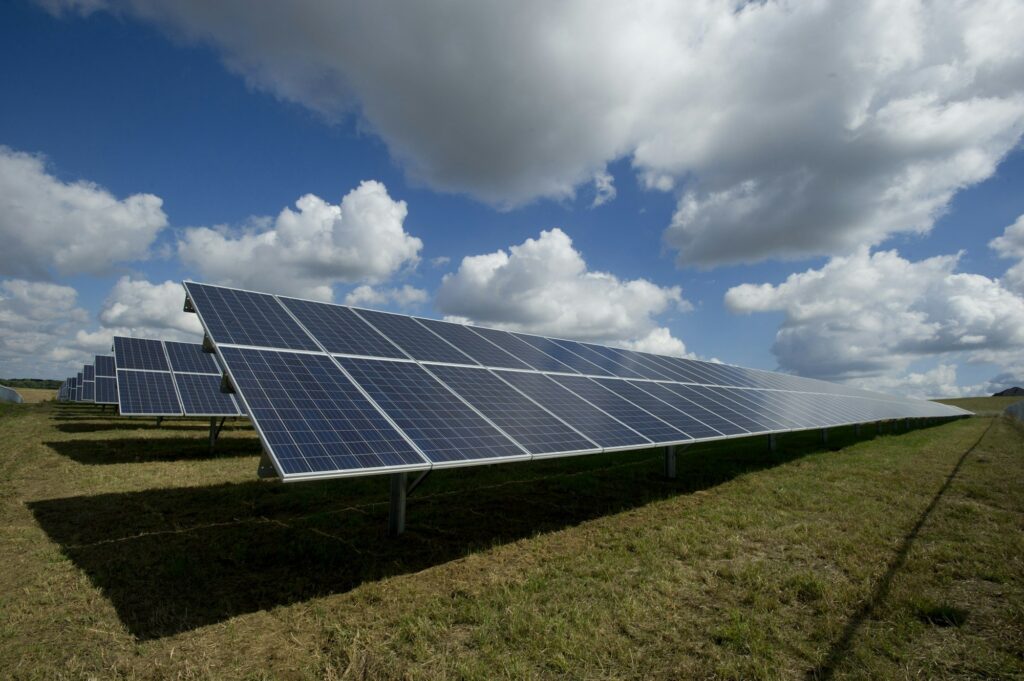
Solar energy in India is the cornerstone of the country’s energy transition and the largest single contributor to the 500 GW non-fossil electricity capacity that the Government of India has promised to achieve by 2030. From a tiny base of about 18 MW of grid-connected capacity at the launch of the Jawaharlal Nehru National Solar Mission (JNNSM) in January 2010, solar energy in India has grown past 95 GW of installed capacity by early 2026, making the country the world’s third-largest solar market after China and the United States. The growth has been driven by a sharp fall in solar tariffs, the production-linked incentive (PLI) scheme for solar cells and modules, mega solar parks like Bhadla and Pavagada, the PM-Surya Ghar Muft Bijli Yojana for one crore rooftops, and the diplomatic push of the International Solar Alliance. Together with green hydrogen, battery storage and distributed energy resources, solar energy is central to India’s Paris Agreement commitments and the net-zero by 2070 pledge.
Solar Energy Potential in India
India sits in the solar sweet spot — between latitudes 8°N and 37°N, with 250–300 clear sunny days a year and an average solar insolation of 4–7 kWh per square metre per day. The Ministry of New and Renewable Energy (MNRE) estimates the country’s total solar power potential at around 748 GW, factoring in land availability and irradiance. Rajasthan, Gujarat, Maharashtra, Madhya Pradesh, Andhra Pradesh, Karnataka and Telangana account for the bulk of the potential. Solar energy in India is therefore not a question of resource but of policy, finance, grid integration and manufacturing.
Jawaharlal Nehru National Solar Mission — The Launchpad
The Jawaharlal Nehru National Solar Mission (JNNSM) was launched on 11 January 2010 with an original target of 20 GW of grid-connected solar capacity by 2022. The mission proceeded in three phases.
Phase I (2010-13)
Phase I focused on demonstrating the technology and creating the regulatory framework. Tariffs at this stage were high — around ₹17 per unit. The Solar Energy Corporation of India (SECI) and NTPC Vidyut Vyapar Nigam acted as off-takers, signing 25-year power purchase agreements with developers. The phase introduced reverse-auction bidding which became the template for future capacity addition.
Phase II (2013-17)
Phase II tripled the target and saw tariffs collapse as global module prices fell. By 2017 solar tariffs in India had touched ₹2.44 per unit in the Bhadla Phase III auction — the lowest in the world at the time.
Revised Target — 100 GW by 2022, Then 500 GW by 2030
In 2015, recognising the scale of the opportunity, the Union Government revised the JNNSM target to 100 GW of solar capacity by 2022, comprising 60 GW utility-scale and 40 GW rooftop solar. The target was missed for rooftop but solar capacity addition stayed strong. At the 2021 Glasgow COP26 summit, Prime Minister Narendra Modi announced India’s “Panchamrit” pledges — including 500 GW of non-fossil installed electricity capacity by 2030 and 50% of electricity from non-fossil sources by 2030. Solar will deliver roughly 60% of that 500 GW number.
Installed Solar Capacity in 2026 — Where India Stands
By early 2026 India’s grid-connected solar capacity is over 95 GW, with another 25–30 GW under construction or under PPA. Capacity is concentrated in:
- Rajasthan — over 23 GW, led by the Bhadla Solar Park.
- Gujarat — over 14 GW, including the Khavda solar-wind hybrid park.
- Karnataka — over 9 GW, anchored by the Pavagada Solar Park.
- Tamil Nadu — over 7 GW, including the Kamuthi project.
- Andhra Pradesh, Telangana, Maharashtra, Madhya Pradesh — 5–8 GW each.
Rooftop solar accounts for about 12 GW of the total — still well short of the original 40 GW rooftop target.
Large Solar Parks — Bhadla, Pavagada, Khavda
The Ultra-Mega Solar Park scheme launched in 2014 created a fast track for large solar farms by aggregating land, transmission and clearances.
Bhadla Solar Park, Rajasthan
Bhadla in Jodhpur district is the largest operational solar park in India and one of the largest in the world, with 2,245 MW of installed capacity spread over 14,000 acres. Temperatures here cross 48°C in summer, and panels are cleaned by autonomous robots to deal with the dust.
Pavagada Solar Park, Karnataka
Pavagada in Tumakuru district has 2,050 MW of capacity over 13,000 acres. The land was leased from over 2,300 farmers for 28 years, earning them annual rents — a model often cited as socially equitable.
Khavda Renewable Energy Park, Gujarat
Khavda in the Rann of Kutch is being developed as a 30 GW solar-wind hybrid park spread across 72,600 hectares. When complete it will be the largest renewable energy park in the world.
PM-Surya Ghar Muft Bijli Yojana — Rooftop at Scale
PM-Surya Ghar Muft Bijli Yojana was launched in February 2024 with an outlay of ₹75,021 crore. The scheme targets one crore households with rooftop solar systems by FY 2026-27 and provides free electricity of up to 300 units per month. Households receive a central subsidy of up to ₹78,000 for a 3 kW system, with concessional loans at around 7% interest available through participating banks. By early 2026 over 14 lakh installations have been completed and another 30 lakh applications are in the pipeline. PM-Surya Ghar effectively re-energises the rooftop solar segment which had stalled at around 9 GW by 2023.
PLI Scheme for Solar Cells and Modules
India imports the majority of its solar cells and modules, primarily from China. To build a domestic ecosystem the Government launched a PLI scheme for high-efficiency solar PV modules in 2021 (Tranche I — ₹4,500 crore) and expanded it in 2022 (Tranche II — ₹19,500 crore). Tranche II awarded 39,600 MW of fully integrated polysilicon-to-module capacity to firms including Reliance New Energy, Waaree, Tata Power, Adani Solar, Avaada, Vikram Solar and First Solar. Combined Tranche I and II awards take domestic module capacity past 65 GW by 2026, and cell capacity past 30 GW.
The PLI is paired with import-side measures — the Approved List of Models and Manufacturers (ALMM) and Basic Customs Duties of 25% on cells and 40% on modules — to give domestic manufacturers a protected runway.
International Solar Alliance
The International Solar Alliance (ISA) was co-founded by India and France at COP21 in Paris in November 2015 and became a full-fledged treaty-based organisation in December 2017. Headquartered at Gurugram, the ISA had 120 signatory countries by 2025 and aims to mobilise $1 trillion of investment in solar energy by 2030 across developing and tropical countries. ISA flagship programmes include Solarising Heating and Cooling, the Affordable Finance at Scale initiative, the One Sun One World One Grid (OSOWOG) framework for cross-border green-grid connections and STAR-C training centres.
The ISA is one of India’s most successful climate-diplomacy outputs and reflects the geopolitical shift towards solar-dominant energy systems in the Global South.
Solar Tariff Trends
The single most important reason solar energy in India has scaled is the steep fall in tariffs. From ₹17 per unit in 2010, tariffs fell to ₹4.34 in 2016, ₹2.44 in 2017 at Bhadla, and around ₹2.40-2.60 in 2021-23 auctions. Recent auctions including SECI’s hybrid and round-the-clock tenders have settled at ₹2.50-2.95 per unit, reflecting higher module prices and inverter costs but also confirming that solar plus storage now beats new coal on a levelised cost basis.
Challenges Facing Solar Energy in India
- Discom financial health. State distribution companies have weak balance sheets and have at times delayed payments or sought to renegotiate solar PPAs. This raises the cost of capital for developers.
- Land and transmission. Large solar parks need contiguous land and dedicated evacuation infrastructure — both scarce and politically sensitive in many states.
- Module manufacturing depth. Despite the PLI, India still imports the bulk of its polysilicon and wafers from China. Backward integration is in progress but incomplete.
- End-of-life waste. Solar modules have a 25-year design life; the first wave of utility installations will start retiring after 2035. India has only a draft framework for solar PV waste management.
- Grid integration. Solar is variable. Without sufficient battery storage, pumped hydro and demand-response mechanisms, high solar penetration causes grid balancing issues.
Way Forward
Solar energy in India must now scale to roughly 280–300 GW by 2030 to underpin the 500 GW non-fossil target. That requires sustained auction volumes of 40-50 GW per year, deep deployment of battery and pumped-storage hybrids, accelerated rooftop adoption through PM-Surya Ghar, and a full domestic supply chain from polysilicon to module. Combined with green hydrogen for industrial decarbonisation, solar energy will be the largest single building block of India’s net-zero economy.
Frequently Asked Questions
What is solar energy in India’s installed capacity?
India had over 95 GW of grid-connected solar capacity by early 2026, making it the third-largest solar market in the world after China and the United States.
What is JNNSM?
The Jawaharlal Nehru National Solar Mission was launched on 11 January 2010 with an original target of 20 GW of grid-connected solar capacity by 2022. The target was revised upward to 100 GW by 2022 and now 500 GW of non-fossil capacity by 2030.
What is PM-Surya Ghar Muft Bijli Yojana?
PM-Surya Ghar Muft Bijli Yojana is a rooftop solar scheme launched in February 2024 with an outlay of ₹75,021 crore. It targets one crore households with rooftop solar and gives up to 300 units of free electricity per month.
What is the largest solar park in India?
Bhadla Solar Park in Rajasthan with 2,245 MW is the largest operational solar park in India. The upcoming Khavda Renewable Energy Park in Gujarat will be 30 GW when complete.
What is the International Solar Alliance?
The International Solar Alliance is a treaty-based organisation co-founded by India and France in 2015 to mobilise investment in solar energy across developing countries. It is headquartered at Gurugram and has 120 signatory countries.
What is the PLI scheme for solar?
The Production-Linked Incentive scheme for high-efficiency solar PV modules has a combined outlay of ₹24,000 crore across two tranches and has awarded 48,000 MW of integrated polysilicon-to-module capacity to leading Indian and foreign firms.
What are the lowest solar tariffs in India?
Solar tariffs in India fell from ₹17 per unit in 2010 to a record low of ₹2.36 per unit in 2020 at the Rewa solar park, with recent auctions settling at ₹2.50-2.95 per unit.
What are the main challenges for solar energy in India?
Discom financial weakness, land and transmission bottlenecks, dependence on imported polysilicon and wafers, end-of-life PV waste management and grid integration are the main challenges.
Tell Google you want more of this.
Add Anantam IAS as a preferred sourceOne tap, and this site shows up more often in your own Top Stories, AI Overviews and AI Mode. Remove it any time.






