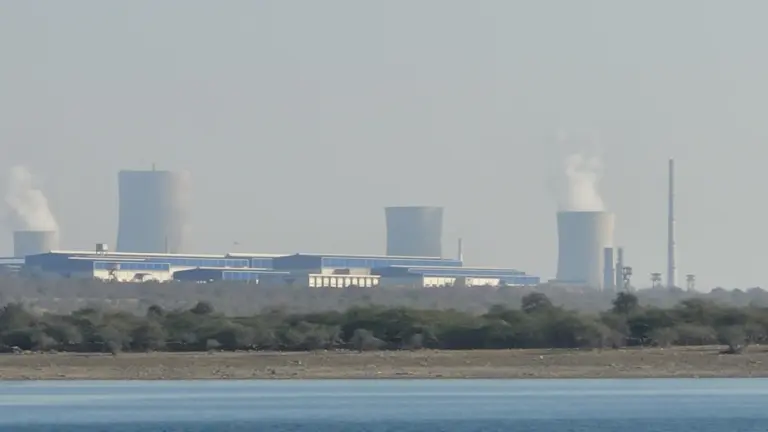
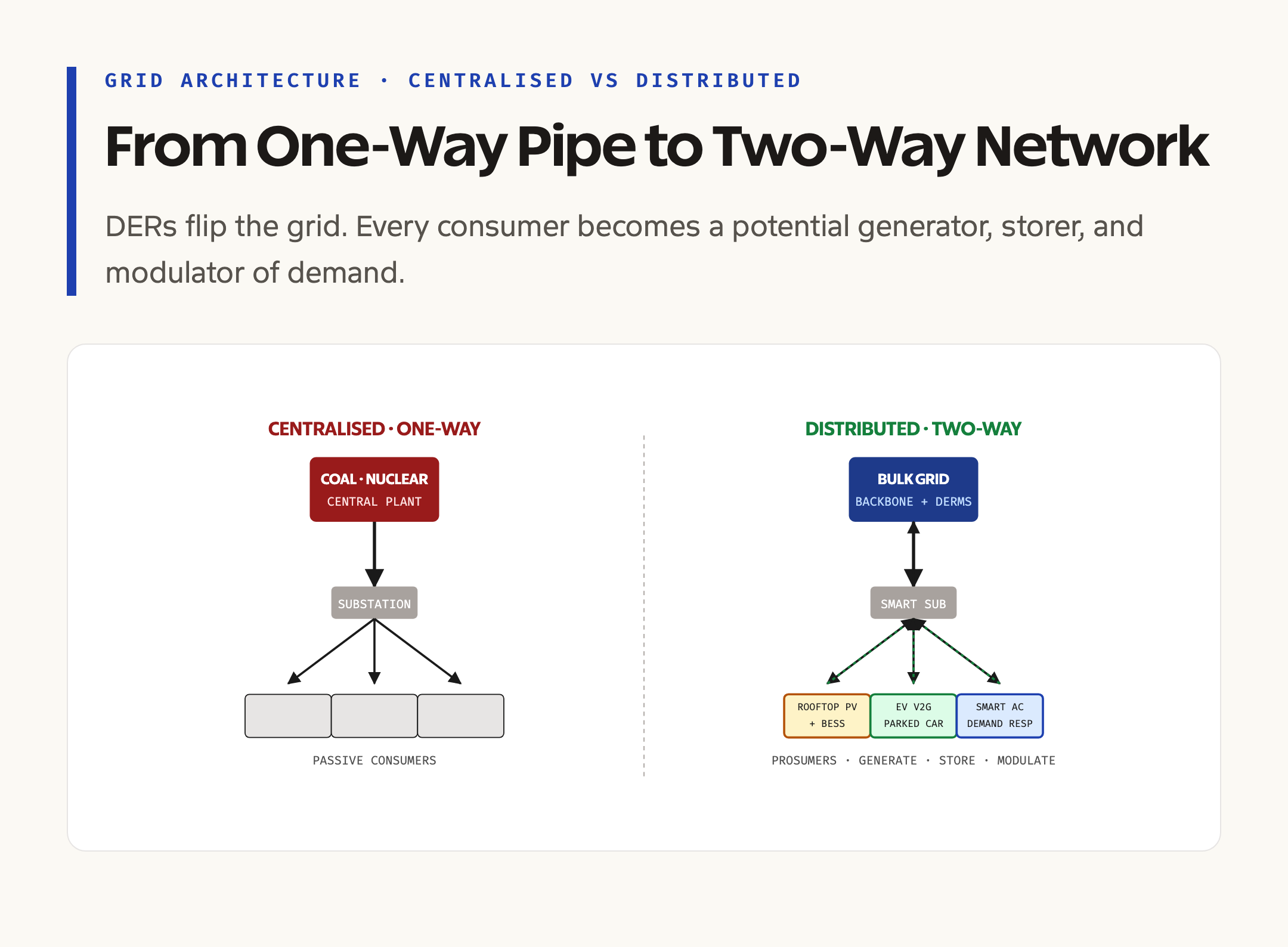
The traditional electricity grid was built around a small number of very large generating stations. A coal plant, a hydro dam, or a nuclear unit generated power at one end, high-voltage transmission lines carried it across the country, distribution companies stepped the voltage down, and consumers drew power from the wall. The flow was one-way. The consumer was a passive load. The grid operator’s job was to match supply to demand by dispatching plants on a merit-order curve.
That picture is changing. Rooftop solar panels turn a household into a small generator. A home battery turns it into a small storage operator. An electric vehicle parked at the curb is a battery that can either draw from the grid or push power back into it. A factory with a microturbine and a fuel cell can island itself from the grid in an emergency. A smart air conditioner can be paused for twenty minutes during peak load. The grid still has the big plants, but the edge has gone from passive to active.
The collective name for the small, edge-sited assets is distributed energy resources, or DERs. They sit close to where the electricity is used, rather than at a central location. They generate, store, or modulate consumption. They turn the grid from a one-way pipe into a two-way network. For UPSC GS-III, the topic spans renewables, energy security, smart cities, and the institutional reform of distribution companies. This article walks through what DERs are, how they fit together, how India is deploying them, and what the policy stack now looks like. For broader context, see renewable energy, perovskite solar cells, and solar energy.
What Counts as a Distributed Energy Resource
A distributed energy resource is any small-scale electricity asset located at or near the point of consumption rather than at a central generating station. The size threshold is fluid. A few kilowatts on a residential rooftop. A few hundred kilowatts on a commercial roof. A few megawatts at an industrial campus. The defining quality is location, not scale. A DER is on the consumer’s side of the substation, connected to the distribution network rather than to the bulk transmission grid.
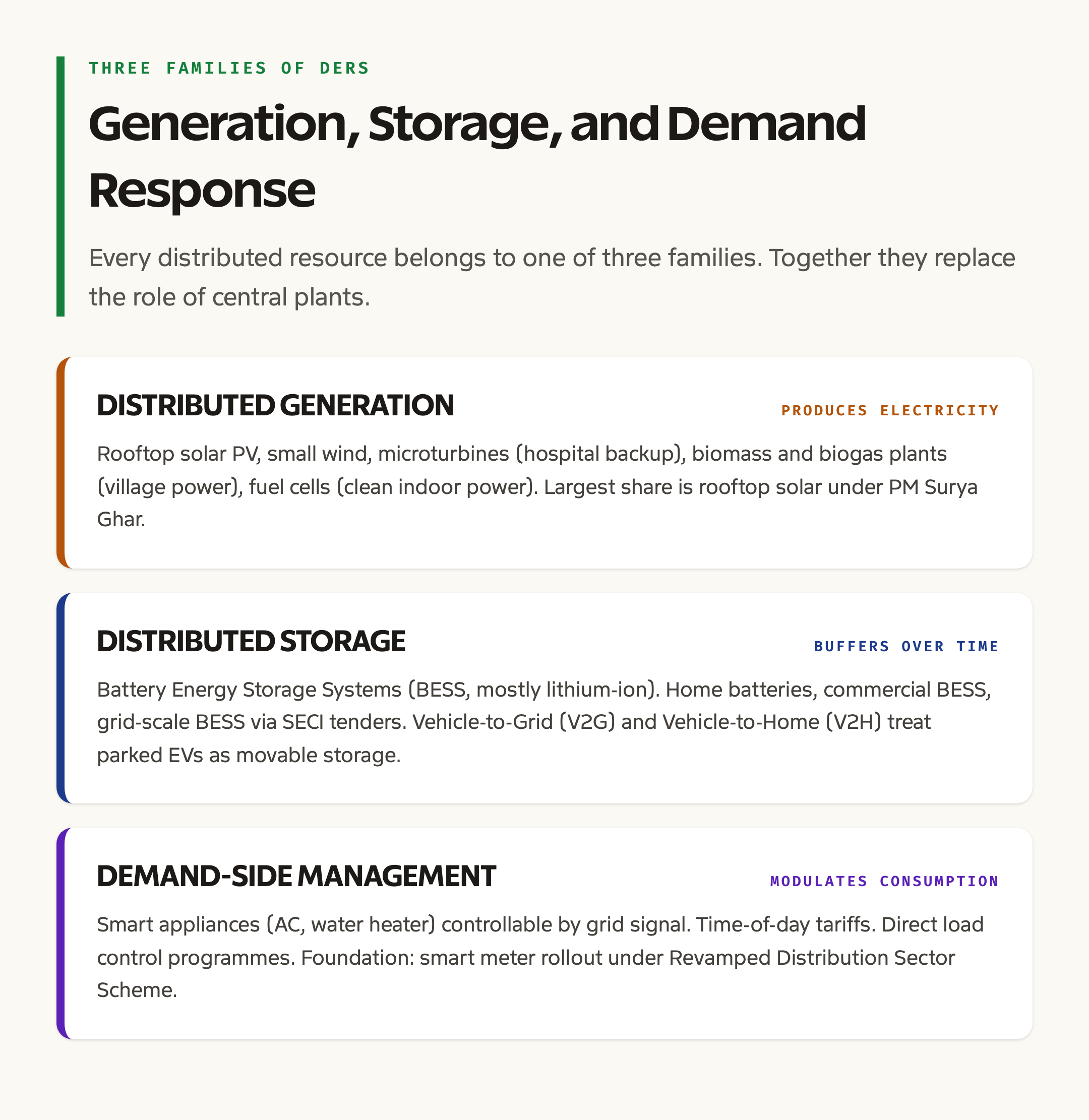
DERs split into three families. The first is distributed generation, which produces electricity. The second is distributed storage, which buffers electricity over time. The third is demand-side management, which modulates consumption rather than supply. All three families coordinate through the distribution network, often under a software layer called a distributed energy resource management system, or DERMS.
Distributed Generation
The largest category by deployment is distributed generation. Rooftop solar PV is the most visible. A household installs a few kilowatts of panels on the roof, an inverter converts the DC output to AC, and a smart meter records both consumption from the grid and export to the grid. Excess generation during the day is exported under net metering or gross metering rules, depending on the state. The financial logic depends on the import-export tariff differential, the capital cost of the system, and the available subsidy.
Small wind turbines occupy a smaller niche, mostly in agricultural and remote applications where wind speeds are favourable. Microturbines are small gas turbines used in hospitals, data centres, and factories that need backup power and can use waste heat productively in a combined heat and power configuration. Biomass and biogas plants serve villages and agricultural clusters, taking organic waste and producing electricity for local consumption. Fuel cells run on hydrogen or natural gas and produce both electricity and heat with no combustion, suited for clean indoor applications.
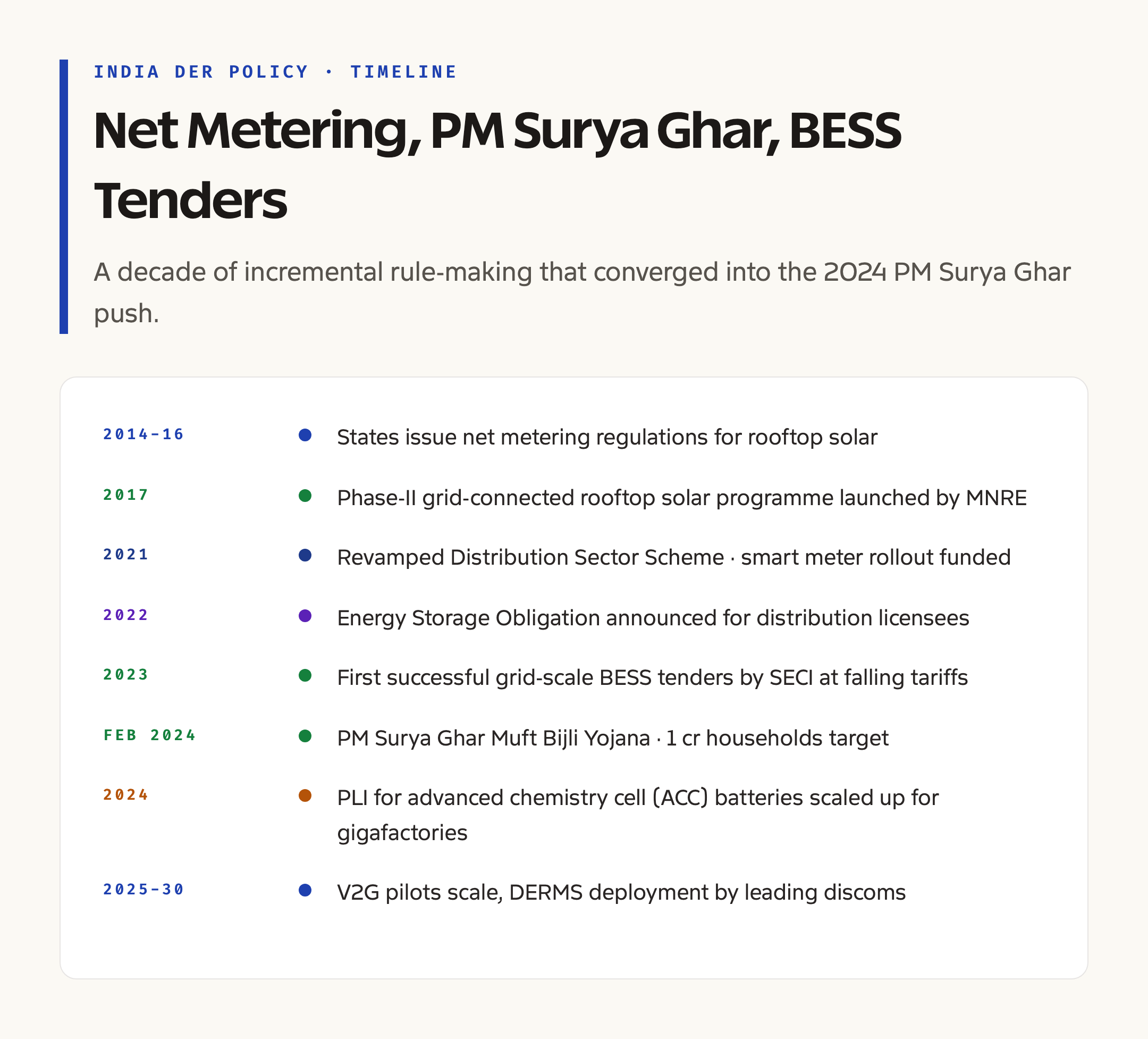
The aggregate capacity of distributed generation in India is dominated by rooftop solar at the moment. The PM Surya Ghar Muft Bijli Yojana, launched in 2024, set a target of one crore households with rooftop solar and provides direct capital subsidy for systems up to three kilowatts. Earlier rooftop subsidy schemes had progressed slowly because of distribution company resistance. The new scheme bypasses several of the older bottlenecks by routing the subsidy directly to the household.
Distributed Storage
Distributed storage is the second family. Battery energy storage systems, abbreviated BESS, are the dominant technology. A residential BESS is a battery the size of a small wardrobe, paired with an inverter, that charges during cheap or solar-rich hours and discharges during expensive or solar-poor hours. A commercial BESS scales the same idea up to several hundred kilowatt-hours. Industrial BESS systems can reach into the megawatt-hours, providing peak shaving, load balancing, and backup power.
Lithium-ion is the dominant chemistry today. Lithium iron phosphate (LFP) is the increasingly preferred sub-chemistry for stationary storage because of its safety and cycle life, even though it has lower energy density than nickel-rich chemistries. Sodium-ion is a long-term alternative for stationary applications where energy density is less important than cost and material availability. Flow batteries occupy a niche for very long-duration storage.
Electric vehicles are an emerging form of distributed storage. The battery in an EV is much larger than a typical home battery. When the vehicle is parked, which is most of the time, the battery is idle. Vehicle-to-grid, abbreviated V2G, connects the EV to the home or grid as a controllable storage asset. Vehicle-to-home, abbreviated V2H, is the simpler version that powers the house from the car battery during outages. Pilots are running in India and other markets, and the technology is maturing rapidly. The challenge is regulatory, not technical. The tariff structure, the warranty implications for the EV battery, and the metering arrangement need to be settled before V2G scales.
Demand-Side Management
The third family is demand-side management. Instead of generating or storing electricity, demand-side management modulates consumption. The simplest version is a time-of-day tariff, which signals to consumers when electricity is cheap or expensive. The next step up is direct load control, where the distribution company can remotely turn down or off specific loads such as air conditioners, water heaters, or industrial processes during peak hours. The smart appliance with a built-in radio that can receive a grid signal is the consumer end of this system.
Demand-side management is harder than generation or storage because it requires consumer cooperation and a granular metering and communication layer. India’s smart meter rollout, supported by the Revamped Distribution Sector Scheme, is laying the foundation. Once millions of smart meters are in place, distribution companies can offer time-of-day tariffs, run direct load control programmes, and credit consumers for participation in demand response.
How DERs Change the Grid
The traditional grid is a one-way flow from a few large plants to many small consumers. With DERs, every consumer is potentially a small generator and a small storage operator. The grid operator’s job changes. It no longer schedules a few large dispatchable plants to follow load. It coordinates millions of small assets, many of which are uncontrollable from a central perspective.
The technical implications are significant. Voltage rises during high export hours on a feeder with many rooftop solar systems. Reverse power flows can confuse traditional protection systems that were designed to assume one-way flow. Frequency control becomes harder when the grid loses inertia from rotating generators. The technical fix is a combination of inverter standards, voltage regulators, smart transformer tap settings, and a software DERMS that aggregates and dispatches the small assets.
The institutional implications are larger. The distribution company in a DER-rich grid is not a passive seller of electricity. It is a network operator and a service provider. Its revenue model needs to shift from selling energy by the kilowatt-hour to selling network access and ancillary services. The Indian distribution sector reform, including the unbundling of supply from distribution licences and the introduction of competition in supply, is partly motivated by this transformation.
Net Metering, Gross Metering, and the Settlement
The financial settlement for rooftop solar depends on the metering arrangement. Net metering counts only the net flow across the meter at the end of the billing period. Excess generation is netted against consumption. Gross metering meters the export and the import separately, with each settled at a different tariff. Most Indian states use net metering for residential systems below a threshold size, and gross metering for larger systems. The choice of arrangement and the tariff differential between import and export determine the consumer’s payback period and the distribution company’s revenue exposure.
A high export tariff makes rooftop solar more attractive but compresses the distribution company’s revenue. A low export tariff protects the company’s revenue but slows adoption. The state regulator sets the balance, and the balance shifts over time as deployment grows. The PM Surya Ghar scheme tries to ease the trade-off by providing capital subsidy that reduces the consumer’s payback period without requiring a generous export tariff.
Battery Energy Storage at Grid Scale
Beyond residential and commercial BESS, India is now deploying utility-scale battery storage on a large scale. The Solar Energy Corporation of India and various state utilities have run successful tenders for grid-scale BESS, with prices falling rapidly. A typical contract is a four-hour battery paired with solar generation, used to shift solar output from the daytime production peak to the evening consumption peak. This is the use case that displaces gas-fired peaking power most directly.
The economics of grid-scale BESS depend on lithium-ion cell prices, which have fallen by an order of magnitude over the last decade and continue to decline. Indian gigafactory projects, supported by the production-linked incentive scheme for advanced chemistry cells, aim to bring battery cell production into the country, reducing import dependence and exposure to global lithium and battery supply chains.
Microgrids and Energy Access
DERs have a special role in energy access. A microgrid is a small grid that can operate independently of the main network. A village microgrid might combine a solar array, a battery, a diesel backup, and local loads. When the main grid is unavailable or unreliable, the microgrid keeps the lights on. Microgrids are deployed in remote areas, on islands, and in defence installations.
In rural India, the role of microgrids has shifted as central grid extension has reached most villages. The remaining role is in islands such as Lakshadweep and the Andamans, in remote border areas, and in disaster-resilience deployments. The technology is also relevant for industrial campuses that want to island themselves during grid outages.
Policy Stack and the Path Forward
The Indian DER policy stack is built up of several layers. The Electricity Act of 2003 provides the framework. The state electricity regulatory commissions set net metering and gross metering rules. The Ministry of New and Renewable Energy administers solar subsidy schemes including PM Surya Ghar. The Revamped Distribution Sector Scheme funds smart meters and distribution infrastructure upgrades. The Ministry of Power has tendered grid-scale BESS through SECI. Standards for smart inverters and grid interconnection are issued through the Bureau of Indian Standards and the Central Electricity Authority.
The remaining gaps are in vehicle-to-grid regulation, which is still in pilot phase, in storage tariff design at the distribution level, and in the integration of DERs into the system operator’s dispatch process. The regulatory architecture is evolving, but the trajectory is clear: India is moving from a centralised grid to a hybrid model in which the bulk system provides backbone capacity and a network of millions of DERs provides flexibility, resilience, and lower-carbon supply at the edge.
Why It Matters for UPSC
DERs touch multiple GS-III themes. The energy transition is the headline. The decarbonisation of the power sector requires both bulk renewable additions and DER deployment, because the two together provide capacity, flexibility, and resilience that neither can offer alone. The distribution sector reform is the institutional question. Distribution companies must change their business model to survive in a DER-rich grid. The smart cities and digital infrastructure thread connects through smart meters, DERMS software, and EV charging.
Prelims questions ask about specific schemes, definitions, and acronyms. PM Surya Ghar, SATAT, V2G, BESS, DERMS. Mains questions are larger. Discuss the role of distributed energy resources in India’s energy transition. Examine the financial implications of high rooftop solar penetration for distribution companies. Evaluate the policy framework for vehicle-to-grid. The set is small enough to memorise and the policy hooks reach into electricity reform, climate policy, and digital infrastructure.
Frequently Asked Questions
What is a distributed energy resource?
A small-scale electricity asset located at or near the point of consumption, rather than at a central plant. Examples include rooftop solar, batteries, microturbines, and smart appliances.
How is a DER different from a centralised power plant?
A DER is connected to the distribution grid close to consumers. A centralised plant is connected to the bulk transmission grid and serves loads across long distances.
What is the difference between net metering and gross metering?
Net metering counts only the net flow across the meter at billing time. Gross metering meters export and import separately, settling each at a different tariff.
What is V2G?
Vehicle-to-grid allows a parked electric vehicle to push power back into the grid as a distributed storage asset.
What is PM Surya Ghar Muft Bijli Yojana?
A 2024 Indian scheme that targets one crore households with rooftop solar and provides direct capital subsidy for systems up to three kilowatts.
What is a DERMS?
A distributed energy resource management system, the software layer that aggregates and dispatches small DERs as if they were a single fleet.
Why is BESS important for the renewable transition?
Solar and wind are intermittent. Battery storage shifts their output to match demand and provides services such as frequency regulation that solar and wind alone cannot offer.
Tell Google you want more of this.
Add Anantam IAS as a preferred sourceOne tap, and this site shows up more often in your own Top Stories, AI Overviews and AI Mode. Remove it any time.