India’s Minerals Diplomacy: Securing Critical Minerals for the Energy Transition
Why in News?
India has stepped up its minerals diplomacy — using overseas asset deals, the National Critical Mineral Mission (NCMM) and supply-chain partnerships to lock in the lithium, cobalt, nickel and rare earths its clean-energy build-out depends on. The push is led by the Ministry of Mines, the state vehicle KABIL and the Geological Survey of India (GSI).
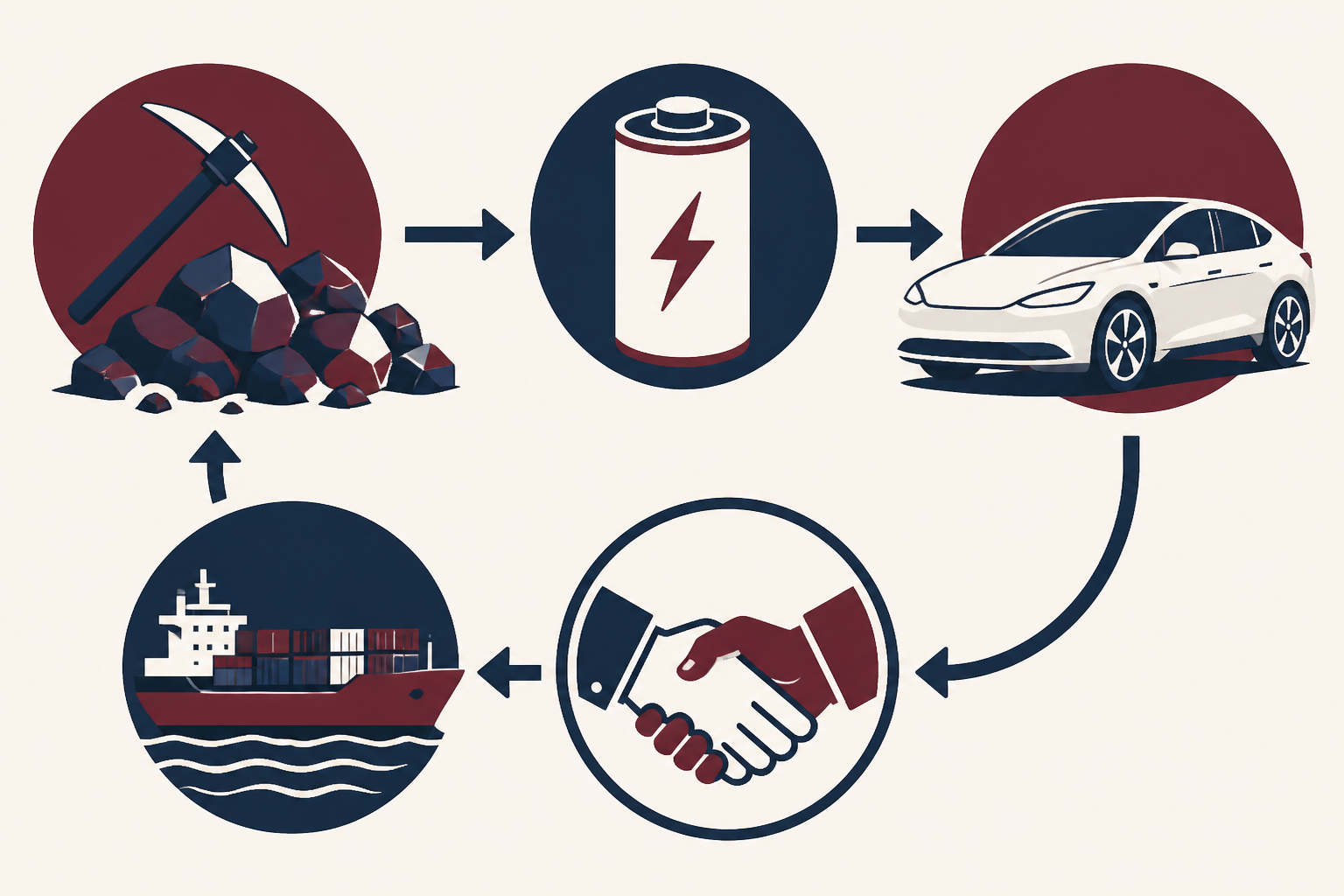
The strategy responds to a single hard fact: a handful of countries hold the ore and China dominates the processing and refining of these minerals, giving it choke-point power over the inputs for electric vehicles (EVs), batteries, wind turbines and solar gear that India must import or build domestically.
- KABIL (Khanij Bidesh India Ltd) — a joint venture of NALCO, HCL and MECL — pursues overseas mineral assets, including a lithium-exploration deal in Argentina’s Catamarca province.
- The National Critical Mineral Mission (NCMM) covers the full chain — exploration, mining, processing, recycling and overseas acquisition.
- The MMDR Act amendments empower the Centre to auction blocks of critical and strategic minerals directly and freed several from the atomic-minerals list.
- India is a member of the US-led Minerals Security Partnership (MSP) and has supply pacts with resource-rich states such as Australia.
- GSI exploration flagged a large inferred lithium resource in Reasi, Jammu and Kashmir, the first sizeable domestic find.
The development matters in the context of:
- Critical minerals are the new strategic commodities — like oil in the 20th century — and access decides who can build the clean-energy economy.
- India’s net-zero by 2070 and EV ambitions are unworkable without secure, diversified mineral supply chains.
UPSC Relevance
Prelims Relevance
- KABIL — a three-PSU joint venture (NALCO, HCL, MECL) for overseas critical-mineral assets
- National Critical Mineral Mission (NCMM) — covers exploration to recycling, including overseas acquisition
- MMDR Act (Mines and Minerals Development and Regulation) — basis for auctioning critical-mineral blocks
- List of critical minerals notified by the Ministry of Mines (lithium, cobalt, nickel, rare earths, graphite and more)
- Geological Survey of India (GSI) — the chief exploration agency; flagged the Reasi (J&K) lithium resource
- Minerals Security Partnership (MSP) — a US-led plurilateral grouping for resilient mineral supply chains
- Rare earth elements are not geologically rare; the bottleneck is mining and especially refining
- Difference between a mineral reserve and an inferred resource
Mains Relevance
GS Paper 3
- Critical-mineral security as the backbone of the energy transition, EV manufacturing and battery supply chains.
- How NCMM, KABIL and MMDR auctions fit together as a resource-security policy stack.
- Why downstream processing and recycling, not just mining, decide India’s leverage.
GS Paper 2
- Minerals diplomacy and strategic autonomy — diversifying away from over-dependence on a single supplier country.
- Plurilateral groupings like the Minerals Security Partnership and bilateral resource pacts as instruments of foreign policy.
Essay
- Resource security in an age of energy transition — who controls the minerals controls the future.
- Strategic autonomy means diversification, not isolation.
Background and Context
Why these minerals are 'critical'
A mineral is critical when an economy depends on it and its supply is concentrated, exposed to disruption or hard to substitute.
- Lithium, cobalt, nickel and graphite are the core inputs for lithium-ion batteries that power EVs and grid storage.
- Rare earth elements (REEs) — such as neodymium and dysprosium — make the permanent magnets in EV motors and wind turbines.
- Criticality combines high economic importance with high supply risk, not geological scarcity.
- The Ministry of Mines has notified a list of critical minerals to guide policy, exploration and incentives.
- Demand is set to surge with the global shift to clean energy, electrified transport and digital hardware.
The China choke-point
The supply risk that frames the whole strategy is the concentration of refining in one country.
- China controls the dominant share of global rare-earth refining and a large share of battery-mineral processing.
- Mining is spread across countries, but midstream refining is heavily concentrated, creating a single point of leverage.
- Export controls or curbs on rare earths and processing technology can disrupt downstream manufacturing worldwide.
- For India, this turns a commercial issue into one of strategic autonomy and supply-chain security.
- Reducing this dependence requires both alternative sources of ore and India’s own processing capacity.
KABIL and overseas acquisition
The outward arm of the strategy is a dedicated state vehicle that hunts for assets abroad.
- KABIL (Khanij Bidesh India Ltd) is a joint venture of NALCO, HCL and MECL set up to acquire and develop overseas mineral assets.
- Its flagship effort is a lithium-exploration agreement in Catamarca, Argentina, part of South America’s ‘lithium triangle’.
- The aim is long-term offtake and equity stakes in lithium, cobalt and other battery minerals, not one-off purchases.
- It mirrors the model India uses for overseas oil and gas assets, adapted to the minerals age.
- Diversifying sources — Argentina, Australia, Africa — cuts exposure to any single supplier.
The domestic policy stack — NCMM and MMDR
At home the strategy rests on a new mission and amended mining law.
- The National Critical Mineral Mission (NCMM) spans the full value chain — exploration, mining, beneficiation, processing, recycling and overseas acquisition.
- MMDR Act amendments let the Centre auction blocks of critical and strategic minerals and removed several from the restrictive atomic-minerals list, opening them to private players.
- Exploration by the Geological Survey of India (GSI) flagged a large inferred lithium resource at Reasi, Jammu and Kashmir.
- Incentives target recycling and urban mining of e-waste to recover battery metals.
- The package complements EV manufacturing and battery cell production incentives downstream.
Partnerships and minerals diplomacy
Because India lacks large reserves of most battery minerals, diplomacy does much of the heavy lifting.
- India joined the US-led Minerals Security Partnership (MSP), a plurilateral push for resilient, diversified supply chains.
- It signed a critical-minerals investment partnership with Australia, a major lithium and rare-earth producer.
- Engagement extends to resource-rich states in Africa and Latin America for offtake and joint ventures.
- These ties knit resource security into foreign policy and the broader logic of geoeconomic statecraft.
- The goal is a friend-shored network that lowers dependence on any one source country.
Stakes, gaps and the critique
Securing ore abroad is only half the battle; the harder gap is downstream and at home.
- India’s biggest weakness is the missing midstream — refining and processing capacity, not just mines.
- Overseas deals take years to convert into delivered metal, and equity stakes carry geopolitical and price risk.
- Domestic mining of critical minerals raises environmental and tribal-land concerns that need careful clearance.
- Recycling remains nascent, though it could become a major secondary source as the first EV fleets retire.
- Without parallel investment in skills, technology and processing, India risks repeating the assembly-not-value trap seen in electronics.
Way Forward
Build the missing midstream
- Invest in domestic refining and processing so secured ore translates into usable battery-grade metal.
- Incentivise recycling and urban mining to create a circular secondary supply of battery metals.
Diversify and deepen partnerships
- Convert KABIL exploration into long-term offtake and equity across Argentina, Australia and Africa.
- Use the Minerals Security Partnership and bilateral pacts to friend-shore supply away from a single source.
Get the domestic enabling base right
- Run transparent MMDR auctions with environmental and community safeguards built in.
- Pair the NCMM with skilling, technology transfer and stable demand from EV and battery makers.
Conclusion
Critical minerals are doing to the 21st century what oil did to the 20th — turning a question of geology into one of geopolitics. India’s response weaves overseas acquisition through KABIL, a full-chain National Critical Mineral Mission, amended mining law and a web of partnerships into a single resource-security strategy.
The real test is leverage, not access. Securing ore abroad matters little if the refining, recycling and processing stay offshore. If India builds the missing midstream while diversifying its sources, minerals diplomacy can underwrite both the energy transition and genuine strategic autonomy; if it does not, it will simply trade one import dependence for another.
UPSC Practice Questions
Prelims MCQ 1
With reference to India’s critical-minerals strategy, consider the following statements:
- KABIL is a joint venture of NALCO, Hindustan Copper and Mineral Exploration Corporation set up to acquire overseas mineral assets.
- The National Critical Mineral Mission covers exploration, processing, recycling and overseas acquisition.
- Rare earth elements are classed as critical mainly because they are among the rarest elements in the Earth’s crust.
How many of the above statements are correct?
(a) Only one (b) Only two (c) All three (d) None
Answer: (b) Only two
Explanation:
Statements 1 and 2 are correct. Statement 3 is wrong: rare earths are reasonably abundant in the crust — they are critical because mining and especially refining are concentrated and difficult, not because the elements are scarce.
Prelims MCQ 2
Which one of the following best explains why China is described as a choke-point in global critical-mineral supply chains?
(a) It holds nearly all of the world’s lithium reserves (b) It dominates the refining and processing of these minerals (c) It is the only country mining cobalt (d) It controls all global rare-earth ore deposits
Answer: (b) It dominates the refining and processing of these minerals
Explanation:
Ore mining is spread across many countries, but China’s dominance lies in the midstream — refining and processing rare earths and battery minerals — which gives it leverage over downstream manufacturing.
UPSC Mains Questions
- Critical minerals are to the energy transition what oil was to the industrial age. Examine India’s strategy to secure lithium, cobalt, nickel and rare earths, and discuss why downstream processing matters as much as access to ore.
- Evaluate the role of minerals diplomacy in India’s pursuit of strategic autonomy. How do instruments like KABIL, the Minerals Security Partnership and bilateral resource pacts reduce supply-chain dependence on a single country?
- Discuss how the National Critical Mineral Mission and the amended MMDR Act seek to build a domestic critical-mineral ecosystem. What environmental and institutional challenges must be addressed?
Sources: PIB, Ministry of Mines and Press Information Bureau.
Frequently Asked Questions
What are critical minerals?
Critical minerals are those an economy depends on but whose supply is risky — concentrated in a few countries, exposed to disruption or hard to substitute. For India they include lithium, cobalt, nickel, graphite and rare earths, which are essential for batteries, electric vehicles, wind turbines and solar equipment. The label reflects economic importance and supply risk, not geological scarcity.
What is KABIL and what does it do?
KABIL (Khanij Bidesh India Ltd) is a state joint venture of NALCO, Hindustan Copper and Mineral Exploration Corporation, created to acquire and develop critical-mineral assets abroad. Its flagship effort is a lithium-exploration agreement in Catamarca, Argentina. KABIL aims to secure long-term supply and equity stakes in battery minerals, mirroring how India pursues overseas oil and gas assets.
Why does China dominate critical-mineral supply chains?
Mining of these minerals is spread across many countries, but China dominates the midstream — the refining and processing of rare earths and battery metals. This concentration gives it choke-point leverage: export curbs or technology restrictions can disrupt manufacturing worldwide. Reducing this dependence is the central aim of India’s minerals diplomacy and domestic processing push.
What is the National Critical Mineral Mission?
The National Critical Mineral Mission (NCMM) is India’s full-value-chain strategy for critical minerals, covering exploration, mining, beneficiation, processing, recycling and overseas acquisition. It works alongside amended MMDR Act provisions that let the Centre auction critical-mineral blocks. The mission aims to secure supply for the energy transition while building domestic capability rather than relying only on imports.
Has India found its own lithium?
Exploration by the Geological Survey of India flagged a large inferred lithium resource at Reasi in Jammu and Kashmir — the first sizeable domestic find. However, an inferred resource is an early estimate, not a proven reserve; extraction faces technical, environmental and processing challenges. Domestic finds reduce import dependence over time but do not replace overseas sourcing in the near term.
How does minerals diplomacy support strategic autonomy?
Because India lacks large reserves of most battery minerals, it diversifies sources through diplomacy — joining the US-led Minerals Security Partnership, signing a critical-minerals pact with Australia and engaging Africa and Latin America. Spreading supply across friendly partners lowers dependence on any single country, turning resource security into an instrument of strategic autonomy and foreign policy.