
Two news cycles, two halves of the same story. On 27 January 2026, India and the European Union concluded negotiations on a Free Trade Agreement that the European Commission called the largest such deal either side has ever done, a trade zone stretching across roughly 2 billion people and almost a quarter of world GDP. In the same year, China kept tightening the screws on rare earths, extending its export licensing to processing equipment and even to foreign-made goods that contain a sliver of Chinese-origin material. One country is opening markets. Another is closing chokepoints. And India is standing in the middle of both, exposed on one side and ambitious on the other.
That’s the whole topic in one frame. Power in the 21st century doesn’t only travel through aircraft carriers and alliances. It travels through tariffs, export controls, chip fabs and refined neodymium. The fancy word for this is geoeconomics, the use of economic tools, trade, investment, sanctions, supply chains, to pursue strategic goals that armies used to pursue. So the question for an aspirant isn’t whether India should care about a free-trade agreement or a lithium block. It’s whether India can turn trade and technology into real strategic leverage fast enough, while it’s still dependent on a rival for the inputs underneath its own factories.
The Issue, Framed
Let’s fix the vocabulary first, because this topic drowns in jargon and most of the noise comes from people using big words loosely.
Geoeconomics is the use of economic instruments to achieve geopolitical ends. Trade deals, investment screening, tariffs, sanctions, control over supply chains, all wielded the way military force once was. The sharpest academic version of this idea is weaponised interdependence, a framing developed by political scientists Henry Farrell and Abraham Newman in a 2019 International Security article. Their argument is simple and a little unsettling. The networks that tie the world together, finance, data, supply chains, all run through a few central hubs. Whoever sits on top of a hub can do two things to everyone else: watch the flows passing through it (the panopticon effect), or cut off access to it (the chokepoint effect). Connection, in other words, isn’t only a peace dividend. It’s also a weapon.
You’ve already seen this play out. Russia’s partial removal from the SWIFT messaging system and the freezing of roughly $300 billion of its central-bank reserves in 2022 was a financial chokepoint. US export controls on advanced chips to China are a technology chokepoint. China’s rare-earth export licensing is a supply-chain chokepoint. Same logic each time: find the node the other side can’t easily replace, then squeeze.
Two responses have a name too. Friend-shoring (sometimes ally-shoring) means moving supply chains into politically aligned countries rather than the cheapest one. China+1 is the corporate version, where a firm keeps its China base but adds a second manufacturing home somewhere else to spread the risk. Both reframe the old globalisation goal. For three decades the rule was cost first. Now it’s security-weighted cost, and India wants to be the “plus one” everyone picks.
Then there’s the trade architecture, which loves its acronyms. An FTA (Free Trade Agreement) cuts tariffs and barriers between members. A CEPA (Comprehensive Economic Partnership Agreement) and a TEPA (Trade and Economic Partnership Agreement) are broader versions that go past goods into services, investment and sometimes binding commitments. Different labels, same family. India has signed a string of them since 2022, and that streak is the agent half of this story.
So here’s the tension that runs through everything below. India is a target of weaponised interdependence, deeply dependent on China for minerals, electronics and pharmaceutical inputs. And India is an agent of geoeconomics, pushing FTAs, a critical-minerals mission and a semiconductor build-out. The editorial lives in the gap between those two facts.
What the Data Says
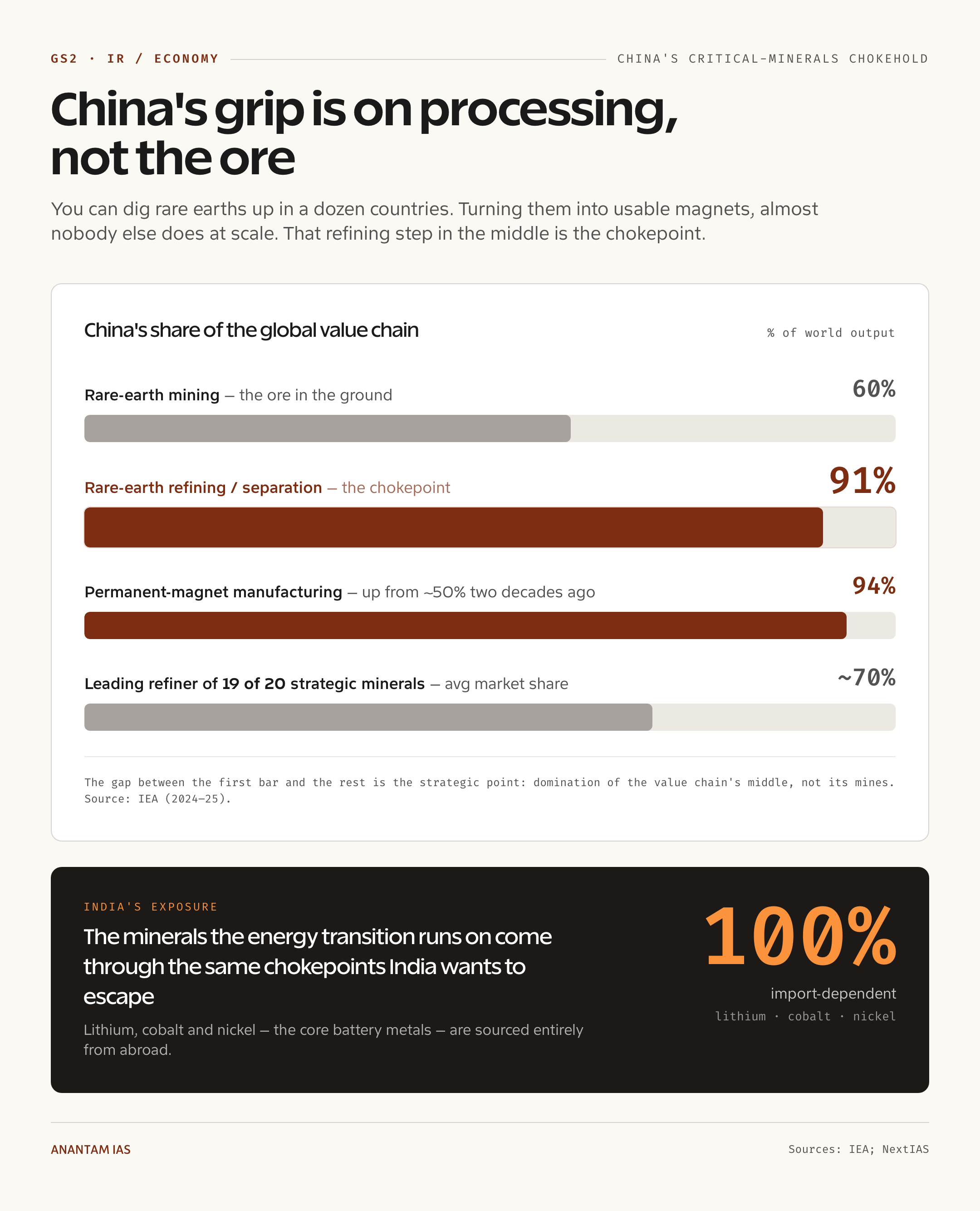
Start with the chokehold, because the numbers explain why a commodity became a weapon. China mines roughly 60% of the world’s rare earths, the magnet metals like neodymium and dysprosium that go into everything from EV motors to missile guidance. That’s a big share, but it isn’t the scary one. The scary one is processing. China runs about 91% of global rare-earth separation and refining, and makes around 94% of the world’s permanent magnets, up from roughly half two decades ago. Read those two numbers together and the strategic point falls out: the chokepoint isn’t the ore in the ground, it’s the refining step in the middle. You can dig rare earths up in a dozen countries. Turning them into usable magnets, almost nobody else does at scale.
And it isn’t only rare earths. Across 19 of 20 strategic minerals, China is the leading refiner, with roughly a 70% average market share. In battery midstream materials, cathode precursors and LFP chemistry, China holds 80% and up, with some segments past 95%. So when an aspirant writes “China dominates critical minerals,” that’s the texture underneath the sentence. Domination of the value chain’s middle, not its mines.
China then turned that position into policy. Its export-control timeline runs from gallium and germanium (July 2023) through graphite, antimony, tungsten, and then the headline move: licensing on seven heavy and medium rare earths, samarium, gadolinium, terbium, dysprosium, lutetium, scandium and yttrium, on 4 April 2025. Beijing widened it in October to processing equipment and battery materials, and by 1 December 2025 extended controls even to foreign-made products containing Chinese-origin material. There was a partial pause in November 2025 on some US-specific add-ons, but the April seven-rare-earth regime was never suspended, and customs data showed yttrium, dysprosium and terbium exports running about 50% below their pre-restriction baseline. So the lever was real, and it stayed pulled.
Now flip to India’s exposure, and it’s uncomfortable. India is 100% import-dependent for lithium, cobalt and nickel, the exact three minerals the clean-energy transition runs on. And the broader China dependence is structural. India’s trade deficit with China hit a record $99.2 billion in FY25, up about 17% in a year, importing roughly eight times what it exports there. The Global Trade Research Initiative puts the sharper number on it: China is about 16% of India’s total imports but supplies around 30.8% of India’s industrial-goods requirements, with roughly two-thirds of those imports clustered in electronics, machinery, computers and organic chemicals, the last category including the pharmaceutical active ingredients (APIs) that feed India’s own famous generics industry. GTRI’s rule of thumb is blunt: keep no single country above 30% of imports in any critical sector. India’s already past it.
The Case For
Here’s the case that geoeconomics is now central to statecraft, and it’s a strong one. Don’t write a Mains answer that pretends otherwise.
Supply chains are the new battlefield. China’s 2025 rare-earth licensing, extended all the way to processing equipment and downstream foreign products, is a live, textbook demonstration of Farrell and Newman’s chokepoint effect. Control the node that 91% of the world depends on, and a commodity becomes a coercive instrument without a single shot fired. For scale, China exported roughly 58,000 tonnes of rare-earth magnets in 2024, enough for millions of vehicles or thousands of military systems. So a licensing tweak in Beijing ripples into car plants in Stuttgart and Pune. That’s power.
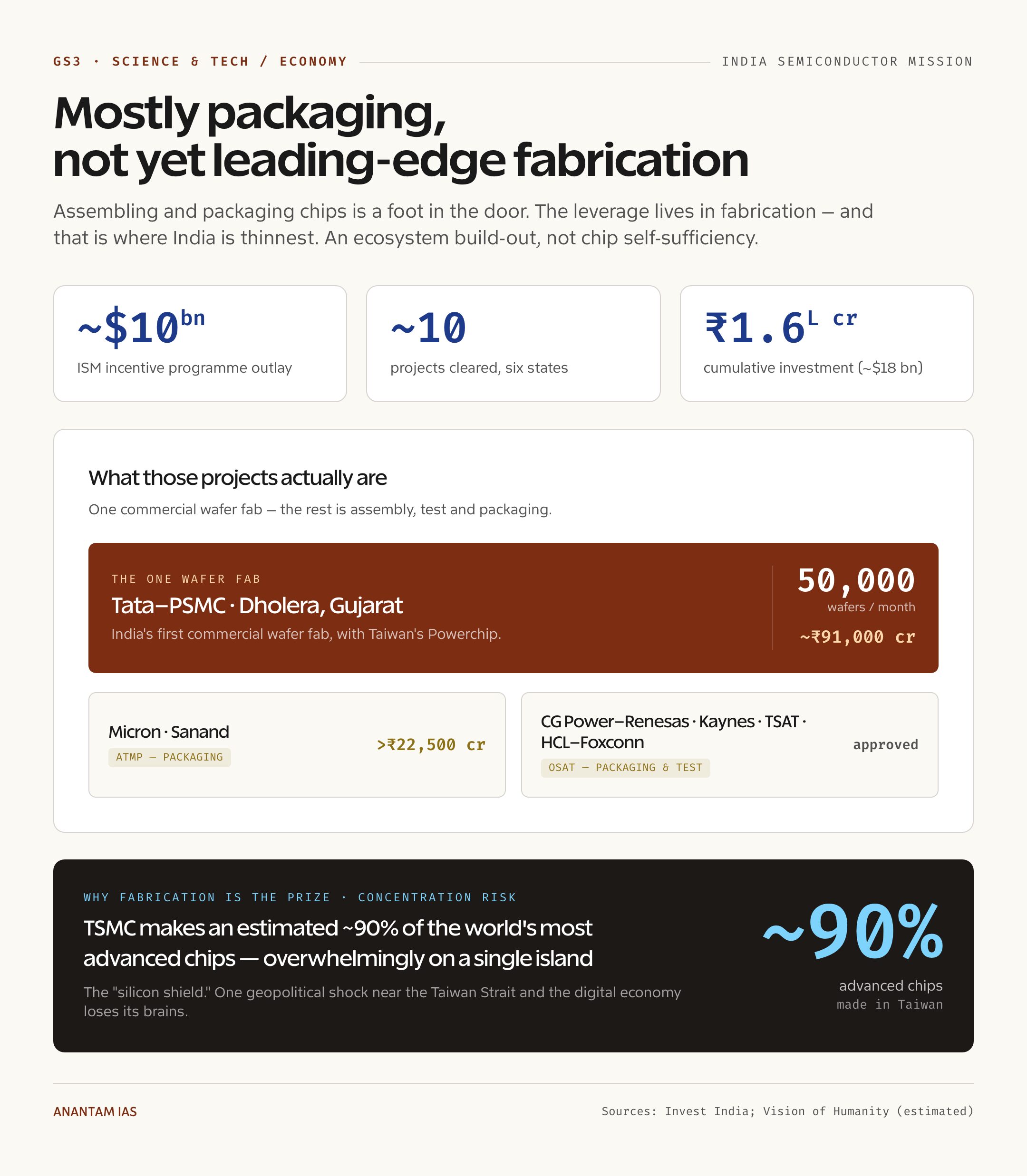
Technology sovereignty is now national security. The clearest example is semiconductors. Taiwan’s TSMC produces an estimated 90% of the world’s most advanced chips, the overwhelming majority of that capacity sitting on a single island. Analysts call it the “silicon shield,” the idea that Taiwan’s chip indispensability deters conflict. But flip it around and it’s a single point of failure for the entire digital economy. One geopolitical shock near the Taiwan Strait and the world’s phones, cars and data centres lose their brains. That fear is exactly why the US passed its CHIPS Act, the EU passed a Chips Act, and India launched its own Semiconductor Mission. Where you can make chips now decides how resilient you are later.
Economic tools have started to do the work that military ones used to. SWIFT exclusion, chip controls, mineral licensing, all deliver coercive effect without kinetic risk. The old liberal assumption was that interdependence pacifies, that countries trading heavily won’t fight. The 2020s rewrote that. Interdependence is now an arena of great-power competition, not an exit from it.
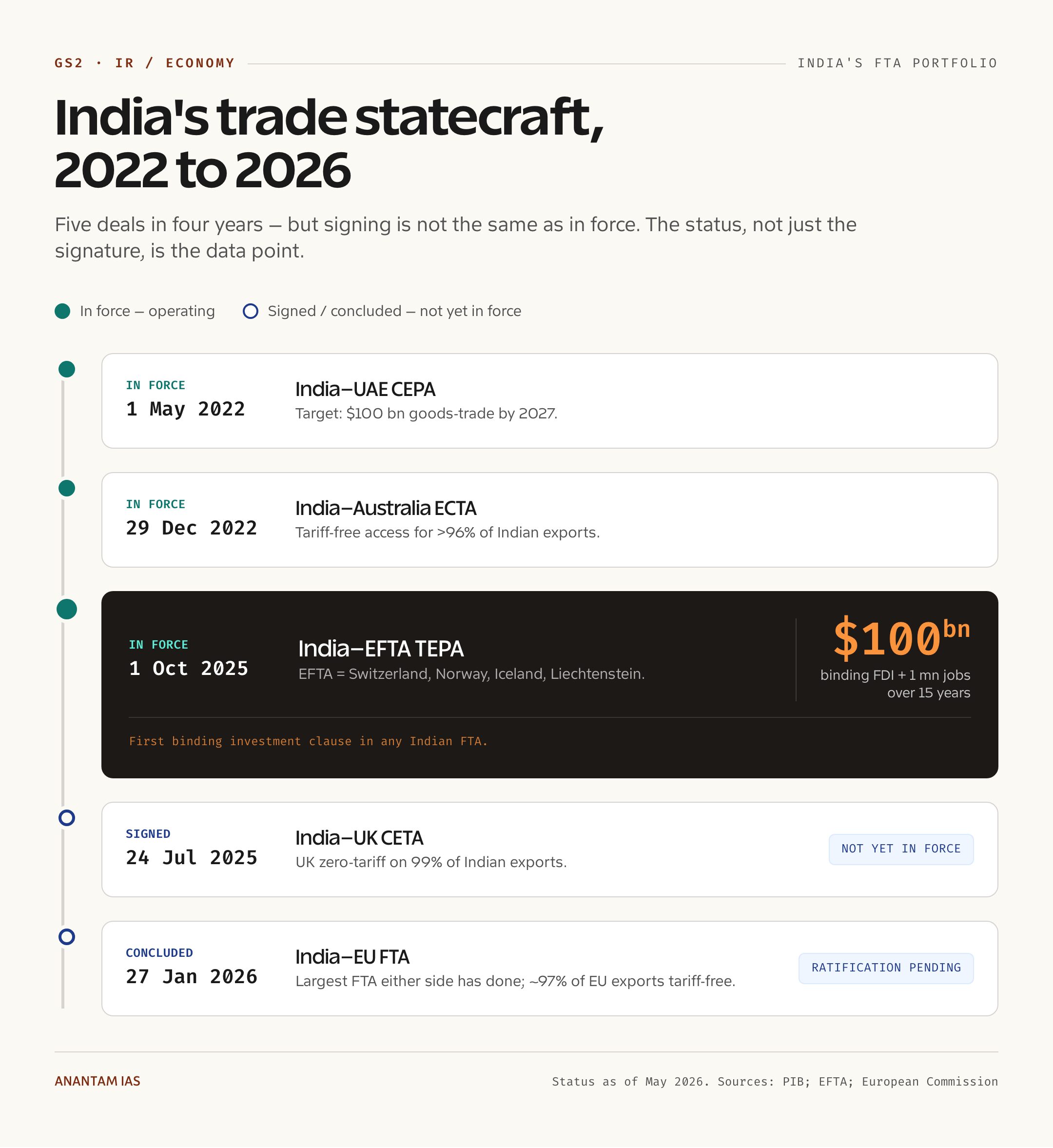
And FTAs are strategic alignment dressed as commerce. India’s recent deals aren’t only about cheaper Scotch or German cars. They’re about anchoring partners and de-risking from China. The clearest tell is the India-EFTA TEPA, in force since 1 October 2025, which carries a binding $100 billion FDI commitment plus 1 million jobs over 15 years, the first such binding investment clause in any Indian FTA. (EFTA, for the record, is Switzerland, Norway, Iceland and Liechtenstein, not the EU.) When a trade deal writes investment promises into the text, the strategic intent stops being subtle.
The Case Against
Now the part the optimistic case walks past. Resilience is easy to announce and hard to build, and India’s vulnerabilities are structural, not cosmetic.
The China dependence sits underneath India’s own manufacturing. That $99.2 billion deficit and the 30.8% industrial-input share aren’t abstract. They mean India’s electronics assembly runs on Chinese components, its pharma exports run on Chinese APIs, and its solar push runs on Chinese cells and modules. So when India makes a phone or a generic drug or a solar panel, a Chinese input layer is sitting one level down. You can’t friend-shore your way out of a dependency that’s baked into your bill of materials overnight. Resilience rhetoric, right now, is running ahead of the input reality.
The mineral exposure is near-total exactly where it hurts. 100% import reliance on lithium, cobalt and nickel means the very minerals India needs for its energy transition come through the same chokepoints it’s trying to escape. India did identify 30 critical minerals through its Ministry of Mines in 2023 and is moving, but identifying a problem and refining your way out of it are different timelines.
The delivery-and-scale gap is the honest worry. Look closely at the India Semiconductor Mission (ISM), the roughly $10 billion incentive programme. As of August 2025 it had cleared 10 projects worth about ₹1.6 lakh crore, roughly $18 billion, across six states. Real money, real progress. But read what those projects are. The Tata-PSMC fab at Dholera, partnering Taiwan’s Powerchip, is India’s first commercial wafer fab at about ₹91,000 crore and a planned 50,000 wafers a month. Micron’s Sanand plant, over ₹22,500 crore, is assembly, test and packaging (ATMP), not fabrication. CG Power-Renesas, Kaynes, the Tata unit in Assam, HCL-Foxconn, mostly packaging and testing too. So India’s near-term entry is in the back end of the chip chain. Leading-edge fabrication, the part that gives you real sovereignty, is still years away. This is an ecosystem build-out, not chip self-sufficiency, and an honest answer says so.
Refining and fabrication are capital, IP and talent-intensive, which is the deepest constraint. China’s 90%-plus processing share reflects decades of accumulated capacity, know-how and tolerance for the environmental cost of separation. Subsidies alone don’t replicate that quickly, and India lacks deep talent pools in both rare-earth metallurgy and advanced chip fabrication. Exploration-to-production cycles for minerals run a decade and more.
And there’s the autonomy squeeze. India has to diversify away from China without over-committing to any single bloc, while the very FTAs that help it de-risk, the EU deal especially, come bundled with regulatory, labour and sustainability conditions that narrow India’s own policy space. Strategic autonomy gets harder, not easier, when your resilience depends on other people’s rulebooks.
The Deeper Structural Read
Step back from the lists of deals and minerals, and a single principle organises the whole topic: in a weaponised economy, your resilience is only as strong as your weakest chokepoint. Not your strongest export. Your weakest dependency.
That reframes what “winning” even means. India can sign every FTA on the planet and still be coercible if its EV industry can’t get refined dysprosium and its drug industry can’t get APIs. Trade openness and supply-chain security are two different problems, and a country can be excellent at one while dangerously exposed on the other. India, right now, is genuinely good at the first, the FTA streak is real diplomatic skill, and genuinely behind on the second. The temptation in an exam is to treat the FTA wins as evidence the resilience problem is being solved. It isn’t. They’re parallel tracks, and the harder track is the mineral and processing one.
There’s a sequencing insight too, and it comes straight from the IEA logic. The chokepoint in critical minerals is processing, not mining. So a strategy that rushes to lock up overseas mines, while useful, misses the binding constraint if it doesn’t also build refining and separation at home. Owning a lithium block in Argentina is good. Being able to turn that lithium into battery-grade material on Indian soil is what actually breaks the chokehold. The same lesson repeats in semiconductors: assembling and packaging chips is a foot in the door, but the leverage lives in fabrication and chip design, which is where India is thinnest. The structural read is that India keeps entering value chains at the easier, lower-leverage end, and the strategic payoff only arrives if it climbs to the harder, higher-leverage end fast enough.
And here’s the bind that makes this a genuine GS2-meets-GS3 problem rather than a pure economics question. The instinct of “self-reliance” pulls toward building everything at home. The reality of weaponised interdependence is that no single country, not even China, makes everything itself. So the answer can’t be autarky, walling yourself off, because that just trades dependence for inefficiency and isolation. The answer is diversified interdependence, spreading your dependencies across enough partners that no single one can squeeze you. That’s why the FTA push and the minerals mission belong in the same sentence. One builds the partner network; the other builds the domestic floor. Neither works alone.
The quiet warning underneath all of it: a state that hands its hardest industrial problems to subsidy and slogans, rather than to capacity, skills and processing know-how, will find the chokepoints still there when the next licensing notice drops in Beijing.
What Should Be Done
So what does a serious geoeconomic strategy look like for India? Not a wish list. A sequenced set of moves, each attacking a specific chokepoint.
- Own the processing node, not just the mine. The fastest way to break a chokehold is to refine at home. India’s National Critical Mineral Mission, approved in January 2025 with a ₹34,300 crore outlay (₹16,300 crore government plus about ₹18,000 crore from PSUs) over seven years, already plans four regional mineral-processing parks and self-sufficiency in processing at least five critical minerals. The instruction to itself should be: prioritise the refining parks over chasing every overseas mine, because the IEA data says processing, not ore, is where the leverage sits.
- Diversify mineral sourcing aggressively, then recycle what you have. KABIL, the public-sector joint venture for overseas assets, has already signed for five lithium-brine blocks across roughly 15,703 hectares in Catamarca, Argentina. Pair that with the NCMM’s ₹1,500 crore recycling incentive, targeting about 270 kilo-tonnes a year of recycling capacity, and you attack import dependence from two directions at once. Recycling is the quickest route to cutting primary-import exposure, because it doesn’t wait on a decade-long mining cycle.
- Climb the semiconductor chain, don’t camp at packaging. ISM’s packaging wins are a real start, but the strategy has to push deliberately from ATMP and OSAT toward the Dholera fab’s success and onward into chip design, materials and equipment. Deepen the US-India and India-Taiwan partnerships so India becomes a node of strategic redundancy in the global chip supply, not just a low-cost assembly stop.
- Use FTAs as de-risking architecture, then actually operationalise them. Signing is the easy part. Converting market access into relocated supply chains and real investment is the hard part. Operationalise the EFTA TEPA’s binding $100 billion investment clause, bring the India-UK CETA (signed 24 July 2025) into force, and ratify the India-EU FTA.
- Cap single-source dependence and build the input layer. Adopt GTRI’s discipline of keeping no single country above roughly 30% of imports in any critical sector, and back it with production-linked incentive (PLI) schemes that target the China input layer directly: electronics components, APIs and solar cells. This is the unglamorous work that the deficit numbers demand.
- Position India deliberately as the China+1 pivot. The Apple, Foxconn and Tata electronics expansion already underway is the proof of concept. A Quad supply-chain-resilience agenda and the Minerals Security Partnership give India the multilateral scaffolding to become the credible alternative manufacturing base, rather than just hoping firms wander over.
Run those six together and the logic is coherent: build partners abroad, build the floor at home, and refuse to let any single chokepoint stay un-addressed.
For Your Mains Answer
This topic is a bridge between two papers, and that’s exactly why examiners love it. Treat it as one argument that spans GS2 and GS3, not two separate notes.
GS paper mapping: GS2 (IR): India and developed-country trade blocs; bilateral and regional groupings; effect of policies of developed and developing countries on India’s interests; economic diplomacy. GS3 (Economy/S&T): trade and investment; indigenisation of technology; energy and mineral security; effects of liberalisation; growth and employment.
Likely question frames:
- “In the 21st century, economic interdependence has become a tool of statecraft rather than a guarantee of peace.” Examine in the context of India’s critical-minerals and semiconductor strategy.
- Critically evaluate India’s trade-agreement strategy since 2022 as an instrument of supply-chain de-risking and strategic autonomy.
- “India is simultaneously a target and an agent of geoeconomic power.” Discuss with reference to critical minerals, semiconductors and free-trade agreements.
Quotable data points:
- China refines ~91% of rare earths and makes ~94% of permanent magnets, despite mining only ~60% of the ore (IEA).
- Across 19 of 20 strategic minerals, China is the leading refiner with ~70% average market share (IEA).
- India is 100% import-dependent for lithium, cobalt and nickel, the core energy-transition minerals (NextIAS).
- National Critical Mineral Mission (2025): ₹34,300 crore over 7 years, ₹16,300 cr government plus ~₹18,000 cr PSU (IBEF/IEA).
- NCMM targets 1,200 exploration projects, 50 overseas mineral assets and self-sufficiency in processing 5 minerals by 2030-31 (IEA).
- TSMC makes an estimated ~90% of the world’s most advanced chips, overwhelmingly in Taiwan, the “silicon shield” concentration risk (Vision of Humanity).
- India Semiconductor Mission (~$10 bn) has cleared 10 projects worth ~₹1.6 lakh crore; the Tata-PSMC Dholera fab targets 50,000 wafers/month (Invest India).
- India-EFTA TEPA carries a binding $100 bn FDI plus 1 million jobs commitment over 15 years, a first in any Indian FTA (PIB/EFTA).
- India’s trade deficit with China hit a record $99.2 bn in FY25, importing ~8× what it exports (Business Today).
- China supplies ~30.8% of India’s industrial-goods imports; GTRI’s safe ceiling is 30% per country (GTRI).
Keywords to use: geoeconomics, weaponised interdependence (Farrell & Newman), chokepoint and panopticon effects, export controls, friend-shoring, China+1, supply-chain resilience, technology sovereignty, silicon shield, critical-minerals diplomacy, strategic autonomy.
Syllabus linkages: bilateral and regional groupings involving India; effect of developed-country policies on India’s interests; Indian economy and trade; indigenisation and development of new technology; mineral and energy security; effects of liberalisation on the economy.
Balanced conclusion line: India has shown it can play offence in geoeconomics through an FTA streak few countries can match; the unfinished work is defence, building the refining capacity, the fabs and the input-layer depth so that the next export-control notice from Beijing meets a country it can no longer squeeze.
How to Build the Answer
Open with the dual identity, not a definition. The single sharpest framing here is that India is both a target and an agent of geoeconomic power. That one sentence shows the examiner you’ve grasped the whole tension before you’ve defined a single term. The definition of geoeconomics can come in the second sentence, woven in, not parked in a glossary box.
Bring data in early, but ration it. A strong opening body paragraph can carry three figures and no more: China’s 91% refining share, India’s 100% import reliance on lithium-cobalt-nickel, and the $99.2 billion China deficit. Then immediately say what they prove together, that India’s resilience push starts from deep exposure. UPSC marks the move from fact to inference, not the fact alone.
Steelman both sides. If your stance is optimistic about India’s strategy, first concede the delivery gap, packaging is not fabrication, signing is not operationalising. If your stance is cautious, first credit the genuine wins, the binding EFTA clause and the EU conclusion are real statecraft. That’s how an answer reads balanced without going mushy.
Group the way forward, never scatter it. Cluster the reforms under clear heads: own the processing node, diversify and recycle, climb the chip chain, operationalise FTAs, cap single-source dependence, become the China+1 pivot. Use the topic’s own vocabulary, chokepoint, friend-shoring, technology sovereignty, so the answer sounds like strategic analysis, not a news recap.
Common Mistakes to Avoid
- Don’t write it as pure economics. This is GS2-plus-GS3. If you forget the strategic-autonomy and statecraft layer, you’ve answered half the question.
- Don’t conflate FTA success with resilience. They’re parallel tracks. India can be brilliant at trade deals and still be coercible on minerals. Say so explicitly.
- Don’t overstate the semiconductor position. India is building packaging plus one fab, not chip sovereignty. Examiners reward the candidate who knows the difference between ATMP and leading-edge fabrication.
- Don’t go anti-China or jingoistic. Present China’s controls as policy actions and India’s measures as responses. Neutral, attributed, analytical. Polemic loses marks.
- Don’t dump ten statistics. Three well-explained numbers beat a wall of percentages no examiner can parse under time pressure.
A Compact Answer Spine
- Introduction: Open with India as both target and agent of geoeconomic power; define geoeconomics and weaponised interdependence in one woven sentence.
- The chokehold: China’s processing dominance (91% refining, 94% magnets) and India’s exposure (100% on Li/Co/Ni, $99.2 bn deficit).
- The agent half: India’s FTA streak (EFTA in force, UK signed, EU concluded), NCMM and ISM as instruments of de-risking.
- Structural diagnosis: resilience equals your weakest chokepoint; the binding constraint is processing and fabrication, not mining and packaging.
- Way forward: six grouped moves, each tied to a clear actor, Ministry of Mines, KABIL, ISM, Commerce Ministry, the Quad.
- Conclusion: adapt the balanced conclusion line to the exact question wording, offence shown, defence unfinished.
Diagram or Flowchart Idea
For a 15-marker, draw one clean causal chain rather than a decorative web: global chokepoint (China ~91% refining) → India’s dependence (100% on Li/Co/Ni, 30.8% industrial inputs) → India’s twin response (FTAs for partners + NCMM/ISM for domestic floor) → the gap (packaging and mining done, refining and fabrication pending) → strategic payoff if India climbs the value chain. The examiner reads that logic in five seconds.
For a 10-marker, skip the diagram and use a two-column table instead: “India as target” (mineral, API, electronics dependence) against “India as agent” (FTA portfolio, NCMM, ISM). It does more work and evaluates faster under time pressure.
Ethics and Governance Angle
Even in a GS2/GS3 answer, add one line on the value question underneath the policy. Self-reliance, Atmanirbhar Bharat, is a genuine national aspiration, but pursued as autarky it trades dependence for isolation and inefficiency. The mature governance position is diversified interdependence, spreading dependencies so no single partner can coerce you, rather than the fantasy of making everything at home.
Then convert that into administrative judgment. The honest official doesn’t oversell a packaging plant as chip sovereignty or a single FTA as resilience achieved. Naming the gap, refining capacity, fabrication depth, talent pools, is not pessimism. It’s the difference between a slogan and a strategy, and that distinction is exactly what a thoughtful answer signals.
A sentence pattern that travels across topics: “The objective is legitimate and the early steps are real, but the leverage lives at the harder end of the value chain, and that’s where capacity, not subsidy, decides the outcome.”
How to Use Data Without Sounding Mechanical
Use fewer numbers than you know. Lead with one big contrast number, China’s 91% refining against ~60% mining, because that single comparison carries the entire chokepoint argument. Use a second to anchor India’s exposure (100% on lithium, cobalt, nickel). Use a third to show the response (₹34,300 crore NCMM, or the binding $100 bn EFTA clause). One chokepoint figure, one exposure figure, one response figure is usually enough.
Never leave a statistic standing alone. Follow it with “this means” or “the implication is.” The 91%/60% gap means the leverage is in processing. The $99.2 billion deficit means the resilience push starts from deep dependence. That small move turns a fact sheet into analysis, which is the whole game in Mains.
Finish by asking whether a tired examiner can follow your answer in one pass. Short introduction, data early, both sides marked cleanly, a grouped way forward, a conclusion that judges rather than summarises. Clarity isn’t a lower standard than depth. For UPSC, clarity is how depth becomes visible. And cut any line that sounds impressive but does no work, replacing it with a fact, a cause, a consequence or a reform.
FAQ
What is geoeconomics, and how is it different from geopolitics?
Geoeconomics is the use of economic instruments, trade, investment, tariffs, sanctions and control over supply chains, to pursue strategic and geopolitical goals. Geopolitics traditionally centred on territory, alliances and military power. Geoeconomics says the same competition now runs through chokepoints in finance, technology and supply chains. China’s rare-earth export controls and US chip restrictions are geoeconomics in action.
What is weaponised interdependence?
It’s a concept developed by Henry Farrell and Abraham Newman in 2019. The idea is that global networks, finance, data, supply chains, run through a few central hubs, and whoever controls a hub can coerce others by either surveilling the flows passing through it (the panopticon effect) or cutting off access to it (the chokepoint effect). China’s roughly 91% share of rare-earth refining is a classic chokepoint.
Why are critical minerals such a vulnerability for India?
Because India is 100% import-dependent for lithium, cobalt and nickel, the exact minerals its energy transition needs, and China refines around 91% of rare earths and makes about 94% of permanent magnets. So even if India sourced ore elsewhere, the refining chokepoint still sits with China. India’s National Critical Mineral Mission (₹34,300 crore over seven years) is the response, prioritising domestic processing, overseas assets and recycling.
Has India achieved semiconductor self-sufficiency through the ISM?
No, and it’s important to be precise. The India Semiconductor Mission (~$10 billion) has cleared 10 projects worth about ₹1.6 lakh crore, but most are assembly, test and packaging units. India has one commercial wafer fab under way, the Tata-PSMC plant at Dholera (50,000 wafers a month). Leading-edge fabrication and chip design remain years away, so this is an ecosystem build-out, not chip self-sufficiency yet.
Tell Google you want more of this.
Add Anantam IAS as a preferred sourceOne tap, and this site shows up more often in your own Top Stories, AI Overviews and AI Mode. Remove it any time.