Physics Olympiad 2026: India’s five-gold sweep and joint world No. 1 finish
Why in News?
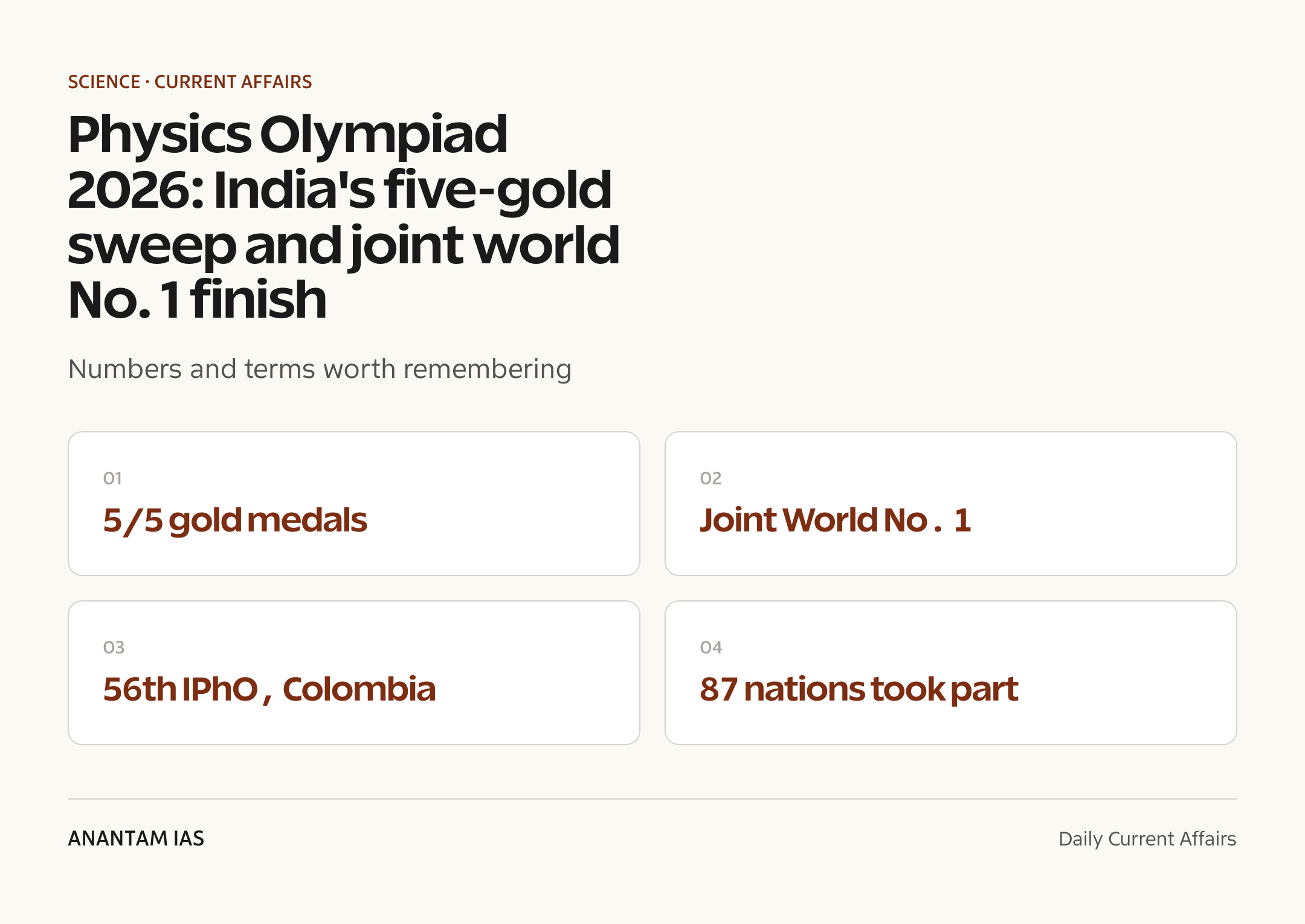
PIB confirmed on 12 July 2026 that all five members of the Indian team won gold medals at the 56th International Physics Olympiad (IPhO) 2026, held at Bucaramanga, Colombia. A five-for-five gold sweep is the best result a country can post at the Olympiad.
With this performance, India finished joint world No. 1 alongside China, Kazakhstan, Russia, South Korea and Taiwan, in a field of 381 students from 87 countries. The team was selected, trained and mentored by the Homi Bhabha Centre for Science Education (HBCSE), a national centre of the Tata Institute of Fundamental Research working under the Department of Atomic Energy.
- All five Indian students won gold medals — the country’s ceiling performance at a single IPhO.
- India shared the world No. 1 position with five countries: China, Kazakhstan, Russia, South Korea and Taiwan.
- The 56th edition drew 381 students from 87 countries to Bucaramanga, Colombia.
- The gold medallists: Kanishk Jain (Pune), Riddhesh Anant Bendale (Indore), Rishit Garg (Dwarka, New Delhi), Shresth Suraiya (Mumbai) and Svarit Joshi (Ahmedabad).
- PIB noted that every Indian participant over the last decade has finished on the podium at IPhO.
- Dr Ajit Kumar Mohanty, Secretary, DAE and Chairman, Atomic Energy Commission, credited the students and the HBCSE-TIFR Olympiad programme.
The development matters in the context of:
- The result is a report card on India’s science-talent pipeline — a decades-old, state-funded system of identifying and mentoring gifted school students rather than a one-off win.
- It spotlights an unusual institutional chain: a school-level competition programme run by a research institution (TIFR) under the Department of Atomic Energy, not the education ministry.
- For UPSC, it packages classic prelims fodder (venue, ranks, institutions) with a GS3 mains theme — converting Olympiad excellence into research leadership.
UPSC Relevance
Prelims Relevance
- IPhO 2026: 56th edition, held at Bucaramanga, Colombia; 381 students from 87 countries.
- India’s result: 5 gold medals (all five team members); joint world No. 1 with China, Kazakhstan, Russia, South Korea and Taiwan.
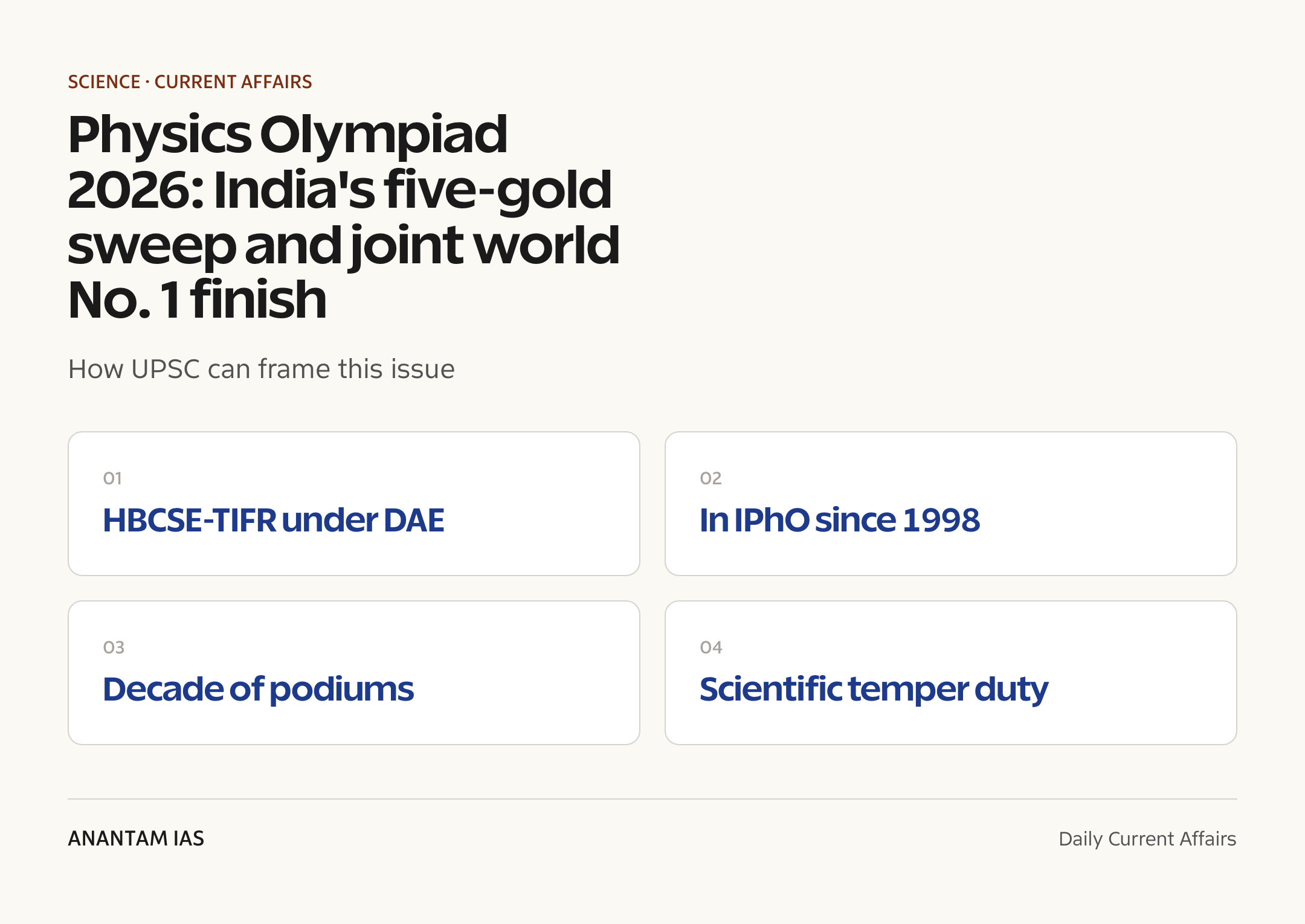
- HBCSE (Homi Bhabha Centre for Science Education), Mumbai — a national centre of TIFR and the nodal centre for India’s National Olympiad Programme.
- TIFR is an aided institution under the Department of Atomic Energy (DAE); DAE (set up 1954) works directly under the Prime Minister.
- The Secretary, DAE is ex-officio Chairman of the Atomic Energy Commission — currently Dr Ajit Kumar Mohanty.
- The International Physics Olympiad began in 1967 in Warsaw, Poland; India has participated since 1998.
- Selection chain for physics: NSEP (by the Indian Association of Physics Teachers) → INPhO → Orientation-cum-Selection Camp at HBCSE → pre-departure training → IPhO.
- IPhO medals go by score benchmarks, not country quotas — which is why several countries can tie at the top of the medal table.
- Article 51A(h): fundamental duty to develop scientific temper, humanism and the spirit of inquiry and reform.
Mains Relevance
GS Paper 3
- Achievements of Indians in science and technology — what sustained, institution-led talent nurturing (HBCSE-TIFR, DAE) delivers versus episodic schemes.
- Building a research pipeline: how Olympiad-level excellence can feed into basic-science research careers through fellowships, undergraduate research and the Anusandhan National Research Foundation.
- Indigenisation of talent development — a fully home-grown selection and training system producing world-topping results.
GS Paper 2
- Education and human-resource development: identifying and nurturing gifted children, a stated priority of NEP 2020.
- Issues relating to the development and management of education — the gap between elite-apex outcomes (Olympiad golds) and mass learning outcomes in school science.
Essay
- Scientific temper as a national project — from Article 51A(h) to Olympiad podiums.
- Excellence versus equity in education: can a country celebrate five golds while its median classroom struggles with basics?
Background and Context
What is the International Physics Olympiad?
The IPhO is the world championship of school physics — and its structure explains how six countries can share the top rank.
- An annual competition for pre-university students, first held in 1967 in Warsaw, Poland; the 2026 edition at Bucaramanga, Colombia was the 56th.
- Each country sends a team of up to five students, accompanied by team leaders; contestants sit demanding theoretical and experimental examinations.
- Medals are awarded against absolute score benchmarks, not country quotas — every student who crosses the gold cut-off gets gold. Country rankings are then read off the medal tallies, which is how India tied at No. 1 with five other nations.
- IPhO 2026 drew 381 students from 87 countries, making a full five-gold sweep statistically rare and competitively significant.
- India has competed at IPhO since 1998; PIB notes that every Indian participant over the last decade has won a medal or podium finish.
India's scorecard at Bucaramanga
The five-member team converted every seat into gold — the best possible national outcome.
- Kanishk Jain — Pune, Maharashtra.
- Riddhesh Anant Bendale — Indore, Madhya Pradesh.
- Rishit Garg — Dwarka, New Delhi.
- Shresth Suraiya — Mumbai, Maharashtra.
- Svarit Joshi — Ahmedabad, Gujarat.
- The delegation was led by Prof Anwesh Mazumdar (HBCSE-TIFR) and Dr Leena Joshi (St. Xavier’s College, Mumbai), with scientific observers Prof Ananda Dasgupta (IISER Kolkata) and Ms Nisha Kelkar (Gogate-Joglekar College, Ratnagiri).
- Note the geographic spread — five students from five different cities across four states and Delhi, a sign the catchment is wider than one or two coaching hubs.
HBCSE-TIFR: the institution behind the medals
India’s Olympiad machine sits inside its atomic-energy establishment, not its education ministry.
- The Homi Bhabha Centre for Science Education (HBCSE), Mumbai, established in 1974, is a national centre of the Tata Institute of Fundamental Research (TIFR).
- TIFR — founded in 1945 by Homi J. Bhabha — is an aided institution of the Department of Atomic Energy, which functions directly under the Prime Minister.
- HBCSE is the nodal centre for the National Olympiad Programme and India’s link to the international Olympiad community, running selection, orientation camps and intensive training for maths and the sciences.
- The programme spans olympiads in mathematics, physics, chemistry, biology, astronomy and junior science — the physics golds are one arm of a broader system.
- Dr Ajit Kumar Mohanty, Secretary, DAE and Chairman, Atomic Energy Commission, called the result a testament to the students’ scientific temperament and the HBCSE-TIFR programme’s commitment.
- Prof Arnab Bhattacharya, Centre Director, HBCSE, attributed the now-routine success to patient mentoring over decades, backed by sustained DAE funding — an argument for institutional continuity over short-term schemes.
How the Indian team is picked
Reaching the IPhO team means surviving a multi-stage national funnel that starts with a mass examination.
- Stage 1 — National Standard Examination in Physics (NSEP), conducted by the Indian Association of Physics Teachers (IAPT), open to school students nationwide.
- Stage 2 — Indian National Physics Olympiad (INPhO), a tougher written round for NSEP toppers, run with HBCSE.
- Stage 3 — Orientation-cum-Selection Camp (OCSC) at HBCSE, Mumbai: theory and experimental tests that pick the final five.
- Stage 4 — pre-departure training at HBCSE, with intensive laboratory work and problem-solving before the team flies out.
- PIB describes this as a rigorous multi-stage selection with orientation camps and training — the design filters lakhs of aspirants down to five.
Why the sweep matters for India's science ecosystem
The medals are a leading indicator for the research pipeline India is trying to build.
- It validates a long-horizon, publicly funded talent model: HBCSE’s mentoring has run for decades, insulated from annual policy churn.
- NEP 2020 explicitly calls for identifying and nurturing gifted students; the Olympiad programme is the working prototype of that idea.
- Olympiad alumni disproportionately enter basic-science and engineering research; each cohort feeds institutions from the IITs and IISERs to global universities.
- Sustained podium finishes build scientific soft power — signalling depth in human capital the way ISRO missions signal capability in technology.
- The win reinforces the case for new research plumbing — the Anusandhan National Research Foundation (ANRF), set up under the ANRF Act 2023, and DST’s INSPIRE scheme — to retain this talent in Indian science.
- It also strengthens the scientific temper mandate of Article 51A(h): role models matter, and five teenagers on a world podium are persuasive ones.
The caveats: apex excellence, broad-base gaps
A clear-eyed note must weigh the golds against the wider state of school science.
- Olympiad golds sit at the apex of a narrow funnel; national learning surveys have repeatedly flagged weak foundational science and maths outcomes in the median classroom.
- Access is uneven — laboratory-grade preparation clusters in urban, English-medium schools, so much latent talent in small towns and government schools never enters the funnel.
- Gender balance in India’s science Olympiad teams has historically been poor; widening the base is both an equity and a talent-yield issue.
- A recurring worry is brain drain: many top Olympiad performers pursue degrees and careers abroad, so the domestic research ecosystem must compete to retain them.
- Medal tallies are a proxy, not a policy outcome — the durable goal is more working scientists, patents and papers, not podium photographs.
Way Forward
Widen the funnel
- Take NSEP-style talent searches into regional-language and government schools, with fee waivers and travel support so the entry gate isn’t self-selecting.
- Expand school-level experimental exposure — Atal Tinkering Labs under the Atal Innovation Mission are natural feeders for Olympiad-style problem-solving.
- Set explicit targets to raise girls’ participation across Olympiad stages, with mentoring camps modelled on HBCSE’s.
Convert medals into careers
- Link Olympiad performance to research fellowships (INSPIRE and successor schemes) and guaranteed undergraduate research placements at IISERs, IITs and TIFR.
- Use ANRF funding to build attractive domestic PhD and early-career tracks so top performers see a future in Indian labs.
- Institutionalise alumni networks so past medallists mentor new cohorts — cheap, high-yield continuity of the kind HBCSE has practised for decades.
Conclusion
India’s five-gold sweep at the 56th International Physics Olympiad is more than a happy headline. It’s evidence that a patient, institutionally anchored talent system — HBCSE, TIFR, DAE — can put Indian school students at the top of the world, jointly with China, Russia, South Korea, Kazakhstan and Taiwan.
The policy task now is symmetry: widen the base so the funnel draws from every classroom, and deepen the exits so the country that trains these physicists also gets to employ them. Medals mark potential; laboratories, fellowships and research careers decide whether it compounds.
For aspirants, this is a compact GS3 package — an institution chain worth memorising, a venue-and-rank fact set for prelims, and a ready mains argument on nurturing scientific talent. Fold it into your GS Paper 3 preparation notes.
UPSC Practice Questions
Prelims MCQ 1
With reference to the 56th International Physics Olympiad (IPhO) 2026, consider the following statements:
- It was held at Bucaramanga, Colombia.
- All five members of the Indian team won gold medals, and India finished joint world No. 1.
- India’s Olympiad programme is anchored by the Homi Bhabha Centre for Science Education, which functions under the Department of Science and Technology.
How many of the above statements are correct?
(a) Only one (b) Only two (c) All three (d) None
Answer: (b) Only two
Explanation:
Statements 1 and 2 are correct: the 56th IPhO was held at Bucaramanga, Colombia, where all five Indian students won gold and India tied for world No. 1 with China, Kazakhstan, Russia, South Korea and Taiwan. Statement 3 is wrong — HBCSE is a national centre of TIFR, an aided institution under the Department of Atomic Energy, not the DST.
Prelims MCQ 2
The Homi Bhabha Centre for Science Education (HBCSE), the nodal centre for India’s National Olympiad Programme, is a national centre of which institution?
(a) Indian Institute of Science, Bengaluru (b) Tata Institute of Fundamental Research, Mumbai (c) Council of Scientific and Industrial Research (d) Indian Association of Physics Teachers
Answer: (b) Tata Institute of Fundamental Research, Mumbai
Explanation:
HBCSE, established in 1974 in Mumbai, is a national centre of TIFR — itself an aided institution of the Department of Atomic Energy. The IAPT conducts only the first-stage NSEP examination; selection and training beyond that run through HBCSE.
UPSC Mains Questions
- India’s sustained medal streak at international science Olympiads coexists with weak foundational learning outcomes in school science. Examine this paradox and suggest measures to build a broad-based talent pipeline in the basic sciences. (250 words)
- Discuss the role of institutions such as HBCSE-TIFR and the Department of Atomic Energy in nurturing scientific talent, and evaluate how NEP 2020 and the Anusandhan National Research Foundation can convert Olympiad excellence into research leadership. (250 words)
Source: PIB, Department of Atomic Energy.
Frequently Asked Questions
Where was the International Physics Olympiad 2026 held?
The 56th International Physics Olympiad (IPhO) 2026 was held at Bucaramanga, Colombia. It brought together 381 pre-university students from 87 countries, who competed in demanding theoretical and experimental physics examinations. It was India’s best possible outing — every member of the five-student team returned with a gold medal.
How did India perform at IPhO 2026?
India won five gold medals — one for each team member — and finished joint world No. 1 alongside China, Kazakhstan, Russia, South Korea and Taiwan. PIB also noted that every Indian participant at the IPhO over the last decade has finished on the podium, underlining the consistency of the programme.
Who were India’s gold medallists at IPhO 2026?
The five gold medallists were Kanishk Jain (Pune), Riddhesh Anant Bendale (Indore), Rishit Garg (Dwarka, New Delhi), Shresth Suraiya (Mumbai) and Svarit Joshi (Ahmedabad). The team was led by Prof Anwesh Mazumdar of HBCSE-TIFR and Dr Leena Joshi of St. Xavier’s College, Mumbai.
What is HBCSE and who runs India’s Olympiad programme?
The Homi Bhabha Centre for Science Education (HBCSE), Mumbai, is the nodal centre for India’s National Olympiad Programme. It is a national centre of the Tata Institute of Fundamental Research (TIFR), an aided institution under the Department of Atomic Energy — so the programme runs under the DAE, not the education ministry.
How are students selected for India’s physics Olympiad team?
Selection is multi-stage: the National Standard Examination in Physics (NSEP) conducted by the Indian Association of Physics Teachers, then the Indian National Physics Olympiad (INPhO), then an Orientation-cum-Selection Camp at HBCSE with theory and experimental tests, and finally pre-departure training before the international round.
Why is this result important for UPSC preparation?
It packs classic prelims facts — venue, joint No. 1 rank, the HBCSE-TIFR-DAE chain — with a GS3 mains theme: how institution-led talent nurturing builds a research pipeline. It also connects to NEP 2020’s gifted-student mandate, ANRF, and the Article 51A(h) duty to develop scientific temper.