The Department of Atomic Energy is the apex government body that runs India’s entire nuclear enterprise. Power reactors, weapons-grade material, isotope production for medicine, basic research in particle physics, and the regulator that signs off on it all are held inside one umbrella department that reports straight to the Prime Minister. Few other departments concentrate so much science, industry, and strategic capability in one place.
For UPSC GS-III, DAE sits at the intersection of energy security, science and technology, and strategic policy. Questions can come at the department from any of those angles. The right way to study it is structurally first, then functionally, then in the context of India’s three-stage nuclear plan and the recent push to open civil nuclear cooperation.
This article walks through the establishment of DAE, the Atomic Energy Commission, the constituent research and industrial units, the role of the Atomic Energy Regulatory Board, and how the department links to broader policy levers like the Civil Liability for Nuclear Damage Act and uranium mining policy.
Establishment and Constitutional Position
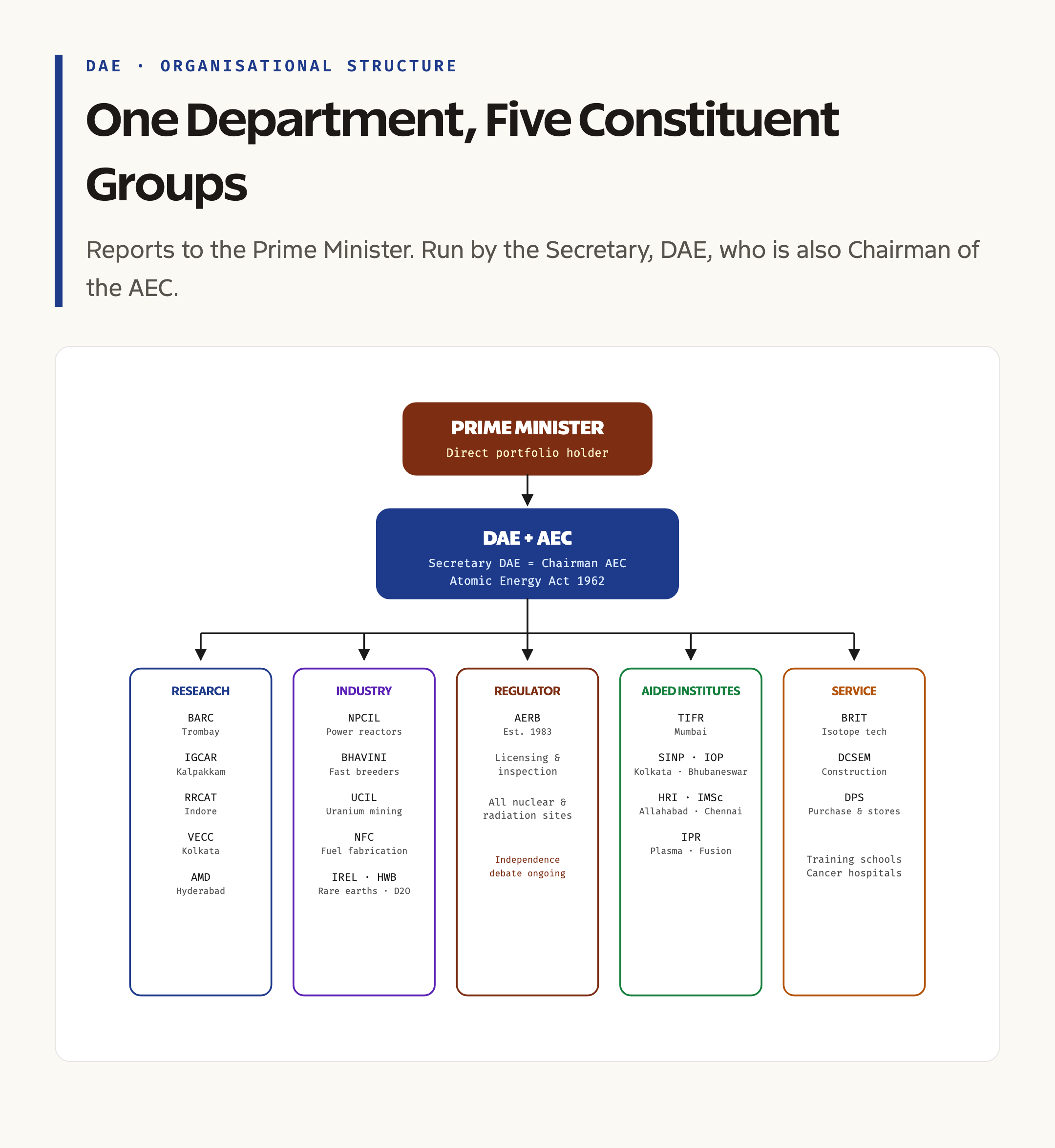
The Department of Atomic Energy was created on 3 August 1954 by a Presidential Order. The order was the formal step that converted the small Atomic Energy Establishment that had existed since 1948 into a full Government of India department.
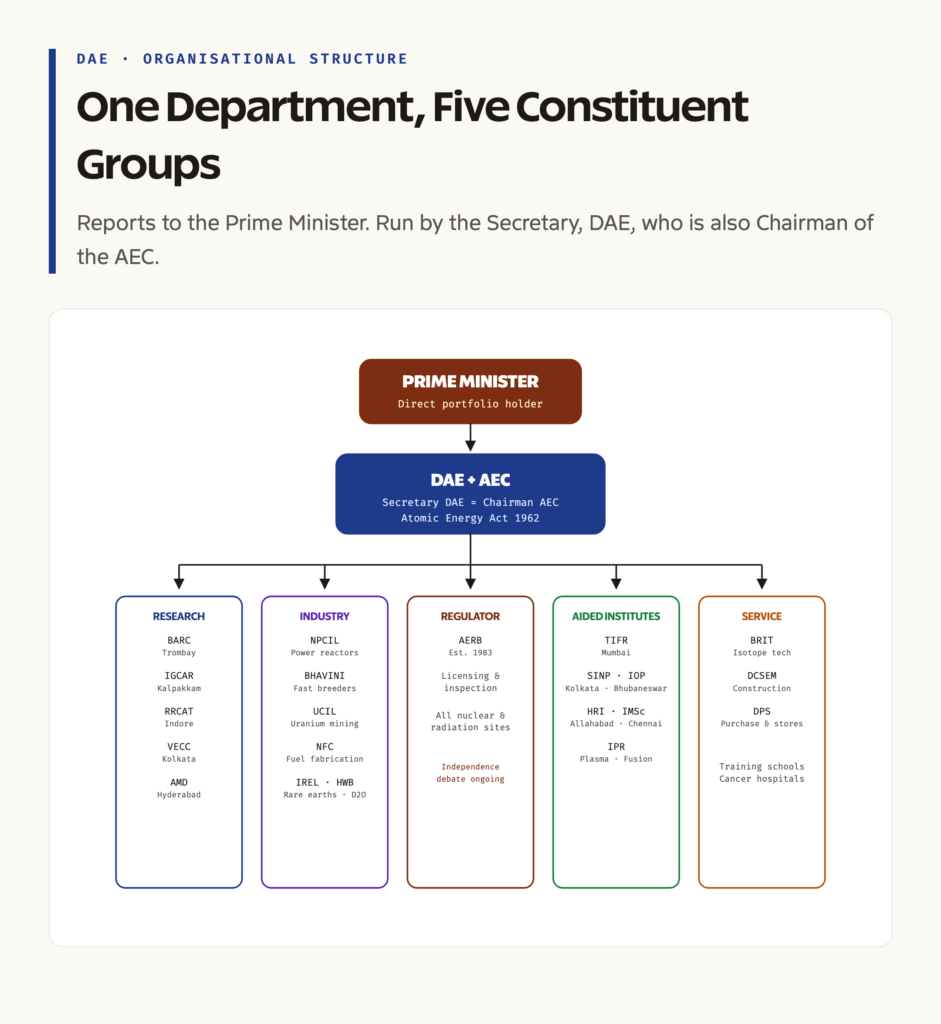
DAE is one of the few departments that does not sit under a regular Cabinet ministry. It works directly under the Prime Minister of India. There is no Minister of Atomic Energy at the Cabinet level. The Prime Minister carries that portfolio, supported by the Minister of State in the Prime Minister’s Office for atomic energy when one is appointed.
The administrative head of DAE is the Secretary, Department of Atomic Energy. The Secretary is also the ex officio Chairman of the Atomic Energy Commission. By tradition, the Chairman is a nuclear scientist, not a generalist civil servant. Homi Bhabha, Vikram Sarabhai, Homi Sethna, Raja Ramanna, M.R. Srinivasan, R. Chidambaram, Anil Kakodkar, Srikumar Banerjee, R.K. Sinha, Sekhar Basu, K.N. Vyas, and Ajit Kumar Mohanty have held the post.
The department draws its statutory powers from the Atomic Energy Act 1962, which replaced the original Atomic Energy Act 1948. The 1962 Act puts the development, production, and use of atomic energy under central government control, restricts mining and processing of prescribed substances, and reserves the production of atomic energy to the central government or its designated entities.
The Atomic Energy Commission
The Atomic Energy Commission was set up in 1948, six years before DAE itself. The original AEC reported directly to the Prime Minister and was modelled loosely on the United States and United Kingdom atomic energy commissions of the time.
After DAE was constituted in 1954, the AEC was reconstituted as the apex policy body for all atomic energy activity in India. The Cabinet retains overall control, but day-to-day strategic decisions on nuclear power, fuel cycle, and research priorities flow through the AEC.
The Commission today is small. The Chairman is the Secretary, DAE. Other members include senior secretaries from the Ministries of External Affairs, Finance, the Cabinet Secretary, the Principal Scientific Adviser, and a few ex-officio scientific members. The structure deliberately keeps the AEC technically led, with civil servants representing finance and foreign policy interests.
The AEC approves major DAE budgets, clears new reactor projects, sanctions large research initiatives, and coordinates with the Department of Space and the Defence Research and Development Organisation on technologies that cut across departments.
Constituent Units of DAE
DAE is not a single body. It is a federation of research institutions, public sector enterprises, an independent regulator, aided institutes, and service organisations. The full structure is what makes the department function as a vertically integrated nuclear enterprise.
The five major research centres come first. Bhabha Atomic Research Centre at Trombay is the flagship. BARC handles reactor design, fuel cycle research, weapons science, isotope production, radiation applications, and most of the high-energy work on India’s three-stage programme. Indira Gandhi Centre for Atomic Research at Kalpakkam runs the Fast Breeder Test Reactor, the Prototype Fast Breeder Reactor programme, and the science of stage-two fast breeder technology. Raja Ramanna Centre for Advanced Technology at Indore focuses on lasers, accelerators, and synchrotron radiation. Variable Energy Cyclotron Centre at Kolkata operates particle accelerators and produces medical isotopes. Atomic Minerals Directorate for Exploration and Research handles uranium and thorium prospecting.
The industrial public sector enterprises form the second tier. Nuclear Power Corporation of India Limited operates every commercial nuclear power station in India. Bhartiya Nabhikiya Vidyut Nigam Limited builds and will operate the fast breeder reactors at Kalpakkam. Uranium Corporation of India Limited mines and mills uranium at Jaduguda and the new Tummalapalle and other sites. Indian Rare Earths Limited mines monazite for thorium, rare earths, and other strategic minerals. Electronics Corporation of India Limited supplies control and instrumentation to nuclear plants and to other strategic sectors. Nuclear Fuel Complex at Hyderabad fabricates fuel assemblies for power reactors. Heavy Water Board produces heavy water for the pressurised heavy water reactors that dominate the Indian fleet.
The Atomic Energy Regulatory Board sits in a separate bucket. AERB was constituted in 1983 under the Atomic Energy Act and is the safety regulator for all nuclear and radiation facilities in India. It is administratively under DAE but has functional independence in licensing and inspection decisions. The independence of AERB has been a long-running policy debate. Standing Committees and the Comptroller and Auditor General have flagged that a regulator under the same department whose facilities it inspects raises a potential conflict of interest. A draft Nuclear Safety Regulatory Authority Bill that would convert AERB into a fully statutory autonomous body has been pending for over a decade.
DAE also runs and aids several premier research institutes. Tata Institute of Fundamental Research is the country’s leading basic-research institute and is wholly funded by DAE. Saha Institute of Nuclear Physics, Institute of Physics, Bhubaneswar, Harish-Chandra Research Institute, Allahabad, Institute of Mathematical Sciences, Chennai, and the Institute for Plasma Research, Gandhinagar are all DAE-aided autonomous institutes. The aided-institute model gives India a science footprint in pure mathematics, particle physics, plasma physics, and nuclear theory that few other ministries support.
Functions of the Department
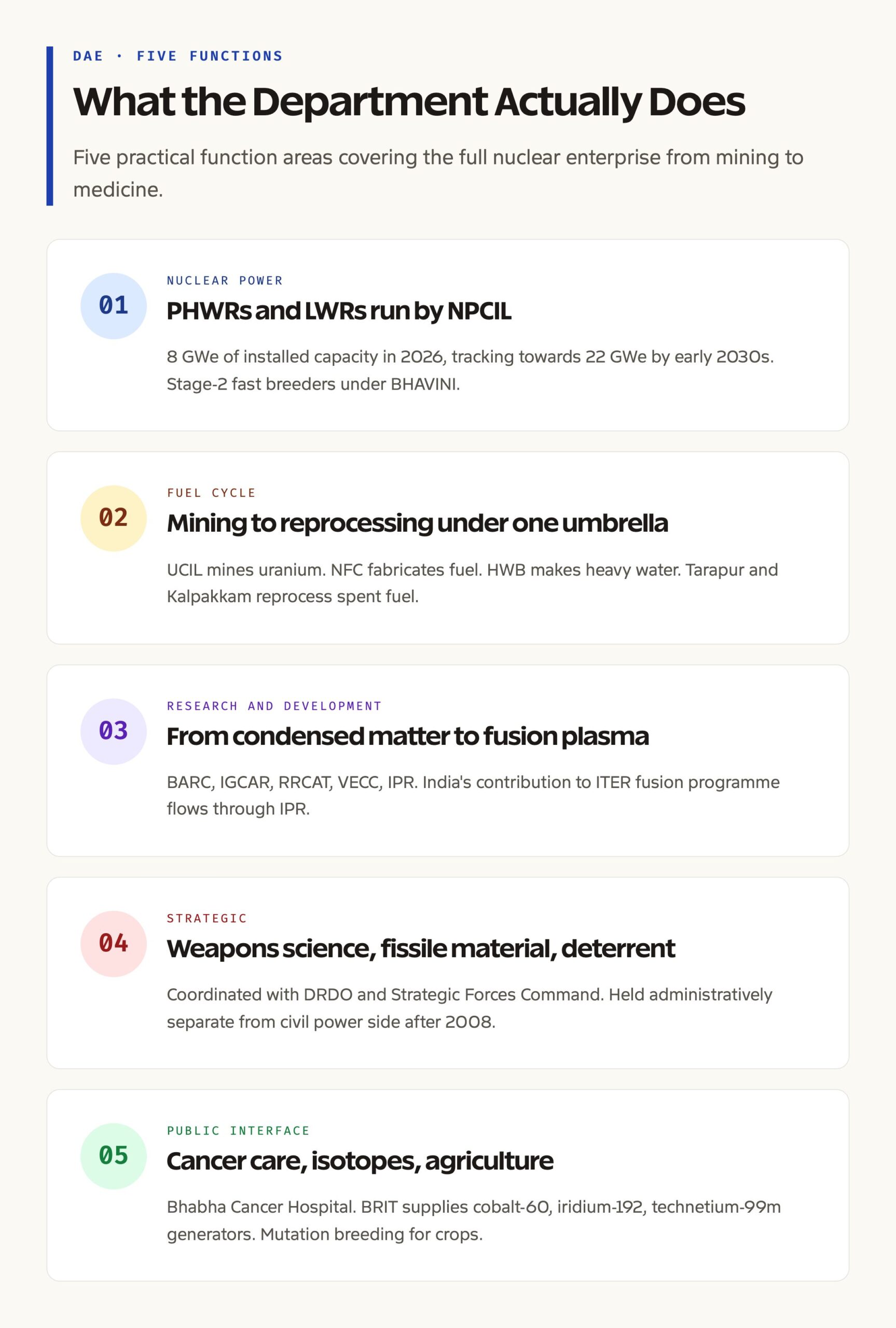
DAE’s mandate is broad. The Atomic Energy Act and the AEC’s terms of reference list five practical function areas.
Nuclear power generation is the most visible. NPCIL operates pressurised heavy water reactors using indigenous uranium fuel and imported light water reactors at Kudankulam. The pressurised heavy water reactors and the light water reactor pool together produced 8 GWe of installed capacity at the start of 2026 and are tracking towards 22 GWe by the early 2030s as the Kakrapar 700 MWe units, the Rajasthan 700 MWe units, the Gorakhpur Haryana site, and Kudankulam units 5 and 6 come online.
Fuel cycle management is the second function. The full fuel cycle from mining at UCIL to reprocessing at the Tarapur and Kalpakkam reprocessing plants is held inside DAE. Front-end activities include uranium mining and milling, conversion to uranium hexafluoride and uranium dioxide, fuel fabrication at NFC, and heavy water production. Back-end activities include spent fuel storage, reprocessing using the PUREX process, plutonium and uranium recycling, and waste vitrification at the waste immobilisation plants.
Research and development is the third function. BARC alone runs research reactors at Apsara-U, Dhruva, Cirus, Kamini at Kalpakkam, and the Purnima series. Research extends from condensed-matter physics and accelerator physics at RRCAT, plasma research at IPR, fusion research on the Aditya and SST-1 tokamaks, and the upcoming SST-2. India’s contribution to the International Thermonuclear Experimental Reactor flows through IPR.
Strategic applications form the fourth function. India’s nuclear weapons programme is administered through DAE in coordination with the DRDO. The fissile material production, weaponisation, and stockpile science work sits inside BARC and at facilities at Kalpakkam, Mysuru, and Visakhapatnam. The strategic component of DAE is publicly acknowledged but operationally classified.
Public interface activities form the fifth function. DAE runs Bhabha Cancer Hospital and Research Centre, Variable Energy Cyclotron Centre’s medical isotope programme, the Board of Radiation and Isotope Technology that supplies isotopes for medicine, agriculture, and industry, and a nationwide network of Cancer institutes that use radiation therapy. India produces and exports cobalt-60, iridium-192, technetium-99m generators, and a growing set of radiopharmaceuticals.
The Three-Stage Nuclear Programme
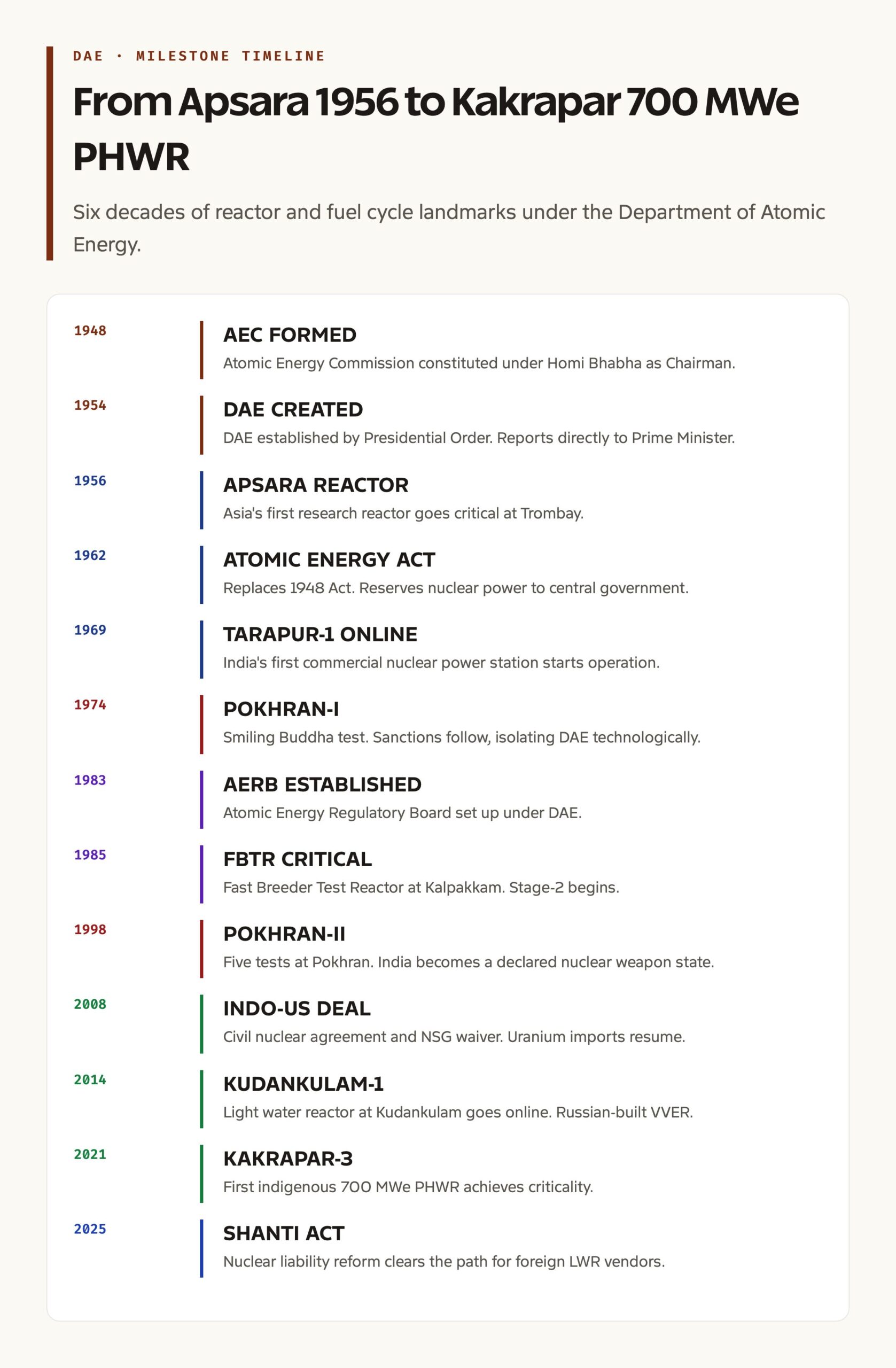
The three-stage programme is the framework that DAE has worked to since 1954. The plan was set out by Homi Bhabha to match India’s resource position. India holds limited natural uranium but a quarter of the world’s known thorium. Bhabha’s design extracts maximum energy from this resource mix.
Stage one uses pressurised heavy water reactors fuelled by natural uranium. The reactors produce electricity and plutonium-239 in their spent fuel. India’s PHWR fleet at Tarapur, Rawatbhata, Kakrapar, Kaiga, Narora, Madras, and Kudankulam supplies almost all current civil nuclear electricity. The 700 MWe indigenous PHWR is now the standard new build.
Stage two uses fast breeder reactors fuelled by the plutonium recovered from stage-one spent fuel. The fast breeders are designed to breed more fissile material than they consume, by converting depleted uranium into more plutonium. The Prototype Fast Breeder Reactor at Kalpakkam is the first commercial-scale unit and is in advanced commissioning under BHAVINI.
Stage three uses thorium fuelled reactors, with uranium-233 bred from thorium-232 inside fast breeders or accelerator-driven systems. The Advanced Heavy Water Reactor under design at BARC, the molten-salt reactor research at IGCAR, and accelerator-driven sub-critical system research are the long-horizon stage-three lines. India’s eventual nuclear independence rides on stage three working at scale.
The programme is technically ambitious and operationally slow. Stage two is decades behind Bhabha’s original timeline. Stage three is still in the design and demonstration phase. But the framework continues to shape DAE budgets, fuel cycle policy, and the case for civil nuclear cooperation.
DAE in International Cooperation
India was outside the Nuclear Non-Proliferation Treaty in 1968 and remains a non-signatory. The 1974 Pokhran-I and 1998 Pokhran-II tests led to long sanctions periods that constrained DAE’s ability to import fuel, technology, and equipment.
The 2008 India-United States civil nuclear agreement and the related Nuclear Suppliers Group waiver opened up civil nuclear cooperation for the first time in decades. India accepted IAEA safeguards on its civil reactors, separated civil and military facilities, and gained access to international uranium markets. Uranium imports from Australia, Kazakhstan, Canada, France, and Russia followed. Light water reactor cooperation with Russia at Kudankulam, France at Jaitapur, and the United States at Kovvada are direct outcomes.
The cooperation is not yet smooth. The CLNDA 2010 introduced supplier liability provisions that have slowed foreign vendor participation. The Shanti Act 2025 reforms the liability framework and is meant to revive stalled projects. We cover this in detail in our SHANTI Act 2025 explainer.
Multilateral export control regimes affect DAE on the supply side. India is now a member of the Missile Technology Control Regime, the Wassenaar Arrangement, and the Australia Group, but is not yet a member of the Nuclear Suppliers Group, despite repeated attempts to gain admission.
DAE and the Defence Production Architecture
The strategic side of DAE is held administratively separate from the civil power side, in line with the 2008 separation plan. Reactors and facilities listed under the civil sector are open to IAEA safeguards. The strategic facilities, fast breeder reactors that are not yet declared civil, and the strategic reprocessing plants remain outside safeguards.
DAE coordinates with DRDO on warhead engineering, with the Strategic Forces Command on stockpile custodianship, and with the Department of Space on launch and re-entry technology that bears on credible deterrent capability. The umbrella body for these inter-departmental decisions is the Nuclear Command Authority.
The opacity that surrounds the strategic side is policy by design. DAE publishes reactor performance data, civil power statistics, isotope output, and research output. It does not publish fissile material inventories, weapons stockpile numbers, or strategic facility capacities.
Recent Reforms and the Road Ahead
Several reforms are in motion as of 2026. The civil liability framework reform under the SHANTI Act 2025 is meant to clear the path for foreign light water reactor vendors. The amendment to the Atomic Energy Act to allow private sector participation in nuclear power is under active discussion in Parliament. Small modular reactors, which DAE is now researching at BARC, are being positioned as a future avenue for distributed industrial heat and electricity. We cover this in our Small Modular Reactors explainer.
DAE’s budget allocation has been climbing through the 2020s, reflecting the push to expand from the current 8 GWe of installed nuclear capacity to a stated target of 100 GWe by 2047. The expansion will require new uranium supply, accelerated fuel cycle infrastructure, sustained PHWR fleet build, and the operationalisation of fast breeders at scale.
For UPSC, the right way to remember DAE is as a vertically integrated department covering everything from uranium mining to the reactor, from research to regulation, from medicine to weapons. The Prime Minister’s direct control reflects that breadth. The challenges that come up in policy and in the press are the regulator’s independence, the slow operationalisation of stage two, the liability framework, and the integration of private sector capital.
Frequently Asked Questions
When was the Department of Atomic Energy established and under whom does it function?
The Department of Atomic Energy was established on 3 August 1954 by a Presidential Order. It functions directly under the Prime Minister of India, not under any Cabinet Ministry. The Secretary, DAE, who is also the ex officio Chairman of the Atomic Energy Commission, is the administrative head and is by tradition a nuclear scientist.
What is the difference between DAE and the Atomic Energy Commission?
The Atomic Energy Commission was set up in 1948 and is the apex policy body for atomic energy in India. The Department of Atomic Energy was created in 1954 as the executive department that implements AEC policy. The AEC sets strategic direction; DAE runs the institutions, programmes, and budgets that turn that direction into reality.
What are the major institutions under DAE?
The major research centres are BARC at Trombay, IGCAR at Kalpakkam, RRCAT at Indore, VECC at Kolkata, and the Atomic Minerals Directorate. The industrial public sector enterprises include NPCIL, BHAVINI, UCIL, NFC, IREL, and Heavy Water Board. AERB is the regulator. TIFR, SINP, IOP, HRI, IMSc, and IPR are major DAE-aided autonomous institutes.
Is the Atomic Energy Regulatory Board independent of DAE?
AERB has functional independence in licensing and inspection but is administratively located within DAE. The arrangement has been criticised by Standing Committees and the CAG as a potential conflict of interest, since AERB regulates facilities operated by other DAE units. A draft Nuclear Safety Regulatory Authority Bill that would convert AERB into a fully statutory autonomous body has been pending in Parliament for over a decade.
How does DAE link to India’s three-stage nuclear programme?
DAE designed and runs the three-stage programme. Stage one uses PHWR reactors on natural uranium, operated by NPCIL. Stage two uses fast breeder reactors on plutonium recovered from stage-one fuel, operated by BHAVINI. Stage three uses thorium-based reactors that breed uranium-233. Each stage matches a research centre, a reactor design programme, and a fuel cycle infrastructure that DAE coordinates.
What is the difference between civil and strategic facilities under DAE?
After the 2008 India-US civil nuclear agreement, India separated civil and military facilities. Civil facilities, mostly the operating power reactors and associated fuel cycle plants, are placed under IAEA safeguards. Strategic facilities, including some fast breeder and reprocessing facilities and the weapons-grade material production line, remain outside safeguards. DAE administers both categories under the same departmental umbrella.
Tell Google you want more of this.
Add Anantam IAS as a preferred sourceOne tap, and this site shows up more often in your own Top Stories, AI Overviews and AI Mode. Remove it any time.